 info@unicomposite.com


Introduction
When a steel angle starts rusting around a trench, platform, fence post, or embedded concrete edge, the problem rarely stays cosmetic. Corrosion can weaken support points, stain surrounding structures, increase inspection work, and create replacement costs in areas where access may already be difficult.
FRP angles give engineers and procurement teams a practical alternative for these conditions. These L shaped fiberglass reinforced plastic profiles combine corrosion resistance, low weight, electrical insulation, and design flexibility in a familiar angle format.
This guide explains what FRP angles are, where they are used, how they compare with steel and aluminum angles, and what buyers should confirm before placing a custom or bulk order.
frp angles
What Are FRP Angles?
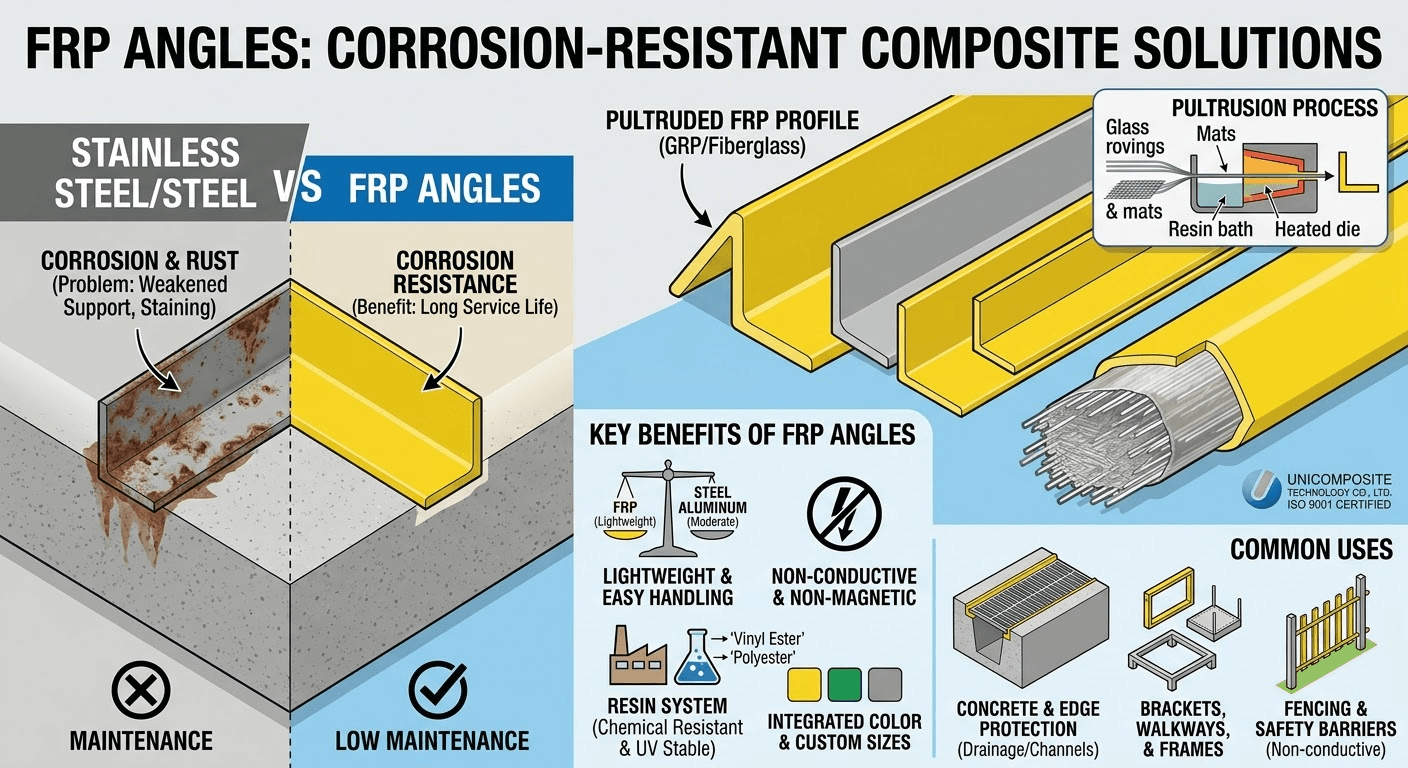
FRP angles are L shaped structural profiles made from fiberglass reinforced plastic. They are usually produced by pultrusion, a continuous manufacturing process that pulls glass fiber reinforcement through a resin system and heated die to create a constant cross section.
The finished profile combines glass fiber strength with resin based protection. In B2B purchasing, FRP angles may also be called fiberglass angles, fiberglass angle profiles, pultruded FRP angles, GRP angles, or composite angle profiles.
What are FRP angles used for?
FRP angles are used as brackets, edge supports, embedded angles, platform components, grating supports, fence parts, aquaculture equipment, walkway accessories, pipe supports, and corrosion resistant structural components. They are most valuable in environments where steel may rust, conduct electricity, require repainting, or add unnecessary installation weight.
Engineers often choose FRP angles when the part does not require extreme steel level impact resistance but still needs reliable service in wet, chemical, outdoor, or electrically sensitive environments.
FRP angle profile structure
A typical FRP angle contains continuous glass fibers and a thermoset resin matrix. The glass fibers provide mechanical reinforcement, while the resin helps protect the profile against moisture, chemicals, UV exposure, and environmental aging.
Performance depends on resin chemistry, fiber architecture, wall thickness, leg size, span, connection design, exposure temperature, UV conditions, and installation quality. Buyers should treat FRP angle selection as an engineered material decision, not only a dimension and price comparison.
Equal angle, unequal angle and embedded angle concepts
An equal FRP angle has two legs of the same size, such as 50 mm x 50 mm. An unequal FRP angle uses different leg sizes, such as 75 mm x 50 mm, when one side needs more contact area or support.
An embedded FRP angle is used around concrete edges, trench covers, drainage channels, grating supports, and other areas where corrosion resistant edge support or corner protection is required.
Key Benefits of FRP Angles
The value of FRP angles comes from how the material behaves in harsh operating environments. For many buyers, the strongest benefit is lower corrosion related maintenance over the service life of the structure.
Corrosion resistance in harsh environments
FRP angles do not rust like carbon steel. This makes them useful in wastewater facilities, aquaculture farms, chemical processing areas, cooling towers, car wash bays, coastal sites, and outdoor utility projects.
For chemical service, buyers should confirm the resin system, chemical name, concentration, service temperature, UV exposure, and whether exposure involves splash, vapor, cleaning cycles, or immersion. A general purpose profile and a chemical resistant profile may look similar, but they can perform very differently in aggressive service.
Lightweight installation
FRP angles are much lighter than steel angles of similar size. This can simplify transportation, manual handling, and installation in retrofit projects, elevated structures, and confined maintenance zones.
Lower weight can also reduce the need for heavy lifting equipment. That matters when crews install components around tanks, walkways, platforms, roofs, electrical equipment, or remote utility areas.
Non conductive and non magnetic properties
FRP angles provide electrical insulation and non magnetic behavior when properly specified. This makes them useful around substations, electrical enclosures, cable support areas, utility fencing, and other sites where metal conductivity may create design concerns.
Electrical insulation does not remove the need for engineering review, safety procedures, or code compliance. It gives engineers another material option when they need a support component that does not behave like metal.
Custom sizes, colors and resin systems
Pultruded FRP angles can be customized by leg size, wall thickness, length, resin type, color, UV package, surface finish, and packaging method. This is useful for OEM manufacturers, contractors, and repeat project buyers that need consistent profiles across multiple installations.
Unicomposite Technology Co., Ltd. manufactures FRP and GRP composite products in Nanjing, China, with ISO 9001 certification and an 18,000 square meter facility. Its capabilities include pultrusion, pulwinding, SMC and BMC molding, hand lay up, and vacuum infusion. For FRP angle projects, this supports standard profiles, custom drawing based profiles, cut to size service, color options, and resin selection for different environments.
frp angles 2
Common Uses of FRP Angles
FRP angles work best where corrosion resistance, insulation, lightweight handling, and low maintenance provide real project value.
FRP embedded angles for concrete and edge protection
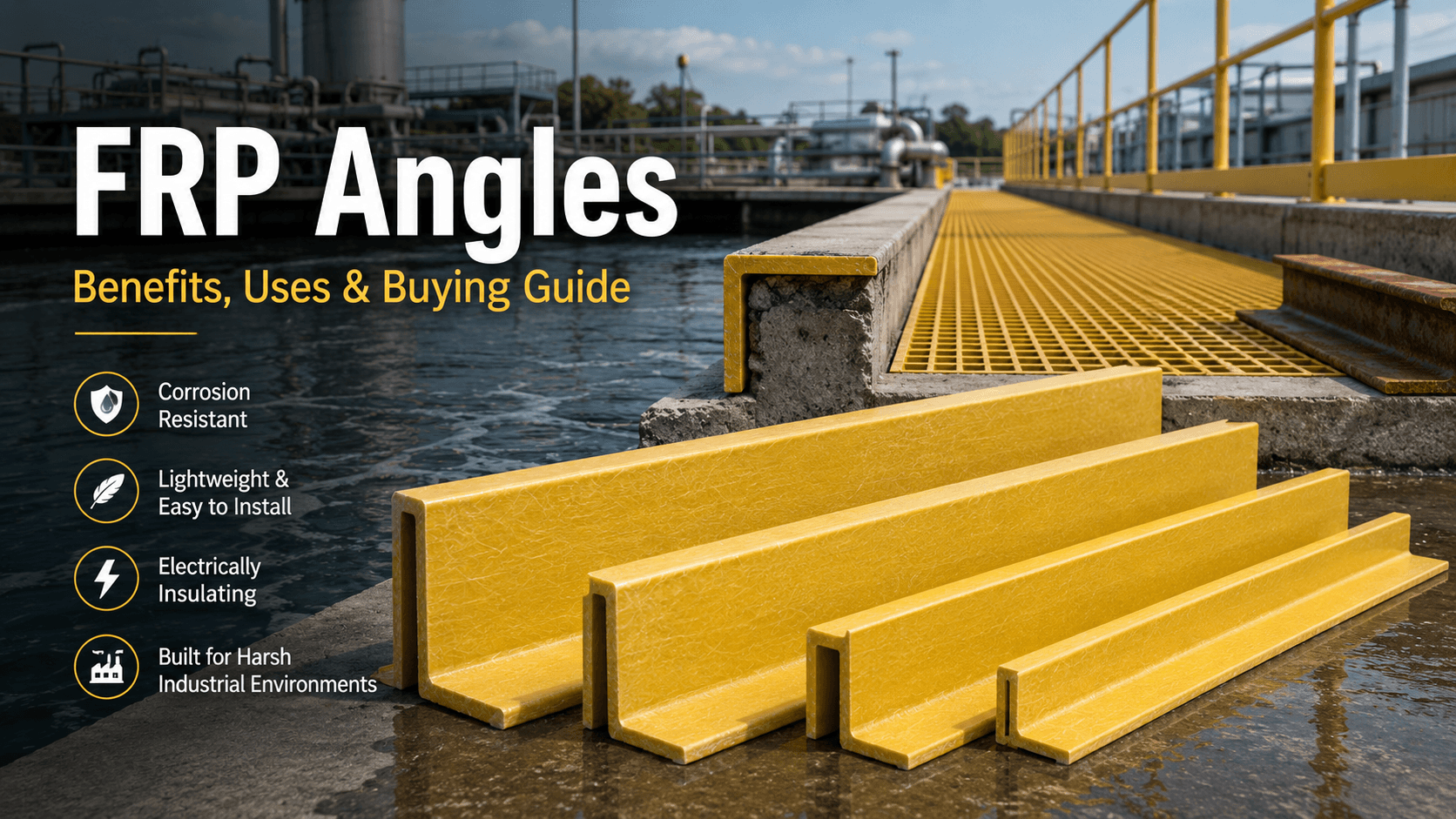
Embedded FRP angles are often used around concrete edges, trench covers, access openings, drainage zones, and platform perimeters. In these areas, steel edges may corrode after long exposure to water, cleaning chemicals, salt, or process fluids.
In one anonymized wastewater facility retrofit, engineers replaced corroded steel edge supports near trench covers with FRP embedded angles and FRP grating supports. The goal was to reduce repainting work, avoid rust staining around drainage channels, and simplify future maintenance near wet process areas.
For this type of application, buyers should confirm embed depth, load requirement, anchoring method, surrounding concrete condition, chemical exposure, and whether the angle will support grating, panels, covers, or only edge protection.
Brackets and support frames
FRP angles can be used as brackets, light support frames, reinforcing edges, equipment supports, and assembly components. They are especially useful when metal brackets create corrosion or conductivity concerns.
OEM manufacturers may use custom FRP angles to reduce part weight while keeping a familiar L shaped assembly format. This can help standardize repeated products used in outdoor, agricultural, marine, or industrial environments.
Platforms, walkways and grating supports
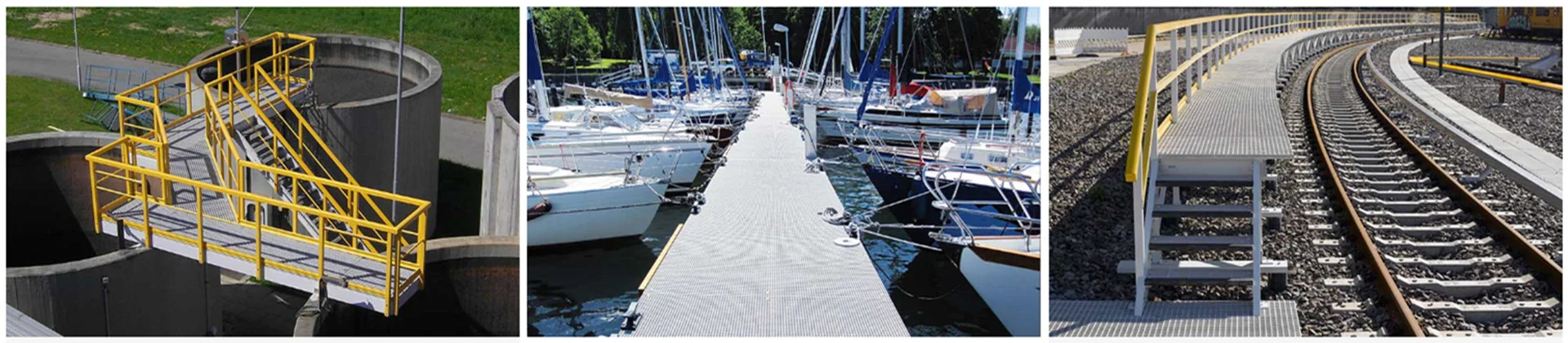
FRP angles are frequently used around FRP grating, work platforms, stairs, walkways, and access systems. They may act as edge trim, secondary support, panel connection pieces, or lightweight framing around platform assemblies.
For better system consistency, engineers often combine FRP grating, FRP channels, FRP angles, FRP handrails, and FRP ladder components. This avoids pairing corrosion resistant grating with rust prone metal accessories.
Fencing, handrails and safety barriers
FRP angles can support fencing and handrail systems in power facilities, substations, chemical plants, wastewater plants, and outdoor industrial sites. Their corrosion resistance and non conductive properties make them useful where steel components may create long term maintenance or electrical concerns.
For fencing applications, buyers should confirm post spacing, panel geometry, wind exposure, fastening method, color, UV package, and any safety requirements.
FRP Angles vs Steel and Aluminum Angles
Material choice should be based on exposure, load, installation conditions, and lifecycle cost. The table below gives a practical comparison for procurement and engineering teams.
| Property | FRP Angle | Steel Angle | Aluminum Angle | Buyer Consideration |
|---|---|---|---|---|
| Corrosion resistance | High with suitable resin | Requires coating, galvanizing, or stainless steel | Good in many environments, limited in some chemicals | FRP is strong for wastewater, chemical, marine, and wet sites |
| Weight | Lightweight | Heavy | Lightweight | FRP and aluminum reduce handling difficulty |
| Electrical behavior | Non conductive | Conductive | Conductive | FRP suits electrical and utility areas |
| Magnetic behavior | Non magnetic | Magnetic unless special alloy | Non magnetic | FRP helps in non magnetic applications |
| Maintenance | Low when specified correctly | Coating inspection and repainting may be needed | Moderate, depending on exposure | Lifecycle cost matters more than unit price |
| Impact resistance | Good for many support uses, design dependent | Strong | Moderate | Steel may suit severe impact zones |
| Custom color | Pigmented resin options | Paint or coating required | Finish options available | FRP color can be integrated into the profile |
| Chemical exposure | Resin dependent | Coating dependent | Chemical dependent | Confirm exposure before ordering |
Can FRP angles replace steel angles?
FRP angles can replace steel angles in many corrosion resistant, lightweight, non conductive, and low maintenance applications. Engineering review is needed for high structural loads, severe impact, fire exposure, long spans, and code governed structural uses.
The best approach is to use FRP where steel creates recurring problems, especially rust, coating failure, heavy handling, electrical conductivity, or maintenance access issues.
How to Specify FRP Angles for a Project
A strong specification prevents wrong profile selection, quoting delays, and installation problems. Buyers should define the profile, environment, load, and connection method before requesting pricing.
Leg size, thickness and length
Basic dimensions include leg size, wall thickness, inside radius, outside radius, and length. Common RFQ formats include equal angle dimensions such as 50 x 50 x 5 mm or inch based sizes for North American projects.
Buyers should also confirm length tolerance, cutting requirements, drilling needs, packaging length limits, and whether the supplier should provide full length stock or cut to size pieces.
Resin system and corrosion exposure
The resin system affects corrosion resistance, temperature performance, UV behavior, and cost. A standard resin may work for general outdoor use. More aggressive chemical environments may require vinyl ester or another higher resistance resin system.
Useful exposure details include chemical name, concentration, cleaning method, temperature, humidity, UV exposure, splash frequency, vapor exposure, and immersion risk.
Load, span and support method
FRP angles should be selected based on actual function. The profile may act as trim, edge protection, secondary support, bracket, frame member, or load bearing component.
Load type matters. Uniform load, point load, vibration, impact, fastener pull out, span, and support spacing all affect profile selection. Engineering review becomes especially important when the angle supports grating, equipment, panels, or elevated access structures.
Drilling, cutting and installation details
FRP angles can often be cut and drilled with suitable tools, but installation quality matters. Poor drilling, incorrect hole spacing, exposed cut edges, or unsuitable fasteners can reduce connection reliability.
Buyers should define whether holes need to be pre drilled, whether cut ends need sealing, and which fasteners will be used. Stainless steel hardware is common in corrosive areas, but the final choice should match the environment.
The table below summarizes the key details buyers should include in an FRP angle RFQ.
| Specification Item | What to Provide | Why It Matters |
|---|---|---|
| Profile dimensions | Leg size, thickness, length | Determines tooling, weight, strength, and price |
| Resin system | Polyester, vinyl ester, epoxy, or project requirement | Controls corrosion and temperature performance |
| Exposure conditions | Chemicals, UV, moisture, temperature | Helps supplier recommend suitable material |
| Application | Bracket, embedded edge, platform, fencing, support | Determines strength and installation needs |
| Processing | Cutting, drilling, color, surface finish | Reduces site labor and improves fit |
| Quantity | Pieces, total meters, annual demand | Supports accurate bulk pricing |
| Packaging | Bundle size, length, export packing | Protects profiles during transport |
| Drawing | PDF, CAD, sample, or sketch | Reduces specification misunderstandings |
Buying Guide for FRP Angles
After technical requirements are clear, supplier selection becomes the next step. Buyers should evaluate both manufacturing capability and application support.
What information should buyers send before requesting a quote?
Buyers should send profile dimensions, quantity, resin requirement, application, drawings, exposure conditions, color, length, cutting or drilling needs, packaging requirements, and target delivery schedule.
For embedded FRP angles, buyers should also provide concrete details, edge geometry, load conditions, and installation drawings. A complete inquiry helps suppliers quote the right material and avoid under specification.
Custom manufacturing and tolerance requirements
Custom FRP angles may require tooling, minimum order quantities, and tolerance review. For repeated OEM or project orders, this can be worthwhile because a custom profile may reduce installation labor, improve fit, and standardize assemblies.
Procurement teams should ask about dimensional tolerance, straightness, color consistency, cut length tolerance, surface finish, hole positioning, packaging, and quality control process.
How to evaluate an FRP angle supplier
A capable FRP angle supplier should understand pultrusion, resin selection, structural profiles, corrosion environments, and export packaging. Buyers should also look for experience with related products such as FRP grating, tubes, channels, beams, handrails, platforms, and fencing systems.
The table below gives a simple supplier evaluation framework.
| Evaluation Area | What to Check | Why It Matters |
|---|---|---|
| Manufacturing capability | Pultrusion lines, custom tooling, profile range | Supports standard and custom profile needs |
| Quality system | ISO certification, inspection process | Reduces risk in bulk orders |
| Engineering support | Drawing review, material suggestions | Helps avoid wrong profile selection |
| Product range | Angles, channels, tubes, grating, handrails | Useful for complete FRP systems |
| Export experience | Packaging, documentation, shipment handling | Reduces logistics problems |
| Application knowledge | Corrosion, electrical, platform, fencing, OEM uses | Improves specification accuracy |
Common purchasing mistakes to avoid
The biggest mistake is ordering FRP angles based only on size and price. The same profile size can perform differently depending on resin chemistry, glass fiber reinforcement, wall thickness, production quality, and application.
Buyers should also avoid vague descriptions such as “corrosion resistant angle” without exposure details. Drilling, cutting, hole spacing, color, UV exposure, packaging, and edge sealing should be confirmed before production.
Conclusion
FRP angles provide a practical alternative to metal angle profiles where corrosion resistance, low weight, insulation, and maintenance reduction matter.
Four takeaways are worth carrying into procurement:
FRP angles are useful for brackets, platforms, walkways, fencing, embedded edges, aquaculture equipment, pipe supports, and corrosion resistant assemblies.
Material performance depends on resin system, fiber architecture, wall thickness, leg size, load requirement, fasteners, UV exposure, and installation quality.
FRP can replace steel in many corrosive and electrically sensitive applications, while heavy structural or severe impact uses need engineering review.
A strong RFQ should include drawings, dimensions, application, exposure conditions, quantity, processing requirements, and packaging details.


