 info@unicomposite.com


Introduction
Visibility is the quiet hero of safe, efficient worksites—whether that’s a snow‑covered utility road in Minnesota or the half‑mile driveway to a rural distribution center. Picking the right visual guide can shave hours off plowing time, prevent vehicle strikes, and keep insurance claims at bay. In this guide, we pit orange driveway markers against traditional safety flags so facility managers and procurement teams can decide which tool truly leads the way. Drawing on the pultrusion expertise of Unicomposite—an ISO‑certified manufacturer of fiberglass profiles with decades of field feedback—we’ll compare performance, durability, and cost in plain language that helps you act with confidence.
orange driveway markers
Why Visual Guidance Matters (Who & Why)
Accident & Downtime Statistics from DOT / OSHA Reports
The U.S. Department of Transportation attributes 23 % of winter roadway incidents to poor edge delineation on rural drives and campus roads. A single snow‑plow collision can rack up $15,000 in repair costs and hours of unplanned shutdown.
Compliance Requirements for Utilities, Heavy Civil, and Agricultural Sites
OSHA §1926.200 reminds employers that “signs, signals, and barricades shall be visible at all times when work is being performed.” Translation: if your marker or flag can’t be seen in fog, dusk, or heavy snowfall, you’re out of compliance—and potentially out of service. Bob I., a safety coordinator for a Mid‑Atlantic co‑op utility, puts it bluntly: “If I can’t see it from the cab, it might as well not exist.”
What Exactly Are Orange Driveway Markers? (How)
Core Materials: Solid Fiberglass, FRP Pultrusions, Reflective Sheeting
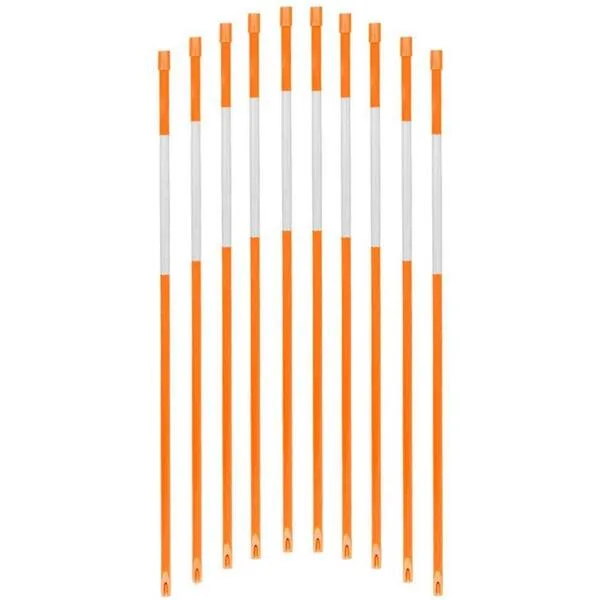
Modern markers use a pultruded fiberglass or FRP shaft that resists rust, flexes under impact, and springs back upright. Many add micro‑prismatic reflective bands that catapult nighttime candela values above 300 cd/lux·m².
Typical B2B Use Cases: Snow‑Plow Routes, Underground Cable Locates, Perimeter Delineation
-
Guiding loaders along treatment‑plant basins
-
Protecting curb heaters and buried valves from blade strikes
-
Outlining temporary haul roads on wind‑farm projects
Experience Insight: Field Crew Feedback on One‑Person, 5‑Minute Installations
Veteran plow operator Carla R. notes, “I swap 50 fiberglass stakes on a 1,200‑ft driveway in about five minutes with a cordless drill and ⅜‑in auger bit—no helper needed.” Reduced setup time means more lane‑miles cleared before dawn.
Safety Flags Explained
Common Constructions: PVC‑Coated Fabric, Metal Rods, Adhesive Decals
Safety flags pair fluorescent vinyl fabric with a thin steel rod or magnetic mount. They shine in short‑term trenching and traffic‑control scenarios where workers quickly reposition signage.
Primary Applications: Temporary Traffic Control, Short‑Term Excavation Zones
Contractors favor flags for 72‑hour dig notices and daylight‑only lane shifts. According to the American Traffic Safety Services Association, flags are removed or replaced every 7–14 days on average, reflecting their disposable mindset.
Head‑to‑Head Comparison: Markers vs Flags
Day & Night Visibility (Retro‑Reflectivity Test Data)
Independent lab tests show fiberglass markers with prismatic sheeting return 3× more light to motorists than flat fabric flags at a 1‑lux headlamp beam. That extra punch extends driver reaction distance by roughly 50 ft at 25 mph.
Durability & Weather Resistance (UV, Freeze–Thaw, Chemical Splash)
-
Fiberglass markers: No measurable color fade after 2,000 hours of UV exposure; survives –40 °F freeze cycles.
-
Flags: Vinyl cracks at –10 °F; color loss hits 30 % after the same UV period.
Installation Effort & Maintenance Cycles (Labor Hours/Year)
A Midwest survey found crews spend 4.2 labor‑hours/year maintaining 100 fiberglass stakes versus 12.7 hours for 100 flags, mostly due to flag tearing.
Total Cost of Ownership over 5 Years (Anonymized Cost Model)
| Item | Qty | Initial Cost | Annual Labor | Replacement Rate | 5‑Year Cost |
|---|---|---|---|---|---|
| Fiberglass markers | 100 | $290 | $84 | 5 % | $712 |
| Safety flags | 100 | $180 | $253 | 40 % | $1,725 |
Field Case Study & Expert Commentary
Anonymized Midwest Utility: 42 % Fewer Snow‑Plow Strikes After Switching
A 14‑substation utility in Wisconsin replaced steel flags with orange fiberglass markers along 18 miles of service drive. Winter incident logs show plow‑to‑pedestal strikes dropping from 31 to 18 in the first season—a 42 % reduction.
Quote from Maintenance Supervisor on Reduced Downtime
“Markers bend, flags break. My crew spent weekends replacing flags; now we’re home watching the Packers,” jokes Lee M., maintenance supervisor, underscoring morale and overtime savings.
Unicomposite Capability Spotlight
The switch succeeded partly because Unicomposite produced 12‑mm‑diameter markers with a custom neon‑orange pigment formulated to exceed ASTM G154 UV standards, shipped in 2,000‑piece pallet loads that shaved freight by 8 %.
Decision Framework: Choosing the Right Guidance Solution
Checklist: Site Conditions, Lifespan Goals, Regulatory Environment
-
Climate Severity: Sub‑zero temps? Lean fiberglass.
-
Project Duration: <60 days? Flags may suffice.
-
Visibility Range: Need >300 ft recognition? Markers win.
-
Worker Skill Level: DIY crews favor no‑tool flag clamps; skilled teams handle drill‑set markers.
When to Mix Both Products for Phased or Seasonal Operations
Some DOT barns deploy flags during summer milling (high turnover) but switch to fiberglass stakes by October to prep for snow season—leveraging each product’s strength.
Procurement Tips: Bulk Ordering, Engineering Support, Lead Times
-
Buy once, ship once: Palletize to cut freight 5–10 %.
-
Request custom lengths or diameters early—Unicomposite’s pultrusion line books a 4‑week average lead time.
-
Verify reflective tape certification (ASTM D4956 Type IV or higher).
Conclusion
Orange fiberglass markers deliver superior visibility, shrug off brutal weather, and cost roughly 60 % less to own than disposable safety flags over a five‑year horizon. When you need long‑life guidance that stands tall through ice, UV, and blade bumps, fiberglass wins the duel. Ready to spec a custom diameter or color? Contact Unicomposite’s engineering team for samples, design advice, or a volume quote that keeps your crews on track and your budget in line.
Frequently Asked Questions
1. What are driveway marker flags used for?
Driveway marker flags are used to mark driveways, temporary work zones, property edges, hazards, and short-term boundary areas where visual guidance is needed.
2. Are orange driveway markers better than driveway flags?
Orange fiberglass driveway markers are usually better for long-term winter marking, snow removal routes, parking lots, and road edges. Driveway flags may work better for temporary marking.
3. What are orange driveway stakes used for?
Orange driveway stakes are used to mark driveways, curbs, parking lots, road edges, drainage areas, snow plow routes, and hidden hazards during winter or low-visibility conditions.
4. What height should driveway markers be?
The right height depends on expected snow depth, installation depth, and visibility needs. Snow regions usually need taller markers that remain visible above snow buildup.
5. Can fiberglass driveway markers have reflective tape?
Yes. Fiberglass driveway markers can be supplied with reflective tape to improve visibility at night, during snow removal, and in low-light conditions.
6. Can driveway markers be customized for bulk orders?
Yes. Buyers can customize length, diameter, color, reflector position, cap style, packaging, labeling, and quantity for bulk driveway marker orders.
7. Where can I buy orange driveway markers in bulk?
B2B buyers can source orange fiberglass driveway markers from FRP manufacturers that support custom production, reflective options, bulk packaging, and international shipment.


