 info@unicomposite.com


Introduction
Industrial roofs often fail slowly. Corrosion starts around fasteners. Moisture sits under panels. Chemical vapor attacks exposed metal. Maintenance teams return again and again to patch, repaint, reinforce, or replace components that were supposed to last.
For engineers, procurement managers, and operations teams, roof decking is rarely just a material choice. It affects installation labor, structural load, maintenance access, corrosion risk, downtime, and long term ownership cost.
Structural fiberglass roof decking gives industrial buyers another option when conventional materials struggle in corrosive, humid, coastal, or electrically sensitive environments. Made from fiberglass reinforced plastic, also known as FRP or GRP, it combines glass fiber reinforcement with a resin system selected for the project environment.
This article explains what fiberglass roof decking is, when it makes sense, how it compares with traditional roof deck materials, and what buyers should specify before requesting a custom FRP roof decking solution.
structural fiberglass roof deck
What Is Structural Fiberglass Roof Decking?
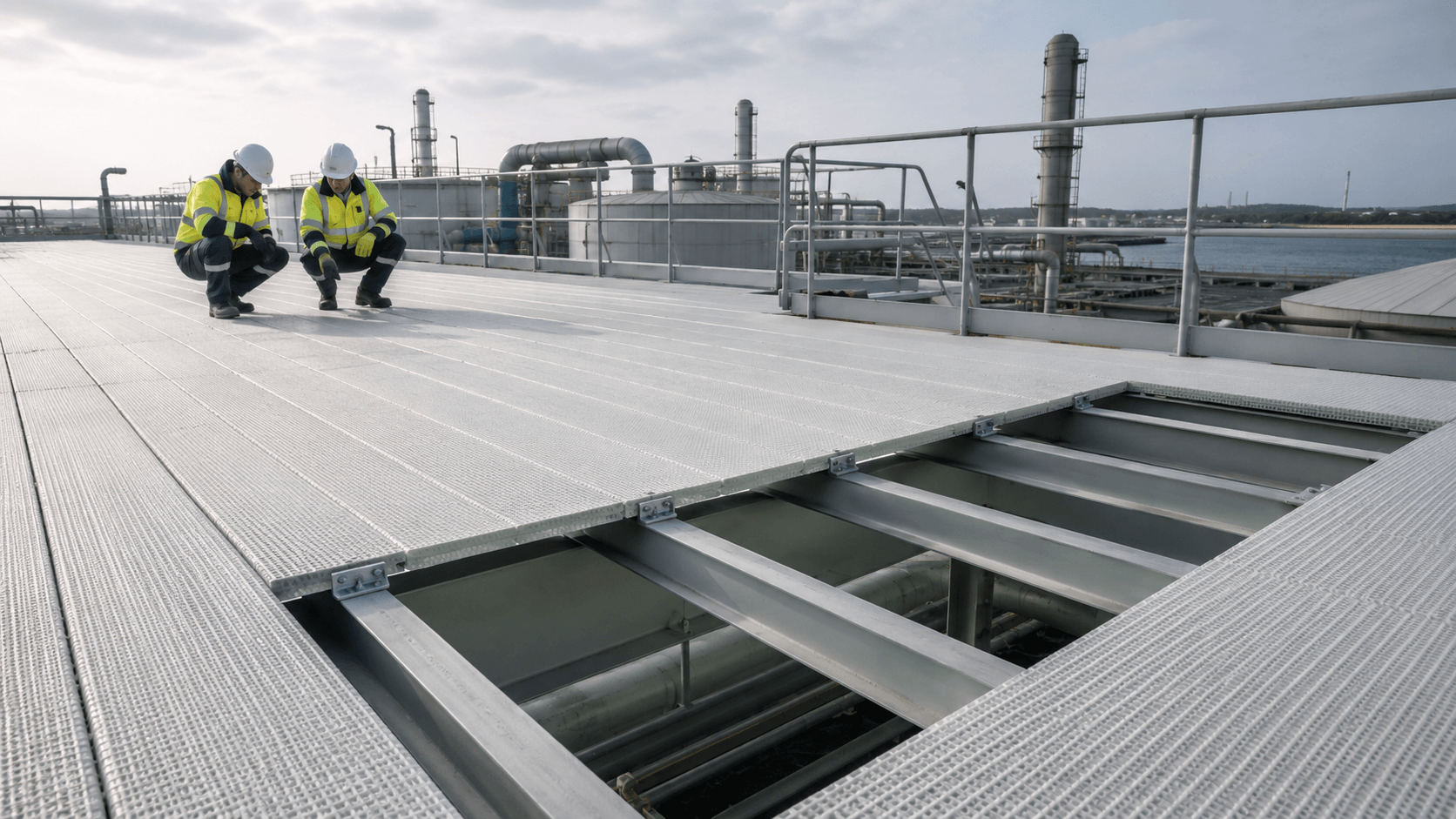
Structural fiberglass roof decking is an engineered composite panel, plank, or profile system designed to support roof loads while resisting corrosion, moisture, weather exposure, and industrial operating conditions. It uses glass fibers for reinforcement and resin as the binding matrix.
Unlike steel roof decking, FRP does not depend on galvanizing or paint alone to resist corrosion. The material itself resists rust, which makes it valuable in places where metal components face salt air, chemical vapor, wastewater gases, or frequent moisture.
A roof decking specification usually covers panel thickness, profile geometry, span capability, resin type, reinforcement design, surface finish, UV resistance, fire performance, color, fastening method, and fabrication needs. These details matter because FRP performance depends on the full system, including resin selection, profile design, installation quality, and the actual operating environment.
Unicomposite manufactures FRP and GRP composite products using pultrusion, pulwinding, SMC/BMC molding, hand lay up, and vacuum infusion. For industrial decking projects, these manufacturing options help buyers discuss standard panels, custom profile geometry, cutting, drilling, and pre fabrication in one sourcing conversation.
The practical takeaway: fiberglass roof decking should be specified as a structural component with defined loads, spans, exposure conditions, and installation requirements.
Why Use Fiberglass Roof Decking in Industrial Roofs?
After defining the material, the next question is fit. FRP roof decking works best when the roof environment creates problems that conventional materials cannot solve economically over the full service life.
Corrosion Resistance in Harsh Environments
Industrial roofs may face airborne chemicals, salt spray, humid air, exhaust, standing moisture, or cleaning agents. In chemical plants, wastewater treatment facilities, cooling tower areas, and coastal industrial buildings, corrosion can shorten the service life of metal roof deck systems.
Fiberglass roof decking resists many corrosive environments because the glass fibers and resin system do not rust. Resin selection still needs careful review. Polyester, vinyl ester, and other resin systems can be matched to different chemical and weather exposure levels.
For buyers, the exposure description should be specific. A quote request should state whether the roof deck faces indoor humidity, outdoor UV, salt fog, chemical vapor, intermittent splash, or direct contact with corrosive substances.
Lightweight Strength for Easier Installation
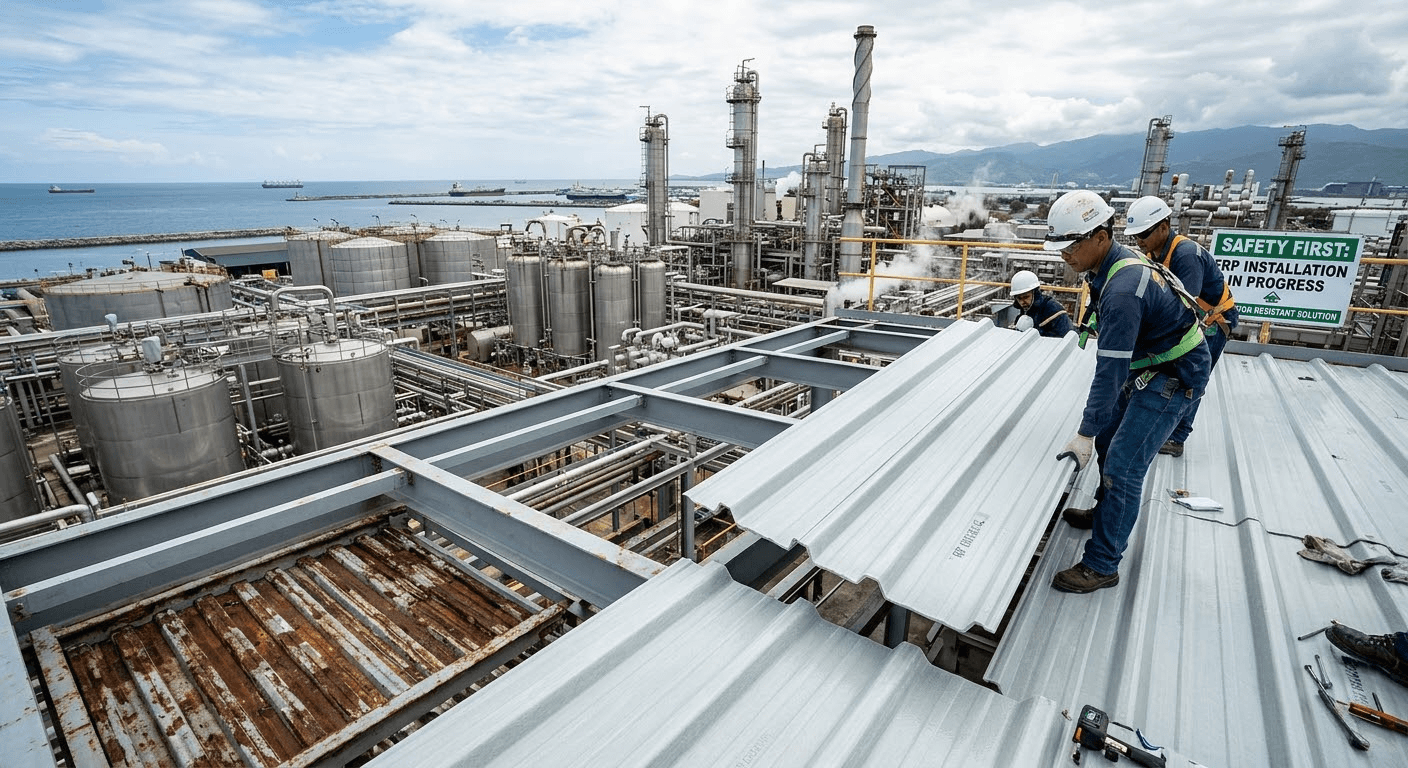
Weight affects freight, site handling, lifting equipment, crew size, installation speed, and the load placed on existing framing. FRP roof deck panels are typically much lighter than concrete decking and can also reduce handling difficulty compared with many metal systems.
In field installations, engineers often find lightweight panels helpful in retrofit projects, elevated roof areas, remote industrial sites, and facilities where crane access is limited. Lower panel weight can also reduce stress on older support structures when a roof system is upgraded.
Procurement documents should include panel size, estimated weight target, support spacing, live load, dead load, maintenance traffic requirements, and wind uplift considerations. These details help the supplier recommend the right panel thickness and profile.
Electrical Insulation and Non Magnetic Properties
Some facilities need more than corrosion resistance. Power utilities, substations, telecommunications buildings, and selected OEM applications may require materials with dielectric or non magnetic properties.
FRP is naturally non conductive compared with metal. That makes it useful around electrical infrastructure when the design calls for insulation, safety separation, or reduced metallic interference.
The key value is combined performance. Fiberglass roof decking can address corrosion, weight, and electrical insulation in a single material system when the project is properly specified.
Fiberglass Roof Decking vs Traditional Roof Deck Materials
Material selection usually comes down to trade offs. Steel, aluminum, wood, concrete, and FRP each have places where they perform well. The right choice depends on exposure, load, maintenance access, installation conditions, and life cycle cost.
The table below compares common roof decking materials used in industrial environments:
| Material | Main Strength | Main Limitation | Best Fit |
|---|---|---|---|
| FRP roof decking | Corrosion resistance, lightweight strength, dielectric properties | Requires correct resin, reinforcement, profile, and installation design | Chemical, coastal, wastewater, utility, and corrosive industrial roofs |
| Steel roof decking | High stiffness, familiar design behavior, broad availability | Can corrode without coating, inspection, and maintenance | Dry industrial buildings and conventional roof systems |
| Aluminum decking | Lightweight and corrosion resistant in many environments | Higher material cost and lower stiffness than steel in some designs | Lightweight structures and selected outdoor applications |
| Wood decking | Easy to cut and install | Moisture, decay, pest, and fire performance concerns | Low exposure buildings and non corrosive environments |
| Concrete decking | High mass and fire resistance | Heavy installation and high structural load | Heavy duty buildings where weight is acceptable |
How does FRP roof decking compare with steel decking?
FRP roof decking is lighter and more corrosion resistant than steel decking in wet, coastal, or chemically exposed environments. Steel may offer high stiffness and familiar design behavior, but it often requires coatings, inspections, and maintenance when corrosion risk is high.
In a clean, dry building, steel may remain the more economical choice. In a wastewater plant, fertilizer facility, cooling tower area, coastal utility structure, or chemical processing site, FRP may reduce maintenance cycles and corrosion related downtime.
A fair cost comparison should include purchase price, freight, installation labor, coating needs, inspection frequency, service life expectations, downtime risk, and replacement difficulty. Buyers should avoid judging FRP and steel only by initial material cost.
This comparison sets the foundation for application fit, where the strongest FRP use cases become clearer.
Common Applications of FRP Roof Decking
Once buyers understand the trade offs, they can match the material to the right environment. FRP roof decking delivers the most value when corrosion, moisture, electrical safety, or difficult maintenance access creates measurable cost or reliability concerns.
Industrial Roof Structures
Industrial roof systems may need to support weather loads, insulation systems, access routes, maintenance traffic, and long term exposure. FRP panels can be designed around specific spans and load requirements when the project provides enough structural information.
A useful early specification is support spacing. Buyers should provide the distance between purlins or beams, expected live load, concentrated load requirements, deflection expectations, and any maintenance walkway conditions.
For example, a ribbed FRP profile may provide better stiffness to weight performance than a simple flat panel. Profile geometry can matter as much as thickness.
Chemical and Wastewater Facilities
Chemical and wastewater sites often expose roof materials to moisture, corrosive gases, chemical vapor, and frequent washdown conditions. These environments are among the strongest candidates for FRP roof decking.
In one anonymized wastewater facility scenario, the project team compared coated steel with FRP for a roof access zone near treatment equipment. Coated steel offered a lower initial material cost, but the maintenance team expected regular coating inspections and repairs due to humid, corrosive air. The team selected FRP for the access zone to reduce repainting work and avoid recurring disruption.
This type of decision does not mean FRP should replace every material in every facility. It shows where lifetime maintenance reduction can justify a composite solution.
Coastal and High Humidity Buildings
Salt air accelerates corrosion in many metal components. Coastal industrial buildings, marine facilities, aquaculture sites, dock structures, and offshore related infrastructure often need materials that tolerate humidity and salt exposure.
For these applications, buyers should review resin system, UV protection, fastener compatibility, drainage, and panel edge treatment. Even corrosion resistant materials perform better when the roof system avoids trapped water and incompatible hardware.
Utility and Electrical Facilities
Power and telecommunication facilities may value FRP for its low conductivity, low maintenance requirements, and resistance to outdoor exposure. Roof decking, platforms, enclosures, cable support structures, and access components may all require similar material logic.
The application filter is straightforward: FRP roof decking fits best where the environment would make corrosion, electrical conductivity, heavy lifting, or maintenance access expensive over time.
How to Choose the Right Fiberglass Roof Deck Panels
After confirming that FRP suits the application, buyers need a clear specification. The material can underperform if the panel thickness, resin system, profile, surface finish, or fastening details do not match the actual project conditions.
What should buyers specify before requesting FRP roof decking?
Buyers should specify load requirements, support span, panel dimensions, resin system, surface finish, UV exposure, fire performance needs, color, installation method, and cutting or drilling requirements. These details help the manufacturer recommend a profile that matches both structural performance and operating conditions.
The table below shows the core information buyers should prepare before requesting a quote:
| Specification Item | What to Provide | Why It Matters |
|---|---|---|
| Load requirement | Live load, dead load, concentrated load, wind uplift, maintenance traffic | Determines panel strength and profile design |
| Support span | Distance between beams, purlins, or framing supports | Affects deflection, thickness, and profile selection |
| Environment | Chemical vapor, salt, humidity, UV, indoor or outdoor exposure | Guides resin system, UV protection, and surface treatment |
| Panel size | Length, width, thickness, tolerance, layout quantity | Supports production planning, packing, and installation |
| Surface finish | Smooth, grit, anti slip, coated, covered, or textured | Affects worker safety and maintenance needs |
| Fabrication | Cutting, drilling, notching, edge treatment, pre assembly | Reduces site labor and installation errors |
| Compliance needs | Fire performance, quality documents, inspection requirements | Helps align product approval with project requirements |
Load and Span Requirements
Structural performance starts with load and span. Engineers should define the expected load case before choosing thickness or profile geometry.
A typical design discussion may include service load, concentrated load, deflection limit, support type, fastening method, and safety factor. If workers will walk on the roof deck during inspection or maintenance, that condition should be stated in the specification.
Panel Thickness and Profile Design
FRP roof decking can be supplied as flat panels, profiled panels, planking, or custom structural sections. Thickness matters, but geometry often determines stiffness more efficiently.
A hollow or ribbed profile may deliver better stiffness to weight performance than a solid flat panel. This is why custom tooling or profile selection can reduce unnecessary material weight while still meeting project needs.
Surface Finish and Anti Slip Needs
Some roof deck areas serve as maintenance access paths. In those zones, buyers may need anti slip texture, grit surface, covered walking areas, or dedicated access panels.
The specification should state whether the panel is hidden within a roof assembly, exposed to foot traffic, or used as a combined structural and walking surface. This affects surface finish, fastening, drainage, and safety details.
UV, Fire, and Weather Exposure
Outdoor FRP roof decking should account for UV exposure and weathering. Depending on the application, buyers may request UV inhibitors, surfacing veil, protective coating, or a specific resin system.
Fire performance should also be reviewed early. Some industrial projects have internal safety requirements that affect resin choice, test documentation, or approval procedures.
Before purchase approval, buyers should request relevant supplier documents such as panel drawings, load or span guidance, resin recommendations, fabrication drawings, installation notes, quality documents, and packaging details. These submittals help engineering and procurement teams verify that the proposed panel matches the actual roof environment.
The best FRP roof deck specification starts with operating conditions, then turns those conditions into measurable product requirements.
frp roof deck
Why Source FRP Roof Decking from Unicomposite?
The sourcing decision depends on more than whether a supplier can provide panels. Industrial buyers need a manufacturer that can support engineering communication, repeat production, fabrication, and multi component procurement.
Unicomposite Technology Co., Ltd is an FRP and GRP composite manufacturer based in Nanjing, China. The company operates under an ISO 9001 certified system and has an 18,000 square meter production facility for standard and custom composite profiles and structural products.
For roof decking projects, manufacturing capability affects buyer risk directly. Pultrusion supports consistent profiles for repeat orders. Custom tooling helps match project specific spans, loads, and installation geometry. Cutting, drilling, machining, and pre fabrication reduce site adjustments. Bulk production supports planning for industrial supply chains.
The table below connects common buyer needs with practical manufacturing support:
| Buyer Need | Manufacturing Support | Project Benefit |
|---|---|---|
| Standard FRP decking or planking | Pultrusion and controlled composite production | Consistent profiles for repeat procurement |
| Custom structural geometry | Tooling, profile design, and process selection | Better fit for project spans, loads, and framing |
| Reduced site labor | Cutting, drilling, machining, and pre fabrication | Fewer field modifications and installation errors |
| Harsh environment performance | Resin and reinforcement selection | Better alignment with corrosion, UV, and weather exposure |
| Multi component sourcing | FRP grating, handrails, ladders, cable trays, platforms, and profiles | Easier coordination across related facility components |
| Repeat bulk supply | Factory scale production and quality control | More stable planning for industrial projects |
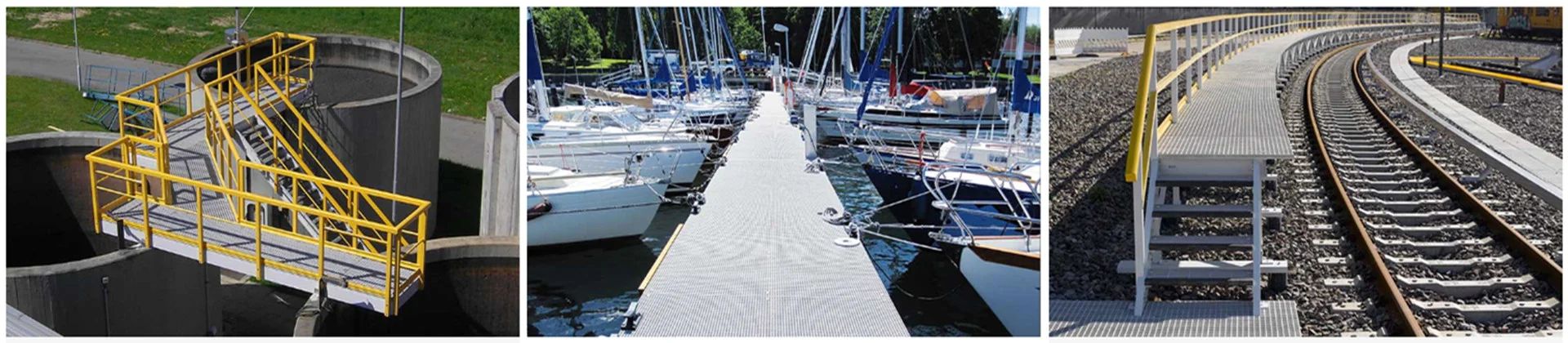
Unicomposite also manufactures FRP grating, handrail systems, cable trays, ladders, platforms, bridge deck components, rebar, poles, rods, and custom structural profiles. This can help when one facility needs multiple corrosion resistant components with similar material requirements.
For example, a chemical facility may need roof decking, grating, stairs, handrails, and cable support products in the same corrosive zone. Working with one FRP manufacturer can simplify drawing review, material selection, fabrication details, and procurement communication.
The sourcing takeaway is clear: choose a supplier that can connect material choice, profile design, fabrication, quality control, and logistics to the actual roof environment.
Request a Custom Fiberglass Roof Decking Solution
Structural fiberglass roof decking can be a strong fit for industrial roofs where corrosion resistance, lightweight handling, electrical insulation, and maintenance reduction matter. It performs especially well in chemical, coastal, wastewater, utility, marine, and other harsh operating environments.
Before requesting a quote, prepare a practical buyer checklist:
| Buyer Checklist | Details to Prepare |
|---|---|
| Project environment | Chemical exposure, humidity, salt, UV, indoor or outdoor use |
| Structural requirements | Span, load, deflection expectations, maintenance traffic |
| Panel requirements | Size, thickness, profile type, surface finish, color |
| Performance needs | Fire requirements, UV protection, dielectric needs, resin preference |
| Fabrication needs | Cutting, drilling, notching, edge treatment, pre assembly |
| Documents | Drawings, photos, layout plans, quantity, inspection requirements |
The main takeaways are direct. FRP roof decking performs best when corrosion or electrical insulation creates a real project challenge. Material comparison should include lifetime maintenance cost, not only initial purchase price. A reliable specification must define environment, load, span, surface finish, and installation needs. A manufacturer with custom FRP experience can help turn those requirements into a practical roof decking solution.
[Contact Unicomposite for a custom FRP roof decking quote →]


