 info@unicomposite.com


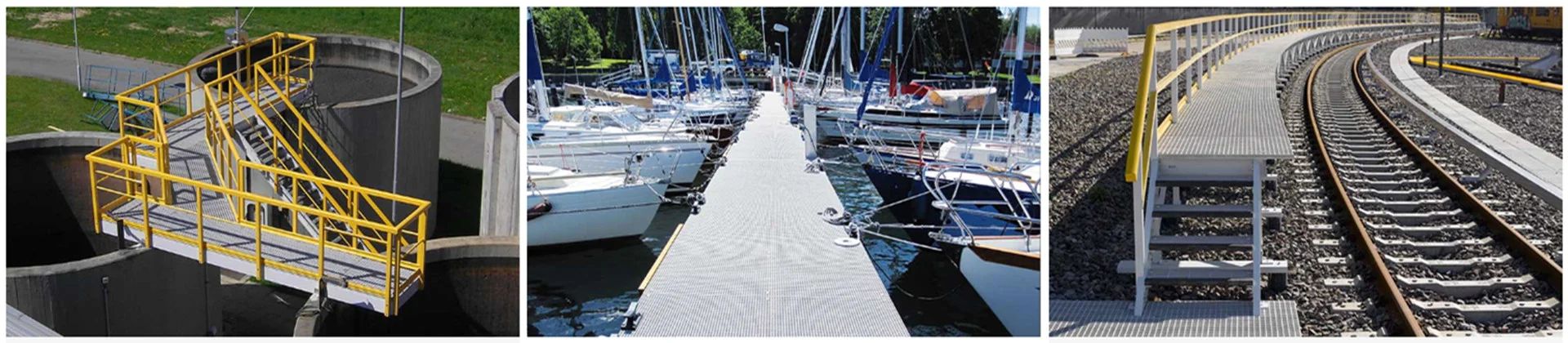
Introduction
Industrial platforms become risky in the exact places where workers need stable access most: wet walkways, chemical processing areas, wastewater service routes, cooling tower platforms, offshore access points, and maintenance decks around heavy equipment. Water, oil, chemical splash, condensation, and corrosion can quickly turn a basic walking surface into a safety and maintenance problem.
Non slip fiberglass floor grating for platforms is designed to address that challenge with traction, corrosion resistance, lightweight handling, and long service performance. For engineers, procurement managers, and operations teams, the decision is not only about choosing a safer surface. It is about matching the right FRP grating type, resin system, surface finish, panel size, support span, and installation method to the actual working environment.
This guide explains what non slip fiberglass floor grating is, where it performs best, how it compares with metal grating, and what buyers should confirm before requesting a custom FRP grating quote.
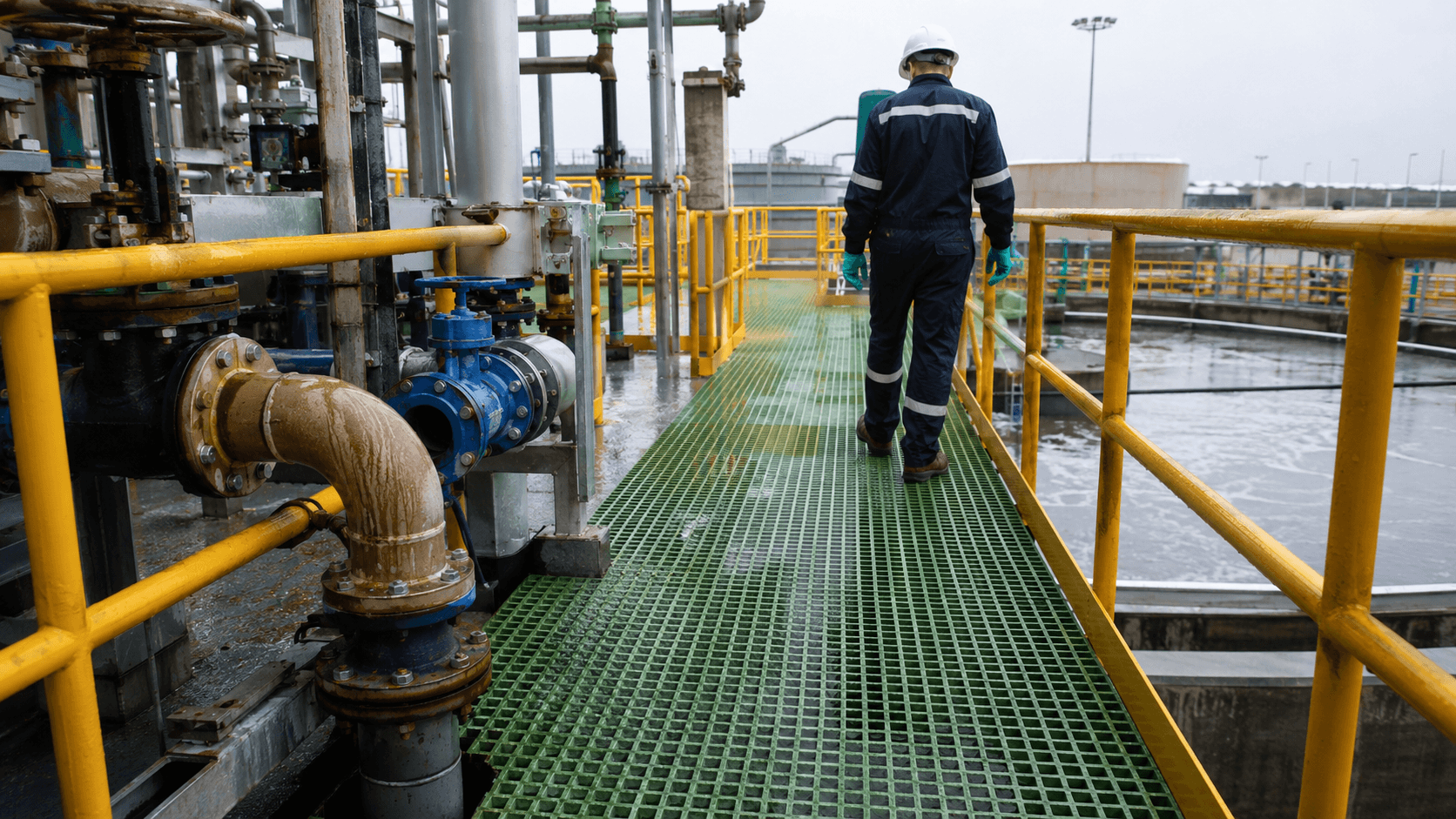
fiberglass floor grating for platforms
What Is Non Slip Fiberglass Floor Grating?
Non slip fiberglass floor grating is an FRP grating panel designed with an anti slip walking surface for industrial platforms, walkways, stair treads, maintenance access routes, drainage covers, and wet operating areas. The grating is usually made from fiberglass reinforcement and resin, then supplied with surface options such as gritted, textured, concave, or covered finishes.
In industrial projects, the term “non slip” usually refers to the surface treatment used to improve traction. A gritted surface can help improve footing in wet or oily areas, while a covered grating panel may help reduce small-object drop-through risk in certain platform designs.
A typical buyer specification may include grating type, panel size, thickness, mesh size, bearing bar depth, resin system, surface finish, color, cutting requirements, installation clips, quantity, and packaging. These details matter because a platform in a chemical plant may require a different resin and surface than a dry maintenance walkway in a general factory.
What is non slip fiberglass floor grating used for?
Non slip fiberglass floor grating is used for industrial platforms, walkways, stair treads, access routes, wastewater facilities, chemical plants, offshore platforms, cooling towers, and wet maintenance areas. It helps provide safer worker access while supporting corrosion resistance, lightweight installation, and long term use in harsh environments.
In field applications, engineers often specify non slip FRP grating when workers need repeated access to equipment in areas exposed to moisture, chemical splash, washdown water, or outdoor weather. The grating does not remove every safety risk, but the right surface and installation method can reduce slip-related hazards.
This makes the product especially useful where safety, corrosion control, and maintenance cost all affect the purchasing decision.
Why Industrial Platforms Need Non Slip Grating
After defining the product, the next question is why platforms need anti slip grating in the first place. Industrial platforms are working surfaces exposed to traffic, tools, weather, chemicals, vibration, and maintenance activity.
Slip Risks in Wet and Corrosive Areas
Water, oil, chemical residue, mud, and condensation can reduce traction on industrial platforms. In wastewater plants, washdown areas, cooling towers, marine facilities, and chemical processing zones, these conditions may occur daily.
Non slip fiberglass grating helps address this risk by combining an open grid structure with a traction surface. The open design can allow water and small debris to pass through, while the gritted or textured surface helps improve footing.
Buyers should match the surface finish to the actual risk level. A lightly textured surface may fit low traffic access areas, while a more aggressive gritted finish may suit wet platforms, stairs, and frequently used walkways.
Worker Access and Maintenance Safety
Many platforms exist because workers need to inspect, repair, clean, or operate equipment. If the walking surface becomes slippery or corroded, maintenance work becomes slower, less predictable, and harder to manage.
In an anonymized wastewater facility upgrade, the maintenance team replaced corroded steel panels around wet equipment with gritted FRP grating. Engineers selected molded FRP grating for wet drainage areas, then used pultruded FRP grating on longer access spans where directional load performance mattered more.
This kind of selection process shows why non slip performance should be treated as part of platform design, not as a minor surface detail.
Corrosion Resistance in Harsh Environments
Steel grating can perform well in many dry or heavy duty applications, but corrosion becomes a concern in wet, chemical, coastal, or wastewater environments. Coatings may help, but they often require inspection, repair, and eventual replacement.
Fiberglass grating uses a resin matrix and fiberglass reinforcement, so it does not rust like steel. When the correct resin system is selected, FRP grating can support long term use in many corrosive industrial environments.
The key decision is resin matching. Buyers should describe chemical exposure, temperature, UV exposure, cleaning method, moisture level, and expected service conditions before finalizing the grating specification.
Best Applications for Non Slip Fiberglass Grating
Beyond general safety, application fit determines whether non slip fiberglass grating is the right choice. It performs best where traction, corrosion resistance, and lightweight installation all matter.
The table below summarizes common applications and why FRP non slip grating fits each environment:
| Application | Typical Environment | Why FRP Non Slip Grating Fits |
|---|---|---|
| Industrial platforms | Factories, equipment access areas | Lightweight panels with safer walking surfaces |
| Chemical plants | Acid, alkali, chemical splash zones | Corrosion resistance and slip protection |
| Wastewater facilities | Wet floors, covers, service walkways | Moisture resistance and lower corrosion maintenance |
| Offshore platforms | Salt spray and wet access areas | Non rusting structure and anti slip surface |
| Cooling towers | Humid and chemical treatment areas | Lightweight handling and corrosion resistance |
| Stair treads | Industrial stairs and access routes | Safer footing and custom sizing |
Where does non slip FRP grating perform best?
Non slip FRP grating performs best on industrial platforms, walkways, stair treads, wastewater service areas, chemical plant access routes, offshore structures, cooling towers, and other wet or corrosive environments. It is most valuable where workers need safe access and metal grating may face corrosion, coating damage, or heavy maintenance.
For procurement teams, the application list helps prioritize where FRP grating should be considered first. Wet floors, elevated maintenance routes, and corrosive access platforms usually provide a stronger business case than dry, low risk areas.
The best projects are those where corrosion control, worker access, and installation weight all influence the total cost of ownership.
Fiberglass Non Slip Grating vs Metal Grating
Once the application is clear, buyers often compare FRP with steel or aluminum grating. Each material has a place, but harsh environments can shift the decision toward fiberglass.
The table below compares common platform grating materials:
| Comparison Item | Non Slip Fiberglass Grating | Steel Grating | Aluminum Grating |
|---|---|---|---|
| Corrosion resistance | Strong in wet and chemical environments | May rust without protection | Better than steel in some conditions |
| Weight | Lightweight | Heavy | Lightweight |
| Slip resistance | Gritted or textured surface available | Needs serrated or coated surface | Needs surface treatment |
| Electrical properties | Non conductive | Conductive | Conductive |
| Maintenance | Lower corrosion related maintenance | Requires coating or inspection | Moderate maintenance |
| Best use | Corrosive industrial platforms | Heavy duty dry areas | Lightweight non corrosive structures |
Steel may still be preferred where extremely heavy impact loads, high temperatures, or specific structural requirements dominate the design. Aluminum can be useful where light weight matters and corrosion exposure is moderate.
Fiberglass becomes more attractive when corrosion, non conductivity, installation weight, and maintenance access are major concerns. Buyers should still verify span, load, deflection, resin system, surface finish, fastener compatibility, and support design before approval.
The material choice should follow the platform environment, not habit or unit price alone.
Molded vs Pultruded Non Slip Fiberglass Grating
After choosing FRP, buyers need to decide between molded and pultruded grating. Both can be supplied with non slip surfaces, but their structures and best-use cases differ.
Molded FRP Grating
Molded FRP grating is made as a one-piece grid structure and is often selected for wet floors, drainage areas, chemical zones, trench covers, and general industrial platforms. Its grid design provides multi directional support and good drainage.
This makes molded grating useful for areas where liquids, debris, and washdown are common. It can also be supplied with concave, gritted, or covered surfaces depending on safety and cleaning requirements.
Pultruded FRP Grating
Pultruded FRP grating uses pultruded bearing bars assembled with cross rods. It is often selected for longer spans, stronger directional load performance, and industrial platforms where bearing direction is clearly defined.
For elevated platforms, walkways, and maintenance access routes, pultruded grating may provide better stiffness in the bearing direction. Buyers should confirm support span and load requirements before choosing a profile.
How should buyers choose between molded and pultruded grating?
Buyers should choose molded FRP grating for wet floors, drainage areas, chemical zones, and platforms needing multi directional support. Pultruded FRP grating is better for longer spans and stronger directional load performance. The final choice depends on load, span, drainage, surface finish, resin system, and installation layout.
In practice, one facility may use both types. A wet processing floor may use molded grating, while an elevated access walkway nearby may require pultruded panels.
Understanding this difference prevents product mismatch and helps buyers request the right quotation.
How to Choose Fiberglass Floor Grating for Platforms
After selecting the grating type, the final specification should match the actual platform design. A complete RFQ saves time, reduces revision rounds, and helps the supplier recommend a suitable panel.
The checklist below shows the key details buyers should prepare before requesting a quote:
| Specification Item | What Buyers Should Confirm | Why It Matters |
|---|---|---|
| Grating type | Molded or pultruded FRP grating | Matches drainage, span, and load direction |
| Platform application | Walkway, stair tread, cover, access deck | Defines safety and fabrication needs |
| Load requirement | Live load, concentrated load, traffic type | Supports structural selection |
| Span and support | Support spacing and bearing direction | Affects stiffness and deflection |
| Deflection expectation | Project limit or performance target | Helps avoid uncomfortable walking surfaces |
| Mesh or bar size | Mesh size, bearing bar depth, thickness | Affects drainage, strength, and weight |
| Resin system | General purpose, chemical resistant, or project-specific | Matches exposure conditions |
| Surface finish | Gritted, textured, concave, or covered | Affects traction and cleaning |
| Panel size | Standard or custom panel dimensions | Supports layout planning |
| Fabrication | Cutting, drilling, openings, edge treatment | Reduces field modification |
| Installation clips | Clip type, fastener material, frame details | Supports secure installation |
| Order details | Quantity, packaging, labels, drawings | Helps production and logistics |
Load Capacity and Span
Load capacity and span should come first. Buyers should provide support spacing, expected live load, concentrated load, deflection expectations, and whether the platform will carry workers, tools, equipment, or occasional carts.
For pultruded grating, bearing direction is especially important. If panels are installed in the wrong orientation, the grating may not perform as expected.
Surface Finish and Safety Conditions
Surface finish affects traction, cleaning, and long term wear. Gritted surfaces are often used on wet walkways and stairs, while concave or covered surfaces may suit other platform conditions.
Non slip performance depends on more than the grating surface. Contamination level, cleaning routine, surface wear, footwear, installation quality, and site safety procedures all affect real-world traction.
Buyers should describe the working conditions rather than simply asking for “anti slip grating.”
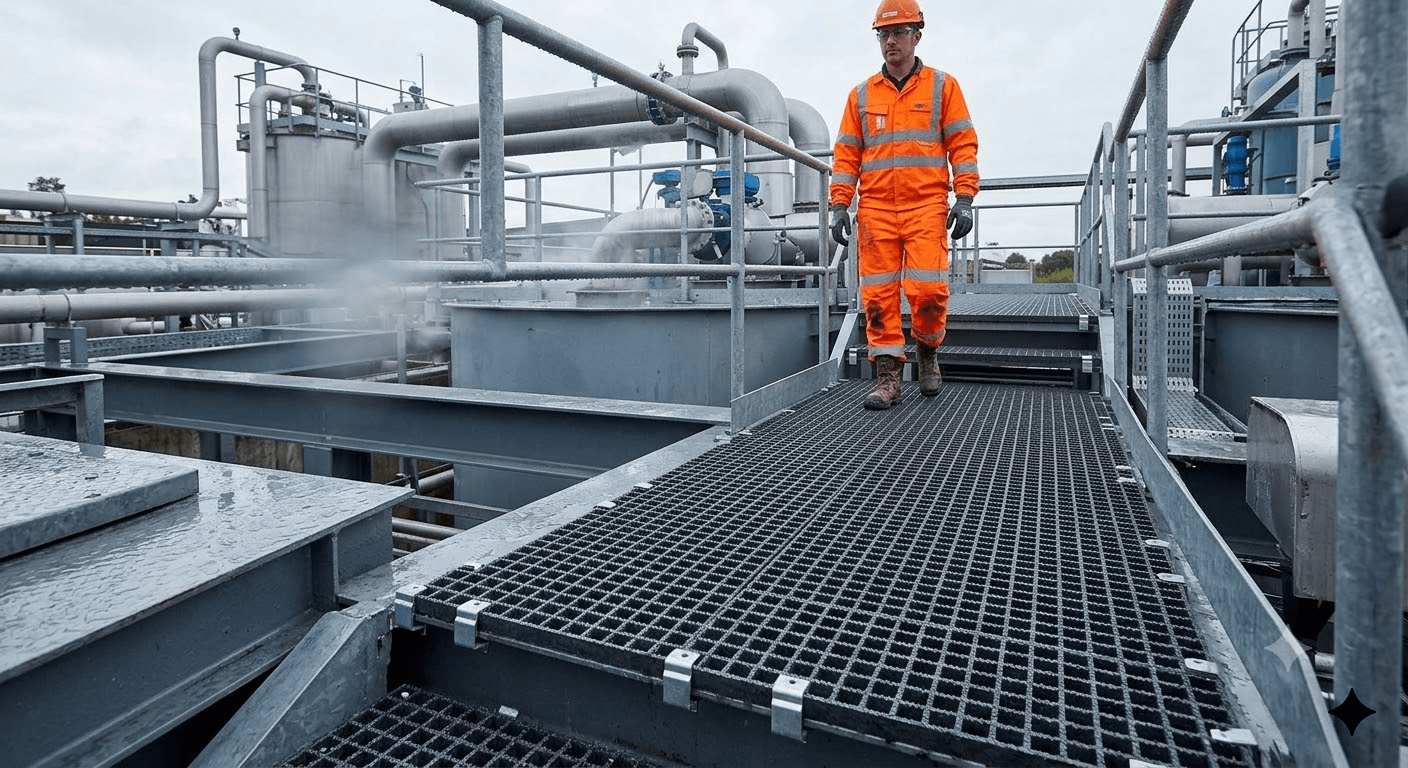
fiberglass floor grating for platforms with non slip
Resin System and Exposure
The resin system affects chemical resistance, fire performance, UV stability, and long term durability. General industrial spaces may use one resin type, while chemical plants, wastewater facilities, or coastal environments may require a different system.
A supplier cannot choose the right resin accurately without exposure information. Buyers should provide details about chemicals, temperature, indoor or outdoor use, cleaning agents, and expected service conditions.
Panel Size, Cutting, and Installation Clips
Custom panel sizes, cutting, drilling, openings, and installation clips can reduce field labor. These details are especially important for platforms with pipes, equipment bases, drainage channels, or irregular framing.
Installation hardware should match the support structure and operating environment. Fasteners and clips should be reviewed along with the grating panel rather than treated as an afterthought.
Source Custom Fiberglass Grating from Unicomposite
For engineers and procurement managers, supplier selection affects more than the purchase price. It affects product consistency, specification support, fabrication accuracy, packaging, lead time, and repeat supply.
Unicomposite Technology Co., Ltd is a professional FRP and GRP composite manufacturer based in Nanjing, China, with ISO 9001 certification and an 18,000 square meter production facility. Its manufacturing capabilities include pultrusion, pulwinding, SMC/BMC molding, hand lay-up, and vacuum infusion, supporting standard and custom composite products for industrial applications.
For fiberglass grating buyers, these capabilities support practical project outcomes. Resin selection support helps match grating to chemical, wastewater, marine, or outdoor exposure. Custom cutting and drilling can reduce field modification. Consistent molded and pultruded panel supply helps buyers manage repeat orders. Installation accessory matching and bulk packaging can simplify project delivery for contractors, distributors, and industrial facilities.
Unicomposite supports fiberglass grating projects for buyers who need corrosion resistance, lightweight handling, non slip surface options, and custom FRP fabrication. Buyers can discuss molded grating, pultruded grating, gritted surface, resin system, panel size, color, cutting, drilling, installation clips, and bulk order requirements.
A practical inquiry should include application area, support span, load requirement, grating type, panel dimensions, surface finish, resin system, environment, quantity, drawings, installation accessories, and packaging needs.
Conclusion
Non slip fiberglass floor grating for platforms is a practical choice for wet, corrosive, or maintenance intensive industrial environments. It supports safer worker access while helping reduce corrosion related maintenance compared with many metal grating options.
The main takeaways are clear. Non slip surface finish should match the actual slip risk. Molded and pultruded FRP grating serve different platform needs. Resin system matters in chemical, wastewater, coastal, and outdoor environments. Load, span, panel size, installation clips, and fabrication requirements should be confirmed before ordering.
For B2B buyers planning industrial platforms, walkways, stair treads, or wet access areas, the right FRP grating specification can improve safety, simplify installation, and support long term performance.
[Contact Unicomposite for a custom fiberglass grating quote →]


