 info@unicomposite.com


Introduction
Telecom cable routes often run through harsh service conditions: rooftops, outdoor base stations, substations, industrial corridors, coastal facilities, and chemical environments. Moisture, UV exposure, cable load, corrosion, fire performance requirements, and difficult maintenance access can all affect the long term reliability of a cable support system.
A fiberglass cable tray gives telecom and industrial buyers a corrosion resistant, lightweight, electrically insulating option for routing and supporting cables. For engineers, procurement managers, utility teams, and OEM cable management buyers, the key question is whether the tray matches the site conditions, cable load, span, protection needs, and installation method.
This guide explains what fiberglass cable trays are, where they are used, how they compare with steel trays, and what buyers should confirm before requesting a quote.
guide to fiberglass cable trays
What Is a Fiberglass Cable Tray?
A fiberglass cable tray is an FRP cable support system made with glass fiber reinforcement and a resin matrix. It supports, routes, and protects telecom, electrical, control, or communication cables in industrial and outdoor environments.
Common forms include ladder trays, trough style trays, covered trays, channel type trays, and custom cable support profiles. Tray geometry, wall thickness, resin system, glass fiber reinforcement, support spacing, and installation quality all influence final performance.
Definition of FRP cable tray
FRP means fiberglass reinforced plastic. In cable tray applications, the glass fiber provides structural reinforcement, while the resin system helps define corrosion resistance, surface performance, fire behavior, UV durability, and environmental suitability.
Typical tray sizes may include compact channel style sections such as 50 x 50 mm, as well as larger options such as 150 x 50 mm and 200 x 50 mm. Covers can be supplied when cable protection, outdoor exposure, or debris control matters.
How is a fiberglass cable tray different from a cable trough or wireway?
A fiberglass cable tray supports and routes cables across industrial or telecom sites, while a cable trough is usually more enclosed and a wireway is often used for protected wiring runs. The best choice depends on cable type, protection needs, ventilation, routing length, cable access, and site exposure.
For outdoor telecom routes, buyers may choose covered FRP trays to protect cable bundles from rain, debris, and sunlight. In equipment rooms, a trough or wireway may provide more enclosed protection. In chemical plants, buyers often prioritize corrosion resistance and resin compatibility.
Why fiberglass is used for cable management
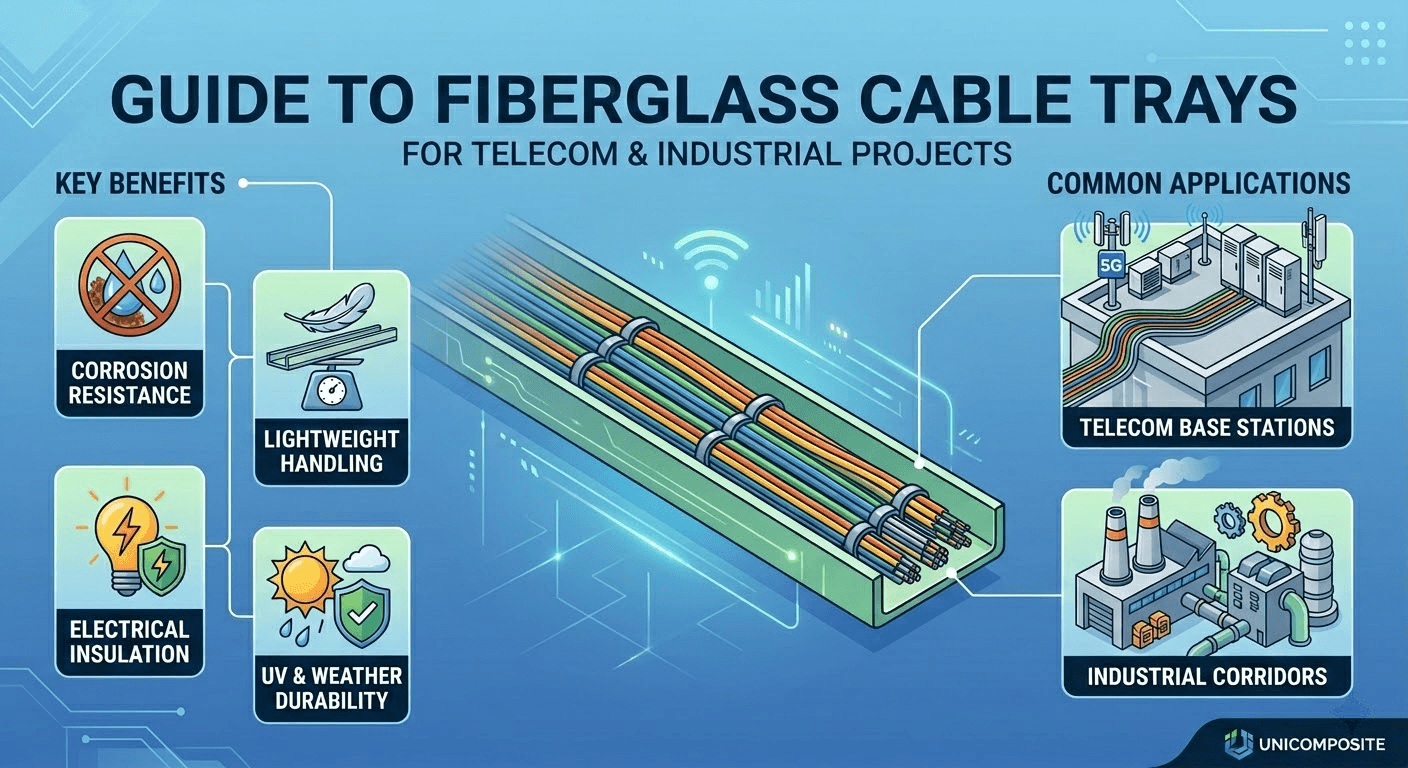
Fiberglass is used for cable management because it can provide corrosion resistance, lightweight handling, electrical insulation, flame retardant options, UV resistance, and custom fabrication. These properties make FRP useful in outdoor telecom sites, industrial plants, and electrically sensitive areas.
Actual performance depends on resin formulation, glass fiber reinforcement, wall thickness, UV package, fire retardant formulation, support spacing, fastener material, cover design, installation method, and operating environment. Buyers should treat FRP cable tray as an engineered cable support product.
Why Use FRP Cable Trays in Telecom and Industrial Sites?
After the basic product definition, the next step is understanding why buyers select FRP instead of traditional metal cable tray systems. The strongest reasons usually involve corrosion, weight, insulation, and customization.
Corrosion resistance for outdoor and chemical environments
Telecom sites may face rain, humidity, salt air, UV exposure, and industrial pollution. Chemical plants, power facilities, and substations can add corrosive vapors, washdown exposure, or harsh outdoor service conditions.
FRP cable trays do not rust like carbon steel. Resin choice still matters, so buyers should describe chemical exposure, temperature, moisture, salt air, cleaning processes, and outdoor exposure before production.
Lightweight installation for elevated or remote sites
FRP cable trays are usually lighter than steel trays of similar function. That matters on rooftops, towers, elevated pipe racks, remote telecom stations, and sites where lifting equipment is limited.
In field installations, crews often value lighter trays because they can reduce handling effort and simplify positioning along long cable routes. Lower component weight may also reduce load on support structures, especially in retrofit work.
Electrical insulation and safety value
Fiberglass is non conductive, which can be valuable around telecom infrastructure, power equipment, and cable routing systems where electrical behavior matters. This property can support safer material selection in certain cable management environments.
System safety still depends on project engineering. Grounding design, cable type, fasteners, support layout, tray cover, and local site rules all need review.
Flame retardant and long service life considerations
Many telecom and industrial projects require flame retardant performance. Buyers should specify fire performance expectations early because FRP formulations can vary by resin system and additive package.
Long service life also depends on UV resistance, anti aging performance, installation environment, cover design, and inspection planning. Outdoor trays should be specified with UV and weather exposure in mind.
Custom sizes, covers and accessories
FRP cable trays can be customized by width, height, length, cover type, resin, color, drilled holes, brackets, supports, labels, and packaging. This helps telecom buyers fit tray systems into tight routing spaces or repeated OEM installations.
Unicomposite Technology Co., Ltd is an ISO 9001 certified FRP and GRP manufacturer based in Nanjing, China, with an 18,000 square meter facility. Its manufacturing capabilities include pultrusion, pulwinding, SMC and BMC molding, hand lay up, and vacuum infusion for standard and custom composite products.
Fiberglass Cable Tray vs Steel Cable Tray
Material selection should compare application conditions, installation limits, maintenance expectations, and lifecycle cost. The table below summarizes the main differences.
| Factor | Fiberglass Cable Tray | Steel Cable Tray | Buyer Takeaway |
|---|---|---|---|
| Corrosion resistance | Resists rust in wet or corrosive environments | May rust if coating is damaged | FRP is strong for outdoor and chemical sites |
| Weight | Lightweight | Heavier | FRP can simplify handling and installation |
| Electrical conductivity | Non conductive | Conductive | FRP may help in electrically sensitive areas |
| Maintenance | Low corrosion related maintenance | May need coating inspection or repair | FRP can reduce long term maintenance work |
| Fire performance | Flame retardant options available | Strong fire resistance depending on design | Fire requirements must be specified |
| Outdoor exposure | Good with suitable resin and UV package | Depends on coating or galvanizing | Environment should guide material choice |
| Customization | Custom sizes, covers and fabrication available | Standard sizes widely available | Telecom projects may benefit from custom FRP |
| Heavy duty protection | Suitable within design limits | Strong for impact and heavy duty systems | Steel may still fit demanding mechanical zones |
When should buyers choose fiberglass cable tray instead of steel?
Buyers should choose fiberglass cable tray when corrosion resistance, electrical insulation, lighter handling, outdoor durability, and reduced maintenance matter in telecom or industrial cable routes. Steel may still fit high load or standard indoor applications, depending on engineering requirements, mechanical protection needs, and site exposure.
FRP is often attractive for telecom base stations, coastal cable routes, chemical facilities, power sites, and outdoor cable bridges. It is especially useful where corrosion repair is difficult or downtime is expensive.
When steel cable tray may still be suitable
Steel cable tray may remain practical for heavy mechanical protection, existing steel systems, standard indoor installations, specific fire designs, or budget driven dry environments. Some projects may also prefer steel when metallic grounding continuity or conventional support systems dominate the design.
A strong specification compares the real application, installation route, support spacing, cable load, and maintenance environment.
Common Applications of Fiberglass Cable Trays
Fiberglass cable trays can serve telecom, utility, and industrial routing needs. The table below shows typical application areas.
| Application Area | Recommended Cable Tray Type | Why It Fits |
|---|---|---|
| Telecom base stations | Covered FRP tray | Outdoor protection and corrosion resistance |
| Rooftop cable routes | FRP ladder or covered tray | Lightweight handling and weather resistance |
| Substations | FRP cable tray or trough | Electrical insulation and outdoor durability |
| Chemical plants | Corrosion resistant FRP tray | Resistance to moisture and chemicals |
| Outdoor industrial corridors | Covered FRP cable tray | Cable protection and reduced maintenance |
| TV and communication systems | Custom FRP tray | Flexible sizing and cable routing |
| Light industry | Standard FRP tray | Simple installation and cable support |
| Coastal sites | UV and corrosion resistant FRP tray | Salt air and moisture resistance |
Telecommunications and base stations
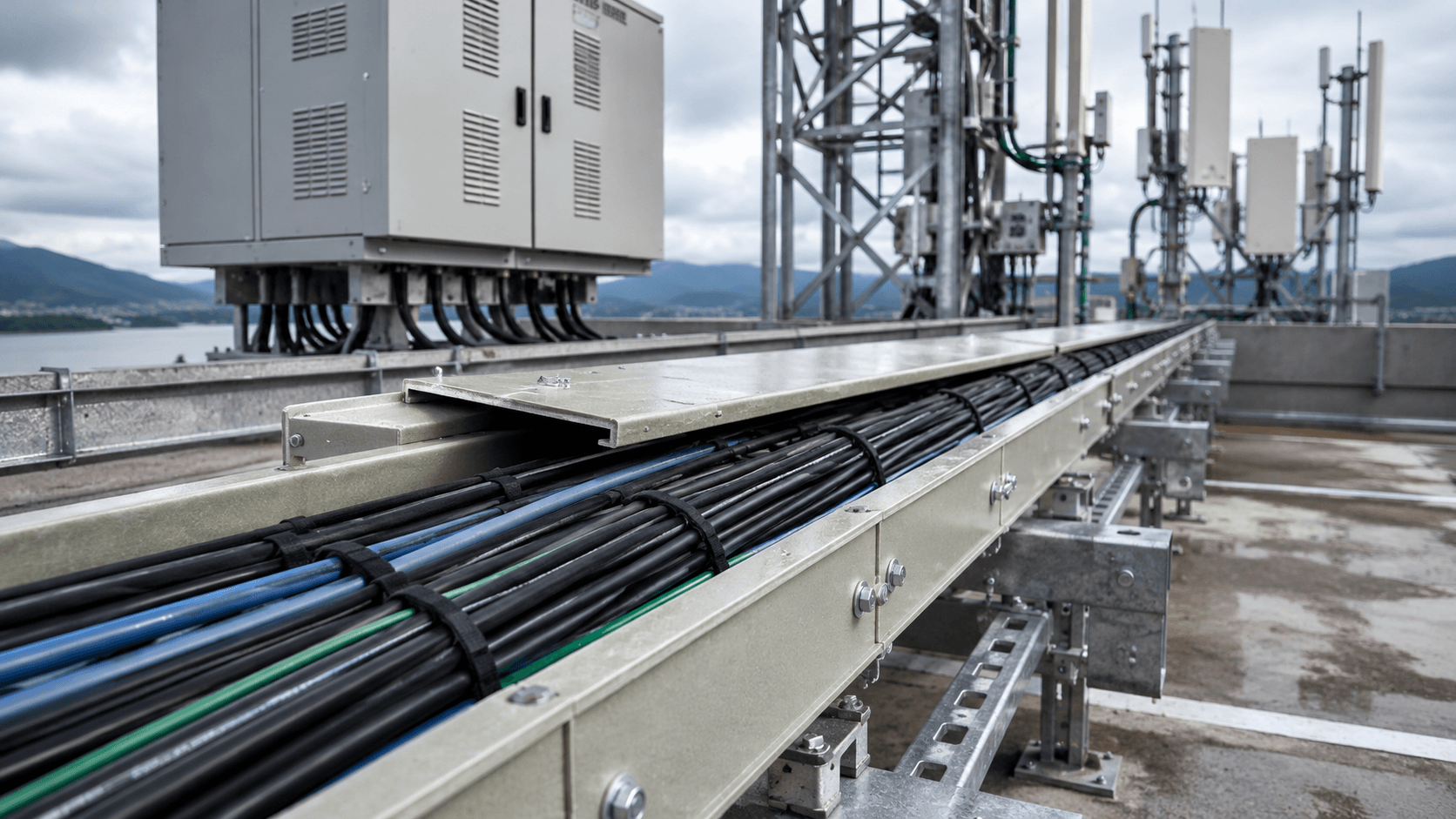
Telecom base stations often need cable routing between equipment, antennas, cabinets, rooftop systems, and utility connections. FRP trays can help protect cable routes while reducing corrosion concerns in outdoor service.
In one anonymized rooftop telecom project, the buyer needed to route cable bundles across an exposed equipment area with limited access for future maintenance. The project team selected covered FRP trays because the route faced rain, UV exposure, and restricted lifting access. Before production, the buyer confirmed tray size, cover type, support span, UV package, bracket layout, bundle packaging, and delivery sequence.
This type of early coordination reduces field cutting and helps installation teams stage materials by route section.
Power plants and substations
Power facilities and substations may need cable trays around outdoor electrical systems, control cables, and equipment areas. FRP’s non conductive nature and corrosion resistance can make it useful in these environments.
Project engineers should still confirm electrical, fire, structural, support, and grounding requirements before final tray selection.
Chemical and petrochemical facilities
Chemical and petrochemical sites often expose cable management systems to vapors, splash, washdown, or corrosive air. FRP trays can reduce rust related maintenance when the resin system matches the exposure.
Buyers should identify chemicals, concentration, temperature, and cleaning processes before requesting a quote. Resin mismatch can reduce service performance.
Outdoor industrial cable routing
Outdoor industrial routes must handle rain, UV exposure, wind, thermal cycling, cable load, and support spacing. Covered trays can provide additional protection where falling debris, splash, or sunlight exposure is a concern.
Tray covers may affect ventilation and installation details, so buyers should include cover requirements in early drawings.
How to Choose the Right FRP Cable Tray
A good cable tray order starts with technical information. Incomplete data often leads to quote revisions, unsuitable tray sizes, or site installation delays.
What size data should buyers confirm before ordering?
Buyers should confirm cable quantity, cable diameter, cable weight, tray width, tray height, support span, cover requirement, installation route, accessories, and future cable capacity. These details help suppliers recommend tray size, wall thickness, resin system, support layout, and whether a covered or open tray design is more suitable.
Tray width alone is not enough to select the system. Cable load, span, cover weight, bend requirements, support layout, and ventilation needs all affect performance.
Tray width and height
Tray width and height should match cable fill, airflow needs, bend radius, protection level, and future expansion. Fill capacity means the amount of cable the tray can hold while still allowing proper routing, access, and heat management.
Small trays such as 50 x 50 mm may fit compact routes. Larger trays such as 150 x 50 mm or 200 x 50 mm may suit bigger cable bundles. Space constraints also matter, especially around rooftops, cabinets, tower structures, and equipment rooms.
Cable load and support span
Cable load means the total weight of cables carried by the tray. Support span means the distance between brackets or supports. Deflection means how much the tray moves under cable weight, cover weight, wind effects, or maintenance handling.
Longer spans, heavier cable bundles, covers, and outdoor wind exposure may require stronger tray designs. Buyers should avoid selecting a tray by size alone.
fiberglass cable tray for telecom
Cover type and protection requirement
Covers can help protect cables from rain, sunlight, debris, splash, and accidental contact. Covered trays are common in exposed telecom and industrial routes.
Cover weight should be included in the load review. Covers may also affect ventilation, heat dissipation, fastening details, inspection access, and removal during maintenance.
Resin system, corrosion exposure and UV
Resin selection should reflect the operating environment. General industrial sites, coastal telecom routes, chemical areas, and outdoor utility applications may need different resin and UV packages.
Buyers should provide sunlight exposure, temperature range, moisture level, salt air, chemicals, cleaning methods, and expected service location. These details help suppliers recommend suitable material options.
Fire retardant requirement and site rules
Fire retardant performance should match project requirements, facility standards, and local expectations. Buyers should communicate fire behavior needs at the RFQ stage.
This helps avoid late redesign after tray dimensions, resin, and production details have already been discussed.
Installation layout and accessories
A cable tray system may need supports, brackets, bends, tees, reducers, covers, clips, fasteners, drilled holes, cutting, and mounting hardware. Missing accessories can delay installation even when the tray itself is correct.
In practice, incomplete accessory planning is one of the most common reasons cable routing projects slow down on site.
Custom Cable Trays for Telecom Projects
Custom tray orders need clear RFQ data. The table below shows what procurement teams should prepare.
| Specification | What Buyers Should Provide | Why It Matters |
|---|---|---|
| Tray size | Width, height, length | Controls cable capacity and fit |
| Cover | Covered or open tray | Defines protection and ventilation |
| Cable load | Total cable weight plus cover weight | Supports structural selection |
| Span | Support spacing | Affects stiffness and deflection |
| Resin | General, vinyl ester, custom | Matches corrosion exposure |
| UV exposure | Indoor, outdoor, coastal | Guides surface and resin package |
| Fire requirement | Flame retardant expectation | Supports compliance planning |
| Drawings | Layout, holes, bends, route | Reduces quote revisions |
| Quantity | Project or annual volume | Supports production planning |
| Accessories | Brackets, covers, clips, fasteners | Prevents installation gaps |
| Packaging | Bundle, pallet, export packaging | Improves handling and shipping |
| Delivery schedule | Required site date | Aligns production and project timing |
When are custom dimensions needed?
Custom dimensions are needed when standard trays cannot meet cable fill, routing space, equipment clearance, cover needs, or installation requirements. Telecom projects may also need repeated custom parts for base stations, rooftop systems, cabinets, or outdoor corridors.
OEM buyers often use custom tray sizes to improve assembly consistency and reduce field modification.
What should buyers send for a quote?
Buyers should send tray dimensions, cable load, support span, cover requirement, resin preference, operating environment, drawings, accessory needs, quantity, packaging requirements, and delivery schedule. If drawings are unavailable, photos, sketches, and site measurements can help suppliers prepare a practical recommendation.
For retrofit projects, old samples, route photos, bracket spacing, and cable bundle estimates can also help. The more complete the request, the fewer quote revisions usually happen.
Fabrication options: cutting, drilling, covers, colors and packaging
Fabrication options may include cut to length trays, drilled holes, covers, special colors, labels, bundled packaging, pallet packaging, and export packaging. These options can reduce site labor and simplify project staging.
Unicomposite can review drawings, route layout, cable bundle estimates, resin exposure, cover needs, accessories, fabrication details, quantity, packaging, and delivery schedule before production. This helps buyers align tray design with site requirements.
Bulk order and project delivery considerations
Bulk telecom orders should consider batch consistency, lead time, shipping length, packaging protection, and installation sequencing. Long trays may need special handling during transport and storage.
Procurement teams should align delivery with the installation schedule so trays do not sit exposed or interfere with site movement.
Installation and Maintenance Considerations
Even a well selected FRP tray needs correct installation. Support layout, fasteners, field cutting, and inspection routines all affect service performance.
Support layout and fastening
Support spacing, bracket design, fastener choice, and installation route should match the tray design. Corrosive or outdoor environments may require compatible hardware.
Engineers should also confirm how covers, bends, transitions, and support brackets will be secured.
Cutting, drilling and field modification
Field crews should use suitable tools, dust control, edge finishing, and correct hole placement. Supplier instructions should be followed when cutting or drilling FRP trays.
Pre cut and pre drilled trays can reduce field mistakes, especially in remote telecom locations or projects with limited installation time.
Inspection and maintenance
Fiberglass cable trays reduce corrosion related maintenance, but cable management systems still need planned inspection. Teams should check fasteners, supports, surface wear, UV exposure, impact damage, debris buildup, cover alignment, and route changes after new cable additions.
Regular inspection protects both cable routing performance and worker safety.
Quick Buyer Checklist
Use this checklist before sending a quote request.
| Item | Confirm Before Ordering |
|---|---|
| Cable route | Rooftop, base station, substation, industrial corridor |
| Tray size | Width, height, length, bend requirements |
| Cable data | Cable quantity, cable diameter, cable weight |
| Capacity | Current cable fill and future spare capacity |
| Span | Support spacing, bracket layout, deflection expectations |
| Cover | Open tray or covered tray, cover weight, ventilation needs |
| Material | Resin system, UV package, flame retardant requirement |
| Environment | Moisture, salt air, chemicals, temperature, sunlight |
| Accessories | Brackets, clips, fasteners, bends, tees, reducers |
| Fabrication | Cut length, drilled holes, colors, labels |
| Logistics | Quantity, packaging, delivery schedule |
Conclusion
Fiberglass cable trays help telecom and industrial buyers manage cables in corrosive, outdoor, and electrically sensitive environments. They can offer lightweight handling, corrosion resistance, electrical insulation, flame retardant options, and custom fabrication.
Buyers should confirm tray size, cable load, support span, cover type, resin system, UV exposure, fire requirements, accessories, quantity, packaging, and delivery requirements before ordering. FRP and steel should be compared by application, maintenance, installation conditions, mechanical protection needs, and lifecycle cost.
A complete RFQ helps suppliers recommend the right tray design, material package, fabrication plan, and delivery approach.
[Contact Unicomposite for a custom fiberglass cable tray quote →]


