 info@unicomposite.com


Introduction
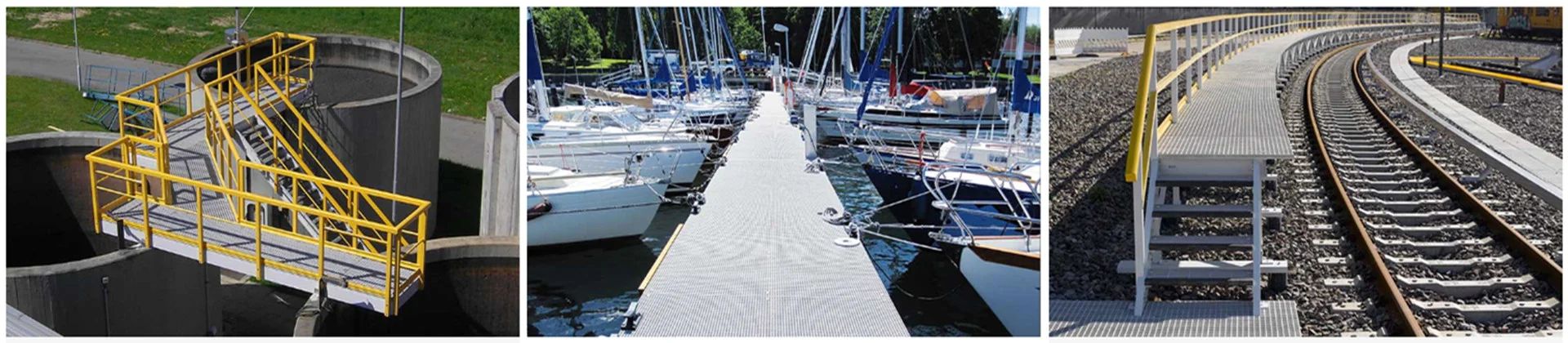
A fiberglass grating order can look simple on paper: panel size, thickness, quantity, and delivery date. In real industrial projects, the risk sits in the missing details. The wrong resin system, support span, surface finish, or cutout layout can delay installation and create avoidable site work.
For engineers, procurement managers, and operations teams, choosing a fiberglass grating factory is a technical sourcing decision. The factory affects product fit, safety performance, corrosion resistance, fabrication accuracy, packaging, and long term maintenance.
This guide explains how industrial buyers can evaluate a fiberglass grating factory before placing a bulk order. It covers project requirements, molded and pultruded FRP grating, factory capability, technical documents, quotation preparation, and verification steps for walkways, platforms, trench covers, wastewater facilities, chemical plants, marine sites, and utility projects.
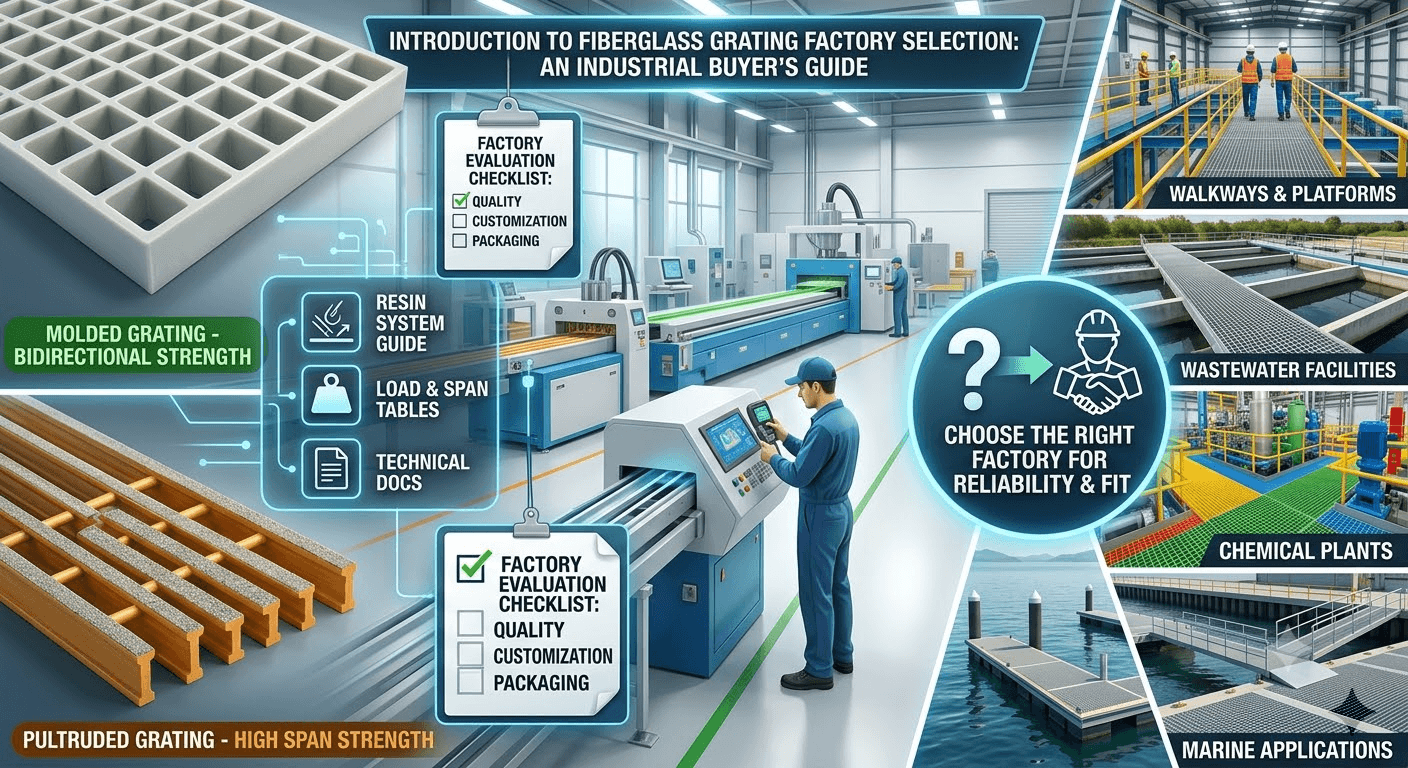
introduction to fiberglass grating factory selection
Why Choosing the Right Fiberglass Grating Factory Matters
Factory selection affects much more than unit price. It influences resin selection, panel tolerances, load suitability, cutting accuracy, export packaging, delivery timing, and how much work remains for the installation team.
In field projects, rework often costs more than the panel. A grating panel that does not match a support span or opening layout may require recutting, replacement, extra installation hours, or a schedule adjustment. Those costs are easy to miss during quote comparison.
Industrial grating projects often combine several requirements at once. Buyers may need corrosion resistance, slip control, electrical insulation, accurate fabrication, and repeatable supply for future maintenance orders. A capable factory should help buyers confirm these points before production starts.
A strong supplier should ask where the grating will be used, what it must carry, which chemicals or moisture conditions it may contact, how it will be supported, and whether custom cutting is required.
What should buyers confirm before choosing a fiberglass grating factory?
Buyers should confirm grating type, resin system, load requirement, support span, panel size, surface type, fabrication needs, quality control, packaging, and delivery capacity before choosing a fiberglass grating factory. These details help prevent material mismatch, poor fit, production delays, and maintenance problems.
A walkway in a wastewater treatment plant may need corrosion resistance and a grit top surface. A utility platform may need electrically insulating FRP grating. A chemical processing area may need a resin system selected for the exposure environment.
The best factory selection starts with site conditions and performance requirements, then moves to pricing.
Understand Your FRP Grating Requirements
After buyers define the project risk, they should convert field conditions into a clear FRP grating specification. FRP grating can perform well in harsh environments when the product type, resin, thickness, mesh, and surface match the application.
A useful specification should include application area, support span, load requirement, panel size, thickness, mesh size, resin system, surface finish, quantity, and installation drawings. If the project involves chemicals, saltwater, UV exposure, heat, drainage, or electrical hazards, those details should appear in the first RFQ.
The table below summarizes project details that buyers should prepare before contacting a factory:
| Requirement | What to Confirm | Why It Matters |
|---|---|---|
| Application | Walkway, platform, trench cover, stair tread, dock, drain cover | Defines load, safety, and fabrication needs |
| Environment | Chemical, marine, wastewater, utility, outdoor, indoor | Guides resin and surface selection |
| Load requirement | Pedestrian load, cart load, equipment load, support span | Helps prevent under specified panels |
| Grating type | Molded or pultruded | Affects strength direction, span, and corrosion behavior |
| Panel size | Length, width, thickness, mesh size | Controls layout and installation fit |
| Surface finish | Concave, grit top, covered, slip resistant | Affects worker safety and drainage |
| Fabrication | Cutting, notching, drilling, openings, stair tread nosing | Reduces site labor and rework |
| Delivery details | Quantity, destination, packaging, timeline | Supports accurate pricing and logistics |
Drawings help the factory estimate cutting loss, panel direction, support arrangement, and packaging requirements. Even a preliminary layout can reduce repeated emails and prevent wrong assumptions.
Clear requirements also help buyers compare quotes fairly. Two suppliers may quote different prices because they assumed different resin systems, surface finishes, or fabrication work.
Molded vs Pultruded Fiberglass Grating
Once the project requirements are clear, buyers should choose the grating type. Most industrial projects use molded fiberglass grating or pultruded fiberglass grating. Both are FRP products, but they support different design priorities.
Molded grating is commonly selected where corrosion resistance, drainage, and strength in multiple directions matter. Pultruded grating is often selected where longer support spans, higher directional stiffness, or defined walkway load paths matter.
The table below compares molded and pultruded FRP grating for industrial sourcing decisions:
| Factor | Molded FRP Grating | Pultruded FRP Grating |
|---|---|---|
| Structure | One piece molded grid | Load bars made through pultrusion with cross rods |
| Strength behavior | More balanced strength in multiple directions | Higher strength along the bearing bar direction |
| Common use | Chemical floors, wastewater platforms, drain covers, marine areas | Walkways, platforms, bridges, elevated access systems |
| Corrosion resistance | Strong fit when the resin system matches exposure | Also corrosion resistant when properly specified |
| Cutting flexibility | Easier to cut around pipes and equipment | Cutting direction and support layout need closer review |
| Buyer focus | Resin, mesh, thickness, surface, drainage | Span, load, bearing bar depth, support direction |
When should buyers choose pultruded fiberglass grating?
Buyers should choose pultruded fiberglass grating when the project requires higher load capacity, longer support spans, or defined walkway and platform performance. Pultruded grating works best when engineers align the bearing bars with the support direction and confirm load requirements before production.
Pultruded grating is often used for industrial walkways, elevated platforms, bridge access areas, and utility structures. The factory should confirm bearing bar size, panel direction, support spacing, resin system, and surface finish.
Molded grating may suit projects with many cutouts or strong corrosion requirements. Pultruded grating may suit projects where span and stiffness control the specification. The project layout should guide the decision.
How to Evaluate a Fiberglass Grating Factory
After choosing the likely product type, buyers should evaluate factory capability. A reliable factory should explain what it can manufacture, what it can customize, and what information it needs before quoting.
A qualified manufacturer reviews support span, load direction, resin exposure, cutting drawings, installation layout, surface finish, and packaging method before production. This factory side review helps buyers avoid mismatched products and unclear assumptions.
Unicomposite is a China based FRP and GRP composite manufacturer with ISO 9001 certification and an 18,000 square meter production facility. Its manufacturing processes include pultrusion, pulwinding, SMC and BMC molding, hand lay up, and vacuum infusion. For FRP grating projects, this background supports standard products, custom fabrication, related profiles, and project based supply.
The table below can be used as a practical factory evaluation checklist:
| Evaluation Area | What to Ask | Strong Factory Signal |
|---|---|---|
| Product range | Do you supply molded and pultruded grating? | Can recommend based on application |
| Resin options | What resin systems are available? | Can discuss chemical, moisture, UV, and fire needs |
| Fabrication | Can you cut, drill, notch, or prepare custom panels? | Can work from drawings or layouts |
| Quality control | What inspections are performed before shipment? | Can provide inspection records or agreed QC checks |
| Batch consistency | How do you control repeat orders? | Uses process control and documented production records |
| Packaging | How are panels packed for export or project delivery? | Can customize pallets, labels, and protection |
| Technical support | Can engineers review span, load, and application details? | Provides practical feedback before quotation |
How can buyers identify a capable fiberglass grating factory?
Buyers can identify a capable fiberglass grating factory by checking whether it understands resin selection, molded and pultruded grating differences, load and span requirements, fabrication drawings, quality inspection, export packaging, and bulk delivery. A capable factory helps prevent product mismatch before production starts.
A weak supplier may quote only by size and quantity. A stronger factory asks about the working environment, support span, load condition, installation layout, surface requirement, and fabricated openings.
That difference matters. In industrial projects, the product can look correct in photos and still fail the project requirement if the support span, resin, or fabrication plan is wrong.
Factory Capability Checklist for Industrial Projects
Beyond product range, buyers should verify whether the factory can support the full order process. Industrial FRP grating projects may require panel cutting, stair treads, pipe openings, fixing accessories, labels, pallets, loading plans, and phased delivery.
Consider an anonymized wastewater walkway replacement. The buyer needs molded FRP grating for a corrosive wet area, a grit top surface for slip control, pipe cutouts near pumps, and area based pallet labeling so installers can unload panels by zone. If the factory cannot coordinate drawings, fabrication, and packing labels, the installation team may spend extra time sorting and modifying panels on site.
Buyers can reduce this risk by requesting technical documents before mass production. The table below lists useful documents and why they matter:
| Document or Check | What It Confirms |
|---|---|
| Product data sheet | Grating type, panel size, thickness, mesh, resin, and surface |
| Load and deflection information | Suitability for support span and expected traffic |
| Resin guidance | Fit for moisture, chemicals, UV, temperature, or fire needs |
| Fabrication drawing confirmation | Cutouts, notches, openings, and edge details |
| Tolerance agreement | Dimensional expectations for installation fit |
| Sample piece | Visual check, handling check, surface review |
| Inspection photos | Production status and packing condition before shipment |
| Packaging plan | Pallet layout, labels, protection, and unloading sequence |
Quality control should match project risk. A small drain cover order may need basic confirmation. A large walkway, platform, or chemical facility order may require samples, signed drawings, inspection photos, and clear tolerance agreement.
The goal is simple: the factory should reduce site work, not transfer every detail to the installation crew.

fiberglass grating factory guide
Information Needed for a Fast Quote
After verifying factory capability, buyers can speed up the RFQ process by sending complete project information. A clear inquiry usually produces a better quote and fewer follow up messages.
The most useful quote information includes grating type, panel size, thickness, mesh size, resin requirement, surface type, support span, load requirement, quantity, drawings, destination, and delivery timeline. If buyers do not know the exact grating type, they should describe the working environment and expected use.
The table below gives procurement teams a practical RFQ structure:
| RFQ Item | Example |
|---|---|
| Product type | Molded FRP grating or pultruded FRP grating |
| Application | Chemical platform, wastewater walkway, marine deck |
| Panel details | Size, thickness, mesh, bearing bar direction |
| Surface | Concave, grit top, covered plate, stair tread nosing |
| Load and span | Pedestrian traffic, carts, equipment, support distance |
| Environment | Chemical exposure, saltwater, UV, indoor or outdoor |
| Fabrication | Cutouts, holes, notches, drawings, edge finishing |
| Quantity | Number of panels or total square meters |
| Delivery | Destination port, address, timeline, packaging needs |
Procurement teams should separate fixed requirements from flexible preferences. A project may require a specific support span, while panel color may be flexible. That gives the factory room to recommend a practical option.
Before bulk production, buyers should verify samples, final drawings, tolerances, resin selection, load information, surface finish, inspection method, packaging labels, and delivery plan. This verification step can prevent expensive corrections after shipment.
Why Work with Unicomposite for Fiberglass Grating
For industrial buyers, a grating supplier should support both product supply and project communication. Buyers may need standard panels, custom sizes, fabricated openings, related FRP profiles, or matching components such as handrails, ladders, cable trays, and structural profiles.
Unicomposite manufactures FRP grating and related composite products for industrial, infrastructure, utility, agricultural, and marine applications. Its broader product range includes FRP structural profiles, grating, handrail systems, cable trays, ladders, platforms, rebar, rods, and custom composite components.
This product range helps when projects require multiple FRP systems. A wastewater project may need grating, handrails, ladders, and structural profiles. A utility project may need electrically insulating access platforms, cable support components, and custom pultruded profiles.
Buyers can contact Unicomposite with drawings, specifications, or project conditions to discuss standard and custom fiberglass grating options.
Conclusion
Choosing a fiberglass grating factory should begin with project performance. Buyers should define the application environment, support span, load requirement, resin needs, surface finish, fabrication details, and delivery plan before comparing prices.
A practical decision framework works well:
- Define the project requirements first, including environment, load, span, surface, and fabrication.
- Match the product type second, choosing molded or pultruded FRP grating based on application needs.
- Verify factory capability third, including resin knowledge, fabrication support, quality control, packaging, and technical communication.
- Request samples and documents before mass production, especially for custom panels or large industrial orders.
[Contact Unicomposite for a fiberglass grating project quote →]


