 info@unicomposite.com


Introduction
Choosing a fiberglass pultruded grating manufacturer can affect far more than the unit price on a quotation. For industrial projects, the wrong supplier choice may lead to poor panel fit, delayed installation, weak corrosion resistance, unsafe walking surfaces, or early replacement.
If you are sourcing FRP grating for wastewater plants, chemical platforms, marine walkways, power facilities, cooling towers, or industrial flooring, the manufacturer behind the product matters as much as the material itself. A good supplier should help you confirm load performance, resin type, surface safety, fabrication details, production control, lead time, and project support.
This guide explains how to compare fiberglass pultruded grating manufacturers from a B2B buyer’s perspective. You will learn which technical details matter, how pultruded grating compares with molded grating, what to include in your RFQ, and how to select a supplier that can support both quality and delivery.
fiberglass pultruded grating manufacturers guide
What Is Fiberglass Pultruded Grating?
Before you compare suppliers, start with the product. Fiberglass pultruded grating is an FRP grating system made from glass fiber reinforcement and resin through a continuous pultrusion process. It is used for platforms, walkways, trench covers, stair treads, and industrial access areas.
FRP grating does not rust like steel and does not rot like wood. It also provides electrical insulation, which makes it useful in utility, power, and telecom related applications. Final performance still depends on resin selection, profile design, support structure, fasteners, and installation quality.
How Pultruded FRP Grating Is Made
Pultruded grating uses continuous glass fibers pulled through resin and shaped through a heated die. This process creates consistent profiles with strong directional strength.
In practical terms, pultruded grating often performs well where the load direction and support span are clearly defined. Engineers commonly choose it for longer walkway spans, industrial platforms, and access surfaces where strength to weight ratio matters.
Why Pultruded Grating Is Used in Industrial Projects
Pultruded FRP grating is selected for projects that need corrosion resistance, lightweight handling, slip resistance, and dimensional stability. In field installations, engineers often find that FRP can reduce coating maintenance compared with steel in wet or corrosive environments.
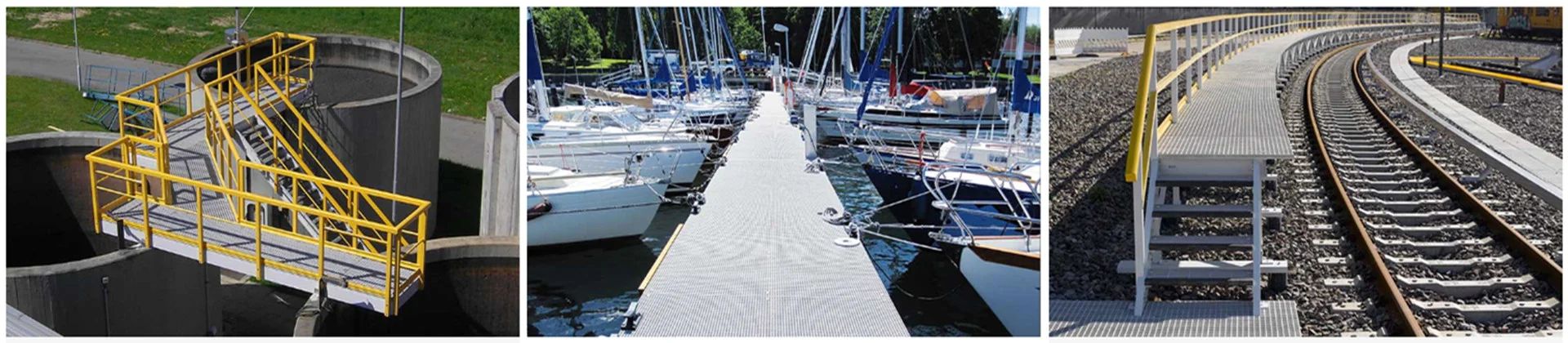
Typical use cases include wastewater treatment walkways, chemical plant platforms, cooling tower access areas, marine facilities, and electrical utility structures.
Where It Performs Better Than Traditional Materials
Pultruded fiberglass grating works especially well in places where steel corrosion, wood decay, or electrical conductivity creates long term risk. It can also reduce installation labor because panels are lighter than many metal alternatives.
The core buying question is simple: does the application need corrosion resistance, lower weight, electrical insulation, and stable walking performance? If yes, FRP grating deserves serious evaluation.
Key Factors When Choosing Fiberglass Pultruded Grating Manufacturers
Once the product type is clear, the next step is evaluating whether the manufacturer can supply the right grating for your project. A low price can become expensive if the supplier cannot support load requirements, resin selection, fabrication, or delivery timing.
The best manufacturers help connect engineering requirements with production reality.
Quality Certification and Manufacturing Control
Start with quality management. A reliable manufacturer should explain its production process, inspection steps, dimensional control, and quality documentation.
For B2B procurement, ISO quality management, clear product specifications, stable production processes, and documented inspection routines all matter. These signals show that the manufacturer can produce repeatable grating panels across batches.
Load Capacity, Span, and Structural Design Support
Load capacity is one of the most important technical checks. Grating selection depends on bearing bar size, profile depth, support spacing, deflection limits, live load, concentrated load, fastening method, and installation layout.
Ask for load related guidance based on panel size, bearing direction, support span, and project use. A manufacturer that asks for span and loading details before quoting is usually taking the application seriously.
Resin Type and Corrosion Resistance
The resin system affects chemical resistance, UV performance, fire behavior, and long term durability. A wastewater treatment plant, a coastal walkway, and a chemical processing platform may require different resin considerations.
A qualified manufacturer should ask about the service environment before recommending a product. If a supplier quotes without discussing exposure conditions, treat that as a warning sign.
Anti-Slip Surface and Safety Requirements
Industrial grating often serves as a walking surface, so safety matters. Pultruded FRP grating can include grit, textured, or covered top surfaces to improve traction.
Define whether the area will be dry, wet, oily, exposed to chemical residue, or used by workers carrying equipment. These details influence surface selection and maintenance planning.
Custom Size, Color, Cutting, and Drilling Options
Many projects need more than standard panels. You may need custom lengths, special widths, pre-drilled holes, cutouts, colors, edge finishing, or matched stair treads.
Manufacturers with fabrication support can reduce field cutting and installation delays. This is especially valuable when grating must fit around pipes, tanks, equipment bases, or irregular support frames.
The table below can help compare manufacturers before purchase orders are issued:
| Evaluation Item | What to Ask the Manufacturer | Why It Matters |
|---|---|---|
| Quality control | Do you follow documented inspection and production procedures? | Helps ensure batch consistency |
| Load support | Can you recommend grating based on span and load needs? | Reduces selection errors |
| Resin selection | Which resin fits my chemical or outdoor environment? | Affects corrosion resistance and service life |
| Surface option | Do you offer grit or anti-slip surfaces? | Supports safer walking conditions |
| Fabrication | Can you cut, drill, or customize panels? | Reduces site modification work |
| Bulk supply | What is your lead time and packing method? | Supports project scheduling |
A strong manufacturer should give clear technical answers before price becomes the final decision.
Pultruded Grating vs Molded Grating
After checking supplier capability, confirm whether pultruded grating is the right FRP grating type. Many buyers compare pultruded and molded grating because both are common in industrial applications.
The right choice depends on load direction, span, drainage needs, panel layout, and site conditions.
When Should You Choose Pultruded Grating?
You should choose pultruded grating when your project needs higher strength in a primary load direction, longer span support, lightweight panels, and corrosion resistance. It is often suitable for industrial walkways, platforms, stair treads, trench covers, and access surfaces with defined support layouts.
Pultruded grating is especially useful when engineers know the bearing direction and can design the support structure accordingly. It often performs well for walkway and platform applications where directional strength matters.
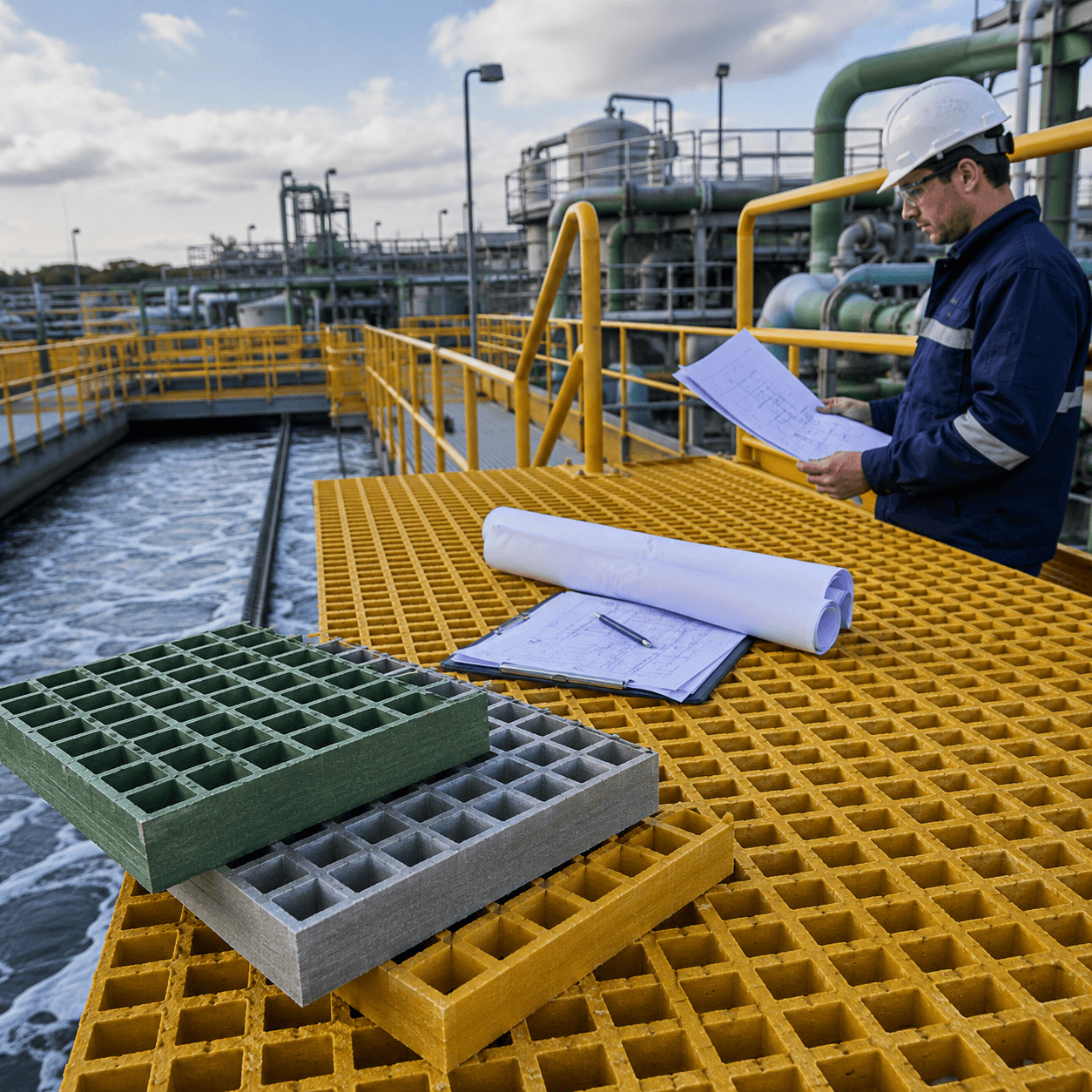
In an anonymized wastewater platform project, the buyer compared molded grating and pultruded grating for a long access walkway. The walkway had a clear bearing direction and wider support spacing, so the engineering team selected pultruded grating to better match the span requirement while keeping the system corrosion resistant and lightweight.
When Molded Grating May Be More Suitable
Molded grating may suit applications that need multi-directional strength, smaller openings, good drainage, or more flexible panel orientation. It is often used in wet, corrosive, or drainage heavy environments.
The decision should be based on engineering requirements. If the project is unclear, send drawings and load requirements to the manufacturer for review before choosing the grating type.
Comparison Table: Pultruded vs Molded FRP Grating
Before evaluating supplier quotations, use the product comparison below to confirm whether the quoted grating type matches the project conditions.
| Factor | Pultruded FRP Grating | Molded FRP Grating |
|---|---|---|
| Strength direction | Stronger in the main bearing direction | More balanced in multiple directions |
| Span suitability | Often better for longer defined spans | Often better for smaller support grids |
| Surface options | Available with grit or anti-slip surfaces | Available with concave or grit surfaces |
| Common uses | Walkways, platforms, trench covers, stair treads | Drainage areas, corrosive floors, general platforms |
| Design check | Bearing direction and support spacing are critical | Panel opening and drainage needs are critical |
Choosing between pultruded and molded grating becomes easier when load, span, drainage, and installation environment are clearly defined.
How to Evaluate Manufacturer Capability
After confirming the product type, look at the supplier’s ability to support the full project. A manufacturer should do more than ship panels. The right supplier helps reduce risk before production starts.
This is where engineering communication, production capacity, packaging, and support become part of the buying decision.
Production Capacity and Lead Time
Ask about monthly production capacity, tooling availability, standard panel stock, and estimated lead time. Large projects may need staged delivery, export packing, or multiple production batches.
A manufacturer with stable production planning can help avoid schedule delays. For procurement managers, that can be just as important as unit cost.
Engineering Communication and Drawing Support
A capable supplier should understand drawings, panel layout, span direction, and cutting requirements. If a project requires special fabrication, the supplier should confirm details before production.
Unicomposite Technology Co., Ltd, based in Nanjing, China, manufactures standard and custom FRP composite profiles and systems. Its pultrusion capability supports consistent grating profiles, while its fabrication support can help with cut-to-size panels, drilled holes, matched FRP handrails, ladders, cable trays, and project batch supply.
Export Packaging and Bulk Order Experience
For international orders, packaging quality matters. FRP grating should be packed to reduce edge damage, surface abrasion, and shipping related deformation.
Ask how the supplier packs bulk panels, labels shipments, and supports container loading plans. These practical details can save time when products arrive on site.
Warranty, Testing, and After-Sales Support
Warranty terms should be clear. Confirm what is covered, which conditions apply, and what information the manufacturer needs if a quality issue occurs.
Testing and documentation also matter. Ask for product specifications, material information, inspection records, and relevant technical data based on project requirements.
A dependable supplier reduces uncertainty during specification, purchasing, shipment, and installation.

fiberglass pultruded grating manufacturers
Common Applications for Fiberglass Pultruded Grating
A manufacturer’s experience should match the application. A company that understands the target industry can ask better questions and recommend more suitable product options.
Pultruded FRP grating is used across many corrosive, outdoor, and electrically sensitive environments.
Wastewater Treatment Plants
Wastewater treatment facilities often need grating for platforms, walkways, trench covers, and access areas. Moisture and chemical exposure can create corrosion problems for metal materials.
FRP grating helps reduce rust related maintenance and supports safer access in wet environments when paired with an appropriate anti-slip surface.
Chemical Platforms and Walkways
Chemical plants require careful material selection because exposure conditions vary by process area. Resin type, surface design, and load requirements should all be reviewed before ordering.
In these environments, a manufacturer should ask detailed questions about chemicals, concentration, temperature, and exposure frequency.
Marine and Coastal Facilities
Marine and coastal sites expose materials to salt air, moisture, and outdoor weathering. FRP grating can be used for docks, walkways, access platforms, and service areas where corrosion resistance is valuable.
For coastal use, discuss UV exposure, resin selection, color, surface durability, fasteners, and support hardware.
Power and Utility Projects
Power and utility facilities may require non-conductive materials around electrical systems. FRP grating offers dielectric properties that can be valuable in selected utility applications.
It can also pair with FRP handrails, ladders, and platforms to create corrosion resistant access systems.
Industrial Flooring and Maintenance Access
Factories, cooling towers, equipment platforms, and maintenance routes often need durable walking surfaces. Pultruded grating can provide a lightweight option for defined access paths.
A practical manufacturer should help match panel type, support spacing, fastening method, and surface choice to actual site use.
RFQ Checklist Before Contacting a Supplier
Once the application and supplier requirements are clear, prepare a precise RFQ. A vague request often delays quoting. A detailed request helps manufacturers recommend the right grating type and allows you to compare suppliers fairly.
What Should You Include in an FRP Grating RFQ?
An FRP grating RFQ should include the application, operating environment, panel size, quantity, load requirement, support span, surface type, resin preference, drawings, cutting needs, and delivery destination. These details help manufacturers recommend suitable fiberglass pultruded grating and provide more accurate pricing.
For example, “need FRP grating for a wastewater walkway” gives the supplier a starting point. “Need pultruded FRP grating for a wastewater walkway, 1,000 mm support span, anti-slip surface, outdoor exposure, 200 panels, cut to drawing” gives the supplier actionable information.
Project Environment
Describe whether the grating will be used indoors, outdoors, in chemical exposure, near salt air, in wet conditions, or around electrical equipment. This affects resin and surface selection.
Panel Size and Quantity
Provide panel length, width, thickness if known, and total quantity. Include drawings when available.
Load and Span Requirements
Share expected load, support spacing, bearing direction, and installation method. This helps the manufacturer recommend a suitable profile.
Surface and Resin Requirements
State whether the project needs grit, anti-slip texture, fire retardant properties, UV resistance, or chemical resistance. If the resin type is uncertain, describe the environment and ask for a recommendation.
Drawings or Installation Conditions
Drawings help suppliers confirm cutting, drilling, layout, and packaging requirements. Explain unusual installation conditions early, especially if the grating must fit around equipment, existing steelwork, or irregular supports.
A clear RFQ helps compare fiberglass pultruded grating manufacturers based on engineering fit, delivery support, and lifecycle value.
Conclusion
Selecting the right fiberglass pultruded grating manufacturer starts with a technical review of the project. You need to understand the application, confirm whether pultruded grating fits the span and load, evaluate resin and surface requirements, and check whether the supplier can support custom fabrication and bulk delivery.
The key takeaways are clear:
- Choose manufacturers that understand load, span, resin, surface, fastening, and application requirements.
- Compare pultruded and molded grating before finalizing the product type.
- Ask for quality control, production, packaging, testing, and technical documentation.
- Prepare a detailed RFQ so suppliers can quote accurately.
- Treat manufacturer capability as part of lifecycle value, not just procurement cost.
Send your project environment, panel size, load requirement, support span, surface preference, quantity, drawings, and delivery destination to request a custom FRP grating recommendation.
[Contact Unicomposite for a custom fiberglass pultruded grating quote →]


