 info@unicomposite.com


Introduction
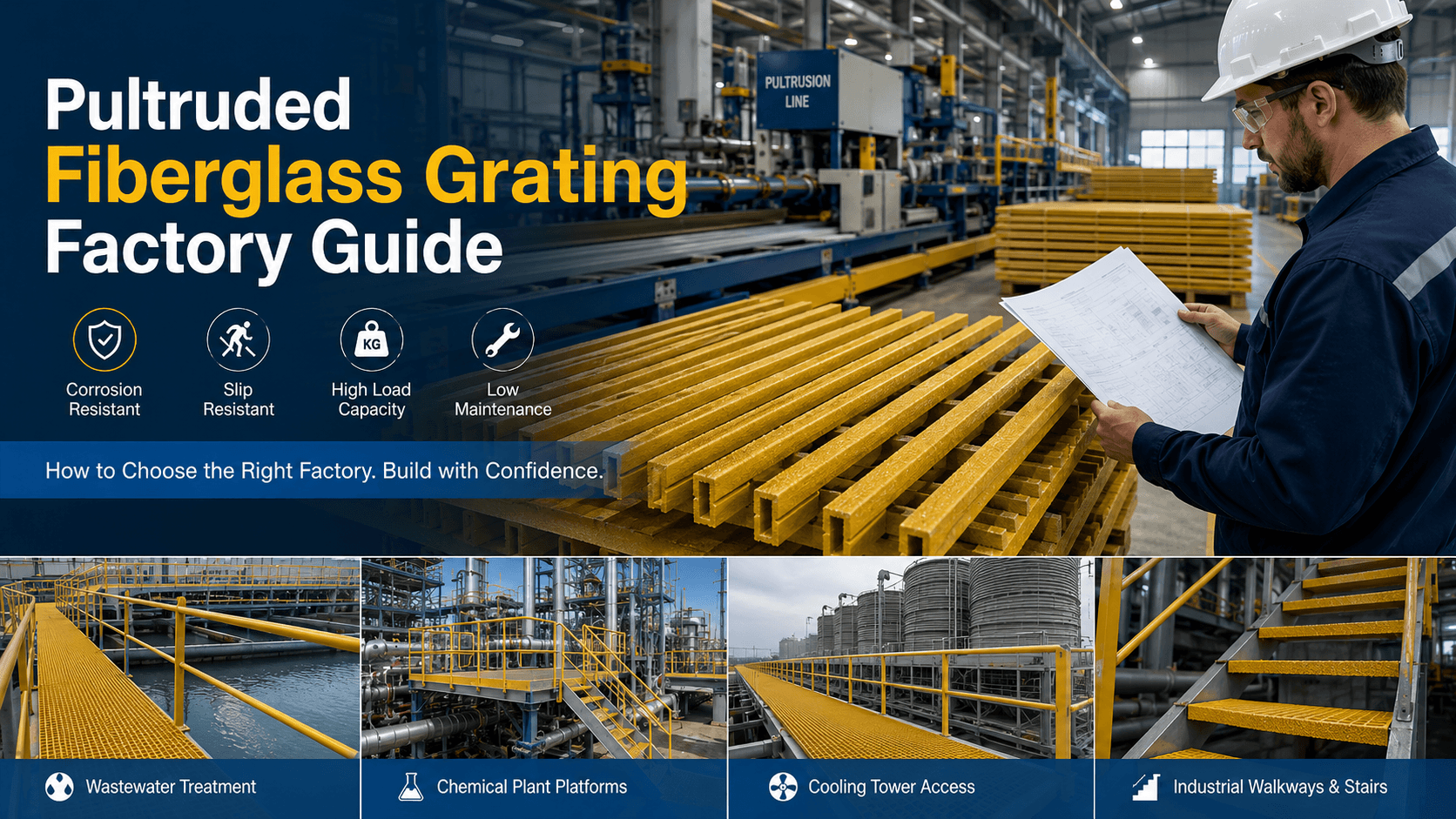
Choosing a pultruded fiberglass grating factory is not only a price decision. For industrial platforms, walkways, stair treads, cooling tower access routes, wastewater facilities, and chemical plant structures, the factory behind the product can affect safety, installation efficiency, corrosion resistance, and long term maintenance cost.
Pultruded fiberglass grating is often selected when buyers need strong directional load performance, lightweight handling, non conductive properties, and resistance to harsh service environments. A capable factory should understand pultrusion capability, resin selection, bearing bar design, load and span requirements, surface finish, fabrication, quality control, packaging, and bulk project coordination.
This guide explains what a pultruded fiberglass grating factory does, how buyers can evaluate supplier capability, and what information procurement teams should prepare before requesting a quote.
pultruded fiberglass grating factory
What Is a Pultruded Fiberglass Grating Factory?
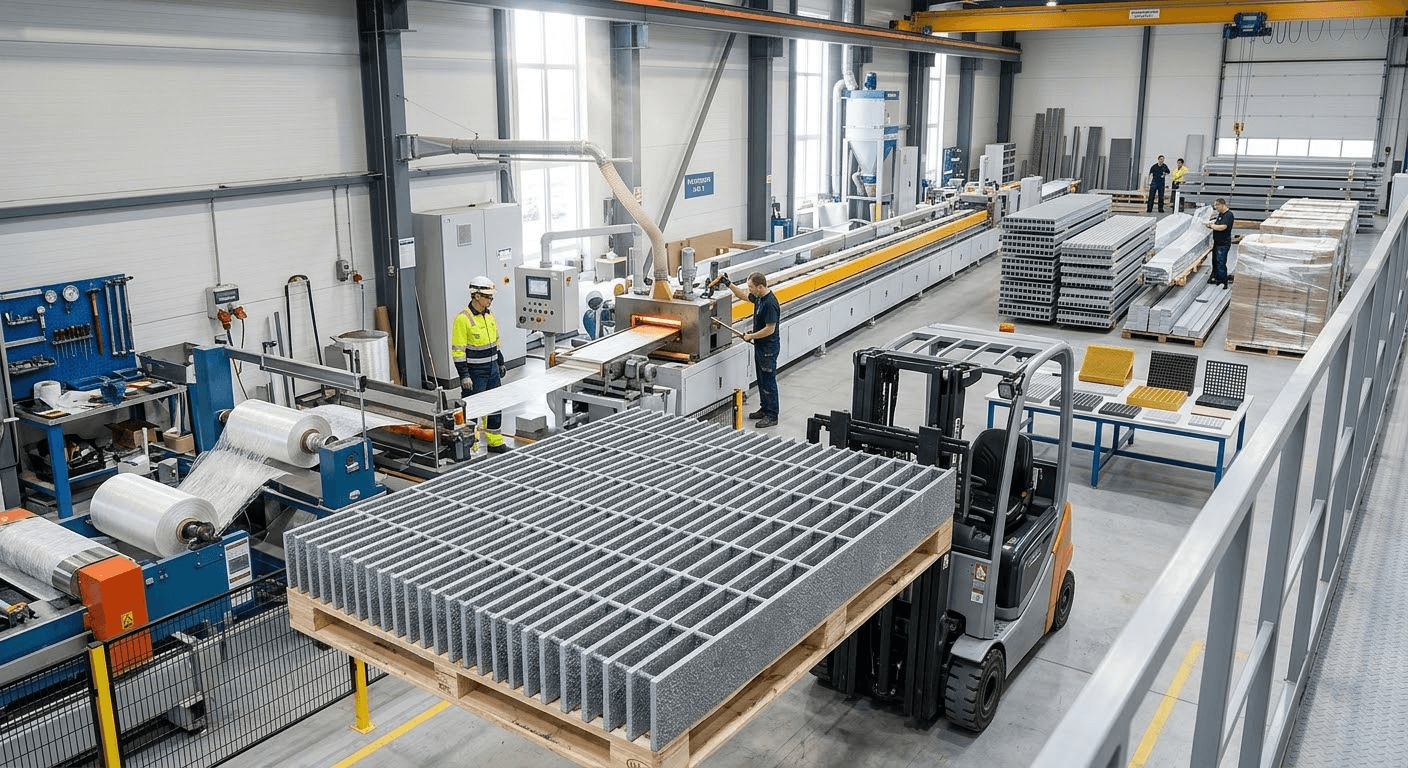
A pultruded fiberglass grating factory manufactures FRP grating panels using pultruded bearing bars and cross rods. The process typically starts with continuous fiberglass reinforcement and resin, which are pulled through a heated die to form consistent profiles. These profiles are then assembled into grating panels for industrial platforms, walkways, stair treads, equipment access areas, and structural flooring.
Unlike a simple trading company, a capable factory should understand how profile geometry, resin system, bearing bar direction, cross rod spacing, surface finish, and fabrication affect field performance. This matters because pultruded grating is commonly used where load, span, corrosion exposure, and safety requirements are clearly defined.
What does a pultruded fiberglass grating factory produce?
A pultruded fiberglass grating factory produces FRP grating panels made from pultruded bearing bars and cross rods. These panels are used for industrial platforms, walkways, stair treads, chemical plant access routes, wastewater facilities, cooling tower service areas, marine structures, and equipment access systems.
For grating buyers, the most relevant output is a panel that matches the project’s load, span, surface, resin, and fabrication requirements. Factory capability should be evaluated by the actual project need, not by product photos alone.
Why Factory Selection Matters for Industrial Grating Projects
After defining the factory role, buyers need to know why factory selection changes project outcomes. Pultruded grating looks simple from the outside, but small specification differences can affect installation, performance, and maintenance.
Load, Span, and Bearing Direction
Pultruded fiberglass grating is strongest in the bearing bar direction. Engineers should confirm support spacing, expected live load, concentrated load, deflection expectation, and panel orientation before approval.
In field installations, one common problem occurs when the panel layout does not match the bearing direction. In an anonymized chemical plant walkway project, the buyer avoided rework by confirming bearing direction, support span, gritted walking surface, clip layout, and chemical exposure before production. The factory adjusted the panel layout and resin recommendation before cutting, which helped reduce field modification.
Resin System and Corrosion Environment
Pultruded grating is frequently used in chemical plants, wastewater facilities, marine access areas, cooling towers, and industrial sites where metal corrosion is a concern. In these environments, resin selection becomes a key specification.
Buyers should describe chemical exposure, moisture level, UV exposure, temperature range, cleaning agents, saltwater exposure, and whether the grating will be installed indoors or outdoors. FRP grating performance depends on resin selection, support design, installation method, fastener compatibility, exposure level, cleaning routine, and project specific load verification.
Surface Finish and Worker Safety
Pultruded fiberglass grating can be supplied with gritted or textured surfaces for better traction on wet platforms, outdoor walkways, stair treads, and maintenance routes. Surface finish affects traction, cleaning, wear, and worker movement, so buyers should define the risk level before production.
How to Evaluate a Pultruded Fiberglass Grating Factory
Once buyers know the technical risks, they can evaluate factories with a structured checklist. A good supplier should be able to answer more than basic questions about price and delivery.
The table below combines factory evaluation points with the RFQ information buyers should prepare:
| Evaluation Item | What Buyers Should Check or Provide | Why It Matters |
|---|---|---|
| Pultrusion capability | Bearing bar profiles, consistency, capacity | Supports structural performance and repeat orders |
| Engineering support | Application, span, load, deflection target | Helps match grating to project conditions |
| Resin selection | Chemical, UV, moisture, fire, or marine exposure | Matches grating to service environment |
| Surface finish | Gritted, textured, covered, or other finish | Affects traction and cleaning |
| Fabrication | Panel dimensions, cutouts, drilling, openings | Reduces site work |
| Packaging and logistics | Quantity, labels, pallets, destination | Supports bulk delivery and repeat orders |
How can buyers verify factory capability before ordering?
Buyers can verify factory capability by reviewing production process, profile options, resin selection support, grating specifications, fabrication services, quality control steps, packaging methods, and project communication. A reliable factory should help confirm load, span, surface finish, resin system, panel size, cutting needs, drawings, and delivery requirements before production.
In an anonymized platform replacement project, the purchasing team first requested only “pultruded grating price.” After technical review, the factory asked for support span, pedestrian load, chemical exposure, stair tread requirements, and drawings. The revised quotation included gritted panels, cut openings, clips, and labeled packaging by installation area.
Pultruded vs Molded Fiberglass Grating Factory Capabilities
After evaluating general factory capability, buyers should also understand whether the supplier can explain the difference between pultruded and molded grating. Many projects include both types, and choosing the wrong one can create unnecessary cost or performance issues.
The table below compares the two common FRP grating options from a factory capability perspective:
| Comparison Item | Pultruded Grating | Molded Grating |
|---|---|---|
| Structure | Bearing bars with cross rods | One piece molded grid |
| Best use | Longer spans, platforms, walkways | Wet floors, drainage areas, chemical zones |
| Design focus | Bearing direction, stiffness, span | Mesh size, drainage, multi directional support |
| Surface options | Gritted or textured surface | Concave, gritted, covered surface |
| Factory capability to check | Profile consistency and panel assembly | Mold size, mesh options, resin control |
When should buyers choose pultruded grating over molded grating?
Buyers should choose pultruded grating when the project needs longer spans, stronger bearing direction performance, or stiffer platform panels. Molded grating is often better for wet floors, drainage areas, chemical zones, and applications requiring more balanced multi directional support.
A facility may use pultruded grating on elevated walkways and molded grating around wet floor areas. The best supplier should help buyers compare both options based on load, span, drainage, resin system, and installation layout.
pultruded fiberglass grating factory 2
Key Questions to Ask Before Ordering
With the factory type and grating type clarified, buyers should ask practical questions before issuing a purchase order. These questions make the quotation more accurate and reduce downstream changes.
Can the factory support custom panel size and cutting?
Industrial grating projects often need custom panel sizes, cutouts, drilling, edge treatment, and installation clips. A factory that supports fabrication can reduce field cutting and help panels arrive closer to the final installation layout.
Can the factory recommend resin based on exposure?
Resin selection should be based on real exposure conditions. Buyers should not request only “standard FRP grating” when the project involves chemical splash, wastewater gases, saltwater, outdoor UV, or cleaning chemicals.
Can the factory support bulk packaging and repeat orders?
Bulk grating orders need consistent panel dimensions, clear labeling, secure pallets, and packaging that supports handling during long distance shipment. Buyers should discuss packaging quantity, pallet size, labels, shipping destination, inspection documents, and reorder references before production.
Common Applications for Pultruded Fiberglass Grating
Factory selection should always be tied to the final application. Pultruded grating is commonly used where corrosion resistance, lightweight handling, and structural access performance are required.
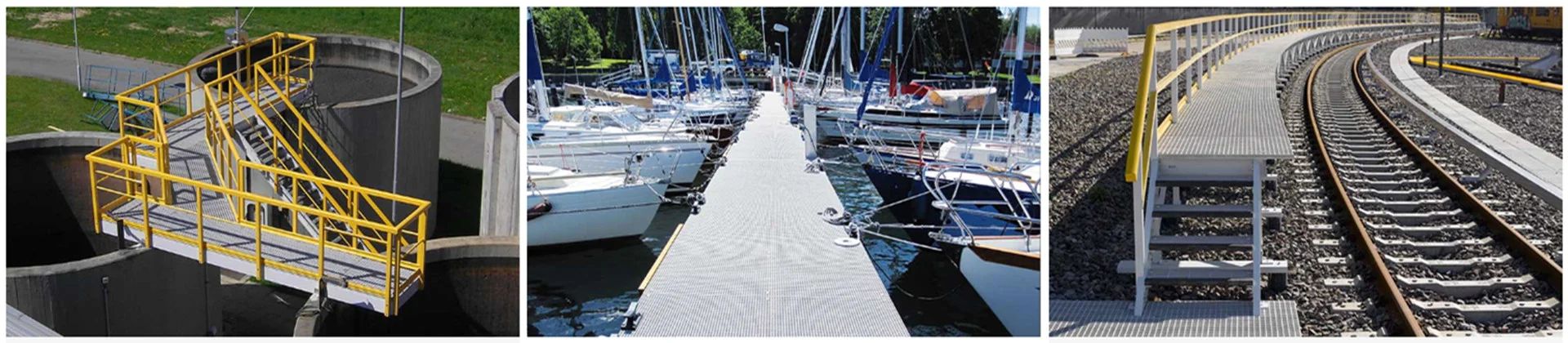
Typical applications include industrial platforms, chemical plant walkways, wastewater service platforms, cooling tower access routes, marine docks, stair treads, equipment access platforms, and utility facilities. A strong factory can connect these application conditions to the correct resin, surface, panel layout, and fabrication plan.
Source Pultruded Fiberglass Grating from Unicomposite
For procurement teams, supplier selection affects specification support, production consistency, fabrication accuracy, delivery planning, and repeat industrial orders.
Unicomposite Technology Co., Ltd is a professional FRP and GRP composite manufacturer based in Nanjing, China. The company has ISO 9001 certification, an 18,000 square meter production facility, and manufacturing capabilities that include pultrusion, pulwinding, SMC/BMC molding, hand lay-up, and vacuum infusion.
For fiberglass grating buyers, these capabilities support consistent bearing bar profiles, resin matching, custom cutting and drilling, molded or pultruded product selection, installation accessory coordination, and export packaging for bulk industrial projects.
A practical inquiry should include application, support span, load requirement, preferred grating type, panel dimensions, resin needs, surface finish, drawings, cutting requirements, quantity, packaging, and destination.
Conclusion
A pultruded fiberglass grating factory should be evaluated by manufacturing capability, engineering support, resin selection, surface finish options, fabrication services, quality control, packaging, and communication, not price alone.
The main takeaways are clear. Pultruded grating fits longer spans and directional load needs. Molded grating may fit wet floors and drainage areas better. Resin, fabrication, clips, and packaging should match the project conditions.
For industrial platforms, walkways, stair treads, cooling towers, wastewater facilities, and chemical plants, the right factory partner can help buyers turn project requirements into reliable FRP grating specifications.
[Contact Unicomposite for a custom fiberglass grating quote →]


