 info@unicomposite.com


Introduction
A molded fiberglass grating order can fail before it reaches the jobsite. The issue is usually not the word “grating.” It is the missing specification behind it: resin system, mesh size, panel thickness, support span, surface finish, cutting tolerance, clip type, packaging, or delivery schedule.
For engineers, procurement managers, and operations teams, choosing a molded fiberglass grating manufacturer is a technical sourcing decision. The right partner helps buyers match FRP grating to corrosion exposure, load requirements, installation layout, and long-term maintenance expectations. The wrong partner may only quote a square-meter price.
This guide explains how buyers can evaluate manufacturer capability, compare suppliers, prepare RFQ details, identify red flags, and source custom molded FRP grating for industrial projects.

molded fiberglass grating manufacturer guide
What Does a Molded Fiberglass Grating Manufacturer Do?
A molded fiberglass grating manufacturer produces FRP grating panels by placing fiberglass reinforcement into molds, saturating the structure with resin, and curing it into a grid panel. Common specification points include panel size, mesh size, thickness, resin system, color, surface finish, fabrication, and packaging.
Experienced buyers usually start with application conditions before discussing price. A wastewater trench cover, marine dock panel, and chemical plant platform may all use FRP grating, but each one may require a different resin, surface texture, span limit, and installation plan.
Core Manufacturing Responsibilities
A capable manufacturer should control both the panel and the project details around it. That includes molded panel production, custom sizes, cutting, drilling, clip supply, edge finishing, inspection, labeling, export packaging, and repeat-order consistency.
For example, a 38 mm molded grating panel may suit many platform and walkway applications, but final selection still depends on mesh type, support span, expected load, chemical exposure, and surface requirement. Thickness alone does not define performance.
How Is Molded Fiberglass Grating Used in Industrial Projects?
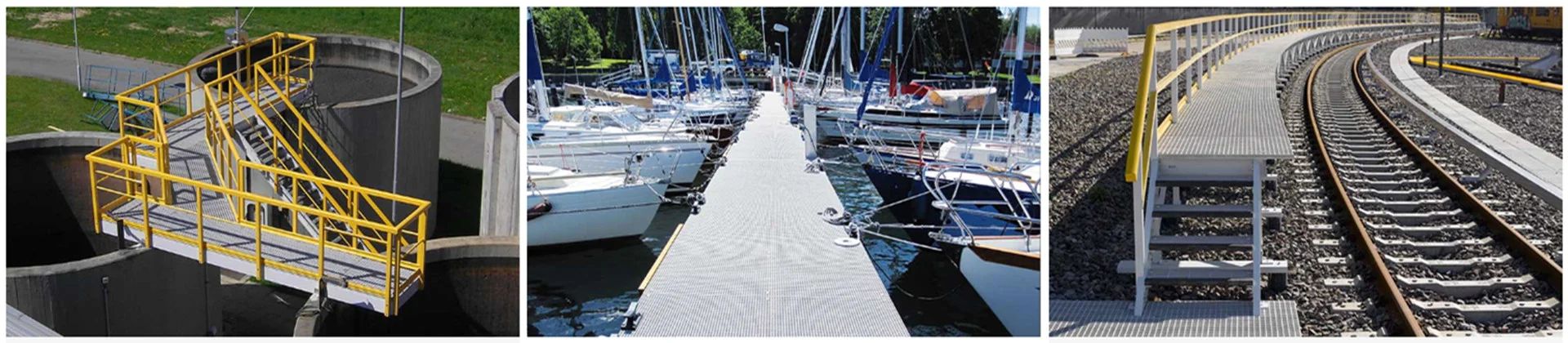
Molded fiberglass grating is used in wastewater plants, chemical processing areas, marine docks, trench covers, platforms, stair treads, cooling towers, utility facilities, and food processing environments. These projects often need corrosion resistance, drainage, slip resistance, dielectric properties, and lower maintenance than metal alternatives.
Performance still depends on the full system. Resin selection, support design, cleaning process, chemical concentration, UV exposure, installation quality, and inspection frequency all affect long-term results.
What should a molded fiberglass grating manufacturer control?
A molded fiberglass grating manufacturer should control panel dimensions, mesh structure, thickness, resin system, surface finish, color, fabrication, quality inspection, packaging, and repeat-order consistency. These controls help reduce installation gaps, wrong chemical resistance, site cutting, shipment damage, and mismatch between ordered panels and real project requirements.
Poor control creates avoidable cost. A panel cut 10 mm short may not fit the support layout. A wrong resin system may perform poorly in chemical exposure. Weak export packaging may lead to damaged corners or missing clips on arrival.
Manufacturer vs Supplier: What Is the Difference?
Not every seller plays the same role. Some companies manufacture directly, some resell stock panels, and some coordinate sourcing through trading networks. Each option can work when matched to the project risk.
The table below compares common provider types for molded fiberglass grating procurement:
| Provider Type | Main Role | Buyer Advantage | Buyer Risk | Best Fit |
|---|---|---|---|---|
| Manufacturer | Produces FRP grating in-house | Better control over specs, quality, customization | Capacity and process must be verified | Custom and bulk projects |
| Supplier | Resells or distributes panels | Faster access to standard stock | Limited custom control | Standard replacement orders |
| Trading company | Coordinates sourcing and export | Flexible sourcing options | Quality consistency may vary | Price comparison or mixed sourcing |
| Custom manufacturer | Produces project-specific panels | Better fit for drawings and engineered needs | Requires clear RFQ details | Complex industrial projects |
When a Supplier May Be Enough
A supplier may be enough when buyers need standard panels, urgent replacements, or low-customization products. Stock-based sourcing can reduce lead time when the required panel size, thickness, surface finish, and resin system are already available.
The limitation appears when projects require cut-to-size panels, custom mesh, special resin, private labels, clip kits, or repeat-order consistency. In those cases, a direct manufacturer gives buyers more technical control.
When a Direct Manufacturer Is Better
A direct manufacturer is better when buyers need custom dimensions, resin matching, load review, fabrication support, packaging control, or long-term repeat procurement. Manufacturing control helps reduce surprises between approved samples, production batches, and future reorders.
This matters most when the grating must match drawings, support spacing, or corrosive service conditions.
Key Factors When Choosing a Molded Fiberglass Grating Manufacturer
After identifying the provider type, buyers should evaluate technical capability. A strong molded grating manufacturer should ask detailed questions before quoting, because price alone cannot confirm suitability.
Manufacturing Capability
Buyers should check whether the factory supports molded grating, pultruded grating, covered grating, custom panel sizes, cutting, drilling, clips, and edge finishing. Many industrial projects need panels to arrive ready for installation.
In one anonymized platform replacement project, the buyer sent drawings, support span, panel layout, and clip requirements before production. The manufacturer pre-cut panels, grouped them by installation area, packed clips with matching labels, and reduced jobsite cutting during installation.
Resin System and Application Matching
Resin selection should match exposure. General corrosion environments may use a standard industrial resin option, while stronger chemical exposure may require a chemical-resistant resin. Fire-retardant, marine, UV, food processing, or utility environments may need additional specification checks.
No resin system fits every environment. Final selection depends on chemical type, concentration, temperature, moisture, UV exposure, cleaning process, fire requirements, and local project conditions.
Load, Span, and Panel Design
Panel design should consider thickness, mesh size, support span, uniform load, point load, deflection expectation, and installation layout. Buyers should provide drawings or support spacing before asking for final recommendations.
A thicker panel does not automatically solve every load case. Span, support direction, mesh design, and load distribution all affect performance.
Surface Finish and Safety Requirements
Surface finish affects walking safety, cleaning, drainage, and maintenance. Common options include gritted surface, concave surface, smooth top, covered top, anti-slip finish, and colored surfaces.
Gritted surfaces often fit wet walkways and platforms. Concave surfaces can support drainage and light foot traffic. Covered grating can fit closed walking surfaces, splash control, odor control, or areas where smaller items must not fall through the mesh.
How do buyers match resin and surface finish to the application?
Buyers should match resin system to chemical, moisture, UV, fire, or marine exposure, then match surface finish to slip resistance, drainage, cleaning, and foot-traffic needs. A chemical trench, outdoor dock, food processing floor, and utility platform may all require different resin and surface choices.
This is where a manufacturer’s application questions matter. A seller that quotes without asking about environment, load, and surface condition may miss the most important part of the selection process.
Manufacturer Evaluation Checklist
A structured checklist helps procurement teams compare manufacturers beyond price. It also gives engineers and purchasing teams a shared framework for technical review.
The table below summarizes the main evaluation items buyers should confirm:
| Evaluation Item | What to Check | Why It Matters | Buyer Action |
|---|---|---|---|
| Product range | Molded, pultruded, covered grating | Matches different applications | Ask for product options |
| Custom options | Size, thickness, mesh, resin, color | Supports project-specific needs | Share drawings and specs |
| Quality control | Inspection process, batch consistency | Reduces variation risk | Request QC details |
| Engineering support | Load, span, application review | Helps avoid wrong selection | Provide site conditions |
| Fabrication | Cutting, drilling, clips, edge finishing | Reduces site work | Confirm fabrication list |
| Packaging | Bundles, pallets, labels | Improves delivery and handling | Define packing needs |
| Lead time | Stock and custom schedule | Supports project planning | Confirm timeline |
| Export experience | Documentation and shipment planning | Reduces logistics issues | Share destination details |
| Sample support | Sample panel or approved reference | Reduces bulk-order risk | Request sample approval |
| Repeat-order control | Stable spec, color, packing, labels | Supports long-term procurement | Keep approved order files |
Quality Control and Batch Consistency
Batch consistency matters for repeated orders, installation fit, color matching, and long-term maintenance. Buyers should confirm how the manufacturer checks panel dimensions, surface finish, visual defects, cut quality, edge finishing, and packaging before shipment.
For large projects, buyers may request photos, sample panels, packing images, or pre-shipment inspection. These steps help prevent small problems from becoming expensive site delays.
Engineering Support and Communication
Good manufacturers ask questions before quoting. They want to know application, environment, load, span, surface finish, fabrication needs, quantity, packaging, and delivery schedule.
Red flags include instant pricing without application details, unclear resin systems, vague lead times, and limited answers about customization. Communication quality often predicts project quality.
What Information Should Buyers Send Before Asking for a Quote?
A clear RFQ shortens the quotation cycle and improves accuracy. Buyers do not need perfect engineering documents, but they should provide enough information for the manufacturer to recommend the right grating.
The table below shows practical RFQ details for molded fiberglass grating:
| RFQ Item | Example Input | Why It Helps the Manufacturer |
|---|---|---|
| Application | Wastewater platform, chemical trench, dock walkway | Defines exposure and use |
| Panel size | Length × width | Supports sizing and cutting |
| Thickness | 25 mm, 38 mm, 50 mm, or custom | Affects load and span |
| Mesh size | Square mesh or custom opening | Affects drainage and support |
| Resin system | General corrosion, chemical, fire-retardant | Matches environment |
| Surface finish | Gritted, concave, covered | Matches safety and cleaning needs |
| Load requirement | Uniform or point load | Supports design review |
| Support span | Support spacing or drawings | Reduces deflection risk |
| Fabrication | Cutting, drilling, clips | Reduces site work |
| Quantity | Panels, square meters, or project batch | Supports pricing and planning |
| Destination | Country, port, warehouse, project site | Supports logistics |
Why Drawings and Site Details Matter
Drawings, support layouts, installation photos, or replacement panel dimensions reduce ambiguity. In one anonymized replacement project, unclear panel dimensions caused extra field cutting and delayed installation because the original quote did not include support spacing or final cut sizes.
Clear drawings also help manufacturers recommend clip types, cutting plans, packaging format, and shipment grouping.
What should buyers send for an accurate molded fiberglass grating quote?
Buyers should send application, panel size, thickness, mesh size, resin system, surface finish, load requirement, support span, fabrication needs, quantity, drawings, packaging, destination, and target delivery schedule. These details help the manufacturer quote the right product instead of guessing from a generic grating request.
For repeat orders, buyers should also include previous purchase records, approved drawings, color requirements, label format, pallet requirements, and any sample approval notes.
Common Applications for Molded Fiberglass Grating
Once the RFQ is clear, the manufacturer can connect the application to the right specification. Molded fiberglass grating serves many industries, but each environment creates different risks.
Wastewater and Chemical Processing Facilities
Wastewater and chemical facilities often require corrosion resistance, drainage, and reduced maintenance in wet or chemically exposed spaces. FRP grating can support walkways, platforms, trenches, and access areas when the resin and support design match the service conditions.
Buyers should define chemicals, cleaning processes, splash risk, concentration, and temperature before final selection.
Marine Docks, Platforms, and Outdoor Walkways
Marine and outdoor projects face moisture, salt exposure, UV, and slip risk. Molded FRP grating can help reduce rust-related maintenance while supporting drainage and lighter handling.
Outdoor performance depends on resin system, UV exposure, surface finish, installation, inspection frequency, and mechanical wear. Buyers should avoid relying on a generic “outdoor grade” label without checking the actual specification.
Utility, Power, and Industrial Access Areas
Utility and power applications may value dielectric properties, corrosion resistance, and maintenance access. Molded fiberglass grating can support trench covers, elevated walkways, access platforms, and equipment areas.
These projects often require clear load information, support layout, surface finish, and safety review before ordering.

molded fiberglass grating manufacturer
Red Flags When Choosing a Fiberglass Grating Supplier
A low price may look attractive, but procurement risk often hides in missing details. Buyers should watch for warning signs before committing to bulk orders.
Red Flag 1: Quoting Without Application Details
If a supplier quotes without asking about environment, load, span, resin, or surface finish, the quote may not match the actual project. This can lead to wrong resin systems, unsuitable thickness, poor slip resistance, or excessive deflection.
Red Flag 2: No Clear Customization or Fabrication Support
Some suppliers only provide standard panels. That may work for stock replacement, but it creates problems when buyers need cutting, drilling, edge finishing, clips, or packaging plans.
A project with many custom cuts should not depend entirely on jobsite fabrication unless the installation team has planned for labor, tools, and waste.
Red Flag 3: Unclear Lead Time, Packaging, or Repeat-Order Control
Lead time and packaging affect project schedules. Unclear pallet size, missing labels, weak corner protection, or inconsistent bundle counts can delay receiving and installation.
For repeat orders, buyers should confirm whether the same specification, resin, color, surface finish, and packaging can be maintained.
Why Work with a Custom FRP Grating Manufacturer?
For engineered or bulk projects, a custom manufacturer can reduce uncertainty. Direct manufacturing supports better control over panel size, resin selection, surface finish, color, fabrication, documentation, and shipment planning.
Better Specification Control
Custom manufacturing gives buyers more control over dimensions, mesh, resin, fabrication, and packaging. This can reduce field labor and installation surprises when buyers provide drawings and application details early.
When panels arrive cut, labeled, and grouped by area, installers can move faster and make fewer site adjustments.
Better Fit for Bulk and Repeat Orders
Bulk buyers need stable SKUs, repeatable packaging, predictable lead times, and clear communication. They may also require cartons, pallets, private labels, clip kits, inspection photos, or export documentation.
A manufacturer that understands repeat-order control can help procurement teams avoid seasonal specification drift and inconsistent replacement panels.
Where Unicomposite Fits
Unicomposite Technology Co., Ltd. is an ISO 9001 certified FRP and GRP composite manufacturer based in Nanjing, China, with an 18,000-square-meter facility. The company manufactures standard and custom composite products for global B2B buyers.
Relevant capabilities include molded FRP grating, pultruded profiles, pulwinding, SMC/BMC molding, hand lay-up, vacuum infusion, cutting, custom composite components, and export supply. For molded grating buyers, these capabilities can support consistent panel sizing, fabrication support, sample confirmation, export packing, and repeat-order reliability.
Source Custom Molded Fiberglass Grating from Unicomposite
A good molded fiberglass grating manufacturer should help buyers turn project conditions into a usable specification. Unicomposite supports B2B buyers who need custom FRP grating for industrial, utility, marine, wastewater, and infrastructure applications.
Custom Options for B2B Buyers
Custom options can include panel size, mesh size, thickness, resin system, color, surface finish, covered top, cutting, drilling, clips, packaging, labeling, and bulk quantity.
Buyers should send application details and drawings for faster specification review. Even a basic sketch or photo can help clarify panel layout, support spacing, and fabrication needs.
Procurement and Quality Checks Before Ordering
Before ordering, buyers should confirm resin, surface, load, span, fabrication, packaging, lead time, sample needs, and destination. For larger orders, sample approval and pre-shipment checks can reduce risk before mass production.
Clear documentation improves quote accuracy and repeatability. It also helps the manufacturer maintain the same dimensions, color, packing format, and labeling in future orders.
Conclusion
A molded fiberglass grating manufacturer should support more than basic product supply. Buyers should evaluate technical capability, resin matching, load and span support, fabrication, quality control, packaging, communication, and repeat-order consistency.
Manufacturer vs supplier choice depends on customization level, project risk, timeline, and long-term procurement needs. A complete RFQ helps reduce quote delays, specification errors, and installation surprises.
For custom panels, bulk supply, or engineered applications, buyers should prepare drawings, project conditions, load requirements, resin preferences, surface requirements, and packaging details before requesting a quote.
[Contact Unicomposite for a custom molded fiberglass grating quote →]


