 info@unicomposite.com


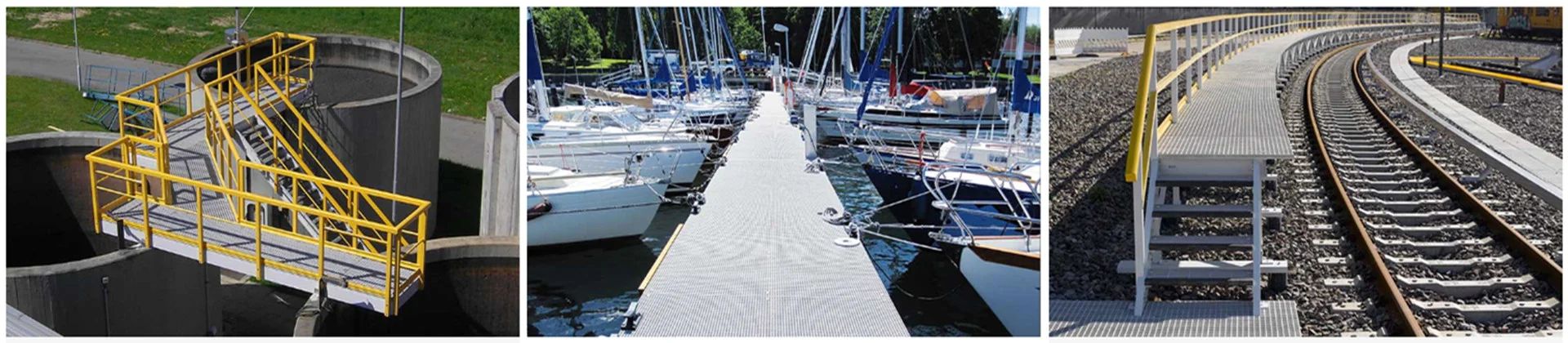
Introduction
Rooftop access areas face harsher service conditions than many project teams expect. Moisture, UV exposure, temperature swings, chemical fumes, and repeated maintenance traffic can all shorten the life of conventional roof deck materials.
If you manage industrial, commercial, utility, or infrastructure assets, the question is practical: how do you create a safe rooftop walking surface without adding unnecessary weight, corrosion risk, or recurring maintenance work?
A fiberglass roof deck gives you an FRP option for rooftop walkways, equipment access platforms, maintenance paths, and light structural surfaces. This article explains where FRP roof deck systems fit, what benefits they offer, how they compare with steel, aluminum, and wood, and what details you should prepare before requesting a quote.
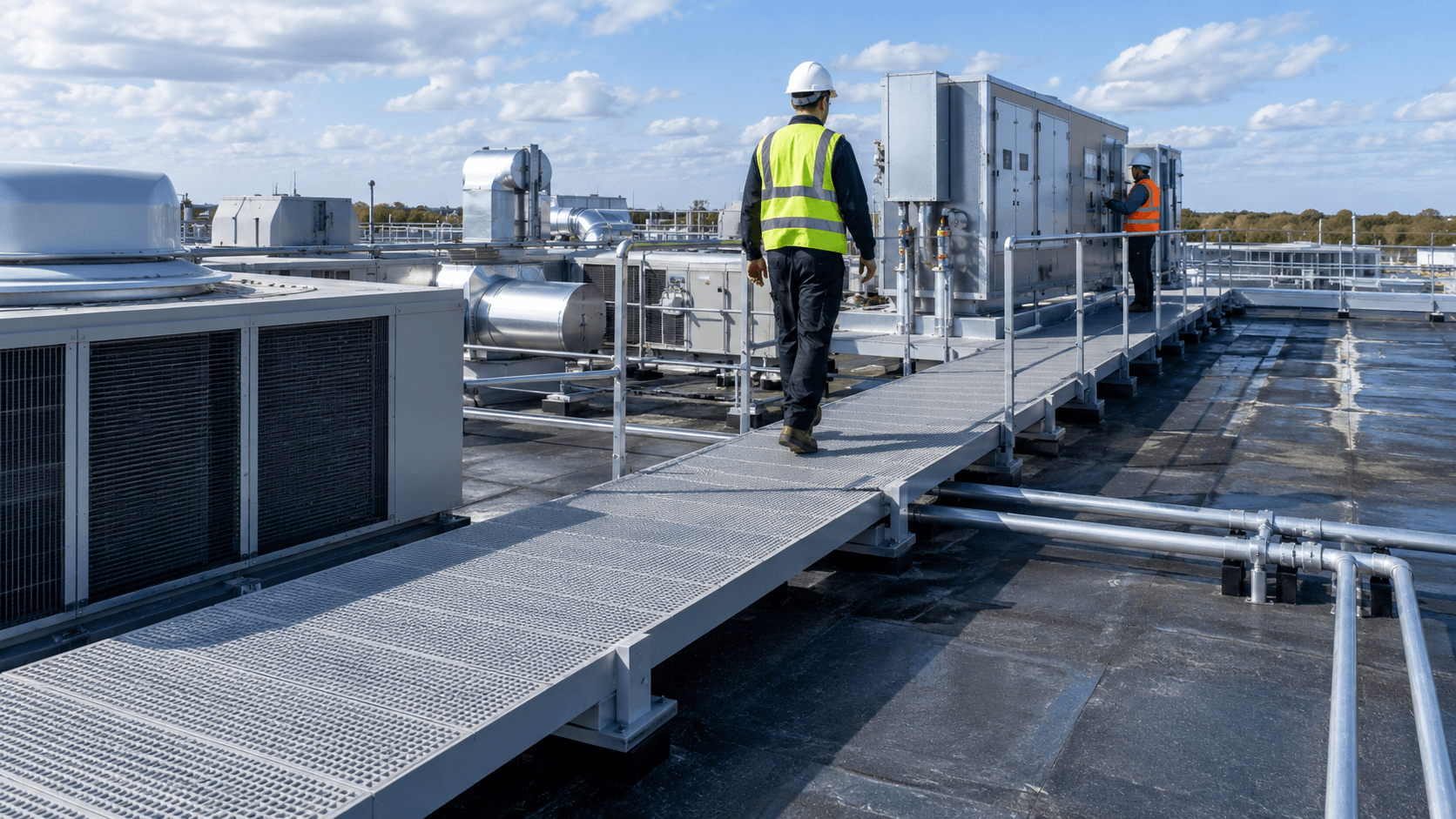
benefits of a fiberglass roof deck
What Is a Fiberglass Roof Deck?
A fiberglass roof deck is a decking or planking system made from fiberglass reinforced plastic, commonly called FRP or GRP. It combines glass fiber reinforcement with a resin system to create a lightweight, corrosion-resistant material for roof access and platform applications.
You will often see FRP roof decks used around rooftop HVAC systems, ventilation units, utility lines, cooling equipment, inspection routes, and corrosive rooftop environments. In these areas, the goal is usually safe access, predictable service life, and reduced maintenance compared with materials that may rust, rot, or require frequent coating.
How FRP Decking and Planking Are Used on Rooftops
In field installations, engineers often select FRP decking when a roof needs a clearly defined walking surface with less added weight than steel. A typical example is a maintenance walkway around rooftop mechanical equipment where technicians need safe access during inspection, cleaning, and repair.
FRP planking can be supplied in standard sections or fabricated to match project drawings. Before choosing a profile, you should confirm span, support spacing, expected load, surface type, fastening method, and exposure conditions.
What Is the Difference Between Fiberglass Roof Deck, FRP Roof Deck, and Fiberglass Roof Decking?
Fiberglass roof deck, FRP roof deck, and fiberglass roof decking usually describe similar rooftop decking applications made from fiberglass reinforced plastic. The terms may vary by buyer, region, or project document, while the technical evaluation should focus on load, span, corrosion exposure, surface safety, and fabrication needs.
For procurement clarity, your RFQ should include both the product term and the intended use. For example, “FRP roof deck for rooftop maintenance walkway” gives a supplier more useful information than “fiberglass deck” alone.
The terminology may differ, while the buying decision should stay grounded in application conditions and specification details.
Key Benefits of Fiberglass Roof Decks
After defining the product category, the next step is understanding why FRP can outperform conventional materials in selected rooftop environments.
A fiberglass roof deck works best when corrosion resistance, weight reduction, electrical insulation, and low maintenance matter to long-term performance. These benefits are especially relevant for utilities, industrial plants, coastal facilities, wastewater sites, and commercial rooftop access projects.
Corrosion Resistance for Harsh Rooftop Environments
Rooftops may be exposed to rain, standing moisture, heat, airborne chemicals, and salt air. In these conditions, unprotected steel can corrode, wood can decay, and coating systems can demand recurring inspection.
FRP materials resist many common corrosive conditions because the resin matrix helps protect the glass fiber reinforcement. The exact performance depends on the selected resin, UV exposure, chemical environment, and maintenance practices, so you should match the material system to the site conditions before ordering.
Lightweight Structure Compared With Metal Alternatives
FRP decking is typically lighter than steel, which can simplify handling, lifting, and installation. This matters on retrofit projects where the existing roof structure may have limited tolerance for added dead load.
Lower weight can also reduce labor during installation. Crews can often move FRP planks and panels more easily than heavier metal sections, especially when access is limited.
Low Maintenance and Longer Service Potential
FRP does not require the same painting or rust-prevention routine as carbon steel. It also avoids common wood problems such as rot, splintering, and moisture absorption.
That does not mean FRP requires no inspection. You should still check fasteners, supports, surface wear, and any damaged sections as part of normal maintenance. The advantage is that FRP can reduce corrosion-driven repair cycles in suitable environments.
Slip-Resistant Surface Options for Safe Access
Rooftop access surfaces must support safe movement during inspection and maintenance. FRP roof decks can be supplied with textured, grit, or anti-slip surfaces depending on the project.
This is useful near rooftop equipment, wet zones, cooling systems, and outdoor walkways. Surface choice should reflect the real walking conditions, cleaning method, and safety requirements of the site.
The table below summarizes the practical value of common FRP roof deck benefits:
| Benefit | Practical Value for You | Typical Application Impact |
|---|---|---|
| Corrosion resistance | Reduces rust and decay concerns | Useful in coastal, chemical, and wet rooftop environments |
| Lightweight structure | Easier handling and lower added load | Helpful for retrofits and elevated access paths |
| Low maintenance | Reduces coating and replacement work | Supports lower lifecycle maintenance effort |
| Slip-resistant surface | Improves walking safety | Useful for inspection paths and equipment access |
| Custom fabrication | Matches drawings and site constraints | Supports cut-to-size panels and special profiles |
These advantages make FRP worth considering when long-term durability and maintenance control matter as much as the initial purchase price.
Common Applications of FRP Roof Decking
Beyond material benefits, the application should drive the product choice. A light maintenance path may need a different profile from a rooftop platform that supports repeated service activity.
FRP roof decking is most effective when you define the site use before you request a quote.
Commercial Roof Access Walkways
Commercial buildings often need safe access routes around HVAC units, solar equipment, drainage systems, vents, and service areas. FRP decking can create a dedicated walkway that keeps maintenance teams on a predictable path.
A defined walkway can also reduce unnecessary foot traffic across roofing membranes. That helps protect the roof surface while making service routes easier to identify.
Industrial Rooftop Maintenance Platforms
Industrial sites may need rooftop platforms for equipment inspection, valve access, ductwork service, or process-related maintenance. In these areas, stable footing, corrosion resistance, and long-term durability become major selection factors.
FRP decking can work with FRP handrails, ladders, grating, and structural profiles when the project needs a more complete rooftop access system.
Chemical, Coastal, and Utility Environments
Chemical plants, wastewater facilities, coastal buildings, and utility sites often expose roof materials to harsh air conditions. Metal systems may require coatings or more frequent corrosion inspections in these environments.
An anonymized field scenario shows the decision logic. On a coastal commercial facility, a rooftop HVAC access route required repeated coating checks on metal walkways due to salt air exposure. The project team evaluated FRP decking to reduce corrosion-related maintenance concerns while keeping the access route lightweight and visible for service crews.
When Should You Choose a Structural Fiberglass Roof Deck?
You should consider a structural fiberglass roof deck when the rooftop surface must support repeated maintenance traffic, resist corrosion, reduce weight, and meet project-specific span or load needs. The final selection should be based on load data, support spacing, profile geometry, surface safety, and environmental exposure.
For example, a simple rooftop inspection path may only require planking for foot traffic. A raised platform around service equipment may require a more engineered FRP system with defined supports, fasteners, and load calculations.
Clear application details help your supplier recommend a roof deck that matches the actual duty of the site.
Structural Considerations Before Buying
Once you identify the application, the specification work becomes the most important step. A request that only says “fiberglass roof deck” can delay quoting because the supplier still needs load, span, size, surface, and exposure details.
A complete RFQ saves time and reduces the risk of ordering the wrong product.
Load Requirements
You should define whether the roof deck will support foot traffic, maintenance carts, equipment access, or heavier operational loads. Final load capacity depends on profile shape, thickness, span, support spacing, fastening method, and installation quality.
For engineering-led projects, provide design loads or drawings when available. For early-stage procurement, at least describe the service conditions and expected traffic.
Panel Size and Thickness
Dimensions influence shipping, installation speed, support layout, and cost. Longer spans may require thicker profiles, closer supports, or a different FRP product form.
Before placing a bulk order, confirm available widths, lengths, thicknesses, tolerances, and custom cutting options. This reduces site modification work and helps keep installation predictable.
Surface Type and Anti-Slip Design
A dry rooftop inspection route may require a different surface from a wet, oily, or chemical-exposed area. Texture, grit surface, drainage behavior, and cleanability all affect long-term usability.
You should also consider whether the walking surface must remain effective under rain, dust, chemical residue, or maintenance debris.
Custom Cutting, Drilling, and Fabrication
Many rooftop projects require cutouts, special lengths, pre-drilled holes, or fitted sections around equipment. A supplier with fabrication capability can reduce site labor and improve installation consistency.
Unicomposite Technology Co., Ltd, based in Nanjing, China, manufactures standard and custom FRP composite profiles and systems. Its capabilities include pultrusion, pulwinding, SMC/BMC molding, hand lay-up, and vacuum infusion, which allows you to source FRP decking, profiles, grating, handrails, ladders, and related components for project-based applications.
The table below shows the key specification details to prepare before requesting a quote:
| Specification Item | What You Should Provide | Why It Matters |
|---|---|---|
| Application | Walkway, platform, equipment access, or custom structure | Helps determine product type and profile strength |
| Load requirement | Foot traffic, carts, maintenance load, or project load data | Supports safer product selection |
| Dimensions | Length, width, thickness, and layout drawings | Reduces quoting errors and fabrication delays |
| Environment | Coastal, chemical, wet, UV-exposed, or indoor | Helps match resin and surface requirements |
| Surface preference | Smooth, textured, grit, or anti-slip | Improves safety and usability |
| Quantity | Trial order, project batch, or bulk supply | Affects pricing, production planning, and packaging |
A stronger specification gives both your engineering team and your supplier the same reference point.
Fiberglass Roof Deck vs Traditional Materials
Material comparison helps you avoid a decision based only on habit. Steel, aluminum, wood, and FRP can all work in the right context, depending on strength requirements, exposure, maintenance expectations, and budget.
For rooftop access applications, FRP is strongest when corrosion resistance, weight reduction, and low maintenance are priorities. Steel may still be the better choice for very high load-bearing structural needs.
Fiberglass vs Steel
Steel provides high strength and wide availability. In wet, coastal, or chemical environments, however, steel may require coatings, inspections, and corrosion management.
FRP can reduce corrosion concerns and lower handling weight for many rooftop access walkways and platforms. You should still verify the load design because steel may remain necessary for certain heavy structural conditions.
Fiberglass vs Wood
Wood may work for simple or temporary applications, but it can absorb moisture, rot, splinter, and degrade outdoors. These risks become more serious in industrial or frequently accessed rooftop areas.
Fiberglass roof decking gives you a more durable option when you need a stable walking surface with lower maintenance demands.
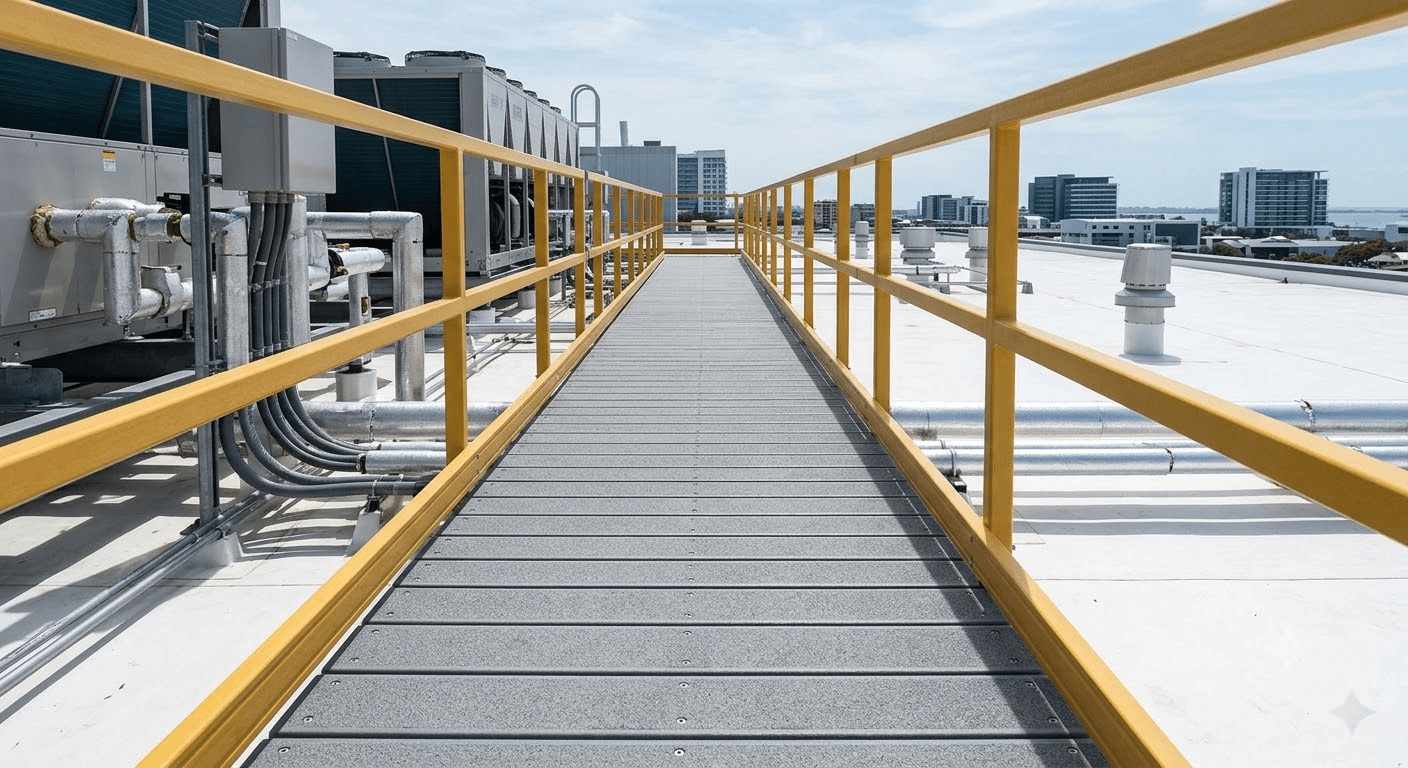
fiberglass roof deck
Fiberglass vs Aluminum
Aluminum is lightweight and corrosion-resistant in many conditions. It also conducts electricity, which may be a concern in some utility, power, or telecom environments.
FRP offers corrosion resistance, lightweight handling, and dielectric properties. That combination makes it attractive for electrical and utility-related settings where insulation performance matters.
The table below compares common roof deck material options and the checks you should make before buying:
| Material | Strength Profile | Corrosion Resistance | Weight | Best-Fit Use | Check Before Buying |
|---|---|---|---|---|---|
| FRP | Strong for many walkway and platform uses | Strong in many harsh environments | Lightweight | Corrosive rooftop access, utility zones, custom platforms | Confirm resin, span, load, surface, and support spacing |
| Steel | Very high | Depends on coating and environment | Heavy | Heavy-duty structural applications | Plan for corrosion control and added load |
| Aluminum | Moderate to high | Good in many conditions | Lightweight | Lightweight access areas | Check electrical conductivity and exposure limits |
| Wood | Moderate | Weak in wet or harsh conditions | Moderate | Temporary or low-demand applications | Check rot, moisture, fire, and maintenance risks |
This comparison helps you choose a material based on service conditions rather than initial price alone.
How to Choose a Fiberglass Roof Deck Supplier
After selecting the material direction, supplier capability becomes the next decision point. Roof deck projects often require more than product availability. You may need engineering communication, fabrication support, consistent quality, and bulk delivery planning.
This matters for OEMs, utilities, infrastructure contractors, and industrial buyers that need repeatable supply.
Pultruded FRP Production Capability
Pultrusion is commonly used to manufacture consistent FRP profiles with stable cross-sections. For roof decking and related structural profiles, pultrusion supports repeatable geometry and efficient production.
You should ask whether the supplier can produce standard sections and custom profiles according to your project needs. Consistency matters when multiple deck sections must align during installation.
Custom Size and Fabrication Support
A strong FRP supplier should help you define profile dimensions, cutting needs, drilling patterns, surface options, and packaging requirements.
For rooftop projects, custom fabrication can reduce field cutting and lower the risk of installation errors. It can also help you match FRP decking with grating, handrails, ladders, or structural profiles from the same supply chain.
Bulk Order and Project Supply Ability
Before placing a large order, confirm production capacity, lead time, packaging method, export experience, and quality management.
Unicomposite operates as an FRP/GRP composite manufacturer with ISO 9001 certification and an 18,000 square meter factory area. For projects that require roof decks together with FRP grating, handrail systems, structural profiles, cable trays, ladders, or custom composite parts, a multi-process manufacturer can simplify sourcing and technical coordination.
The right supplier should help you connect design intent, fabrication details, and delivery planning.
Request Custom Fiberglass Roof Decking Solutions
A fiberglass roof deck can support durable rooftop walkways, platforms, and access surfaces in commercial and industrial environments. The best results come from matching the FRP profile to the actual load, span, exposure, surface, and installation method.
Key takeaways:
- FRP roof decks are useful when corrosion resistance, lightweight handling, and lower maintenance matter.
- You should define application, load, dimensions, surface type, and environment before requesting pricing.
- Fiberglass can be a practical alternative to steel, wood, or aluminum for many rooftop access applications.
- Custom fabrication helps reduce installation time and supports project-specific layouts.
- A capable FRP manufacturer can support both standard decking and related composite systems.
Send your application, span, load requirement, surface preference, environment, quantity, and drawings to request a custom FRP roof deck recommendation.


