 info@unicomposite.com


Introduction
Many buyers start with one question: “How much does an FRP grating walkway cost?” A single online price cannot answer that well because walkway grating is specified by application, load, span, resin, surface, fabrication, quantity, packaging, and freight.
For engineers, procurement managers, utility buyers, chemical plant teams, wastewater operators, marine project teams, and OEM buyers, the real target is a reliable project cost. Unit price matters, yet total cost also includes maintenance, downtime, corrosion repair, installation handling, and replacement risk.
This guide explains the major cost drivers, how FRP compares with steel and aluminum grating, how buyers can estimate a practical budget, and what information suppliers need for an accurate quote.
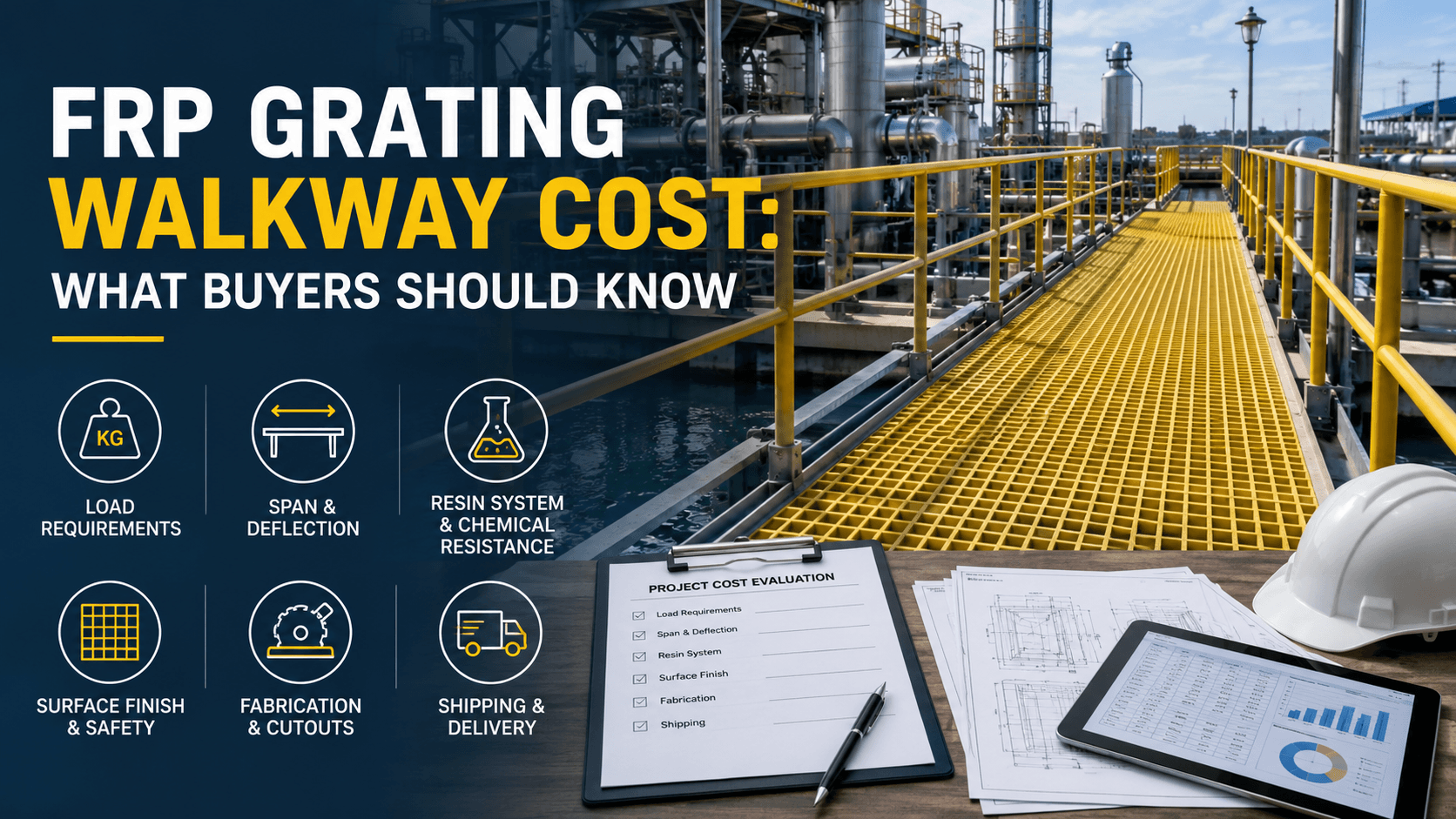
frp grating walkway cost
What Affects FRP Grating Walkway Cost?
Before comparing numbers, buyers need to compare equal specifications. A molded FRP panel for a short pedestrian walkway will price differently from a pultruded grating system designed for longer spans, higher directional stiffness, and heavier service.
The table below summarizes the main cost drivers buyers should review before requesting a walkway grating quote:
| Cost Factor | What Changes the Price | Buyer Action |
|---|---|---|
| Grating type | Molded, pultruded, covered, custom panel | Select by span, load, and environment |
| Thickness and size | More material, larger panels, cut to size work | Confirm width, length, thickness, and quantity |
| Load and span | Longer spans and higher loads need stronger grating | Provide live load, concentrated load, and support spacing |
| Resin system | Chemical resistance, fire needs, UV exposure | Describe chemicals, temperature, and outdoor exposure |
| Surface finish | Grit top, concave top, covered surface | Match traction to traffic and cleaning needs |
| Fabrication | Cutouts, drilling, notches, edge finishing, labels | Send drawings or marked photos |
| Logistics | Quantity, pallets, export packaging, destination | Confirm delivery location and installation sequence |
Grating type: molded vs pultruded
Molded FRP grating is often selected for corrosion resistance, drainage, and multi directional strength. It performs well in chemical areas, wastewater plants, and layouts with many cutouts.
Pultruded FRP grating is often selected for longer spans and stronger directional stiffness. Its cost structure can differ because bearing bar depth, cross rod design, and support layout affect performance.
Panel size and thickness
Panel thickness, sheet size, and cut to size requirements affect material use and production planning. Buyers should provide panel length, width, thickness, mesh size, and total quantity.
Standardizing panel sizes can reduce fabrication complexity. Many unique cut panels usually increase processing time, labeling needs, and packaging complexity.
Load rating and support span
Load rating means the grating’s ability to carry expected service loads. Live load refers to people or moving traffic. Concentrated load refers to weight applied over a small area, such as a wheel, cart leg, or equipment foot.
Support span is the distance between supports. Deflection is the amount the panel moves under load. Bearing direction is the direction in which the grating carries the main load, and it matters especially for pultruded grating.
Resin system and corrosion exposure
General purpose resin may fit ordinary industrial access. Chemical plants, refineries, wastewater areas, and marine sites may require upgraded resin systems.
Buyers should provide chemical type, concentration, temperature, moisture, UV exposure, and cleaning method. A resin upgrade can increase initial cost, yet it may reduce replacement risk in harsh environments.
Surface finish and slip resistance
Grit top, concave surface, and covered panels each affect price, traction, and cleanability. Wet or oily walkways often need stronger grip.
Aggressive slip resistance can improve worker safety, while food processing or washdown areas may need a surface that balances traction with cleaning requirements.
Cutouts, drilling, edge finishing and custom fabrication
Cutouts for pipes, notches around equipment, pre drilled holes, edge sealing, and custom labels add fabrication cost. These details are common in platforms, tank access routes, trench covers, and retrofit projects.
Clear drawings reduce quote revisions and prevent suppliers from making assumptions about the layout.
Quantity, packaging and shipping
Bulk order volume affects production planning and packaging. Pallet type, export packaging, installation sequence labels, and destination all affect total project cost.
For large projects, packaging by installation zone can reduce sorting time and labor on site.
FRP Grating Cost per Square Foot: Why There Is No One Fixed Price
Cost per square foot helps early budgeting, yet it can mislead buyers when specifications are incomplete. Online numbers may exclude clips, cutting, export packing, freight, resin upgrades, fire requirements, color, and special surfaces.
How much does FRP grating walkway cost?
FRP grating walkway cost depends on grating type, panel thickness, load rating, support span, resin system, surface finish, fabrication, order quantity, packaging, and shipping. Buyers need project specific specifications to receive an accurate cost per square foot or per square meter.
A meaningful budget compares the same thickness, resin, load requirement, span, surface finish, quantity, and accessories. Without these details, two quotes may appear different because they cover different scopes.
Why fixed online prices can be misleading
A listed panel price may exclude cutting, clips, hold downs, special resin, UV package, export packaging, or delivery. It may also reflect a different thickness, mesh size, or load condition.
Specification driven quotes are safer for procurement because prices change with project scope, supply conditions, freight, and production requirements.
When cost per square foot is useful
Cost per square foot works best when buyers already know the grating type, thickness, resin, surface finish, support span, and quantity. It helps compare similar options during early budgeting.
It becomes less reliable for chemical plants, oil refineries, offshore platforms, heavy load areas, or custom layouts.
When buyers need a custom quote
Custom quotes are needed for heavy loads, chemical exposure, irregular layouts, cutouts, special fire requirements, bulk packaging, export delivery, or phased installation schedules.
Accurate drawings, even simple marked sketches, can reduce back and forth and speed up pricing.
FRP Grating vs Steel and Aluminum Grating Cost
After defining the specification, buyers should compare material choices by total project value. FRP, steel, and aluminum can all work in walkway projects, yet their cost profiles differ.
The table below compares cost related factors across common grating materials:
| Factor | FRP Grating | Steel Grating | Aluminum Grating | Buyer Takeaway |
|---|---|---|---|---|
| Initial cost | Specification dependent | Often competitive in standard forms | Often higher than steel | Compare equal load and span |
| Corrosion resistance | Strong with suitable resin | Needs coating or alloy selection | Good in many environments | FRP fits wet and chemical sites |
| Weight | Lightweight | Heavy | Lightweight | Weight affects handling and labor |
| Maintenance | Low rust related maintenance | May need repainting or coating repair | Lower rust risk | Lifecycle cost matters |
| Conductivity | Non conductive | Conductive | Conductive | FRP supports electrical areas |
| Slip resistance | Grit and concave options | Serrated options | Serrated options | Match surface to contamination risk |
| Chemical exposure | Resin dependent | Coating or alloy dependent | Environment dependent | Review real exposure conditions |
| Lifecycle value | Strong in corrosive sites | Strong in high impact or welded areas | Useful for lightweight corrosion needs | Choose by environment and cost scope |
Is FRP grating more cost effective than steel?
FRP grating can be more cost effective than steel in corrosive, wet, chemical, marine, or electrically sensitive environments because it may reduce rust repair, repainting, handling effort, and replacement frequency. Steel may still suit some high impact, welded, or dry applications.
Procurement teams often compare unit price first. Operations teams usually focus on downtime, coating repair, maintenance access, and replacement cycles. A balanced decision should include both views.
Initial price vs lifecycle cost
Initial price includes material and basic fabrication. Lifecycle cost includes labor, downtime, corrosion repair, repainting, clip replacement, access difficulty, and replacement frequency.
In corrosive environments, lower maintenance can offset a higher upfront price. In dry indoor areas, steel may remain cost effective.
When aluminum may be suitable
Aluminum may suit lightweight walkway applications where corrosion exposure, load, and surface requirements fit the project. It can work in selected industrial and marine settings.
Buyers should verify load capacity, slip surface, chemical exposure, fastener compatibility, and project requirements before comparing aluminum with FRP.
Where FRP Walkway Grating Is Commonly Used
Application affects cost because every site creates different performance requirements. A refinery walkway, wastewater trench cover, and food processing platform may all use FRP grating, yet resin, fire, surface, and fabrication needs can differ.
Industrial walkways and elevated platforms
Industrial walkways support worker access around tanks, pipe racks, maintenance zones, and machinery. Buyers should confirm support span, bearing direction, panel orientation, live load, and concentrated load before ordering.
Chemical plants
Chemical plants may expose grating to acids, alkalis, salts, vapors, and washdown. Buyers should provide chemical type, concentration, temperature, and cleaning method to avoid under specifying the resin system.
Wastewater treatment plants
Wastewater facilities often deal with wet access routes, tanks, channels, trench covers, slippery walkways, and corrosive air. FRP grating can reduce coating failure and rust related maintenance.
In one anonymized wastewater project, the plant had repeated steel coating failure near wet treatment paths, corroded clips, and shutdown work for replacement panels. The team evaluated FRP by confirming resin exposure, live load, support span, grit surface, clip type, panel grouping, and delivery sequence before comparing final project cost.
Marine and dock areas
Marine walkways face salt air, splash, UV, and outdoor handling constraints. Buyers should confirm resin, UV package, fastener material, fire requirements, and packaging before production.
Oil refineries and oil and gas facilities
Refinery walkways, platforms, trench covers, drainage zones, and maintenance access areas may require FRP grating. Fire requirements, load, span, chemical exposure, and site standards should be reviewed by the project team.
Food processing and washdown areas
Food and beverage facilities may need drainage, slip resistance, corrosion resistance, and cleanability. Surface finish selection matters because aggressive grit may improve traction while changing cleaning routines.
Utility and electrical access zones
Non conductive FRP grating can support safety goals in electrical and utility access areas. Qualified project teams should still verify the complete site safety design.
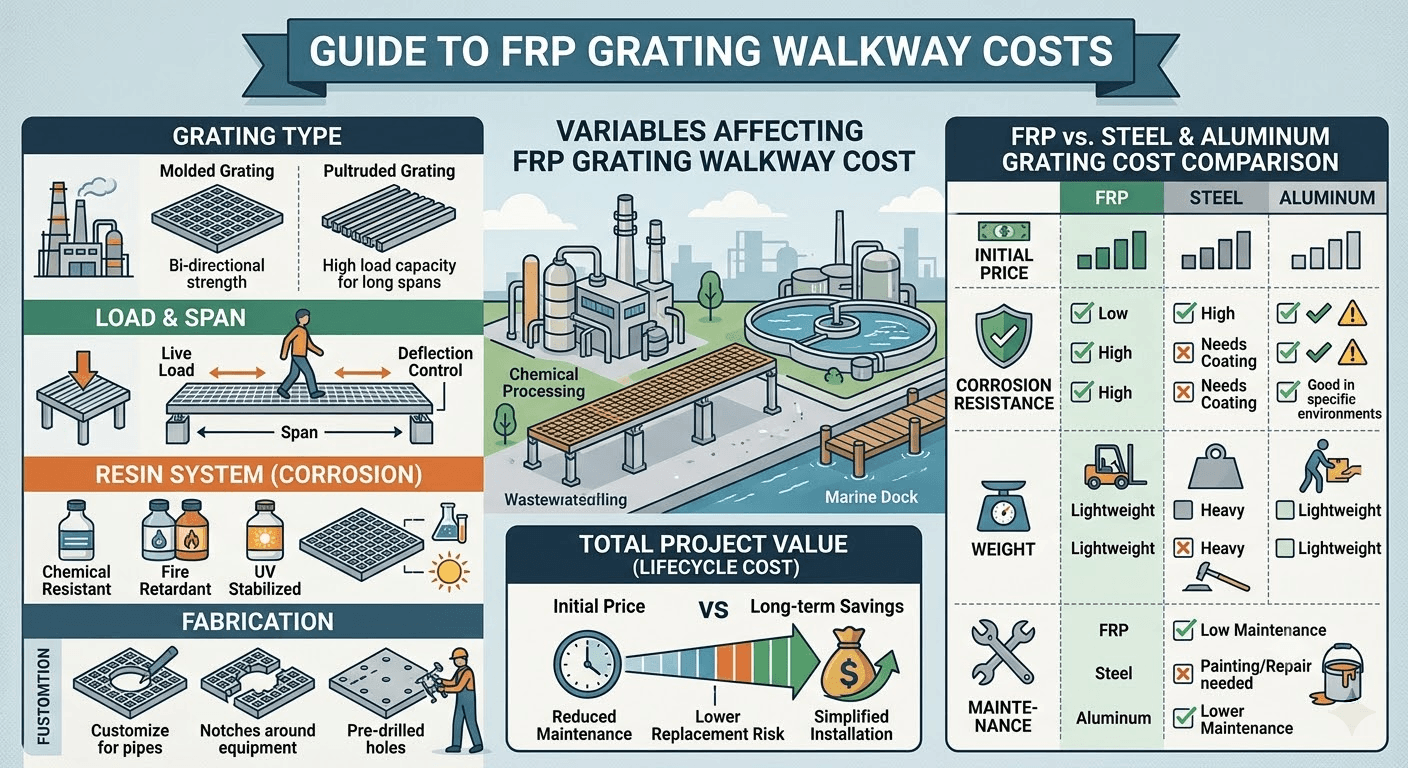
guide to frp grating walkway costs
How to Estimate FRP Walkway Grating Budget
A practical estimate starts with area, then adds performance requirements, fabrication, accessories, freight, and installation factors.
Measure total walkway area
Buyers can estimate area by multiplying walkway length by width. Irregular platforms should include drawings, cutout locations, and a waste allowance.
Replacement panels and spare panels should be counted separately.
Confirm support span and load requirements
Live load, concentrated load, carts, equipment access, and support spacing affect grating selection. Longer spans or stricter deflection expectations may require a different grating type.
Span and load should be confirmed before comparing price.
Choose molded or pultruded grating
Molded grating often fits corrosive, wet, or irregular layouts. Pultruded grating often fits longer spans and directional strength requirements.
The wrong grating type can create extra cost through over specification or performance risk through under specification.
Select resin and surface finish
Resin affects chemical resistance, outdoor performance, and fire behavior. Surface finish affects traction, cleaning, and worker comfort.
Buyers should match resin and surface to actual exposure rather than defaulting to the lowest price option.
Add fabrication and accessories
Clips, hold downs, cutouts, drilling, edge finishing, stair treads, color, and labels affect project cost. Standard layouts and repeatable panel sizes can reduce fabrication effort.
Fabrication cost is the added labor and processing required to turn standard panels into project ready components.
Include freight, packaging and installation factors
Final project cost includes packaging, freight, unloading, storage, labor, downtime, and installation sequence. Pallet grouping by installation area can reduce site handling time.
What Buyers Should Send for an Accurate Quote
The fastest way to control FRP grating walkway cost is to send complete project information. The checklist below helps procurement teams prepare a clear RFQ.
| Requirement | Buyer Should Provide | Why It Matters |
|---|---|---|
| Application | Walkway, platform, trench cover, refinery, utility | Defines performance priorities |
| Total area | Length, width, layout, spare panels | Supports budget and quantity |
| Load | Live load, concentrated load, carts, equipment | Guides grating strength |
| Span | Support spacing and bearing direction | Controls deflection |
| Panel size | Standard or cut to size dimensions | Affects production and packing |
| Grating type | Molded, pultruded, covered | Guides product selection |
| Resin | General, chemical resistant, fire retardant | Matches exposure |
| Surface finish | Grit, concave, covered | Affects traction and cleaning |
| Color | Standard or custom color | Supports visibility or branding |
| Chemical exposure | Type, concentration, temperature | Helps resin selection |
| Fabrication | Cutouts, notches, drilling, labels | Affects processing cost |
| Accessories | Clips, hold downs, fasteners | Completes installation scope |
| Quantity | Project volume or repeat orders | Supports production planning |
| Packaging | Pallets, export packing, sequence labels | Helps site handling |
| Destination | Delivery location and schedule | Affects freight and timing |
RFQ checklist for FRP grating walkway cost
Buyers should send application, total area, load, span, panel size, grating type, resin, surface finish, color, fire requirement, UV exposure, chemical exposure, cutouts, clips, quantity, packaging, destination, and delivery schedule. These details help suppliers prepare a more accurate quote.
Custom panel sizes, cutouts and colors
Custom options may include cut to size panels, notches, openings, edge finishing, color options, project labels, and staged packaging. These details matter in large platforms, oil refinery access areas, wastewater plants, and marine walkways.
Unicomposite Technology Co., Ltd is an ISO 9001 certified FRP and GRP composite manufacturer in Nanjing, China, with an 18,000 square meter facility. Its capabilities include pultrusion, pulwinding, SMC and BMC molding, hand lay up, and vacuum infusion for standard and custom composite products.
Unicomposite can review drawings, walkway area, load and span data, chemical exposure, grating type, resin, surface finish, cutouts, clips, packaging, quantity, destination, and delivery schedule before preparing a project quote.
Packaging and bulk order planning
Bulk orders should align packaging with the installation sequence. Pallet labels, panel grouping, export packaging, and delivery planning can reduce sorting time at the site.
This is especially useful for large walkways, phased platforms, and multi zone industrial projects.
How to reduce quote revisions
Drawings, photos, load requirements, support span, resin exposure, quantity, accessories, and delivery location reduce back and forth. Supplier review of drawings and specifications helps identify missing details before production.
Buying Tips for B2B Procurement Teams
Cost control means choosing a grating system that matches the site, avoids unnecessary over specification, and reduces installation problems.
Avoid comparing only unit price
Buyers should compare equivalent specifications: same thickness, same resin, same surface, same span, same accessories, and same delivery scope.
A lower unit price may exclude clips, fabrication, packaging, freight, or resin upgrades.
Confirm standards and project requirements
Project teams should confirm load expectations, fire requirements, chemical exposure, electrical requirements, UV exposure, and facility rules before ordering.
Safety critical areas should receive engineering review.
Ask for fabrication details before ordering
Cutouts, notches, drilling, panel labels, clip type, edge finishing, and color should be confirmed before production. Missing fabrication details can delay installation.
Plan packaging by installation sequence
Pallet labels and panel grouping can reduce sorting work on site. This matters for platforms, large walkways, and phased projects.
Use lifecycle value for corrosive sites
In corrosive environments, buyers should compare maintenance savings, reduced rust repair, lighter installation, and replacement frequency. FRP should be justified by the operating environment, performance needs, and total cost.
Quick Cost Checklist
Use this checklist before requesting pricing.
| Item | Confirm Before Quote |
|---|---|
| Project scope | Walkway area, layout, drawings, spare panels |
| Loads | Live load, concentrated load, carts, equipment |
| Span | Support spacing, bearing direction, deflection limit |
| Product type | Molded, pultruded, covered, custom cut |
| Material package | Resin, fire requirement, UV exposure |
| Surface | Grit, concave, covered, cleanability needs |
| Fabrication | Cutouts, notches, drilling, edge finishing |
| Accessories | Clips, hold downs, fastener material |
| Logistics | Quantity, packaging, destination, schedule |
Conclusion
FRP grating walkway cost depends on specifications, environment, fabrication, quantity, packaging, freight, installation scope, and operating exposure. Cost per square foot can help early budgeting, while custom quotes are more reliable for real procurement.
Buyers should compare FRP with steel and aluminum by lifecycle cost, corrosion exposure, installation handling, maintenance, and site requirements. Accurate drawings, load and span data, resin requirements, surface finish, cutouts, clips, quantity, packaging, and delivery location help suppliers quote correctly.


