 info@unicomposite.com


Introduction
When you search for fiberglass grating for sale near me, you usually need more than a nearby stock panel. You need a supplier who can help you match FRP grating to corrosion exposure, load requirements, fabrication needs, delivery timing, and total installed cost.
For B2B buyers, fiberglass grating often goes into wastewater platforms, chemical trenches, marine walkways, utility access floors, agricultural facilities, or OEM assemblies. A wrong choice can create fit-up delays, unsafe footing, or premature replacement. This guide shows you how to compare suppliers, prepare a better RFQ, and decide when local inventory is enough or when direct manufacturer support gives you better control.

fiberglass grating for sale near me
What Fiberglass Grating Is and Why Buyers Specify It
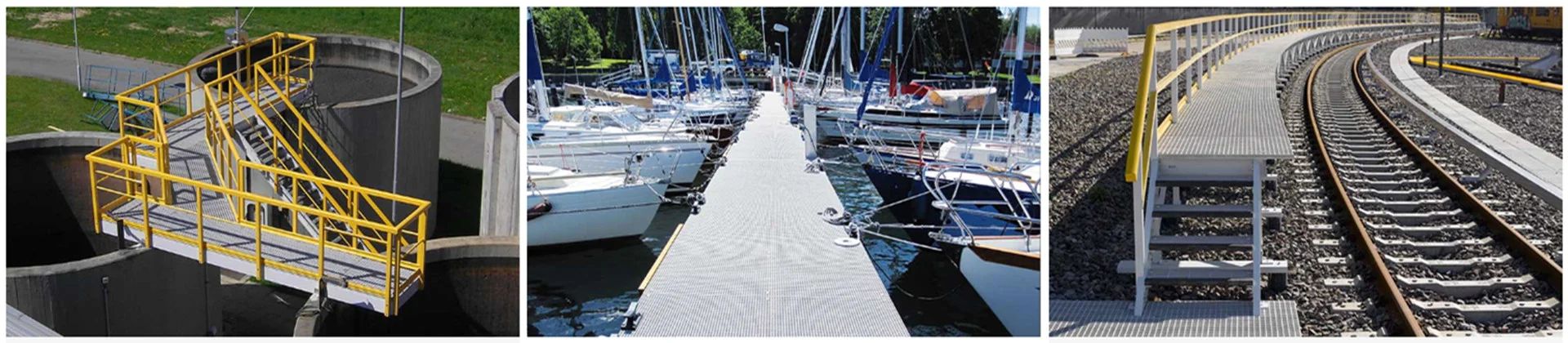
Fiberglass grating, also called FRP grating or GRP grating, combines glass fiber reinforcement with a resin matrix to create a lightweight, corrosion-resistant access and flooring panel. Buyers specify it when steel corrosion, electrical conductivity, repainting, or heavy handling creates long-term operating problems.
A good FRP grating decision should confirm at least four checkpoints: grating type, resin system, surface finish, and load/span requirement. If one of these is missing, the quote may look attractive while the product fails to match the application.
The table below connects common applications with the selection focus:
| Application | Buyer Concern | Selection Focus |
|---|---|---|
| Wastewater platforms | Moisture and corrosion | Resin, slip surface, drainage |
| Chemical trenches | Splash exposure | Chemical compatibility, fabrication |
| Marine walkways | Saltwater and wet footing | Corrosion resistance, grip, UV exposure |
| Utility platforms | Electrical safety | Non-conductive properties, load/span |
| OEM equipment | Repeatable assembly | Custom size, cutouts, packaging |
Takeaway: fiberglass grating performs best when the supplier starts with the service environment, then recommends the panel.
Molded vs Pultruded Fiberglass Grating
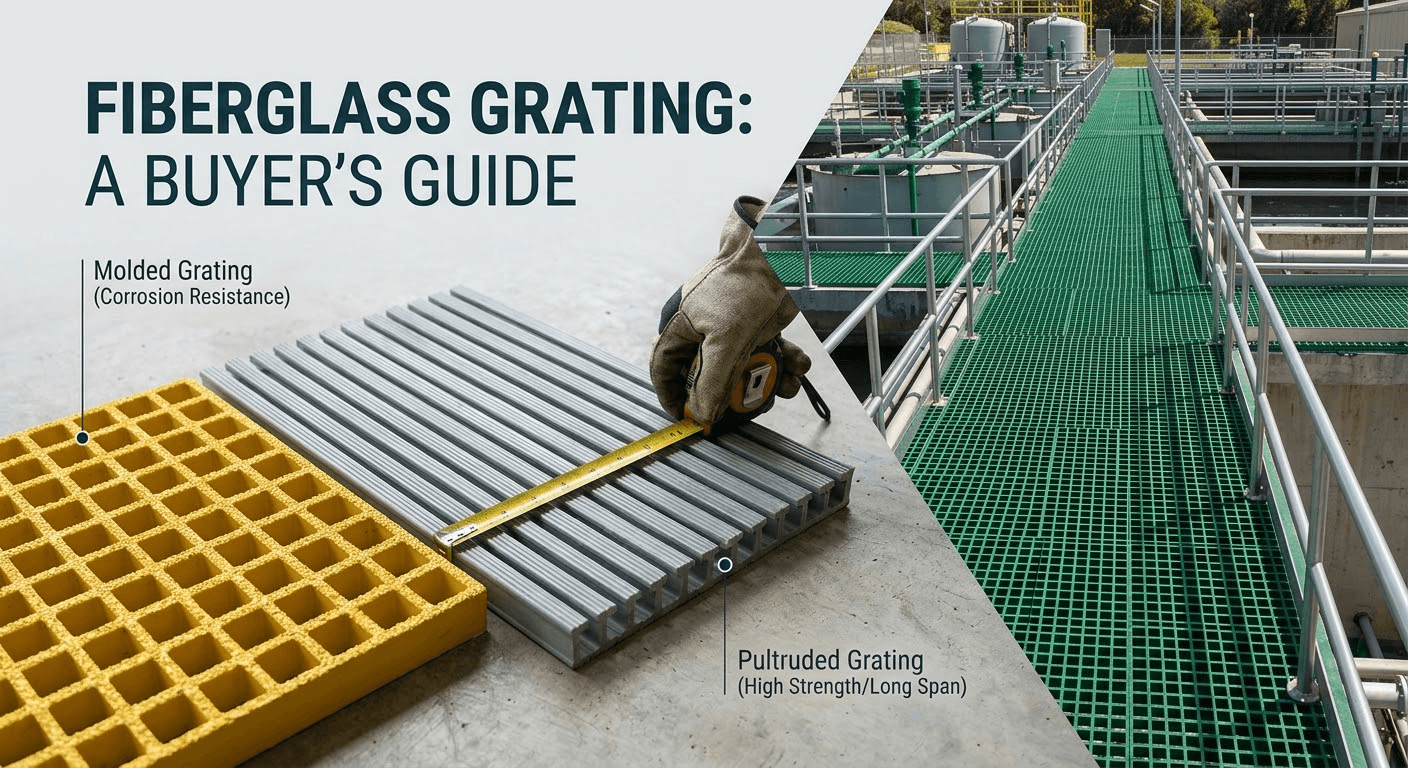
Once you know FRP grating fits the project, compare molded and pultruded options. Molded fiberglass grating is commonly used in wet, corrosive, and general industrial areas because its grid structure provides multi-directional performance. Pultruded fiberglass grating uses load bars and cross rods, making it a strong fit when span, stiffness, and load direction need closer control.
Which fiberglass grating type should you choose?
Choose molded fiberglass grating when you need corrosion resistance, drainage, slip resistance, and multi-directional panel performance. Choose pultruded fiberglass grating when the project requires longer spans, higher stiffness, or defined load-bearing direction. Final selection should always be checked against load, support spacing, exposure conditions, and supplier guidance.
The table below gives a practical comparison:
| Factor | Molded Grating | Pultruded Grating |
|---|---|---|
| Strength behavior | Multi-directional grid | Main load-bar direction |
| Common use | Platforms, trench covers, wet areas | Longer spans, structural walkways |
| Fabrication | Easier around pipes and cutouts | Load-bar direction matters |
| Buying focus | Resin, mesh, thickness, surface | Span, bar depth, load, connections |
| Best fit | Corrosive service areas | Higher stiffness requirements |
In field installations, the costly mistake is buying by panel price alone. A cheaper panel can become expensive if it does not match the support span, load, or exposure condition.
How to Evaluate Fiberglass Grating Suppliers Near You
A local supplier can help when you need standard panels fast. For industrial projects, however, location should be only one part of the decision. You also need technical communication, stable quality, fabrication support, packaging experience, and clear RFQ handling.
A qualified supplier should ask where the grating will be used. A chemical platform, outdoor trench cover, marine walkway, utility zone, and OEM floor may each require different resin, surface, fastening, and packaging decisions.
The checklist below helps you compare suppliers:
| Supplier Capability | What to Verify | Why It Matters |
|---|---|---|
| Product range | Molded, pultruded, stair treads, covered grating | Matches different applications |
| Resin options | General, chemical-resistant, fire-retardant options | Supports exposure needs |
| Fabrication | Cutting, drilling, cutouts, edge finishing | Reduces site labor |
| Quality process | Dimension and surface checks | Protects repeat orders |
| Export support | Pallets, labels, documents, shipping coordination | Helps North American buyers |
An anonymized field scenario shows why this matters. A coastal industrial site had repeated rust issues on a small access platform near saltwater spray. The buyer considered FRP grating to reduce corrosion-related replacement and make installation easier, but the final decision still required confirmation of resin, surface, support span, and fasteners.
Unicomposite is a China-based FRP/GRP composite manufacturer located in Nanjing. Its production capabilities include pultrusion, pulwinding, SMC/BMC molding, hand lay-up, and vacuum infusion. For buyers who need grating plus FRP profiles, ladders, handrails, cable trays, rods, rebar, or custom composite parts, this broader manufacturing base can support project-based sourcing.
Takeaway: choose a supplier who asks technical questions before sending a final price.
What to Confirm Before Requesting a Quote
After you shortlist suppliers, your RFQ determines the quality of the answer. “Please quote fiberglass grating” gives too little information. A stronger RFQ helps each supplier price the same requirement and helps your team compare offers fairly.
What should you send to get an accurate fiberglass grating quote?
Send grating type, panel size, thickness, mesh or bar spacing, resin system, surface finish, color, quantity, destination, application, support span, and expected load. Include drawings, photos, cutout details, or installation notes when available. Clear RFQ data reduces guessing and improves product selection.
Use this RFQ table as a working checklist:
| RFQ Item | Details to Provide | Buying Impact |
|---|---|---|
| Grating type | Molded or pultruded | Determines structure and price basis |
| Size and thickness | Length, width, panel depth | Affects production and freight |
| Mesh or bar spacing | Standard or custom spacing | Impacts drainage and load behavior |
| Resin system | General, chemical-resistant, fire-retardant | Matches exposure conditions |
| Surface finish | Gritted, concave, smooth, covered | Affects slip resistance |
| Load and span | Uniform load, point load, support spacing | Supports safer selection |
| Fabrication | Holes, cutouts, clips, edge finishing | Reduces installation work |
| Quantity and destination | Pieces, square meters, port or address | Drives cost and lead time |
Takeaway: a complete RFQ shifts the discussion from “lowest panel price” to correct product value.
Local Distributor or Direct Manufacturer?
The phrase “near me” often leads to local distributors, and they can be useful. If you need one or two standard panels for an urgent replacement, local stock may reduce downtime.
For bulk orders, custom dimensions, repeated purchasing, OEM supply, or multi-product FRP projects, a direct manufacturer may give you stronger control over material selection, fabrication, labeling, packaging, and repeat-order consistency.
When is a local distributor the better choice?
A local distributor is often better for urgent small orders, standard panel sizes, and simple maintenance replacements. If you already know the exact product and need fast pickup or regional delivery, local inventory can simplify purchasing and reduce waiting time.
When is a direct FRP manufacturer the better choice?
A direct FRP manufacturer is often better for bulk purchasing, custom grating, private-label supply, repeat orders, and projects requiring technical coordination. Manufacturers can usually support specification control, production planning, custom fabrication, packaging consistency, and related FRP components across the same project.
Takeaway: local sourcing helps with speed; direct manufacturing support helps with specification control and long-term supply.
fiberglass grating for sale
How Fiberglass Grating Pricing Works
Price matters, but the best comparison is total delivered value. Fiberglass grating cost depends on product type, thickness, resin, surface finish, fabrication, order quantity, packaging, and freight.
A gritted surface may cost more than a basic surface, yet it may be the right choice for wet pedestrian areas. A chemical-resistant resin can raise the quoted price, yet it may be necessary when exposure conditions demand it. Load capacity also depends on product design and support conditions, so confirm project assumptions before approving a cheaper alternative.
Common cost drivers include grating type, bar depth or panel thickness, resin system, cut-to-size work, clips, pallet requirements, and shipping volume. Ask the supplier to state what is included in the quote, what is excluded, and which technical assumptions were used.
Takeaway: the lowest line-item price can hide extra cost if fabrication, accessories, freight, or service conditions are missing.
Final Buying Checklist
Before placing an order, confirm the grating type, panel dimensions, mesh or bar spacing, resin, color, surface finish, support span, load requirement, fabrication details, clips, packaging, lead time, and destination.
Align the purchase with everyone who owns the result. Engineering may care about span and resin. Procurement may care about landed cost and lead time. Operations may care about slip resistance, cleaning, and replacement intervals.
If you need fiberglass grating with related FRP structures, Unicomposite can support project-based supply across grating, pultruded profiles, ladders, handrails, cable trays, rods, rebar, and custom composite parts.
Conclusion
When you search for fiberglass grating for sale near me, the best supplier is the one that helps you buy the right product for the actual application.
Define the service environment first. Compare molded and pultruded options second. Prepare a complete RFQ with load, span, resin, surface, fabrication, quantity, and destination details. Then evaluate suppliers by technical support, consistency, packaging, lead time, and total delivered value.
For urgent small orders, a local distributor may be the fastest route. For bulk projects, custom requirements, OEM supply, or multi-product FRP sourcing, a direct manufacturer can give you better specification control.
[Contact Unicomposite for a custom fiberglass grating quote →]


