 info@unicomposite.com


Introduction
A tree stake looks like a small purchase until a bulk planting project starts showing uneven support, leaning trees, broken stakes, or inconsistent installation speed. For nurseries, orchards, tree farms, municipal planting teams, and landscape contractors, the diameter of a stake can affect handling, field performance, packaging, and repeat-order planning.
3/8 fiberglass tree stakes give buyers a lightweight and consistent support option for young trees, nursery stock, and commercial planting projects. They can be especially useful when buyers want better weather resistance, cleaner handling, and more predictable sizing than many traditional wooden stakes.
This guide explains what 3/8 fiberglass stakes are, how they compare with wooden stakes, when they are a practical choice, how to specify them for bulk orders, and what information to prepare before requesting a quote.
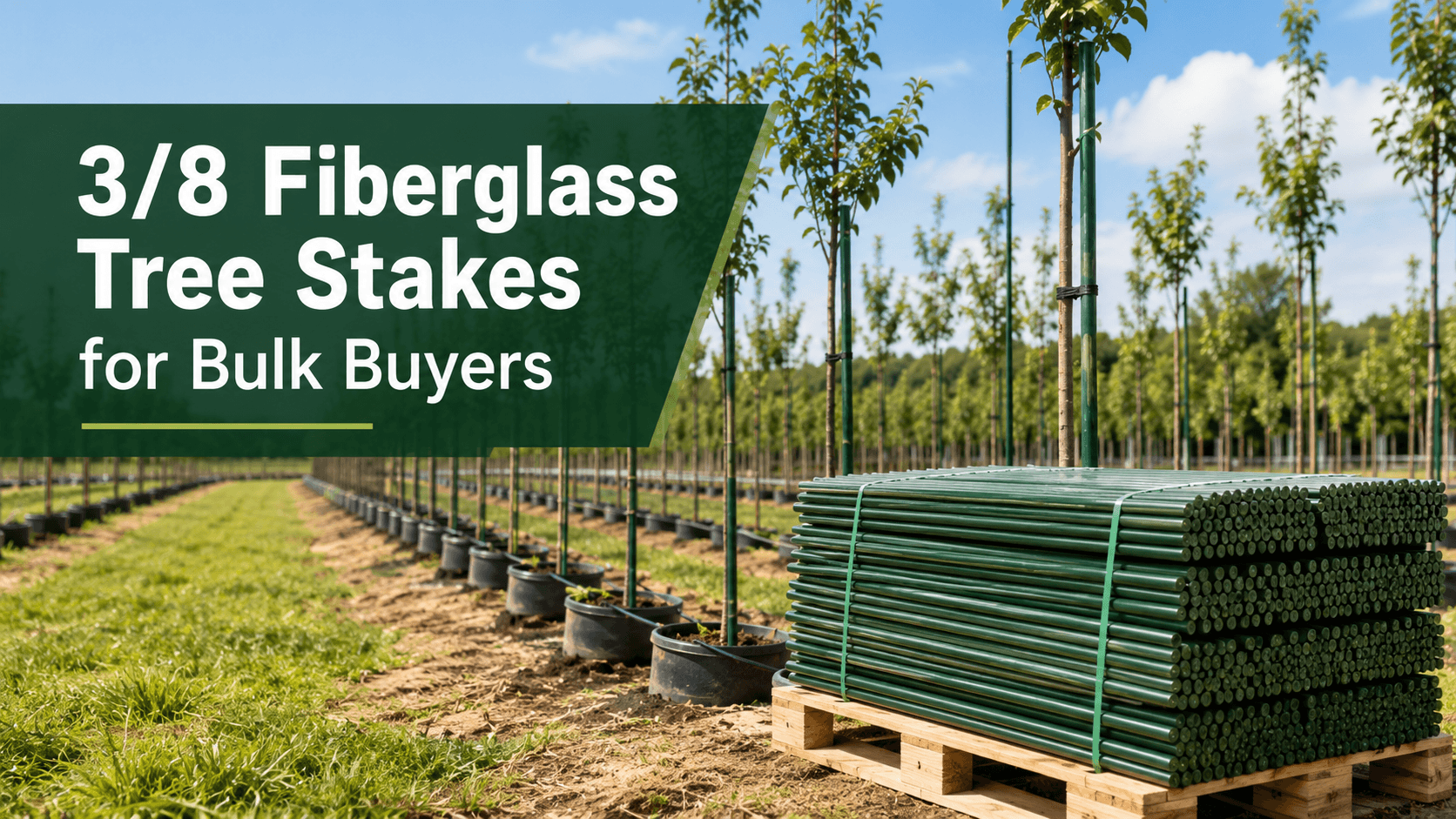
3 8 fiberglass tree stakes for bulk buyers
What Are 3/8 Fiberglass Tree Stakes?
3/8 fiberglass tree stakes are FRP support rods with a diameter of approximately 3/8 inch. They are made with glass fiber reinforcement and resin, creating a lightweight, weather-resistant stake for young trees, nursery rows, orchards, landscaping projects, and other planting applications.
For bulk buyers, the 3/8 size is often attractive because it balances handling efficiency with support. Crews can carry and install the stakes quickly, while procurement teams can standardize packaging, color, labeling, and repeat orders around a clear diameter specification.
What does 3/8 mean in tree stake selection?
In tree stake selection, 3/8 usually refers to the stake diameter, about 0.375 inch. Diameter affects stiffness, handling, tie contact, packaging, and suitable application. For bulk buyers, it helps standardize procurement and installation across nursery, landscaping, orchard, and tree farm projects.
A smaller diameter may work for lighter young trees and controlled nursery conditions. Larger trees, looser soil, stronger wind exposure, or longer support periods may require a larger diameter or a different installation method.
Takeaway: 3/8 diameter is a practical specification, but it should always match tree size and site conditions.
Why Choose Fiberglass Over Wooden Tree Stakes?
After diameter, material choice becomes the next major decision. Wooden stakes are familiar and often inexpensive, but they can vary in straightness, surface quality, diameter, and long-term condition after outdoor exposure.
Fiberglass stakes provide more consistent dimensions because they are manufactured products. They also resist moisture-related issues that commonly affect wood, such as splitting, warping, decay, and rough surface deterioration.
A nursery procurement team, for example, may find that wood stakes require sorting before installation because some pieces arrive warped or inconsistent. Switching part of the stake inventory to fiberglass can reduce sorting time and give crews a more predictable product across repeated planting cycles.
The table below compares fiberglass and wooden stakes from a bulk purchasing perspective:
| Factor | 3/8 Fiberglass Tree Stakes | Wooden Tree Stakes |
|---|---|---|
| Diameter consistency | More uniform across batches | Can vary by wood source and cutting quality |
| Outdoor durability | Performs well when correctly specified, stored, installed, and inspected | Can rot, split, swell, or warp outdoors |
| Handling | Lightweight, clean, and consistent | Can splinter or have rough surfaces |
| Reuse potential | Often reusable after inspection | Usually lower after long exposure |
| Appearance | Clean and uniform | Natural look, less consistent |
| Bulk buying fit | Good for nurseries, tree farms, landscaping, and repeat orders | Useful for short-term or low-cost applications |
Reuse should depend on inspection. A fiberglass stake should be reused only when it remains straight, clean, undamaged, and suitable for the next planting project.
Takeaway: fiberglass stakes fit buyers who value consistency, cleaner handling, and repeatable field performance.
3/8 Fiberglass Tree Stakes vs Wooden Stakes
Material comparison becomes more useful when buyers connect it to labor, maintenance, and replacement risk. A wooden stake may have a lower unit price, but a bulk project should also consider sorting time, breakage, storage conditions, replacement frequency, and site appearance.
Fiberglass stakes can reduce some of those hidden costs because they are more uniform and less affected by moisture. Still, they should be selected according to the application, since no single stake size fits every tree or site.
The table below helps buyers decide which material fits each purchasing scenario:
| Buying Factor | Fiberglass Stakes | Wooden Stakes | Buyer Note |
|---|---|---|---|
| Upfront cost | Usually higher than basic wood | Usually lower | Compare total use value |
| Support duration | Better for longer or repeat-use programs | Better for temporary support | Match material to project length |
| Crew handling | Consistent shape and lightweight feel | May need sorting | Important for large planting crews |
| Outdoor exposure | Stronger moisture and weather resistance | Can degrade over time | Storage and field conditions matter |
| Best-fit use | Nurseries, tree farms, landscaping, municipal planting | Short-term or budget-sensitive jobs | Choose by operating need |
For some buyers, both materials may have a place. Wood can work for temporary support. Fiberglass may be better for repeat-use inventory, visible landscape projects, and planting programs where consistency matters.
Takeaway: the better material depends on support duration, labor cost, and reuse expectations.
How to Choose the Right 3/8 Fiberglass Tree Stakes
Once buyers choose fiberglass, the specification should become precise. Diameter is only one part of the purchase. Length, color, surface finish, packaging, bundle size, and delivery terms all influence the buying result.
For 3/8 stakes, buyers should review tree size, stake length, insertion depth, soil condition, wind exposure, and support duration. If the trees are taller, the soil is loose, the site is exposed, or support is needed for a longer period, a larger diameter may be more suitable.
The table below can be used as a practical specification checklist before sending an RFQ:
| Specification | What to Confirm | Why It Matters |
|---|---|---|
| Diameter | 3/8 inch or acceptable tolerance | Affects stiffness and support behavior |
| Length | Standard or custom length | Matches tree height and insertion depth |
| Color | Green, black, white, or custom | Supports visibility and site appearance |
| Surface finish | Smooth or textured | Affects handling and tie contact |
| Quantity | Pieces, bundles, pallets, or container volume | Impacts price and production planning |
| Packaging | Bundle size, pallet, label, carton | Improves storage and crew distribution |
| Destination | Port, warehouse, or jobsite | Affects freight planning and lead time |
When are 3/8 fiberglass stakes a practical choice?
3/8 fiberglass stakes are a practical choice for young trees, nursery stock, orchards, landscaping projects, and tree farms when moderate support is enough. Buyers should review tree height, soil firmness, wind exposure, support duration, and tie method before selecting this diameter for large orders.
A protected nursery block may perform well with 3/8 stakes. A windy orchard edge, loose roadside soil, or taller landscape tree may require a stronger diameter or additional support points.
Takeaway: 3/8 stakes are useful when the support requirement matches their size and handling advantages.
Installation Tips for Commercial Planting Projects
Good specifications still need correct installation. A suitable stake can underperform if crews place it too close to the trunk, drive it too shallow, or tie it too tightly.
For many young trees, crews position stakes away from the trunk and use soft ties that allow limited natural movement. The goal is to support the tree without damaging bark or restricting healthy development.
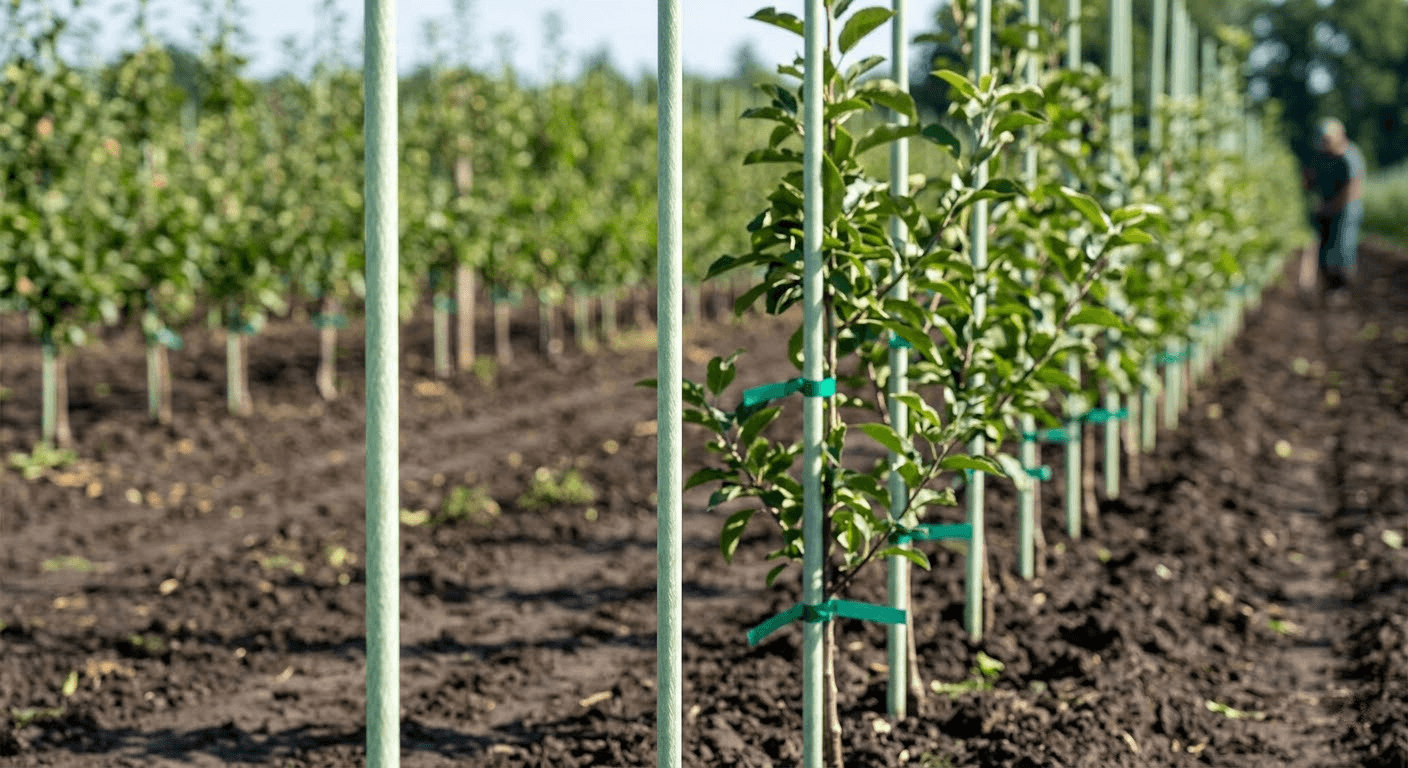
3 8 fiberglass tree stakes for bulk buyers
How should 3/8 fiberglass tree stakes be installed?
Install 3/8 fiberglass tree stakes at a suitable distance from the trunk, drive them securely into the soil, and use soft, flexible ties. Avoid excessive tie tension. Inspect the stakes and ties after wind, rain, and early growth because support conditions can change quickly.
In an anonymized municipal roadside planting project, crews found that exposed wind and compacted soil changed the support requirement. Some young trees needed closer inspection after storms, while others required adjusted tie tension. The stake specification mattered, but the inspection schedule mattered just as much.
For large projects, create a simple crew checklist covering stake spacing, insertion depth, tie height, tie tension, and inspection dates. This helps different crews install stakes consistently across multiple sites.
Takeaway: installation and inspection determine whether the stake delivers reliable support in the field.
What to Send Before Requesting a Bulk Quote
A clear RFQ helps suppliers quote accurately and helps buyers compare offers fairly. A vague request such as “quote fiberglass stakes” often leads to missing details, slow communication, and inconsistent pricing.
Bulk buyers should include diameter, length, quantity, color, application, packaging requirements, destination, and delivery schedule. If the order requires private-label packaging, repeat shipments, or custom colors, those details should be included from the beginning.
The table below can be copied into a procurement email:
| RFQ Item | Example Detail |
|---|---|
| Product | 3/8 fiberglass tree stakes |
| Length | Required length or acceptable range |
| Quantity | Pieces, bundles, pallets, or container order |
| Color | Green, black, white, or custom |
| Application | Nursery, orchard, landscaping, municipal planting |
| Packaging | Bundle quantity, pallet, label, carton |
| Destination | Country, port, warehouse, or jobsite |
| Quote request | Unit price, lead time, packaging, freight terms |
What information is needed for a bulk quote?
For a bulk quote, buyers should send diameter, length, quantity, color, application, packaging method, destination, and target delivery schedule. Buyers should also include custom label needs, bundle size, pallet requirements, private-label requests, and repeat-order plans when relevant.
Repeat buyers should also ask about batch consistency. A nursery or landscaping contractor needs future shipments to match the approved sample in diameter, finish, color, and handling feel.
Takeaway: a complete RFQ reduces guesswork and improves supplier comparison.
Why Buy FRP Plant Stakes from Unicomposite?
Supplier capability becomes more important when buyers move from small purchases to bulk supply. Local retailers may help with urgent small quantities, while direct FRP manufacturers can provide better control over specifications, packaging, repeat orders, and custom requirements.
Unicomposite is a Nanjing-based FRP/GRP composite manufacturer with ISO 9001 certification and an 18,000 square meter factory. Its production capabilities include pultrusion, pulwinding, SMC/BMC molding, hand lay-up, and vacuum infusion. For fiberglass tree stake buyers, this manufacturing background supports consistent diameter, custom length, color matching, bundle packaging, private-label supply, and repeat-order control.
Buyers who need related FRP products may also benefit from sourcing plant stakes, fiberglass rods, profiles, grating, ladders, handrails, and other composite components from one manufacturer.
Takeaway: a qualified FRP manufacturer should support both the stake specification and the purchasing process behind it.
Conclusion
3/8 fiberglass tree stakes can be a practical choice for bulk buyers who need lightweight handling, consistent diameter, outdoor durability, and reuse potential after inspection.
Four buying steps matter most: define the stake diameter, match the application, confirm packaging and color requirements, and send a complete RFQ before requesting pricing. Buyers should also consider a larger diameter when trees are taller, soil is loose, sites are windy, or support duration is longer.
For nurseries, tree farms, orchards, landscaping contractors, and municipal planting teams, reliable stake supply can reduce field inconsistency and improve planting workflow.
[Contact Unicomposite for a custom fiberglass tree stake quote →]


