 info@unicomposite.com



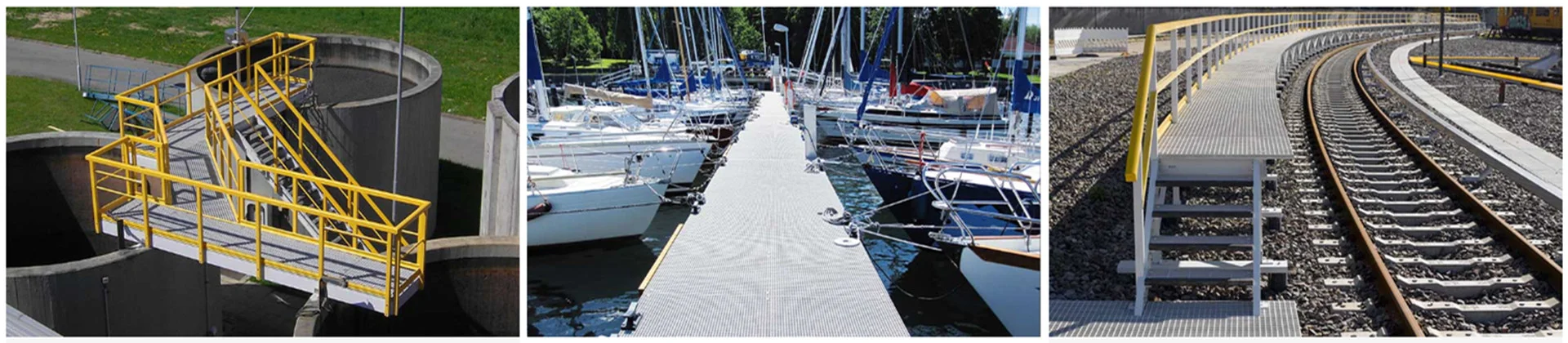
Open fiberglass-reinforced plastic (FRP) grating can provide supported walking surfaces and access platforms around sewage tanks. [1] Its potential benefits include corrosion resistance matched to the exposure and a choice of walking surfaces. [2][3]
The open mesh lets water pass through where the openings remain clear and a suitable receiving area is available below. It does not form an odor seal. Suitability depends on the selected panel, supports, loads, and operating conditions.

frp grating sewage tank
Where Open Grating Fits Around a Sewage Tank
Distinguish grating beside a tank from grating spanning a service trench or other access opening. Both locations require an appropriate support arrangement. Molded and pultruded grating are different constructions, and the term FRP alone does not establish a panel’s load capacity. Spanning an opening does not make open grating a sealed cover. [1]
Use the required function to identify the component:
| Required function | Component to identify |
|---|---|
| Personnel access | Walking-surface grating with supports and load data for the intended traffic. [1] |
| Drainage through a walking surface | Open-mesh grating with unobstructed openings and a suitable receiving area below. |
| Removal of large solids from wastewater | Process-screening equipment for the wastewater flow. [6] |
| Odor containment and any specified gas collection | A cover system designed for containment and the required gas-handling connections. [5] |
Practical Benefits and Their Limits
Corrosion Resistance Matched to the Exposure
FRP grating is a candidate for wet, chemically exposed access areas because suitable resin systems can resist particular corrosive environments. The useful question is which exposure the proposed product can tolerate, including cleaning chemicals, concentration, temperature, and contact duration. Fibergrate’s chemical guide separates these conditions and distinguishes continuous contact from splash exposure. It also calls for testing under actual conditions where service conditions and mixtures differ. [2]
Assess chemical compatibility using information for the selected grating product and resin system. Match the listed chemical, concentration, temperature, and exposure category to the actual service conditions. Another manufacturer’s chart does not establish compatibility for that product. Corrosion resistance alone does not establish a universal service life or remove the need for inspection.
Openings for Drainage
An open grid gives water a path through the walking surface. That can be useful where washdown or splash needs to drain to a suitable area below. It also means the panel is permeable: it will not retain liquids or stop tank gases simply because it spans an opening.
The opening size must also suit the traffic and the location. A drainage opening can be unsuitable for a small wheel or allow dropped objects to pass through. Drainage and containment are separate functions.
Surface Options for Walking Areas
Walking-surface options let the grating specification address different access conditions. Strongwell’s molded-grating brochure, for example, describes concave and gritted options for its products. Compare the proposed surface with the water, sludge, grease, footwear, and cleaning practices expected at the site. [3][4]
A textured surface does not remove contamination or guarantee that a wet walkway will be slip-free. HSE’s contamination guidance identifies flooring, cleaning, and footwear as parts of slip prevention. [4]

wastewater treatment plant grating
Can Open FRP Grating Contain Sewage-Tank Odors?
No. Open FRP grating leaves a path for gases to escape. Odor containment requires a cover system designed for that purpose. Where gas collection and treatment are specified, the cover forms part of that wider system. Containment alone is not treatment. [5]
Adding a solid sheet does not by itself establish sealed joints, sealed penetrations, or the required gas-handling connections. NEFCO’s odor-control cover description illustrates the distinction: its system uses sealing features and can include inlet and exhaust connections for use with gas-treatment equipment. A walkable cover also needs evidence for its intended loads. [5]
Review Selection Requirements or Send a Grating Inquiry
For detailed selection, use our FRP grating selection guide for wastewater treatment to examine exposure, supports, loads, surface conditions, and maintenance access in more detail.
For a grating inquiry, visit our FRP products for wastewater treatment applications page and send the intended walking-surface location, approximate panel dimensions and quantity, and delivery destination. Include any available layout or exposure information.
References
- Fibergrate — Guidelines for the Engineer & Designer, SI Units. Pedestrian walkways, grating construction, supports, and loading considerations.
- Fibergrate — Chemical Resistance Guide. Product-specific exposure categories and actual-use limitations.
- Strongwell — DURAGRATE Molded Fiberglass Grating Brochure. Surface options for the manufacturer’s molded grating.
- HSE — Contamination. Contamination and slip prevention guidance; not a U.S. compliance standard.
- NEFCO — Cover Systems. Odor-control enclosure features described by the manufacturer.
- U.S. EPA — Peak Flows at Sewage Treatment Plants. Preliminary screening removes large solids from wastewater.


