 info@unicomposite.com



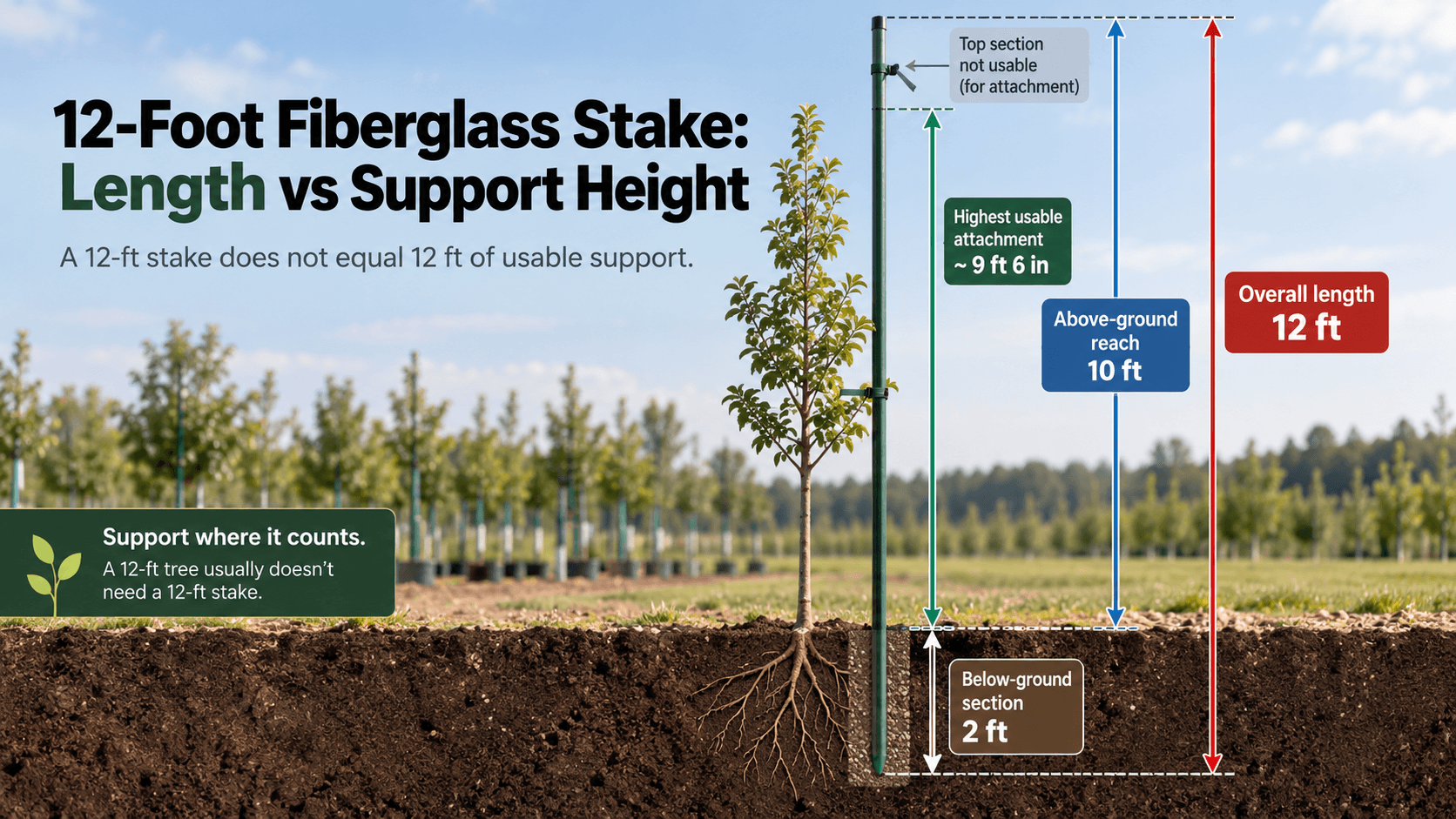
A 12-foot fiberglass stake is a length choice, not a complete support specification. For a vertical stake, any length below ground reduces its above-ground reach, and the highest usable attachment may sit below the tip. Choose this length only when the planned support height needs it and the exact stake section, anchorage and connections suit the job. A 12-foot tree does not automatically need a 12-foot stake.
12 foot fiberglass stake
How much support height does a 12-foot stake provide?
Twelve feet equals 144 inches, or approximately 3.66 meters. That is the overall length before allowing for installation geometry.
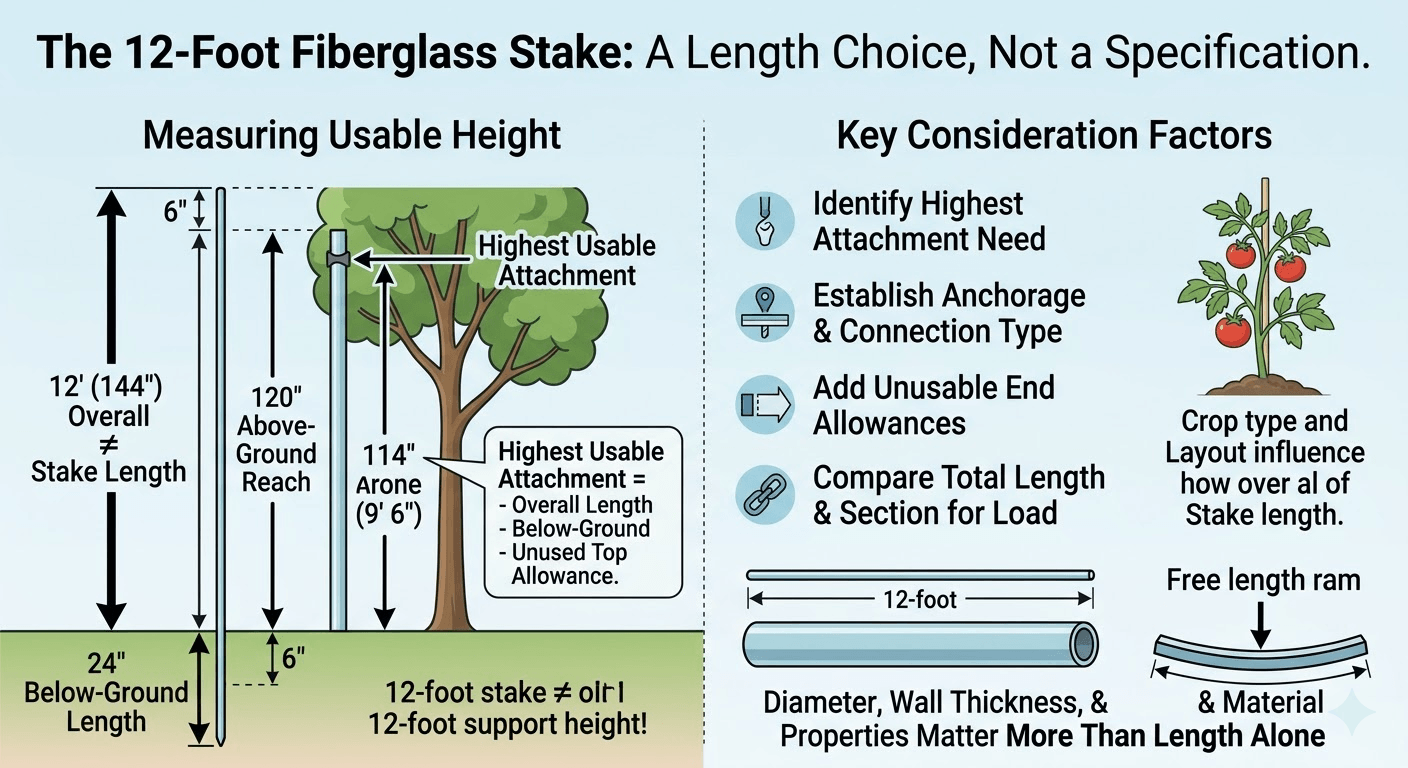
For a straight, vertical, ground-set stake, separate three measurements:
- Overall length: the full end-to-end length of the stake.
- Above-ground reach: overall length minus the portion below the finished soil level.
- Highest usable attachment: above-ground reach minus any top section that the selected tie, clip or connection cannot use.
In this simple arrangement:
Highest usable attachment height = overall length − below-ground length − unused top allowance.
The following example is dimensional arithmetic, not an installation recommendation or a tested support design. It assumes 24 inches below ground and a 6-inch unused top section solely to show the distinction.
| Measurement | Illustrative value |
|---|---|
| Overall stake length | 144 inches / 12 feet |
| Assumed below-ground length | 24 inches / 2 feet |
| Above-ground reach | 120 inches / 10 feet |
| Assumed unused top allowance | 6 inches |
| Highest attachment height — geometry only | 114 inches / 9 feet 6 inches |
Under those assumptions, the stake cannot provide an attachment point 12 feet above the soil. Conversely, if the intended attachment is much lower, a shorter stake may satisfy the height requirement. This calculation checks reach only; it does not establish the required anchorage or load capacity.
For an inclined stake, a bracket-mounted component or a stake joined to another structure, use the actual layout drawing. A distance measured along an inclined rod is not its vertical height. Do not substitute the example’s ground allowance for installation requirements appropriate to the site and product.
Does a 12-foot tree need a 12-foot stake?
No. Supporting a newly planted landscape tree is primarily a stability problem, not a requirement to match the top of its canopy. University of Minnesota Extension explains that staking is often unnecessary and warns that overly tall stakes can rub against branches. University of Maryland Extension likewise bases the need for support on the tree and site rather than height alone. Both recommend allowing some trunk movement. [1][2]
First decide whether temporary stabilization is needed. If it is, select the attachment position and support arrangement for that purpose. Extra stake length should not be used simply to hold the whole trunk rigid or reach the highest branch. Nursery training and landscape establishment are different jobs, so identify which one the proposed stake will perform.
For the wider application assessment, see our fiberglass tree stake guide for nurseries and orchards. Here, the key sizing decision is whether the planned attachment position actually calls for a 12-foot component.
When might 12-foot garden stakes make sense?
A long stake is worth evaluating when a tall crop-support layout needs the available reach after installation allowances. Examples to assess include a tall individual support or an upright within a specified netting or trellis arrangement. These are layout possibilities, not a recommendation that a particular fiberglass rod can carry the system.
The crop name alone does not settle the length. In its field-tomato basket-weave guidance, Penn State Extension describes wooden or metal stakes 6–7 feet long for indeterminate varieties and 4 feet for determinate varieties. Those dimensions apply to that guidance and those materials; they are not fiberglass specifications. They illustrate why a 12-foot stake should not be the automatic choice for every tomato planting. [3]
Use this order when comparing lengths:
- Identify the highest attachment the growing system needs.
- Establish the anchorage or mounting arrangement and its length allowance.
- Add any unusable end or connector allowance.
- Compare the required total with the available stake lengths.
- Check whether the selected section and connections suit the support arrangement.
If a shorter option meets the first four conditions, extra length alone is not a reason to select 12 feet. If 12 feet is too short after the allowances, revisit the layout or the available component lengths rather than assuming the whole rod can remain above ground. Our general fiberglass plant stake selection guide covers the broader crop and system choices.
the 12 foot fiberglass stake
Why length alone cannot determine diameter or strength
Two stakes with the same overall length can respond differently because their material properties, cross-sections and restraints differ. For a hollow stake, outside diameter does not fully describe the section; wall thickness also matters.
Basic beam mechanics explains why unsupported length deserves attention. In an idealized, fixed-base cantilever under the same tip force, increasing the free length increases deflection when material and section remain unchanged. A stake in soil is not automatically a fixed-base laboratory beam, so that relationship is useful for understanding the variables, not calculating a field rating from the product name. [4]
Compare the exact section, the distance between restraints and the attachment layout. For netting or row supports, identify whether the proposed component is an intermediate upright or an end support. Do not assume a diameter used for a shorter stake or a different position has been validated for the 12-foot arrangement.
There is no single diameter, insertion depth or tie spacing established by the phrase “12-foot fiberglass stake.” Those details need to match the selected product and its intended installation.
What to specify when requesting a 12-foot stake
Our FRP plant stake range includes solid rods, hollow tubes, and assembled trellis stakes. To discuss a 12-foot requirement, send the requested form and overall length, the intended attachment height above ground, a simple support-layout sketch, quantity and delivery destination. Include the required diameter or section if it is already specified. Confirm availability for the requested overall length and cross-section before ordering.
Keep requested length, required support height and confirmed product configuration separate. This makes it possible to compare suitable options without treating a length label as proof of strength, stock availability or suitability for every plant.
References
- University of Minnesota Extension. Staking and guying trees. Reviewed in 2026.
- University of Maryland Extension. Planting a Tree or Shrub — Staking and guying trees.
- Penn State Extension. Stake your Tomatoes. Updated March 9, 2026.
- David M. Parks, MIT OpenCourseWare. Euler-Bernoulli Beams: Bending, Buckling, and Vibration, lecture 2, February 9, 2004, slide 9.


