 info@unicomposite.com


Introduction
The price difference between a fiberglass structural profile and its carbon fiber equivalent can exceed 500%. For most industrial applications, that premium never translates into measurable performance gain. Yet procurement teams continue to over-specify carbon fiber — and under-utilize fiberglass — because the comparison is rarely laid out in terms engineers can act on directly.
This article cuts through the material marketing. It covers how each fiber is made, where the properties diverge in ways that actually matter for structural and industrial design, what the cost economics look like across a full project lifecycle, and how to build a defensible specification decision either way.
fiberglass vs carbon fiber
What Are These Materials? A Manufacturing Baseline
Understanding the property differences between fiberglass and carbon fiber starts at the manufacturing level. The two fibers are produced through fundamentally different processes — and those processes drive most of the cost and performance gap engineers encounter downstream.
How Is Fiberglass Made?
Glass fiber starts as molten silica-based glass, drawn through precision bushings into continuous filaments with diameters typically ranging from 5 to 24 micrometers. These filaments are gathered into rovings, then combined with a thermoset resin — polyester, vinyl ester, or epoxy — and formed into composite structures through pultrusion, filament winding, hand layup, or compression molding.
The process is energy-efficient, highly scalable, and compatible with a wide range of resin systems. Production volumes are large, tooling costs are moderate, and material consistency across batches is well-controlled at ISO-certified facilities. The result: a structural composite that delivers predictable, well-documented mechanical properties at a cost accessible to industrial-scale procurement.
How Is Carbon Fiber Made?
Carbon fiber begins as polyacrylonitrile (PAN) precursor fiber, which undergoes a multi-stage thermal treatment — stabilization at 200–300°C, carbonization at 1,000–1,500°C, and optional graphitization above 2,000°C. This process converts the polymer chain into a tightly aligned carbon structure with exceptional stiffness and low density.
The energy intensity of carbonization, combined with lower production volumes and tighter process controls, makes carbon fiber inherently more expensive to manufacture. Commodity-grade carbon fiber costs four to ten times more per kilogram than E-glass fiber. Converting it into finished composite parts adds further cost through more demanding layup requirements and lower processing tolerance for error.
Head-to-Head: Key Property Comparison
Properties vary by fiber grade, resin system, and fiber volume fraction. The table below reflects typical values for standard industrial-grade composites used in structural and infrastructure applications (tensile strength per ASTM D638; flexural modulus per ASTM D790; pultruded GFRP profile properties per ASTM D4385):
| Property | Fiberglass (GFRP) | Carbon Fiber (CFRP) | Structural Steel |
|---|---|---|---|
| Density (g/cm³) | 1.8–2.0 | 1.5–1.6 | 7.85 |
| Tensile Strength (MPa) | 550–900 | 1,000–1,800 | 400–600 |
| Tensile Modulus (GPa) | 25–45 | 70–200 ¹ | 200 |
| Electrical Conductivity | Non-conductive (dielectric) | Conductive | Conductive |
| Corrosion Resistance | Excellent | Excellent | Poor (uncoated) |
| Thermal Expansion (×10⁻⁶/°C) | 6–10 | 0–3 | 12 |
| Relative Material Cost | 1× (baseline) | 5–10× | 0.3–0.5× |
| Typical Service Life (years) | 25–50+ | 25–50+ | 10–20 (coated) |
¹ CFRP tensile modulus by grade: standard-modulus 70–80 GPa; intermediate-modulus 100–150 GPa; ultra-high-modulus 150–200 GPa. Grade selection is governed by deflection targets, not strength targets — a distinction that significantly affects specification cost.
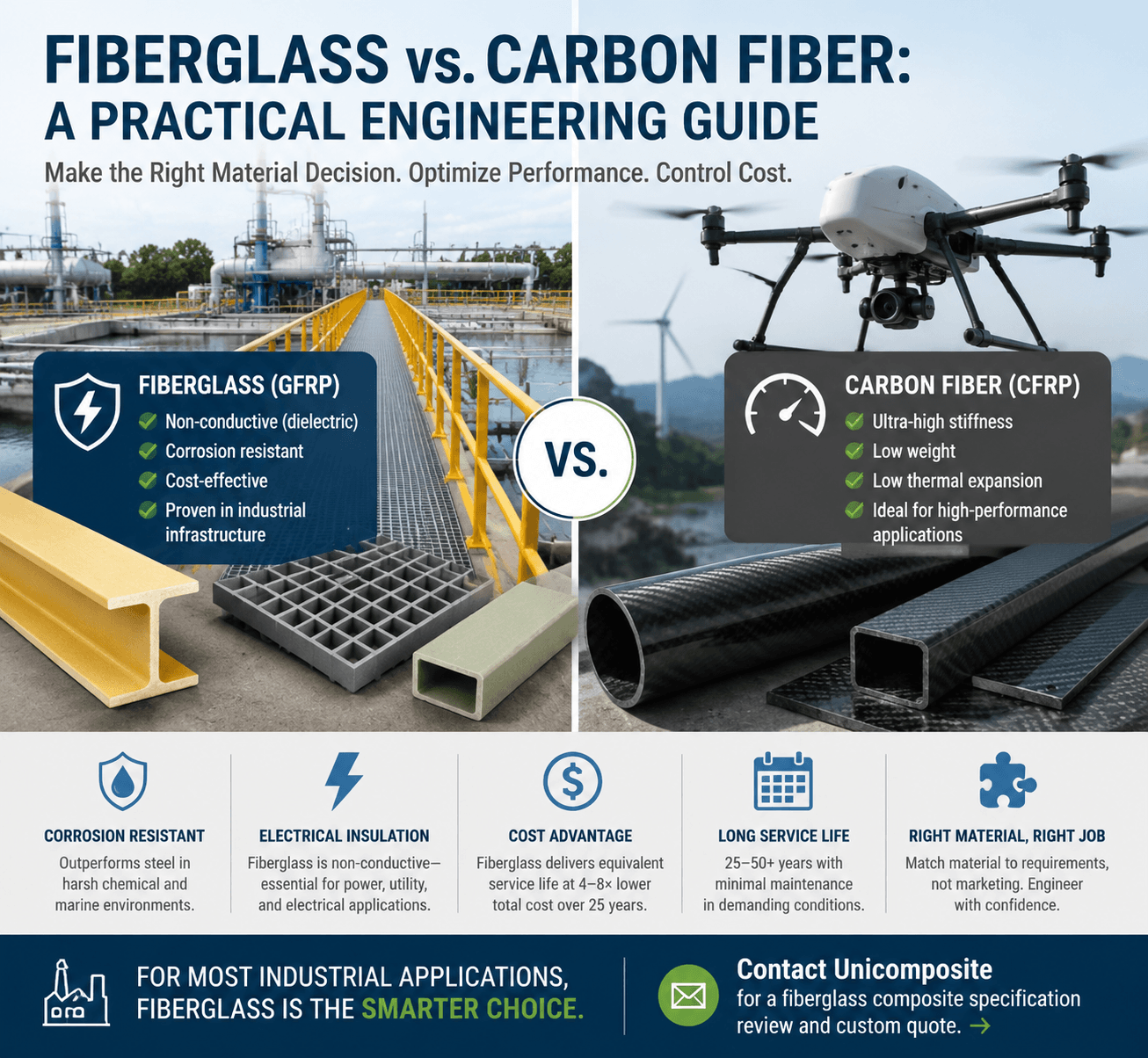
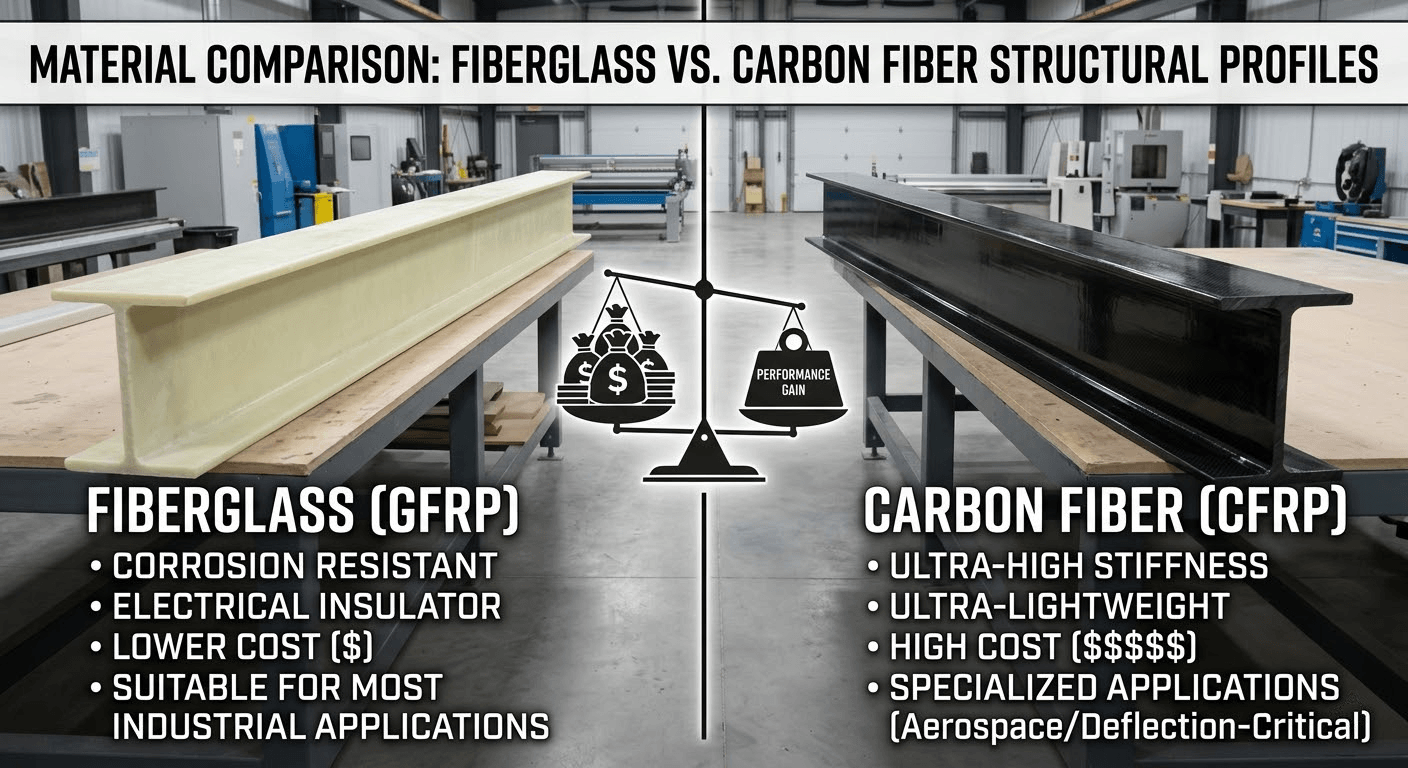
Two distinctions matter most for industrial specification decisions. First, tensile modulus: carbon fiber is roughly three to five times stiffer than fiberglass per unit cross-section at standard grade. In deflection-critical designs — long-span structural members, precision instrument frames — this stiffness advantage is real and sometimes decisive. Second, electrical conductivity: carbon fiber conducts electricity. In any application requiring dielectric isolation — utility infrastructure, switchgear support, electrical enclosures — CFRP is disqualifying regardless of its mechanical merits, and fiberglass is the only composite option.
Where Fiberglass Wins
The majority of industrial composite applications do not require carbon fiber’s stiffness-to-weight ratio. They require corrosion resistance, electrical insulation, dimensional stability, and long service life — all of which fiberglass delivers at a fraction of the cost. Two design constraints deserve acknowledgment upfront: GFRP exhibits measurable creep under sustained compressive or flexural load, which structural engineers must account for in long-span or continuously loaded members through appropriate safety factors. Additionally, without UV-stabilized resin or protective surface coating, outdoor-deployed fiberglass profiles will experience gradual surface degradation. Both constraints are manageable design inputs, not disqualifying limitations — but they belong in the specification, not the footnotes.
Is Fiberglass Strong Enough for Structural Applications? [Q&A]
Yes. For the vast majority of industrial structural applications, fiberglass composites provide more than adequate strength. Standard pultruded GFRP profiles achieve tensile strengths of 550–900 MPa — comparable to low-alloy steel — while weighing approximately one-quarter as much. In corrosive environments such as chemical plants, wastewater facilities, and marine structures, fiberglass outperforms both steel and carbon fiber on a total cost of ownership basis because it eliminates the corrosion maintenance cycle entirely. Creep under sustained load must be accounted for in the structural design, but this is a calculation input, not a reason to reject the material.
In field practice, the performance record is consistent. A Gulf Coast chemical processing facility replaced carbon steel cable tray supports with pultruded vinyl ester fiberglass profiles after documenting three corrosion-related replacements within eight years. The fiberglass installation, now entering its eleventh year, has required no maintenance intervention — closing a recurring OPEX line item that previously required annual budget allocation. Engineers specifying structural grating, cable trays, cross-arms, and platform framing report similar outcomes: fiberglass meets load requirements while delivering the corrosion immunity and electrical insulation that make carbon fiber both structurally redundant and electrically problematic in those environments.
Best Applications for Fiberglass Composites
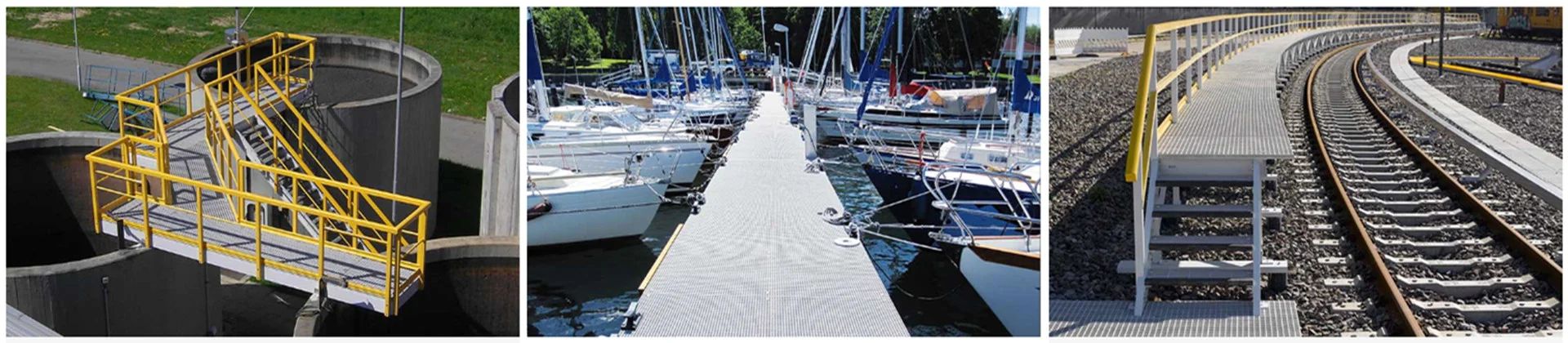
Power utilities deploy pultruded fiberglass cross-arms, insulating spacers, and substation structural members precisely because non-conductivity is a hard design requirement — carbon fiber cannot be substituted regardless of its mechanical properties. In wastewater treatment and chemical processing, vinyl ester fiberglass profiles handle continuous immersion in acids, alkalis, and hydrogen sulfide atmospheres where coated steel fails within years. Agricultural operations use fiberglass rods and stakes because galvanized steel corrodes in fertilizer-rich soil and bamboo degrades within two to three seasons under continuous moisture exposure.
For bulk procurement programs — thousands of linear meters of structural profile, tens of thousands of plant stakes, or distributed utility hardware — the cost differential between fiberglass and carbon fiber is not a detail. It is the project budget.
material comparison fiberglass vs carbon fiber structural profiles
Where Carbon Fiber Wins
The cost case for fiberglass is strong — but it rests on an assumption that the engineering requirements fiberglass meets are the same requirements carbon fiber would meet. In a narrow set of applications, they are not. Carbon fiber’s combination of ultra-low density, high stiffness modulus, and near-zero thermal expansion creates performance envelopes that fiberglass cannot enter, regardless of section geometry or resin optimization.
When Does the Higher Cost of Carbon Fiber Justify Itself? [Q&A]
Carbon fiber justifies its cost premium in three specific scenarios: first, when weight reduction is a hard system constraint with quantifiable value — aerospace structures, high-performance marine hulls, and racing vehicle chassis where every kilogram saved has a measurable performance or fuel cost impact; second, when stiffness governs the design and the required section modulus cannot be achieved in fiberglass within acceptable dimensional constraints — long unsupported spans, precision robotic arms, or satellite structures where deflection limits are tight; third, when near-zero thermal expansion is critical — CFRP’s coefficient of 0–3 × 10⁻⁶/°C versus 6–10 for GFRP matters in precision optical assemblies, metrology equipment, and instrumentation structures where dimensional stability across temperature cycles is a specification requirement. In standard industrial, civil, and agricultural contexts, none of these conditions typically applies.
The aerospace, motorsport, and advanced instrumentation sectors account for the majority of CFRP structural volume. Outside those sectors, the engineering case for carbon fiber over fiberglass is narrow, project-specific, and should be validated against actual load and deflection calculations — not assumed from a performance data sheet.
Cost Comparison: Total Project Economics
Material unit cost is only one input. The table below frames the full cost comparison across a typical industrial structural procurement decision:
| Cost Factor | Fiberglass (GFRP) | Carbon Fiber (CFRP) |
|---|---|---|
| Raw material cost (relative) | 1× baseline | 5–10× |
| Fabrication complexity | Low–moderate | Moderate–high |
| Tooling and die cost | Moderate (standard pultrusion) | Higher (precision layup or pultrusion) |
| On-site cutting and joining | Standard carbide tooling | Diamond tooling required; higher brittleness risk |
| Maintenance over 25 years | Near-zero in corrosive environments | Near-zero in corrosive environments |
| End-of-life disposal | Landfill (limited recyclability) | Landfill (limited recyclability) |
| Total 25-year cost index | 1× | 4–8× |
Cost index assumptions: standard industrial structural profiles; 25-year service period; corrosive or outdoor environment with no applied weight-reduction premium. Projects with strict weight targets, stiffness-governed span designs, or aerospace-class performance requirements may shift the crossover point significantly. Validate against project-specific parameters before using these ratios in budget justification.
For procurement managers evaluating the two materials on a project basis, the conclusion is straightforward in most industrial contexts: where both materials are technically viable, fiberglass delivers equivalent service life at a fraction of the total project cost. The cost crossover point — where carbon fiber’s performance advantage generates savings that offset its material premium — exists primarily in weight-sensitive, high-value systems, not in fixed industrial infrastructure.
How to Choose: A Decision Framework
The following framework applies to standard industrial, infrastructure, and agricultural applications. Aerospace, motorsport, and precision instrumentation decisions involve additional constraints — thermal cycling fatigue, vibration damping, radiation resistance — that fall outside this scope.
| Decision Question | Specification Implication |
|---|---|
| Does the application require electrical insulation? | If yes: carbon fiber is eliminated. GFRP is the only composite option, regardless of mechanical comparison. |
| Is weight reduction a hard constraint with quantifiable value? | If yes and savings are measurable (fuel, payload, structural load): evaluate CFRP. If weight reduction is a preference rather than a constraint: specify GFRP. |
| Does stiffness or deflection govern the design? | Calculate required section modulus. If GFRP meets the stiffness requirement within acceptable dimensions: the higher modulus of CFRP provides no practical benefit. |
| What is the annual procurement volume? | At industrial scale, cost differentials compound. A borderline prototype decision becomes decisively in GFRP’s favor at full procurement volume. |
| Does the application involve sustained compressive or flexural load? | If yes: account for GFRP creep in the structural design. Apply appropriate long-term load factors. If creep margin cannot be achieved: re-evaluate section geometry before switching to CFRP. |
Running a candidate application through these five questions in sequence produces a defensible, documented specification rationale — the kind that survives internal review, engineering sign-off, and supplier negotiation.
Conclusion
For engineers and procurement managers choosing between fiberglass and carbon fiber, the decision is less ambiguous than the marketing suggests. Four principles hold across most industrial applications:
- Default to fiberglass in corrosive, electrically sensitive, or high-volume applications. The performance is sufficient; the cost and maintenance economics are substantially better. Account for creep under sustained load and specify UV-stable resin for outdoor deployment — both are manageable design inputs.
- Reserve carbon fiber for applications where stiffness-to-weight ratio, ultra-low thermal expansion, or extreme weight reduction is a documented hard constraint — not a preference or a materials upgrade.
- Eliminate carbon fiber immediately in any application requiring dielectric isolation. Conductivity is a disqualifying property, not a trade-off to manage around.
- Validate with a manufacturer before volume commitment. Material selection decisions made at the concept stage without supplier input frequently result in over-specification or missed application constraints. A structured engineering consultation can confirm whether fiberglass meets the load, chemical, and dimensional requirements of a project before procurement locks in.
Having supplied pultruded fiberglass profiles to utility, infrastructure, and agricultural customers across North America, Europe, and Southeast Asia for over two decades, Unicomposite Technology Co., Ltd.’s engineering team routinely assists procurement managers in confirming whether fiberglass meets the load, chemical resistance, and dimensional requirements of a project before volume commitment — preventing the costly specification changes that surface after production begins.
The right material is the one that meets the specification at the lowest total cost of ownership. For the vast majority of industrial applications, that material is fiberglass.
[Contact Unicomposite for a fiberglass composite specification review and custom quote →]


