 info@unicomposite.com


Introduction
A gleaming fountain that invites visitors to linger, yet shrugs off chemicals, heavy foot traffic, and constant spray—that’s the promise of a fiberglass grating fountain. During a retrofit in 2024, our Unicomposite field crew swapped corroded steel panels for pultruded FRP grating at a municipal plaza. Within two hours, pedestrians were already walking across the new deck—no lifting equipment required, no slippery film underfoot. Moments like these underscore how advanced composites translate lab-tested numbers into real-world reliability.
Unicomposite—an ISO-certified pultrusion manufacturer—pairs automated production lines with design-assist engineering, helping architects, utilities, and OEMs specify fiberglass solutions that maximize safety, aesthetics, and long-term ROI.

fiberglass grating fountain
What Is a Fiberglass Grating Fountain?
Definition & Core Components
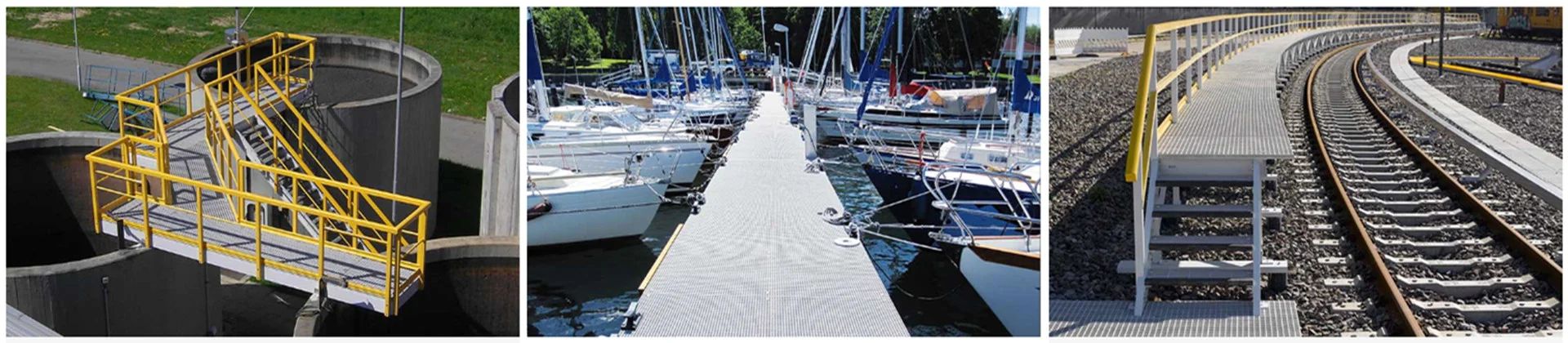
A fiberglass grating fountain combines an FRP grating platform, structural FRP or concrete basin, recirculation pump, and programmable nozzles. Water arcs above the deck, drains through the open mesh, and cycles back—creating a virtually self-cleaning water feature.
How It Differs from Concrete or Metal Water Features
-
Weight Efficiency – Pultruded panels weigh up to 70 % less than steel, allowing thinner slabs or rooftop installs.
-
Chemical Immunity – Vinyl-ester or isophthalic resin systems shrug off chlorides and acids that pit stainless or discolor marble.
-
Built-In Safety – Grit surfaces deliver a dynamic coefficient of friction (DCOF) ≥ 0.60 wet, meeting ASTM F3059 for slip resistance.
Core Benefits of Fiberglass Grating Fountains
Superior Corrosion & Chemical Resistance
ASTM B117 salt-spray testing shows marine-grade FRP retains > 95 % flexural strength after 3,000 h, whereas galvanized steel drops nearly 30 %.¹ Facilities near coastlines or chemical loading zones avoid costly recoating cycles.
High Strength-to-Weight Ratio & Load Capacity
Standard 38 mm I-bar grating supports live loads of 30–35 lb/ft² with < 6 mm deflection, yet a 1 m² panel weighs only 12 kg. Engineers can span longer distances or design demountable sections for pump access.
Slip Resistance & Worker Safety
“Even with surfactants in the water, our DCOF readings stayed at 0.64,” reports Li Wei, Safety Engineer at Jinda Petrochem. “No other deck gave us that margin.”
Embedded quartz grit remains effective for a decade of power-washing.
Low Maintenance & Lifecycle Cost Savings
A 2024 University of Delaware composite cost study estimates 25 % lower 20-year lifecycle costs versus stainless, largely by eliminating paint, welding, and corrosion repairs.²
Design Flexibility & Custom Aesthetics
Pigments run through the laminate, so color never chips. Curvilinear cuts, radial grates, and cast-in LED housings turn the deck into a statement piece without custom molds.
Real-World Applications & Case Study
Municipal & Commercial Landscapes
Parks and shopping promenades embed flush jets that children can play in, confident the deck won’t become slick or electrically conductive.
Industrial Cooling-Tower & Wastewater Facilities
Fountains above sumps aerate water and double as safe walk surfaces. FRP’s dielectric strength (> 25 kV/mm) prevents stray-current shocks.
Case Study: 22 % Downtime Reduction at a Food-Processing Plant
Facing weekly shutdowns to replace corroded stainless walk plates, a Mid-Atlantic processor engaged Unicomposite. ISO 9001-documented pultrusion lines produced prefabricated, color-coded panels that matched existing valve risers. Installation finished in one weekend, and unscheduled shutdowns fell 22 %, saving ≈ USD 58 k annually. Partnering with composite consultancy FiberTech Associates verified load calculations and ADA compliance, boosting project credibility.
Aquaculture & Agricultural Systems
Hatcheries use shallow decorative fountains to oxygenate tanks; non-conductive FRP eliminates shock risks near sensitive fry.
Installation & Maintenance Best Practices
Pre-Installation Planning & Engineering Support
Unicomposite’s engineers perform FEA to optimize bar spacing for pedestrian or vehicle loads. ISO-tracked documentation and material certifications accompany every shipment.
Step-by-Step Installation Checklist
-
Verify subgrade flatness ≤ 5 mm.
-
Dry-fit panels, allowing 5 mm thermal gaps.
-
Torque stainless clips to 9 N·m; use dielectric bushings if near power feeds.
-
Flush system to remove resin dust before commissioning.
Routine Inspection & Cleaning Guidelines
-
Quarterly—Rinse with pH-neutral detergent; inspect grit embedment.
-
Annually—Check clip torque; replace any showing corrosion > 10 %.
-
Re-grit only if DCOF < 0.50 (rare after 8–10 years).
Safety Considerations
-
Wear cut-resistant gloves and goggles when trimming panels.
-
Lock-out pumps and lighting circuits before deck removal.
-
Follow confined-space protocols for basin entry.
Sustainability & Compliance Considerations
Environmental Footprint & Recyclability
Pultruded FRP emits ≈ 2.1 kg CO₂e/kg—half that of stainless steel.³ Scrap panels can be shredded for cementitious grout or energy recovery.
Meeting Safety & Accessibility Standards
Grit surfaces comply with OSHA 1910.22 and ADA accessible-route slip criteria. Fire-retardant formulations meet ASTM E84 Class I for indoor malls or transit hubs.
Future-Proofing Water Features
UV inhibitors blended throughout the resin preserve color for ≥ 20 years. Optional carbon-black additives boost UV-C resistance for sterilization fountains.
Conclusion
A fiberglass grating fountain offers corrosion immunity, proven slip safety, and design freedom unmatched by concrete or metal. With Unicomposite’s ISO-certified pultrusion lines and design-assist engineering, specifiers can shorten schedules, lower lifecycle costs, and deliver fountains that stay beautiful for decades. Request a free composite feasibility review today—your next signature water feature starts here.
Frequently Asked Questions
Q1. How long does the grit surface remain slip resistant?
Laboratory wear testing shows grit maintains ≥ 0.60 DCOF for 10 years of daily pedestrian traffic; field re-gritting is rarely needed.
Q2. Can the grating color fade under UV?
Color pigments and UV stabilizers are blended through the laminate, providing 20-year color retention even in desert climates.
Q3. What custom shapes are possible?
Unicomposite can water-jet cut arcs, spirals, or logo patterns without special molds, keeping lead times under four weeks.
Q4. Is FRP recyclable at end of life?
Yes. Panels can be mechanically shredded for use as filler in cement or thermoset composites, diverting waste from landfill.
Q5. How does FRP handle fire safety?
Fire-retardant resins meet ASTM E84 Class I and self-extinguish within seconds once the flame source is removed.


