 info@unicomposite.com


Introduction
Steel platforms and walkways can look economical at the purchase stage, then become expensive after corrosion, coating failure, shutdown time, and replacement labor appear in the maintenance budget. For wet industrial sites, chemical areas, cooling towers, marine access routes, and utility facilities, grating selection affects safety, lifecycle cost, and daily operations.
Pultruded grating is an FRP grating option designed for projects that need high directional stiffness, corrosion resistance, low maintenance, and lightweight installation. This guide helps engineers, procurement managers, operations teams, and OEM buyers understand what it is, where it fits, how it compares with molded FRP grating, and what to confirm before requesting a quote.
The practical goal is simple: help buyers specify the right load, span, resin system, surface, panel size, support layout, and installation details before the material reaches the job site.

pultruded grating
What Is Pultruded Grating?
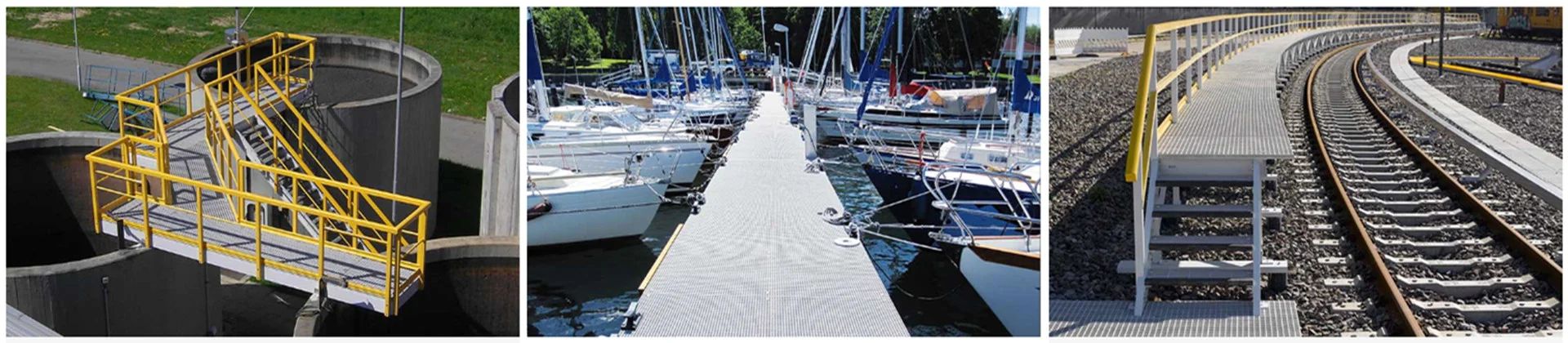
Pultruded grating is a fiberglass reinforced plastic grating made from structural FRP profiles. It is commonly used as industrial flooring, walkways, platforms, trench covers, cooling tower access panels, and corrosion resistant work surfaces.
How pultruded grating is made
The pultrusion process pulls continuous glass fiber reinforcement through a resin bath and a heated die. This creates constant cross section FRP profiles with controlled geometry, such as bearing bars and structural shapes.
A grating panel is typically assembled from pultruded bearing bars and cross rods. The bearing bars carry the main load, while the cross rods help stabilize the panel and keep spacing consistent. Because the glass fibers run mainly along the length of the profile, the panel provides strong performance in the primary span direction.
In manufacturing and field selection, engineers usually pay close attention to bearing bar height, bar spacing, resin type, panel size, and surface finish. These details decide how the panel behaves under load.
What are the main components of pultruded grating?
Pultruded grating usually includes bearing bars, cross rods, resin matrix, glass fiber reinforcement, and surface treatment. Each component affects strength, corrosion resistance, stiffness, slip resistance, and service life, so buyers should confirm these details before comparing products by price alone.
Bearing bar height affects stiffness and span capability. Cross rod spacing affects stability and panel feel. Resin selection affects chemical resistance and outdoor durability. A grit top or textured surface improves traction in wet or oily areas.
Pultruded grating vs general fiberglass grating
Fiberglass grating is the broader category. It includes both molded FRP grating and pultruded grating.
Buyers searching for pultruded products usually need more predictable directional stiffness, longer span capability, or a structural walking surface for industrial access. Buyers searching for general fiberglass grating may still be comparing molded, pultruded, covered, or custom options.
Understanding this category difference helps buyers avoid comparing products that serve different structural roles.
Key Benefits of Pultruded Grating
After defining the product, the next step is understanding why engineers choose it for demanding sites. The core benefits usually come from stiffness, corrosion resistance, weight savings, and reduced maintenance.
High strength-to-weight ratio
FRP grating is much lighter than steel, and many fiberglass structural products are commonly referenced as about one quarter the weight of steel, depending on profile geometry and reinforcement design. That weight difference can reduce handling difficulty, support structure load, freight pressure, and installation time.
For elevated walkways, roof access areas, and retrofit platforms, lighter panels can reduce the need for heavy lifting equipment. This becomes useful when a site has limited crane access or must install panels during short shutdown windows.
Actual strength depends on bearing bar height, spacing, resin system, reinforcement design, support span, and load type. Buyers should never treat all FRP panels as interchangeable.
Better span performance in one direction
Pultruded grating often performs well when the main load direction is clear. The bearing bars should run in the primary span direction so the panel uses its strongest orientation.
In field installations, engineers often check whether the panel crosses the support correctly before approving the layout. If installers rotate a panel incorrectly, the system may lose expected stiffness and create unacceptable deflection.
This directional performance makes the product useful for walkways, platforms, bridge access, and cooling tower routes where support spacing can be planned.
Corrosion resistance for harsh environments
Pultruded FRP grating resists rust and can perform well in wet, chemical, wastewater, cooling tower, marine, and utility environments when the resin matches the exposure. Polyester may suit many general industrial areas, while vinyl ester or custom resin systems may be used for stronger chemical exposure.
Corrosion resistance depends on resin formulation, fiber architecture, surface protection, fastener material, and installation conditions. Buyers should describe the actual environment, including salt air, acids, alkalis, solvents, washdown, UV exposure, temperature, and chemical concentration.
Low maintenance and lifecycle value
Steel grating may require coating, rust repair, or replacement in corrosive zones. FRP grating can reduce those recurring tasks and help lower maintenance disruption over the project lifecycle.
Procurement teams should compare total installed value, not only panel price. Labor, shutdowns, access equipment, coating, replacement frequency, and safety risk all affect the final cost.
Non-conductive and slip-resistant options
Fiberglass grating is non-conductive, which gives it value in utility areas, electrical facilities, cable access routes, and industrial sites where metal walking surfaces may create concerns. For safety, buyers can specify grit top, textured surface, color, UV package, and fire-retardant resin options.
A surface selected for a dry indoor plant may not fit a wet cooling tower or wastewater platform. Application drives surface choice.
Pultruded Grating vs Molded FRP Grating
The best FRP grating choice depends on span, load direction, cutting needs, installation layout, and exposure. The table below compares the two common grating types for B2B buyers.
| Factor | Pultruded Grating | Molded FRP Grating | Buyer Takeaway |
|---|---|---|---|
| Load direction | Strong directional performance | More balanced multi-directional behavior | Use pultruded panels when the main span direction is clear |
| Span performance | Often stronger for longer spans | Often better for shorter, complex layouts | Match panel type to support spacing |
| Stiffness | High stiffness along bearing bars | Good general stiffness | Check deflection limits before buying |
| Cutting flexibility | Requires careful layout planning | Often easier for irregular cutouts | Molded panels may suit complex field fitting |
| Corrosion resistance | Resin dependent | Resin dependent | Resin selection matters for both |
| Surface options | Grit or textured options | Grit or concave surfaces common | Choose based on wet, oily, or dry conditions |
| Common applications | Walkways, platforms, cooling towers | Trench covers, floors, irregular areas | Use the site layout to guide selection |
| Cost logic | Can be cost-effective for span-driven designs | Can be cost-effective for cut-heavy layouts | Compare lifecycle and installation cost |
When should buyers choose pultruded grating over molded grating?
Buyers should choose pultruded grating when longer spans, higher directional stiffness, predictable load direction, and strong structural performance matter more than multi-directional load behavior or extensive field cutting. It often fits walkways, cooling tower access routes, platforms, trench covers, and industrial flooring with planned support layouts.
For example, an elevated access walkway with consistent supports may benefit from pultruded bearing bars aligned with the span. A floor area with many irregular penetrations may need a different approach.
When molded FRP grating may be more suitable
Molded FRP grating may be better when the project requires frequent cutouts, complex drainage layouts, multi-directional loads, or irregular field fitting. It can also work well in areas where panels must be trimmed around pipes, drains, or equipment bases.
Balanced material selection avoids overbuying. A project may even use pultruded panels in long walkways and molded panels in cut-heavy zones.
Common Uses of Pultruded Grating
Once the buyer understands the comparison, application becomes easier to define. Pultruded FRP products fit best where the layout, load direction, and operating environment support their strengths.
Industrial platforms and walkways
Factories, warehouses, processing plants, and equipment areas use FRP grating for elevated walkways, access platforms, maintenance routes, and plant flooring. Buyers should confirm live load, concentrated load, support span, deflection expectation, and traffic type.
A technician walkway has different requirements from a platform that supports tool carts or temporary maintenance equipment.
Cooling tower access systems
Cooling towers expose access surfaces to moisture, chemical treatment residues, airflow, and repeated maintenance traffic. In an anonymized cooling tower retrofit, an operations team selected FRP grating after coated metal panels showed corrosion at support points and created recurring replacement work.
The selection team focused on resin system, support span, grit surface, panel orientation, and fastener material. The goal was to reduce corrosion-related maintenance while keeping access routes safe for wet foot traffic.
Chemical and wastewater plants
Chemical and wastewater facilities often include splash zones, wet floors, vapor exposure, and aggressive cleaning routines. In these environments, resin compatibility can matter as much as mechanical performance.
Buyers should identify the chemicals present, exposure duration, washdown frequency, temperature, and whether the area is continuously wet or intermittently exposed. Fasteners and support frames should also match the environment.
Marine and offshore walkways
Marine sites introduce salt air, UV exposure, water contact, and slip risk. Lightweight FRP panels can help installation teams handle materials on docks, platforms, and access routes where heavy lifting equipment may be limited.
For these projects, surface grip, UV resistance, corrosion exposure, and fastening hardware deserve early review.
Utility and electrical facilities
Utility and electrical facilities often value non-conductive grating, corrosion resistance, and lightweight installation. FRP grating may fit cable access routes, electrical maintenance platforms, substations, and equipment walkways.
The full system still needs review. Support frames, fasteners, handrails, grounding requirements, and nearby conductive components can affect the final safety design.
How to Choose Pultruded Grating for Your Project
A strong specification starts before the RFQ. Buyers should collect load, span, environment, surface, and installation data before comparing suppliers.
What load and span data should buyers confirm?
Buyers should confirm live load, concentrated load, support span, bearing bar direction, deflection limit, traffic type, and whether carts or equipment will move across the grating. These details determine bar height, panel type, reinforcement direction, support layout, and whether a standard or custom panel is suitable.
Live load includes people, tools, temporary work loads, and moving traffic. Concentrated load covers smaller contact areas, such as cart wheels, equipment feet, or maintenance stands.
Deflection also matters. A panel may carry the load yet still feel too flexible if the span or profile height is wrong.
Resin system and corrosion exposure
Resin selection should match the operating environment. Polyester can serve many general industrial applications, while vinyl ester or custom resin may suit stronger chemical exposure.
Buyers should list wastewater, salt air, acids, alkalis, solvents, washdown, UV, and heat exposure where applicable. The more precise the exposure description, the better the material recommendation.
Surface finish and slip resistance
Surface finish should match the safety risk. Grit top surfaces often work well in wet, oily, or outdoor areas. Textured surfaces may suit moderate slip conditions, while covered grating can help when small objects, tools, or foot traffic need a more continuous surface.
Slip resistance should be treated as a functional requirement.

pultruded grating 2
Bar height, panel size and open area
Bearing bar height affects stiffness and span capability. Bar spacing and open area affect drainage, airflow, weight, light transmission, and walking comfort.
For cooling towers, open area may affect airflow and drainage. For platforms, walking comfort and deflection may matter more. For trench covers, load and bearing support often drive selection.
Fasteners, support layout and installation method
Buyers should confirm clip type, hold-down method, support spacing, bearing surface, panel orientation, cutting, drilling, and edge treatment. If field cutting is expected, supplier guidance should be followed.
Installation quality often determines whether the grating performs as designed.
Buying Guide for B2B Procurement Teams
Procurement teams can reduce quoting delays by sending complete project information early. The table below shows the key details to confirm.
| Specification | What to Confirm | Why It Matters |
|---|---|---|
| Application | Walkway, platform, trench cover, cooling tower, marine, utility | Defines performance priorities |
| Load | Live load, concentrated load, cart traffic | Determines bar height and spacing |
| Span | Support spacing and bearing direction | Controls stiffness and deflection |
| Resin | Polyester, vinyl ester, custom resin | Matches corrosion exposure |
| Surface | Grit, textured, covered, color | Affects safety and usability |
| Fire retardancy | Project or facility requirement | Affects resin formulation |
| Panel size | Length, width, tolerance | Controls fit and installation |
| Cutouts | Holes, notches, field cuts | Reduces rework |
| Fasteners | Clips, hold-downs, hardware material | Supports safe installation |
| Packaging | Bundle size, labels, pallets | Improves job site handling |
| Drawings | Layout, supports, quantities | Improves quote accuracy |
What information should buyers send for a quote?
Buyers should send drawings, panel dimensions, load requirements, support span, resin preference, surface type, quantity, exposure environment, color, cutting needs, fastening method, and packaging requirements. Complete information helps suppliers quote accurately, recommend suitable panels, and reduce production delays.
When drawings are unavailable, buyers can provide photos, sketches, old panel samples, support spacing, and a description of the site environment. That information still helps the supplier narrow the selection.
When is custom pultruded grating needed?
Custom grating may be needed for non-standard panel sizes, special resin systems, custom colors, pre-cut panels, drilled holes, special packaging, or OEM repeat orders. It also helps when standard panel dimensions create waste or installation rework.
Unicomposite Technology Co., Ltd is an ISO 9001 certified FRP/GRP composite manufacturer based in Nanjing, China, with an 18,000 square meter manufacturing facility. Its production capabilities include pultrusion, pulwinding, SMC/BMC molding, hand lay-up, and vacuum infusion for standard and custom composite products.
For buyers, that means drawings, exposure conditions, load/span data, resin requirements, surface finish, cutting plans, and packaging requirements can be reviewed before production.
Lifecycle cost vs initial price
Initial panel price should be compared with freight, installation labor, coating, shutdowns, maintenance frequency, and replacement risk. A cheaper material can become expensive in corrosive or hard-to-access sites.
For a remote utility platform or cooling tower access route, avoiding repeated replacement work can justify a higher-performance material.
Installation and Maintenance Considerations
After selection, installation quality controls real performance. The panel must match the support layout, bearing direction, and fastening method.
Support layout and bearing direction
Bearing bars should run in the intended span direction. Installers should verify panel orientation before fastening, especially when panels are cut to fit around equipment or supports.
A panel selected for one support span should not be stretched across a wider opening without engineering review. Deflection and safety can change quickly when span increases.
Cutting, drilling and edge treatment
Field cutting and drilling should follow supplier guidance. Installers should use suitable tools, dust control practices, and edge finishing where required.
In field installations, problems often start at unsupported edges, rough field cuts, incorrect fastener placement, or panels installed against the wrong support direction. Planning the layout before cutting reduces those risks.
Inspection and maintenance routine
Pultruded FRP grating is low maintenance, but industrial sites still need planned inspection. Teams should check fasteners, supports, surface wear, impact damage, debris buildup, and any change in chemical exposure.
A simple inspection routine helps buyers protect the service value they selected during procurement.
Conclusion
Pultruded grating is best suited for industrial projects that need directional stiffness, corrosion resistance, low maintenance, and lightweight installation. It is widely used for platforms, walkways, cooling tower access routes, chemical and wastewater facilities, marine areas, and utility sites.
Buyers should compare pultruded and molded FRP grating based on span, load direction, cutting needs, exposure, surface safety, and installation layout. The strongest RFQs include drawings, load and span data, resin requirements, surface finish, quantity, fastening details, and packaging needs.
Custom grating should be considered when standard panels do not match the site layout, exposure environment, or OEM assembly requirements.
[Contact Unicomposite for a custom pultruded grating quote →]


