 info@unicomposite.com


Introduction
Sourcing fiberglass grating from China is not only a price comparison. For engineers, procurement managers, and operations decision-makers, the real question is whether a manufacturer can match the correct grating type, resin system, panel size, support span, load requirement, surface finish, fabrication plan, packaging method, and export schedule.
A low quote can become expensive if panels do not fit the frame, if the resin does not match chemical exposure, or if packaging causes damage before the grating reaches the jobsite. This guide helps buyers evaluate a China fiberglass grating manufacturer before requesting quotes or placing bulk orders.
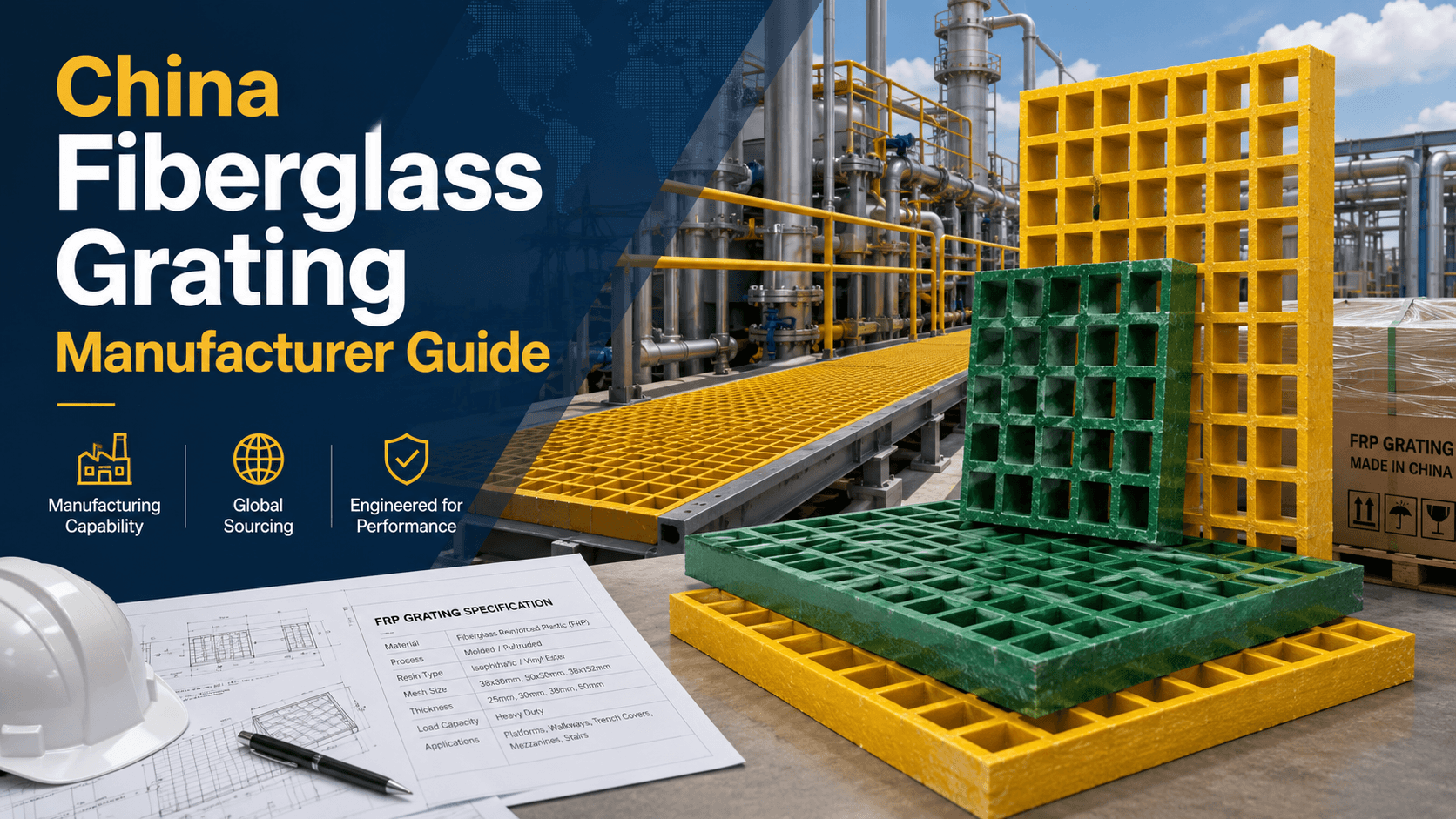
The focus is practical sourcing: FRP grating types, manufacturer checks, key specifications, RFQ preparation, provider comparison, and custom supply for industrial platforms, walkways, trench covers, and access areas.
china fiberglass grating manufacturer guide
What Is China Fiberglass Grating?
China fiberglass grating refers to FRP or GRP grating manufactured in China for industrial, commercial, municipal, utility, marine, and infrastructure applications. It uses fiberglass reinforcement and resin to form open mesh panels, walkway surfaces, stair treads, trench covers, or custom platform components.
Common product forms include molded fiberglass grating, pultruded fiberglass grating, fiberglass walkway grating, stair tread grating, and trench cover grating. Buyers choose FRP grating for corrosion resistance, lightweight handling, drainage, slip-resistant surface options, and dielectric behavior when these properties match the service environment.
Fiberglass Grating Material and Structure
Fiberglass grating combines glass fiber reinforcement with a resin matrix. The reinforcement provides structural support, while the resin helps protect the product against moisture, chemicals, UV exposure, or other site conditions.
Key specification points include panel size, mesh size, thickness, resin system, surface finish, color, support span, load requirement, cutting, clips, and packaging. These details matter more than a generic product name.
Why Buyers Search for China Fiberglass Grating
Buyers often search for China fiberglass grating to compare manufacturers, bulk supply options, custom specifications, factory capability, and export-ready pricing. Searches that include manufacturer, supplier, walkway grating, custom, or quote usually carry clear B2B sourcing intent.
In sourcing reviews, engineers often find that a quote without application details is difficult to compare. A grating panel for a chemical trench, a wastewater platform, and a utility walkway may look similar in a catalog, but each one can require different resin, thickness, surface, and support-span decisions.
What is China fiberglass grating used for?
China fiberglass grating is used for industrial platforms, walkways, trench covers, stair treads, wastewater facilities, chemical plants, marine docks, and utility access areas where buyers need corrosion resistance, drainage, slip resistance, and custom FRP grating supply. Application conditions should guide resin, mesh, thickness, and surface selection.
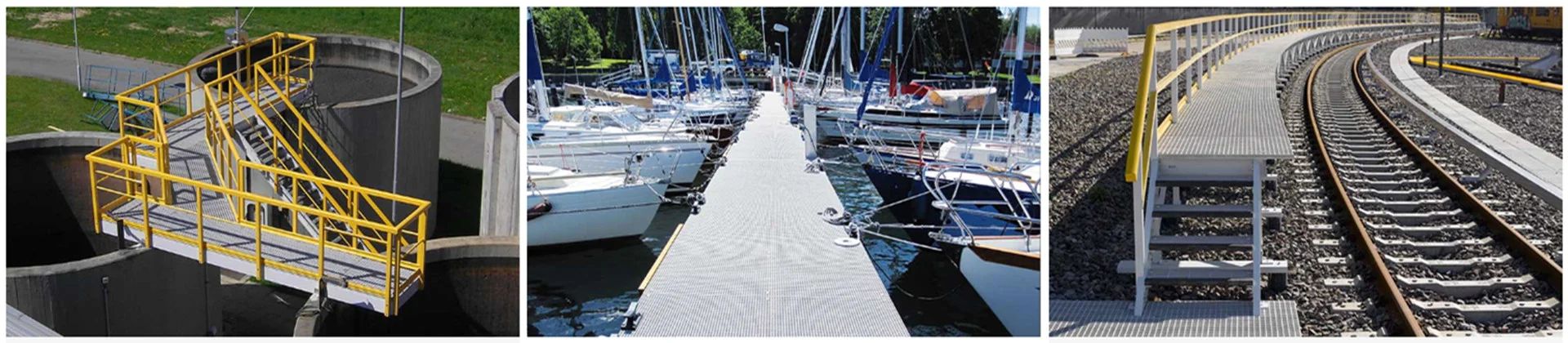
For example, wastewater walkways may prioritize corrosion resistance and drainage, while utility access areas may value lightweight handling and dielectric properties. Marine applications may need more attention to salt exposure, UV conditions, fasteners, and inspection planning.
Why Source Fiberglass Grating from China?
After defining the product, buyers need to decide whether China sourcing fits the project. The answer often depends on production capacity, customization, bulk-order support, export experience, and the buyer’s ability to verify factory controls.
Manufacturing Capacity and Custom Supply
Many B2B buyers source fiberglass grating from China because they need production capacity, custom dimensions, multiple grating types, fabrication support, and repeat-order supply. This can help industrial contractors, distributors, OEMs, wastewater plants, and infrastructure projects.
Buyers should not assume every supplier has the same factory capability. A practical check includes asking whether the supplier can provide molded and pultruded grating, custom panel sizes, resin choices, surface finishes, cutting, drilling, clips, and labeled packaging.
Cost, Customization, and Export Readiness
China sourcing can support custom mesh size, panel size, thickness, resin system, color, surface finish, cutting, clips, labels, and packaging. These options help buyers move from standard catalog supply to project-specific grating.
Export readiness also affects total project risk. Buyers should confirm pallet design, package labels, documentation, sample confirmation, lead time, destination port, and repeat-order consistency before comparing prices.
What should buyers check before choosing a China fiberglass grating manufacturer?
Buyers should check production capability, molded and pultruded grating options, resin systems, panel size control, load and span support, fabrication services, quality inspection, sample availability, export packaging, lead time, and communication quality before choosing a China fiberglass grating manufacturer. These checks reduce specification, delivery, and installation risks.
A serious manufacturer should ask about application, environment, support spacing, load requirement, surface finish, and drawings before finalizing a quote. If the supplier only asks for quantity and target price, the technical risk stays with the buyer.
Common Types of Fiberglass Grating
Once buyers confirm sourcing direction, they still need to choose the right grating category. Molded, pultruded, walkway, stair tread, and trench cover grating do not serve the same purpose.
Molded Fiberglass Grating
Molded fiberglass grating is often selected for corrosion resistance, open mesh drainage, bidirectional support, platforms, walkways, and chemical or wastewater environments. It can suit areas where fluids need to pass through the panel and where loads may come from more than one direction.
Buyers should confirm mesh size, panel thickness, resin system, surface finish, color, and cutting requirements. Molded grating can be a strong fit when corrosion, drainage, and walking access matter more than long-span directional stiffness.
Pultruded Fiberglass Grating
Pultruded fiberglass grating is often used when directional load performance, longer support spans, or stronger bearing bars are needed. Engineers should confirm span, load, deflection expectations, bearing direction, and support layout before ordering.
This type can fit industrial platforms and access areas where the bearing direction must match the structural frame. It should not be selected only by thickness; load path and support spacing matter just as much.
Fiberglass Walkway Grating
Fiberglass walkway grating supports maintenance routes, access platforms, outdoor walkways, marine docks, and facility walk paths. Buyers searching for China fiberglass walkway grating usually want a walking surface with drainage, corrosion resistance, custom sizing, and suitable traction.
Surface finish matters here. Gritted or concave tops can improve footing, while covered options may fit applications where dropped-object risk or small-item passage must be reduced.
Product Type Comparison Table
The table below helps buyers match common fiberglass grating types with typical use cases and specification priorities:
| Type | Typical Use | Buyer Benefit | Key Specification |
|---|---|---|---|
| Molded fiberglass grating | Chemical platforms, wastewater walkways | Corrosion resistance, drainage, multi-directional support | Mesh size, resin, thickness |
| Pultruded fiberglass grating | Higher span platforms | Stronger directional load support | Bearing direction, span, load |
| Fiberglass walkway grating | Access routes and maintenance paths | Safer walking surface and drainage | Surface finish, width, support spacing |
| Stair tread grating | Industrial stairs | Better footing on steps | Nosing, width, fixing method |
| Trench cover grating | Drainage channels and pits | Removable access with drainage | Edge support, load, panel fit |
Choosing the right type reduces the risk of overpaying for the wrong structure or under-specifying a safety-critical access area.
Key Specifications Buyers Should Confirm
After selecting the grating type, buyers should convert the requirement into measurable specifications. A clear specification allows the manufacturer to quote the correct product instead of guessing.
Panel Size, Thickness, and Mesh Size
Buyers should confirm length, width, thickness, mesh or opening size, bearing direction, support span, and whether panels must fit existing steel frames. Thickness should be selected together with support spacing and load requirement.
A thick panel does not automatically solve a poor support layout. Load type, point load, frame condition, bearing direction, and deflection expectations all affect the final selection.
Resin System and Environment
Resin selection should reflect general industrial use, chemical exposure, wastewater, marine or salt exposure, outdoor UV exposure, and fire-retardant project requirements. Performance depends on chemical type, concentration, temperature, cleaning process, UV exposure, installation, and inspection schedule.
Buyers should describe the environment clearly. “Chemical area” is less useful than naming the exposure type, temperature, cleaning routine, and whether contact is occasional splash or continuous exposure.
Surface Finish and Safety
Surface finish affects traction, cleaning, drainage, maintenance, and worker access. Common options include gritted top, concave surface, smooth surface, covered grating, and anti-slip treatment.
Gritted and concave surfaces often suit walkways and platforms. Covered grating may fit areas where a more continuous surface is needed or where small objects should not pass through the openings.
Cutting, Clips, and Installation Support
Pre-cut panels, drilled holes, edge finishing, fixing clips, layout labels, and installation-zone packaging can reduce jobsite confusion. These details help most in retrofits, where grating must match existing support frames.
In one anonymized platform retrofit, the initial plan risked delays because panels were not grouped by work zone and clip positions were unclear. After the buyer provided frame drawings and fixing details, the manufacturer pre-cut panels, grouped them by installation area, labeled the packages, and supplied matching clips for each zone.
China Fiberglass Grating Manufacturer vs Supplier
Provider type affects technical control. A direct manufacturer, trading supplier, stock distributor, and project fabricator can all be useful, but each one fits a different procurement situation.
Direct Manufacturer
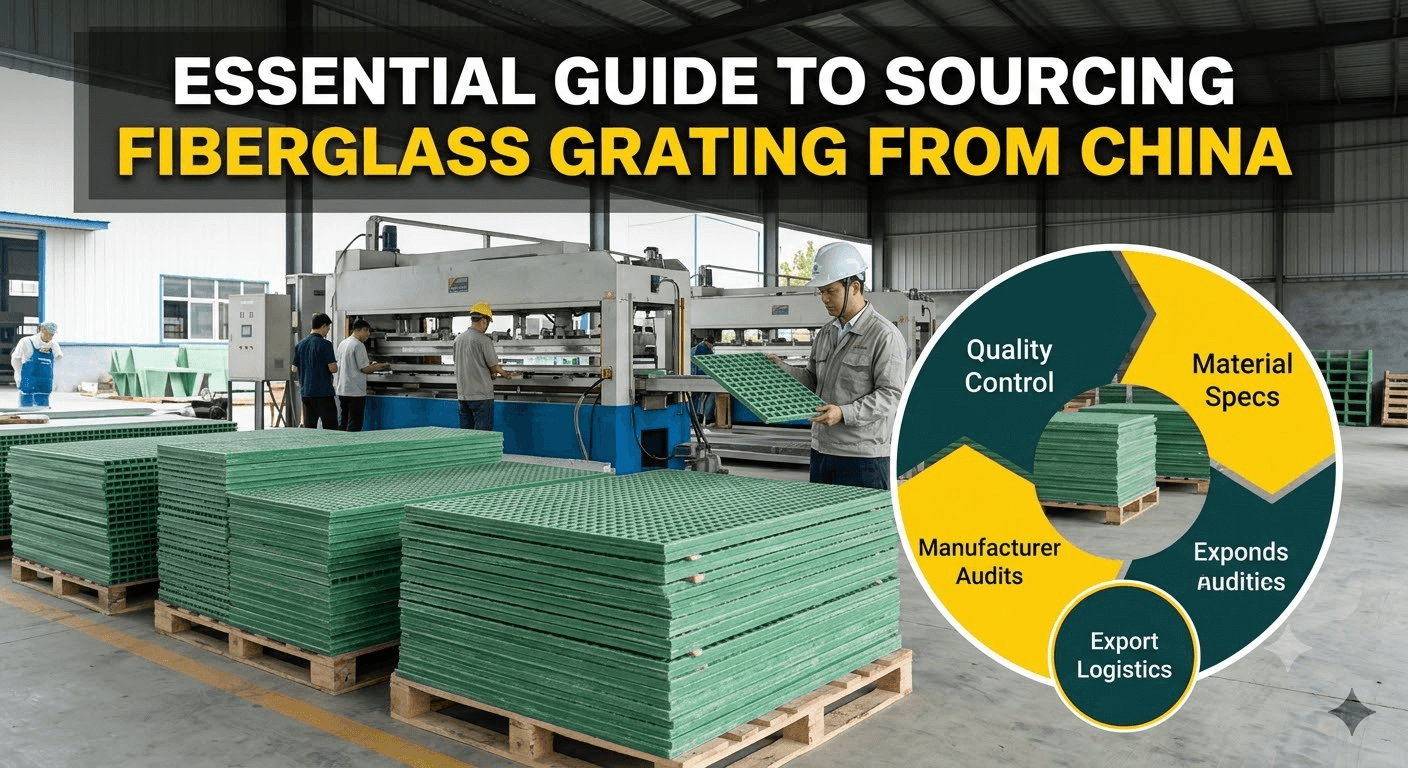
A direct manufacturer is better suited for custom specifications, bulk production, repeat orders, and closer technical control. Buyers should ask about production process, mold availability, quality control, sample support, fabrication capability, and export packaging.
Direct factory communication can also shorten technical clarification when drawings, special resin, or cut-to-size panels are involved.
Trading Supplier
A trading supplier may help with mixed sourcing or smaller orders. This can work when the buyer needs multiple products from different factories or wants flexible sourcing.
The main risk is less control over production details. Buyers should ask about factory traceability, inspection responsibility, sample approval, and repeat-order consistency.
Stock Distributor
A stock distributor may help with urgent standard panels or local inventory needs. This can work for replacement panels and small-volume orders.
The limitation is customization. Stock distributors may have fewer choices in resin, mesh, color, cutting, or packaging.
china fiberglass grating
Provider Comparison Table
The table below gives buyers a quick way to compare provider types before requesting quotes:
| Provider Type | Best For | Main Risk | What to Ask |
|---|---|---|---|
| Direct manufacturer | Custom and bulk orders | Capability must be verified | Factory process, QC, samples |
| Trading supplier | Mixed sourcing | Less control over specs | Source traceability |
| Stock distributor | Urgent standard orders | Limited customization | Available sizes and resin |
| Project fabricator | Installation-ready packages | May not produce panels | Fabrication scope and source |
After buyers choose the provider type, the next step is to prepare an RFQ that gives each supplier the same technical baseline.
How to Prepare a Fiberglass Grating RFQ
A clear RFQ reduces quote revisions and helps manufacturers recommend the right grating. It also allows engineering and purchasing teams to compare offers fairly.
RFQ Information Buyers Should Provide
A useful RFQ should describe the application, environment, panel geometry, load, span, surface, resin, fabrication, packaging, and destination. For repeat orders, buyers should also include approved samples, previous specifications, packaging records, and label requirements.
The goal is simple: reduce assumptions before price comparison begins.
RFQ Checklist Table
The table below can be used as a practical RFQ checklist for fiberglass grating projects:
| RFQ Item | What to Provide | Why It Matters |
|---|---|---|
| Application | Platform, walkway, trench, dock | Defines use environment |
| Panel dimensions | Length, width, thickness | Supports accurate quote |
| Mesh and thickness | Opening size and panel depth | Affects drainage and load |
| Load and span | Support spacing and load type | Prevents under-specification |
| Resin system | Chemical, UV, marine, fire needs | Matches exposure conditions |
| Surface finish | Gritted, concave, covered | Matches safety and cleaning |
| Fabrication | Cutting, drilling, clips | Reduces site work |
| Quantity | Panels or square meters | Affects production planning |
| Drawings | Layout or installation sketch | Reduces errors |
| Destination | Country, port, warehouse | Supports shipping quote |
What specifications are needed for a fiberglass grating quote?
Buyers should provide application, panel size, thickness, mesh size, support span, load requirement, resin system, surface finish, fabrication needs, quantity, drawings, packaging, destination, and delivery expectations for an accurate fiberglass grating quote. These details help manufacturers match the grating to the project environment.
For long-term purchasing, buyers should keep a final specification file. It should include drawings, approved resin, surface finish, color, clips, packaging, and sample notes.
Source Custom Fiberglass Grating from Unicomposite
For buyers seeking custom fiberglass grating from China, manufacturer capability should translate into procurement benefits. Unicomposite Technology Co., Ltd. is an ISO 9001 certified FRP and GRP composite manufacturer based in Nanjing, China, with an 18,000-square-meter facility.
Manufacturing and Customization Capabilities
Unicomposite supports molded FRP grating, pultruded profiles, pulwinding, SMC/BMC molding, hand lay-up, vacuum infusion, cutting, drilling, custom fabrication, and export supply. These capabilities support different buyer needs: molded grating for corrosion-focused platforms, pultruded production for consistent profiles, fabrication for cut-to-size orders, and export packaging for safer overseas delivery.
For procurement teams, that means custom dimensions, sample review, labeled packages, and export-ready pallets can be planned before mass production.
Best-Fit Buyers and Applications
Unicomposite is a fit for engineering contractors, distributors, wastewater facilities, chemical plants, municipal infrastructure buyers, marine projects, utilities, and industrial platform builders. These buyers often need corrosion-resistant resin, slip-resistant surfaces, cutting, clips, and repeat-order consistency.
A project buyer may need grating grouped by platform zone. A distributor may need stable labels and packaging. An engineer may need resin and span support clarified before approval.
Quote Preparation Checklist
Buyers should send application, size, thickness, mesh, resin, surface, load and span, drawings, quantity, packaging, destination, and target lead time. Clear information helps the manufacturer quote faster and reduce specification errors.
For custom projects, buyers can also send photos, frame drawings, clip preferences, pallet requirements, and inspection expectations.
Conclusion
China fiberglass grating sourcing should focus on manufacturer capability, not only price. Buyers should compare molded, pultruded, walkway, stair tread, and trench cover grating based on the actual application.
Resin, mesh, thickness, surface finish, load, span, cutting, clips, and packaging should be confirmed before ordering. Direct manufacturers can support custom and repeat orders when factory capability, quality control, and export packaging are verified.
A complete RFQ helps reduce quote errors, specification mismatch, delivery issues, and jobsite confusion.
[Contact Unicomposite for a custom fiberglass grating quote →]


