 info@unicomposite.com


Introduction
Last spring, I stood on a job site where a pedestrian bridge retrofit had stalled: the specified steel stringers were too heavy for the boom lift and the contractor’s rental window was closing. We swapped in pultruded fiberglass-reinforced plastic (FRP) beams, shaved 68 kg per piece, and finished the install before sunset—no change order required. Moments like this illustrate why mastering the behaviour of FRP beams turns composites from “interesting option” into a reliable design tool. Drawing on Unicomposite’s three-decade pultrusion track record and fresh 2024 research, this guide converts lab data into practical rules you can use on your next bill of materials.

behaviour of frp beams
Fundamentals of FRP Beam Behaviour
Composite makeup & anisotropy basics
FRP beams are built from continuous glass fibers (strength) embedded in a thermoset resin (shape and durability). Because ≈ 75 % of fibers run longitudinally, flexural stiffness is high about the strong axis and lower about the weak. Typical longitudinal modulus: 28 GPa; transverse modulus: 8 GPa.
Stress–strain profile vs. steel & aluminum
Steel yields, then work-hardens. FRP is linear-elastic until a brittle cliff at ≈ 2 % strain (ASTM D7264). Yet at one-quarter the density of steel, designers can hit the same stiffness with far less weight.
Role of fiber orientation & resin type
A 5° fiber misalignment trims bending strength by ~10 %. Resin selection drives environment limits: vinyl-ester boosts chemical resistance but lowers heat-deflection ≈ 10 °C. Choose chemistry first, lay-up second.
Load-Driven Performance Factors
Flexural & shear under static loads
Four-point bends on 100 × 50 mm pultruded I-beams carry 12 kN at L/180 deflection—matching light-gauge steel studs. Shear seldom governs until spans exceed 2 m thanks to biaxial veil reinforcement.
Creep, fatigue & impact over service life
A 2024 ASCE Composites Congress paper reports 50-year creep rupture thresholds at 31 % of short-term ultimate stress—up one point from 2023’s figure. Fatigue tests (2 Hz, 25 °C) show a 1 × 10⁶-cycle endurance limit near 45 % of ultimate, outperforming aluminum panels [1].
Design safety factors & partial-factor guidelines
Eurocode draft prEN 13706-4 recommends γ_m = 1.35 (flexure) and 1.50 (shear). When codes are silent, many EPC firms use 0.5 × ultimate for allowable service stress and 0.85 × ultimate for accidental overloads.
Environmental & Service Conditions
Temperature, UV & moisture
Glass-transition (Tg) sets the ceiling. Polyester pultrusions: Tg ≈ 120 °C; maintain loads ≤ 0.3 × ultimate above 80 °C to curb creep. UV-blocking surfacing veils limit color fade to ≤ 5 ΔE over five years of Arizona exposure.
Chemical vs. galvanic corrosion
In pH 1 hydrochloric acid, FRP retains ≥ 90 % tensile strength after 2 000 h; carbon steel loses > 40 % section. FRP’s non-conductivity also sidesteps galvanic coupling between dissimilar metals in brackish water.
Fire, smoke & dielectric properties
A 2024 University of Sheffield study found halogen-free FR resin systems achieve ASTM E84 flame-spread ≤ 20 and smoke-developed ≤ 225 while maintaining 95 % flexural modulus post-exposure [2]. Dielectric breakdown exceeds 200 kV/cm—critical for power-utility cross-arms.
Design Optimization Strategies
Profile geometry & wall thickness
Replacing a steel W4 × 13 with a 100 × 50 × 6 mm rectangular FRP tube cuts 6 kg/m yet keeps identical moment of inertia. Aim for I/G ≥ 1.5 to limit torsional twist on open sections.
Hybridizing with steel plates or carbon fibers
Bonding a 3 mm galvanized “tension face” plate raises buckling capacity 25 % (use isolation tape). For ultra-light footbridges, carbon cap-strips add stiffness without inflating GI.
Connection methods
-
Bolted: Oversize holes + neoprene sleeves distribute bearing; torque 50 % lower than steel.
-
Bonded: Methacrylate adhesives deliver 8–10 MPa lap-shear—abrade to 50 µm Ra first.
-
Embedded inserts: Unicomposite integrates stainless bosses during pultrusion, eliminating secondary drilling and preserving warranty.
“Integrating inserts at the 1.2 m/min line speed saves contractors a full day per bridge deck,” says Liu Wei, Senior Process Engineer, Unicomposite.
Safety Considerations
-
Wear cut-resistant gloves & P2 respirator when machining; glass dust irritates lungs.
-
Use carbide blades at ≤ 3 m/s feed to prevent fiber pull-out.
-
Torque bolts gradually to avoid local crush; verify with calibrated wrench.
-
Conduct spark-testing before energizing installations near live conductors.
Validation, Testing & Quality Assurance
Key ASTM/ISO methods
D790 flexural, D2344 short-beam shear, ISO 527 tensile, and DMA for Tg tracking form the baseline mechanical dossier.
Factory production & third-party certification
Unicomposite’s ISO 9001 lines feature in-line laser micrometers and monthly Lloyd’s Register audits. Certificates of Analysis tie each beam to resin and glass lot numbers.
Case study: Wastewater walkway, 2019–2024
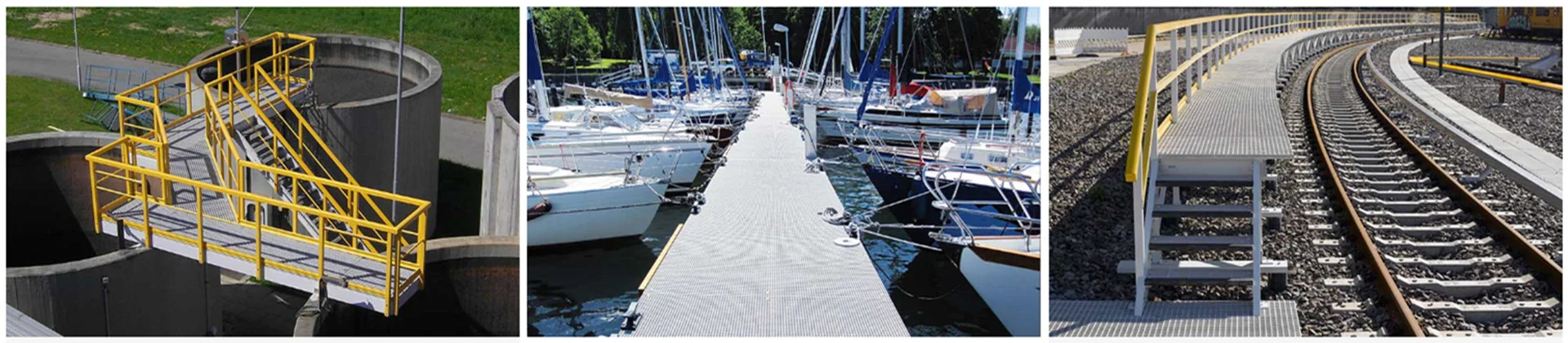
A Midwest facility replaced rusted steel supports with Unicomposite 152 mm I-beams. Five-year pull-off tests show 98 % modulus retention and zero blistering, saving US $75 000 in repainting.
Conclusion
Understanding the behaviour of FRP beams—from anisotropic mechanics to long-term creep—lets engineers trade rust and weight for durability and design freedom. Apply code-based factors, choose environment-specific resins, and consult specialists early. Ready to lighten your next structure? Contact the Unicomposite engineering desk for tailored beam selection and tooling.
Frequently Asked Questions
Q1. How do FRP beams handle freeze–thaw cycles?
Flexural modulus drops ≤ 5 % at –40 °C, and micro-cracking is minimal. Select resin systems toughened with elastomers for cold regions.
Q2. Can I machine FRP beams on-site?
Yes—use carbide tools, low feed, vacuum extraction, and seal exposed fibers with UV-stable resin to maintain durability.
Q3. What lead time should I expect for custom profiles?
Unicomposite typically designs tooling in three weeks and ships first articles in 6–8 weeks, depending on complexity.
Q4. Are there building codes covering FRP beams?
ICC-AC454 (2023) and Eurocode prEN 13706 provide design equations; most jurisdictions accept them via alternative-materials clauses.
Q5. Do FRP beams meet fire-safety requirements?
Fire-retardant formulations can achieve ASTM E84 Class A flame-spread; always verify project-specific ratings with test reports.


