 info@unicomposite.com


Introduction
Carbon fiber pultrusion produces profiles with a tensile strength-to-weight ratio approximately 5× higher than structural mild steel — based on T700 CFRP composite at 60% fiber volume fraction versus A36 steel at 250 MPa yield strength — and a specific stiffness that no other continuous-fiber manufacturing process matches at equivalent cross-section. Despite these properties, the majority of composite structural specifications still default to fiberglass. The reason is rarely technical: it is that engineers lack a clear decision framework for when carbon fiber pultrusion delivers decisive advantage and when the cost premium is not justified.
This guide closes that gap. You will find an explanation of how the carbon fiber pultrusion process works, what profile types it produces, a direct property comparison against fiberglass across the parameters that drive B2B specification decisions, the five application categories that make the strongest case for carbon over glass, and a specification checklist that produces a purchase document the supplier is bound to deliver against.
Unicomposite Technology Co., Ltd produces pultruded profiles in both carbon fiber and fiberglass resin systems at its 18,000 m² manufacturing facility in Nanjing, China. The process comparisons and specification guidance in this article reflect direct production experience across both fiber types — not a single-fiber manufacturer’s advocacy for carbon fiber as a universal material upgrade.
carbon fiber pultrusion
1. How Carbon Fiber Pultrusion Works
1.1 The Pultrusion Process with Carbon Fiber Reinforcement
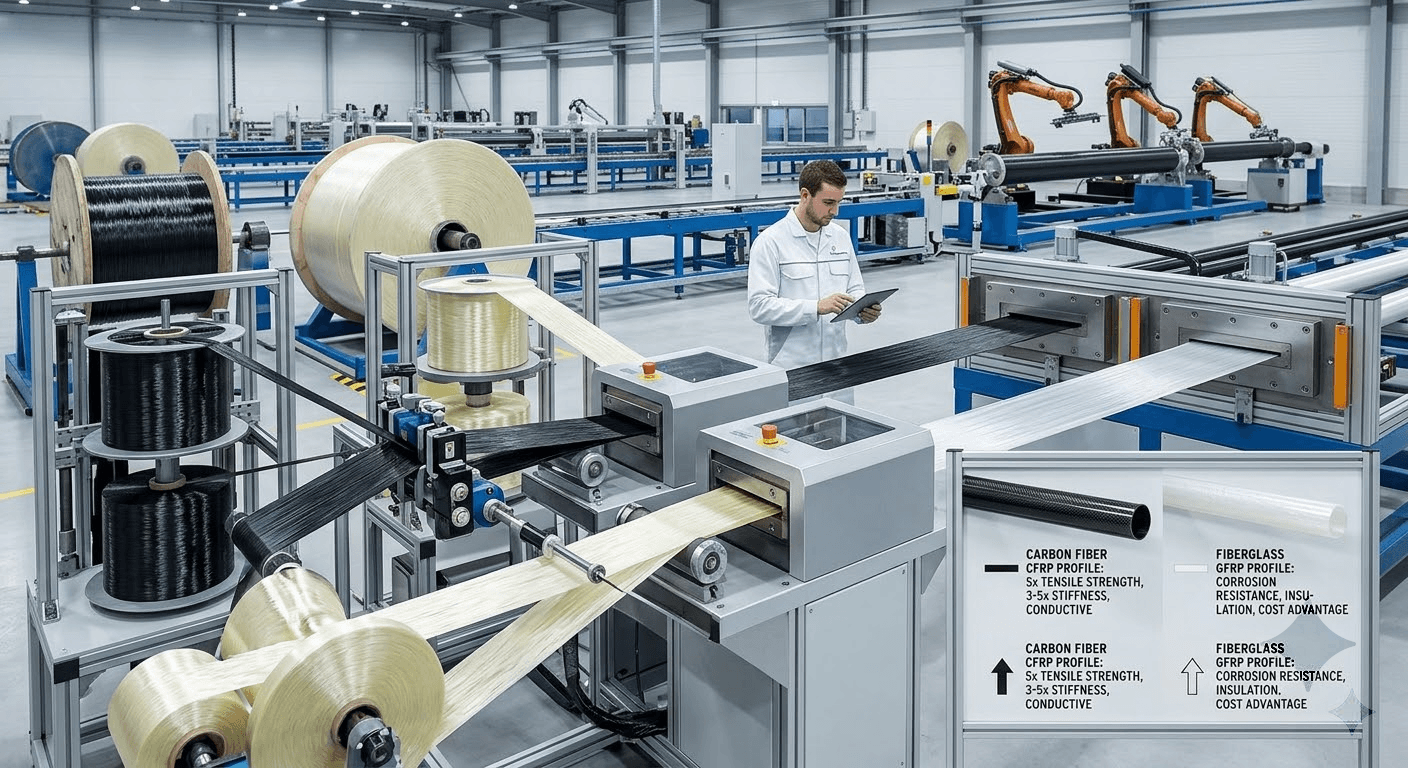
Carbon fiber pultrusion follows the same fundamental mechanism as fiberglass pultrusion: continuous fiber reinforcements are pulled through a resin impregnation system, then drawn through a heated steel die where the composite cures under controlled temperature and pressure to produce a profile of constant cross-section. The output is a seamless, continuous-length structural shape with fiber volume fractions typically reaching 55–65% and highly consistent cross-sectional dimensions.
Three process variables distinguish carbon fiber pultrusion from its fiberglass equivalent in ways that matter for manufacturing quality and specification. First, carbon fiber’s electrical conductivity requires modified die design and grounding precautions that standard fiberglass pultrusion lines do not incorporate — a capability gap that narrows the field of qualified CFRP pultrusion suppliers relative to the broader fiberglass pultrusion market. Second, carbon fiber’s higher fiber modulus requires tighter tension control throughout the fiber creel and guide system to prevent fiber waviness, which directly degrades the composite’s axial stiffness and strength. Third, carbon fiber’s lower elongation-at-break — approximately 1.5% versus 4.8% for E-glass — means the process has less tolerance for uneven resin impregnation before fiber damage initiates.
In Unicomposite’s CFRP pultrusion production, fiber tension control is the process variable that most consistently separates qualified from unqualified carbon fiber pultrusion suppliers. Fiberglass tolerates tension variation without visible quality impact; carbon fiber waviness from inadequate tension control produces profiles that pass dimensional inspection but underperform on elastic modulus by 10–20% relative to specification — a failure mode that only appears in mechanical testing, not visual inspection. When qualifying a new CFRP pultrusion supplier, requesting elastic modulus test data alongside dimensional inspection reports is the single most informative quality verification step a buyer can take.
1.2 Resin Systems Used in Carbon Fiber Pultrusion
Resin system selection in carbon fiber pultrusion follows the same logic as in fiberglass pultrusion, with epoxy as the standard structural matrix and alternatives selected for specific performance requirements.
Epoxy resin is the correct default for structural CFRP pultrusion. It provides the highest fiber-matrix bond strength of any common thermoset, the best mechanical property translation from fiber to composite, and reliable performance at elevated service temperatures. Aerospace, robotics, UAV, and high-load structural applications all default to epoxy unless a competing requirement overrides it.
Phenolic resin is specified where fire resistance and low smoke toxicity are primary requirements — rail transit, enclosed industrial spaces, and offshore platform applications where fire performance standards govern material selection. Phenolic’s mechanical performance is lower than epoxy, but the fire behavior advantage is frequently non-negotiable in these environments.
Vinyl ester extends CFRP pultrusion into corrosive industrial environments where both chemical resistance and structural stiffness are required. Less common than epoxy in CFRP applications but applicable in chemical processing structural members where fiberglass’s lower modulus cannot meet deflection requirements.
Thermoplastic matrices — PEEK, PA, PPS — represent an emerging frontier in high-performance CFRP pultrusion for aerospace and medical applications where recyclability, impact resistance, or continuous service temperatures above 150°C are design requirements. Processing complexity and tooling cost are substantially higher than thermoset pultrusion, and this category remains a specialist application rather than a standard procurement option.
1.3 Carbon Fiber Grades and Their Specification Implications
Carbon fiber is not a single material — it is a family of reinforcements with significantly different mechanical properties and costs. Specifying “carbon fiber pultruded profile” without a fiber grade designation allows the supplier to provide T300 where T700 or T800 was assumed — a substitution that changes mechanical performance meaningfully and cost significantly.
Standard modulus fibers (T300, T700) are the commercial workhorse grades for pultruded profiles. T300 carries a fiber-level tensile modulus of approximately 230 GPa and fiber tensile strength around 3,500 MPa. T700 improves fiber tensile strength to approximately 4,900 MPa at similar modulus — making it the preferred grade where both stiffness and strength matter and budget permits the modest additional cost over T300.
Note: these are manufacturer-published fiber properties, not composite properties. In a pultruded composite at 60% fiber volume fraction with standard epoxy resin contribution, composite tensile strength typically reaches 55–65% of the fiber value — yielding 800–1,500 MPa composite tensile strength depending on fiber architecture and resin system. Composite elastic modulus similarly reaches 60–70% of the fiber modulus value, resulting in composite longitudinal moduli in the 100–150 GPa range for T700 and 140–180 GPa for T800.
Intermediate modulus fibers (T800) reach fiber tensile modulus of approximately 294 GPa — specified where the design is simultaneously stiffness-critical and strength-critical, as in aerospace structural booms and precision instrument frames. High modulus fibers (M40J and above) push modulus to 370+ GPa but are significantly more brittle and costly, reserved for precision structural applications where deflection control absolutely dominates the design.
2. Carbon Fiber vs. Fiberglass Pultruded Profiles: Property Comparison
2.1 Mechanical and Physical Property Differences
The property gap between CFRP and GFRP pultruded profiles is large enough that the two materials are rarely in direct competition for the same application — one is typically clearly correct and the other clearly incorrect once the design requirements are defined.
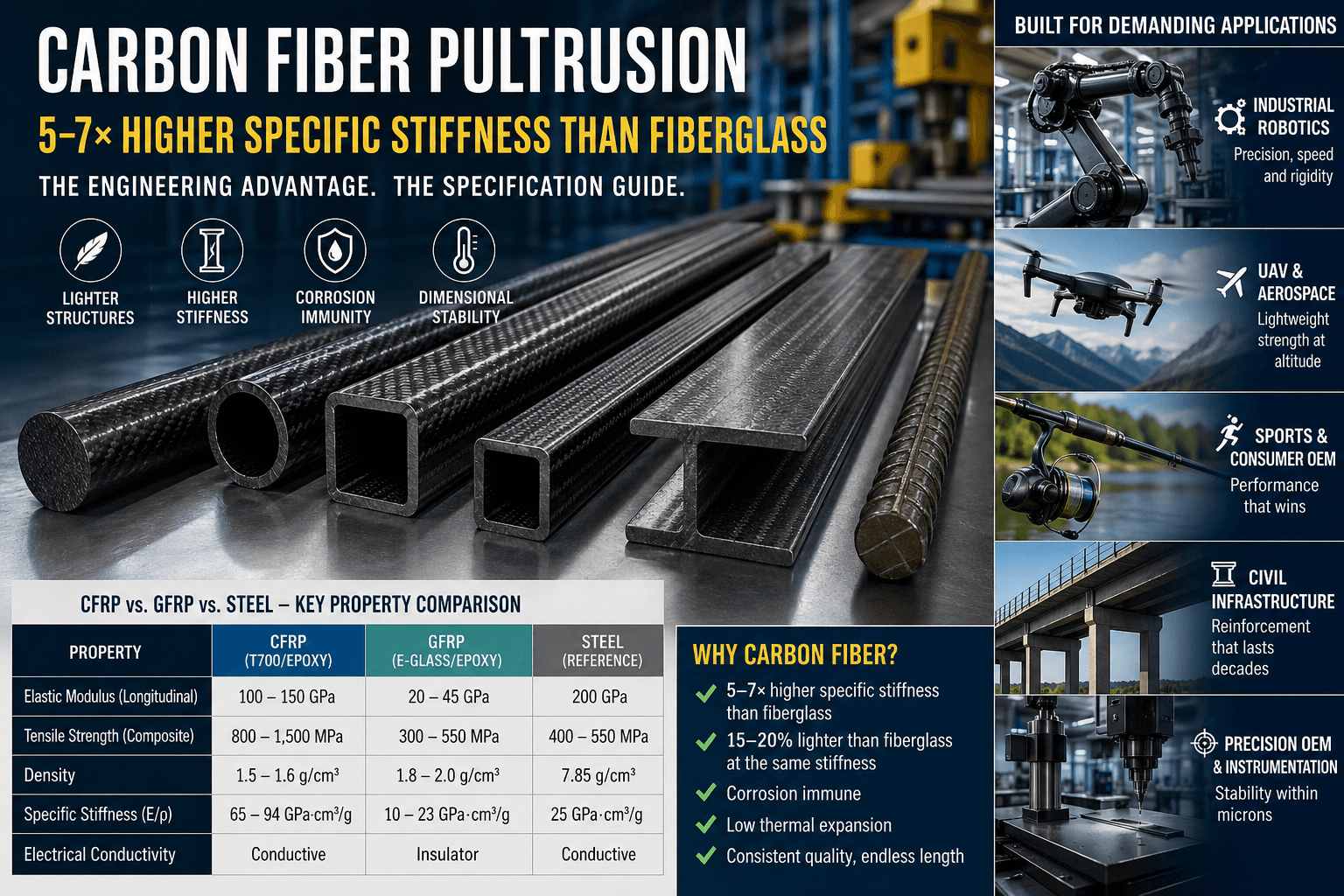
Stiffness is the most decisive difference. CFRP pultruded profiles achieve longitudinal elastic modulus of 100–150 GPa per ASTM D790 flexural testing at standard fiber volume fractions and T700 fiber grade. GFRP profiles achieve 20–45 GPa. This 3–5× stiffness advantage is the primary engineering driver for specifying carbon fiber, and it is not reducible by changing the cross-section geometry — a larger fiberglass profile can carry the same load, but it cannot match CFRP’s deflection performance at equivalent weight.
Density compounds the stiffness advantage into the specific stiffness metric that governs weight-sensitive design. CFRP density runs approximately 1.5–1.6 g/cm³ versus GFRP at 1.8–2.0 g/cm³ — CFRP is lighter by 15–20% before accounting for the smaller cross-section that CFRP’s stiffness advantage typically enables. The combined effect is a specific stiffness for CFRP pultruded profiles roughly 5–7× higher than GFRP profiles.
Electrical conductivity is a property difference that is not a matter of degree — it is categorical. Carbon fiber is electrically conductive; E-glass is a dielectric insulator. Applications requiring electrical insulation must use fiberglass regardless of any mechanical argument for carbon fiber. Applications requiring EMI shielding, electrostatic dissipation, or electrical grounding continuity may actively benefit from CFRP’s conductivity.
The table below compares key properties across CFRP and GFRP pultruded profiles, with carbon steel included as a structural reference point. Composite mechanical values reflect ASTM D638 (tensile) and ASTM D790 (flexural) test conditions at ambient temperature:
| Property | CFRP (T700/Epoxy) | GFRP (E-glass/Epoxy) | GFRP (E-glass/Polyester) | Steel (reference) |
|---|---|---|---|---|
| Longitudinal tensile strength (composite) | 800–1,500 MPa | 300–550 MPa | 250–450 MPa | 400–550 MPa |
| Elastic modulus (ASTM D790, longitudinal) | 100–150 GPa | 20–45 GPa | 18–40 GPa | 200 GPa |
| Density (g/cm³) | 1.5–1.6 | 1.8–2.0 | 1.7–1.9 | 7.85 |
| Specific stiffness (E/ρ, GPa·cm³/g) | 65–94 | 10–23 | 10–21 | 25 |
| Electrical conductivity | Conductive | Insulator | Insulator | Conductive |
| Thermal conductivity (W/m·K, axial, 60% Vf) | 5–10 | 0.3–0.4 | 0.3–0.4 | 50 |
| Relative material cost index | 3–8× | 1.0× | 0.7–0.9× | — |
| Primary application driver | Stiffness + weight | Corrosion + insulation + cost | General structural | Reference |
2.2 When Fiberglass Is the Correct Choice
Carbon fiber’s cost premium is justified only when stiffness, weight, or dimensional stability under thermal cycling is the governing specification driver. When none of these applies, fiberglass is the correct specification regardless of CFRP’s superior mechanical properties — because superior properties that the design does not require do not justify their cost.
The table below provides a direct decision reference for the most common specification scenarios:
| Specify Fiberglass When… | Specify Carbon Fiber When… |
|---|---|
| Electrical insulation is required | Stiffness (deflection control) governs the design |
| Corrosion resistance is the primary driver | Weight is a primary design constraint |
| Operating loads are moderate, deflection not critical | Fatigue or cyclic load resistance is required |
| Budget constraints are genuinely overriding | Dimensional stability across temperature cycles is required |
| Impact resistance is a primary concern | EMI shielding or electrostatic dissipation is needed |
Fiberglass also outperforms CFRP in impact resistance on a cost-normalized basis — an important consideration in applications subject to accidental mechanical damage. Understanding these boundaries prevents over-specification of carbon fiber where fiberglass performs adequately, and under-specification where CFRP’s stiffness advantage is the enabling condition for the design to work at all.
3. Carbon Fiber Pultruded Profile Types
3.1 Standard Profile Geometries
Five standard geometries cover the majority of carbon fiber pultrusion applications — the correct geometry depends on whether bending, torsion, or combined loading governs the design.
Solid rods cover diameters from approximately 2 mm to 100 mm and represent the simplest carbon fiber pultruded geometry — the highest achievable fiber volume fraction at equivalent cross-section, and consequently the highest specific stiffness and strength per unit weight. Primary applications include fishing rod blanks, arrow shafts, drone landing gear struts, kite frames, antenna support members, and structural reinforcement inserts in composite sandwich panels.
Round tubes extend the geometry to hollow sections where bending stiffness per unit weight is the design objective. Wall thickness ranging from 0.5 mm to 5 mm covers the range from ultra-light UAV frame members to structural robotics components. Telescoping tube assemblies — thin-wall CFRP tubes with close-tolerance OD/ID fits — are a standard delivery format for portable structural applications requiring field assembly.
Square and rectangular tubes provide higher torsional stiffness than round tubes at equivalent wall thickness and cross-sectional area — relevant for robotic arm profiles, modular machine structures, and structural frames where combined bending and torsion loading governs the design.
Flat plates and strips serve surface reinforcement, tooling face sheets, and precision substrate applications where flatness and dimensional stability across temperature cycles are the primary requirements. Standard structural shapes — I-beams, channels, angles — are specified for lightweight structural trusses, bridge inspection access platforms, and aerospace ground support equipment where weight reduction at the system level justifies the material cost.
3.2 Custom Carbon Fiber Pultruded Profiles
Custom cross-sections are available for OEM applications where standard geometries do not match the design intent. Pultrusion tooling constraints require a constant cross-section along the full profile length — any taper, variable wall thickness, or non-prismatic geometry requires a different manufacturing process. Within that constraint, custom die tooling can produce virtually any cross-sectional shape, with tooling lead times of 4–8 weeks depending on complexity.
Hybrid fiber profiles — carbon fiber rovings in the load-bearing layers combined with glass fiber fabrics in the non-critical layers of a single pultruded cross-section — reduce material cost while preserving the stiffness advantage where it matters most. In practice, the most common hybrid specification pattern in industrial OEM applications is T700 carbon fiber rovings in the outer flanges of an I-beam or channel profile — where bending stress is highest — combined with E-glass woven roving in the web, where shear rather than bending governs and the cost of carbon fiber provides diminishing structural return. This configuration typically achieves 80–90% of the full CFRP profile’s bending stiffness at 50–60% of the full CFRP material cost.
Unicomposite’s pultrusion lines produce hybrid fiber profiles alongside standard single-fiber constructions — providing a cost-optimization path for OEM applications where full CFRP specification exceeds the project budget but GFRP cannot meet the stiffness requirement.
process products applications
4. Application Categories for Carbon Fiber Pultrusion
4.1 Industrial Robotics and Automation
Carbon fiber pultruded tubes and rectangular sections dominate the robot end-effector and linear motion carriage market for a straightforward reason: in high-speed automation, structural deflection under inertial loading limits positioning accuracy and maximum cycle speed. CFRP’s specific stiffness advantage over aluminum — approximately 3–4× higher modulus-to-weight ratio — enables longer arm spans at equivalent deflection budgets, or faster acceleration at equivalent arm length. Neither fiberglass nor aluminum can replicate this combination at equivalent weight.
Engineers specifying CFRP for robotics applications should focus the specification on elastic modulus and dimensional stability rather than tensile strength — the arm rarely approaches tensile failure, but it routinely operates at the deflection limit that determines positioning accuracy. T700 fiber in an epoxy matrix at 60% fiber volume fraction, verified by ASTM D790 flexural modulus testing, represents the practical optimum for most industrial robotics structural members — providing the stiffness-to-cost ratio that T800 fiber improves only marginally at significantly higher cost.
4.2 Unmanned Aerial Vehicles and Aerospace
UAV frame design is governed by weight and stiffness simultaneously — maximizing payload capacity requires minimizing frame weight while maintaining the structural rigidity that prevents aerodynamic flutter and maintains control surface geometry under load. Carbon fiber pultruded tubes and flat sections are the primary structural material in commercial and industrial UAV frames across the size range from small consumer drones to large cargo platforms.
Aerospace structural applications extend to antenna support booms, satellite deployment mechanisms, and aircraft interior structural brackets — applications where the profile’s constant cross-section and precise dimensional control simplify assembly integration. Carbon fiber’s near-zero coefficient of thermal expansion (approximately 0–1 × 10⁻⁶/°C axially for standard modulus fiber in epoxy) is an additional advantage in space and aerospace applications where dimensional stability across temperature cycles is a design requirement independent of mechanical loading.
4.3 Sports, Recreation, and Consumer OEM
Fishing rods, archery arrows, ski poles, bicycle frame tubes, kayak paddles, and hockey stick shafts represent the highest global volume of commercial carbon fiber pultrusion production. These applications established the manufacturing infrastructure — fiber supply chains, resin qualification, tooling investment — that makes CFRP pultrusion cost-accessible for industrial OEM applications today.
The consumer sports market also provides a useful cost reference for B2B procurement managers: the performance premium that CFRP commands over fiberglass in consumer sporting goods reflects the stiffness and weight difference that the same fiber delivers in industrial structural applications. The engineering rationale is identical; only the application environment and procurement process differ.
The consumer sports market established CFRP pultrusion as a commercially viable manufacturing process at scale — the civil infrastructure sector is now applying the same fiber, resin, and tooling capabilities to structural challenges where the performance case is even more compelling: corrosion immunity that steel reinforcement cannot replicate.
4.4 Civil Infrastructure and Structural Reinforcement
Carbon fiber pultruded strips and plates serve as external structural reinforcement for concrete beams, columns, and bridge decks undergoing rehabilitation — CFRP’s high modulus and corrosion immunity make it the specified material for infrastructure repair in chloride-rich, marine, and de-icing salt environments where bonded steel plates corrode at the adhesive interface within 10–15 years of installation.
CFRP pultruded rebar is an active growth application in new concrete construction. In aggressive chloride exposure environments with inadequate concrete cover, conventional steel rebar structures may require rehabilitation within 30–40 years — CFRP rebar eliminates the corrosion mechanism entirely, enabling design service lives of 75–100 years in environments where steel rebar durability is the limiting factor. ACI 440 and ASTM D7957 govern CFRP rebar design and specification in North American concrete construction.
4.5 Precision OEM and Scientific Instrumentation
Industrial measurement equipment frames, medical imaging structural components, semiconductor fabrication positioning systems, and satellite communication structural members all require CFRP pultrusion’s unique combination of dimensional stability, low thermal expansion, and high specific stiffness. In these applications, the governing design requirement is not load capacity — it is maintaining dimensional tolerances across operating temperature cycles that would cause aluminum or steel structures to expand or contract beyond the system’s tolerance budget.
Carbon fiber’s near-zero axial coefficient of thermal expansion — approximately 0–1 × 10⁻⁶/°C for standard modulus fiber in epoxy — makes CFRP pultruded profiles the material of choice for precision structural applications at a level of performance that no other continuous-fiber material and no conventional metal can match at equivalent weight.
The table below maps application category to the recommended fiber specification and governing design criterion:
| Application | Primary Design Driver | Recommended Fiber | Resin System | Key Standard |
|---|---|---|---|---|
| Industrial robotics / automation | Specific stiffness, deflection | T700 | Epoxy | ASTM D790, D638 |
| UAV / aerospace structural | Specific stiffness + weight | T700 or T800 | Epoxy | ASTM D3916 |
| Sports / consumer OEM | Weight + stiffness | T300 or T700 | Epoxy | ASTM D638 |
| Civil infrastructure reinforcement | Modulus + corrosion immunity | T700 | Epoxy | ACI 440, ASTM D7957 |
| Precision OEM / instrumentation | Dimensional stability + low CTE | T800 or HM fiber | Epoxy | ASTM D3916, D695 |
| Electrical infrastructure | Insulation required | Fiberglass (not CFRP) | Epoxy / polyester | ANSI C29, IEC 61109 |
5. How to Specify Carbon Fiber Pultruded Profiles Correctly
5.1 Required Specification Parameters
Four parameters must appear in every carbon fiber pultruded profile specification to bind the supplier to a defined performance level. First, fiber grade: specify T300, T700, T800, or the equivalent commercial designation — this single parameter most strongly determines mechanical performance and cost, and omitting it allows substitution that may not be detectable at dimensional inspection. Second, resin system with hardener type: epoxy (standard structural), phenolic (fire-resistant), or vinyl ester (chemical environments); for epoxy, specify amine-cured (HDT 100–120°C) or anhydride-cured (HDT 130–150°C) where service temperature is a design requirement. Third, minimum fiber volume fraction: 55% minimum for structural profiles; fiber volume fractions above 65% introduce resin starvation risk, increased brittleness, and processing difficulty — specify 60–65% as the practical structural optimum rather than pushing for maximum fiber content. Fourth, applicable test standards: ASTM D638 (tensile), D790 (flexural), D695 (compressive), D2290 (hoop tensile for tubes), D2583 (Barcol hardness as cure verification) — cite each standard applicable to the mechanical properties specified.
5.2 Standards Reference
ASTM D3916 (Standard Specification for Pultruded Bars, Rods, Tubes and Shapes) provides the dimensional and quality specification framework applicable to both carbon fiber and fiberglass pultruded profiles. ASTM D3917 governs dimensional tolerances. ASTM D7957 covers CFRP bars for concrete reinforcement. ACI 440 governs the design and construction of concrete structures reinforced with FRP bars in North American civil engineering projects. ISO 10406 is the international equivalent for FRP reinforcement of concrete.
5.3 Common Specification Errors
Three errors account for the majority of carbon fiber pultruded profile specification failures. First, specifying “CFRP profile” without fiber grade — T300 and T700 are not interchangeable; the composite tensile strength difference is approximately 25–40% and the cost difference is meaningful at volume. Second, omitting minimum fiber volume fraction — profiles at 45% and 65% fiber volume fraction both qualify as “carbon fiber pultruded” but differ significantly in modulus and strength. Third, not requesting Barcol hardness data per ASTM D2583 as a cure verification check — under-cured CFRP profiles underperform on all mechanical properties, and this condition is invisible in dimensional inspection alone.
Conclusion
Carbon fiber pultrusion is not a universal upgrade from fiberglass — it is the correct specification when stiffness, weight, or dimensional stability under thermal cycling is the governing design requirement, and the wrong specification when electrical insulation, corrosion resistance, or cost is the primary driver. Four takeaways:
- Specific stiffness is the decisive advantage. CFRP pultruded profiles achieve 5–7× higher elastic modulus-to-weight ratio than fiberglass — this property gap determines whether carbon fiber is necessary, not tensile strength alone.
- Fiber grade must appear in every specification. T300, T700, and T800 differ significantly in both composite mechanical performance and cost. Specifying “carbon fiber” without grade designation is an incomplete specification that allows substitution undetectable at visual inspection.
- Carbon fiber is electrically conductive. Applications requiring dielectric insulation must specify fiberglass — no exception. Applications requiring EMI shielding or electrostatic dissipation may benefit from CFRP’s conductivity.
- Hybrid fiber profiles reduce cost without sacrificing stiffness where it matters. T700 carbon fiber in the load-bearing flanges, E-glass in the web — a single pultruded profile that achieves 80–90% of full CFRP bending stiffness at 50–60% of full CFRP material cost.
As UAV infrastructure, industrial automation, and civil infrastructure rehabilitation programs expand, the volume economics of carbon fiber pultrusion continue to improve — making CFRP profiles accessible in application categories where cost previously favored fiberglass.
[Contact Unicomposite for carbon fiber pultruded profile samples and specifications →]
Frequently Asked Questions
T700 fiber in an epoxy matrix at 60% fiber volume fraction is the practical specification optimum for most industrial robotics structural members — it provides the stiffness-to-cost ratio that T800 improves only marginally at significantly higher cost. Confirm the specification with an ASTM D790 flexural modulus requirement in the purchase order so the supplier is bound to a defined stiffness level rather than a fiber grade alone, which allows variation in fiber volume fraction and architecture.
Yes — custom die tooling produces any constant cross-section geometry, with tooling lead times of 4–8 weeks depending on profile complexity. Provide a dimensioned cross-section drawing with tolerances per ASTM D3917, the mechanical performance requirements with applicable ASTM test method references, and the service environment description. For OEM applications where full CFRP specification exceeds the project budget, discuss hybrid fiber options — T700 carbon in the load-bearing layers, E-glass in the non-critical layers — at the inquiry stage.
Request Barcol hardness testing per ASTM D2583 with every delivery — this non-destructive test confirms the resin achieved full cross-linking. Fully cured epoxy CFRP profiles typically achieve Barcol values of 50–60 depending on the resin system. Below-specification Barcol readings indicate incomplete cure, which degrades all mechanical and thermal properties. Specify a minimum Barcol acceptance value in the purchase order alongside the dimensional tolerances.
Standard geometries (solid rods, round tubes, flat plates) in T300 or T700 fiber with epoxy resin are typically available on 3–5 week production lead times from order confirmation. Custom cross-sections add tooling lead time of 4–8 weeks for first-article delivery, plus the production run lead time. Specialty fiber grades (T800, high modulus) or thermoplastic matrix systems extend lead times further — communicate your delivery window at the inquiry stage so the manufacturer can confirm production scheduling before a purchase order is placed.
Yes, with correct surface specification. Carbon fiber composite has good inherent UV resistance compared to fiberglass, but the epoxy resin matrix and any surface finishing layer still require UV stabilization for long-term outdoor service. Specify a UV-stable surface veil — typically a polyester or ECR glass surface mat with UV-stabilized resin — when ordering profiles for outdoor exposure applications. Without a UV-stable surface layer, surface chalking and resin degradation at the fiber-matrix interface will initiate within 3–5 years in full solar exposure, eventually reducing surface smoothness and increasing moisture ingress risk at the profile surface.


