 info@unicomposite.com


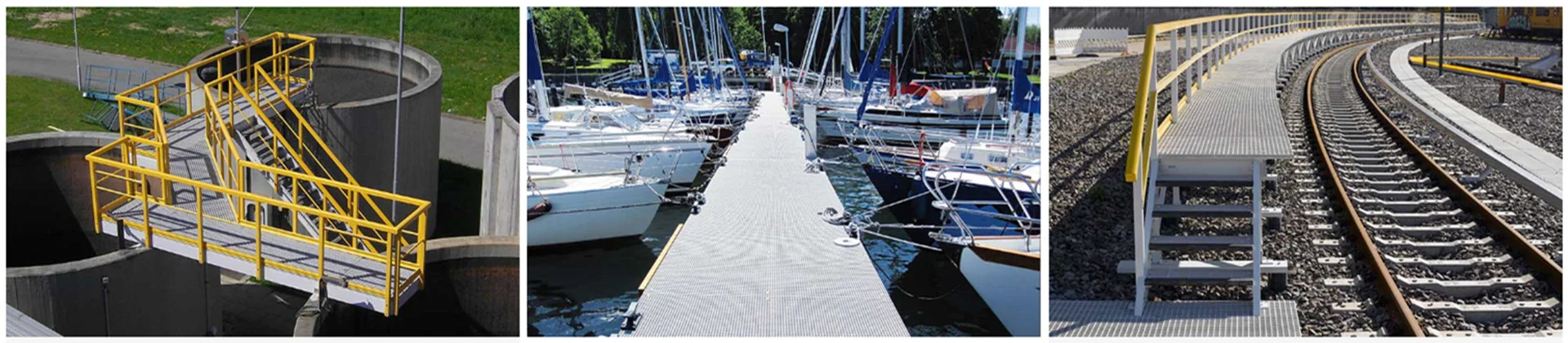
A trench cover looks like a simple panel until it fails in the wrong environment. In a chemical plant, a corroded steel cover can become a safety hazard. In a wastewater facility, constant moisture can shorten service life. In a power or utility area, electrical insulation and low maintenance may matter as much as load capacity.
This is why engineers and procurement teams often evaluate FRP trench cover plates for drainage channels, cable trenches, walkways, factory floors, operating platforms, and utility access areas. Made from fiberglass reinforced plastic, these covers combine corrosion resistance, slip resistant surfaces, manageable weight, and long service value in demanding industrial environments.
This guide explains what FRP trench cover plates are, where they are used, how they compare with steel and aluminum covers, and what buyers should confirm before placing OEM or bulk orders.
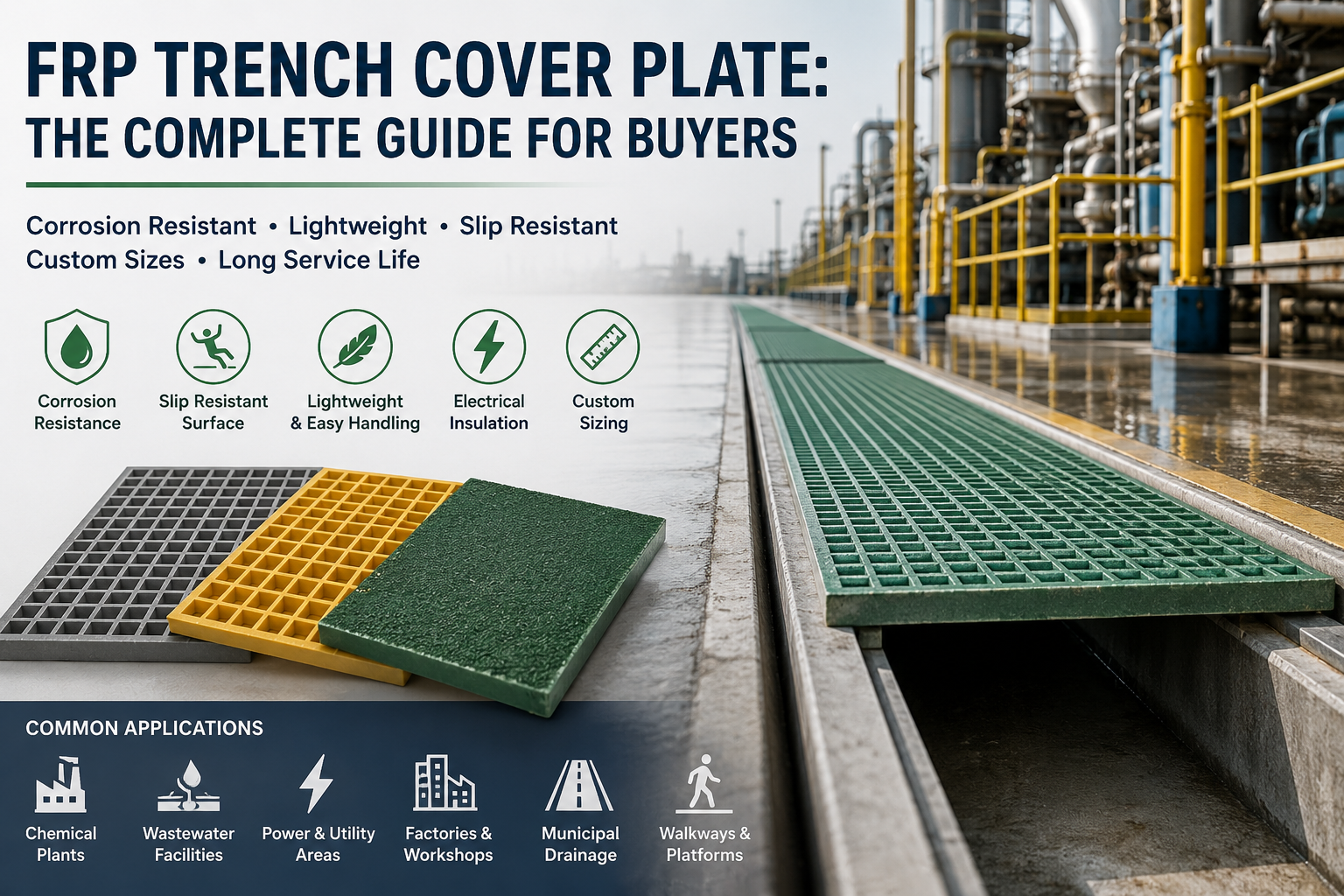
frp trench cover plate
What Is an FRP Trench Cover Plate?
An FRP trench cover plate is a fiberglass reinforced plastic panel used to cover trenches, drainage channels, cable trenches, utility openings, walkways, industrial floors, and access areas. In many projects, the cover plate is made from FRP grating or composite panels, then cut or customized to match the trench size and installation method.
FRP, also called fiberglass reinforced plastic or GRP in some markets, combines glass fiber reinforcement with a resin matrix. The glass fiber provides strength, while the resin helps protect the structure from moisture, chemicals, weathering, and corrosion.
What is the difference between FRP trench cover, FRP grating, and FRP cover plate?
An FRP trench cover is a finished cover used over a trench or channel. FRP grating is the fiberglass panel material often used to make trench covers. FRP cover plate is a broader term for panels used over trenches, platforms, drains, pits, or access openings.
For buyers, wording affects supplier response. If a project needs a drainage trench cover, the RFQ should include trench width, clear span, expected load, traffic type, surface requirement, environment, quantity, and any custom cutting or shaping.
A clear definition helps avoid a common sourcing problem: receiving a generic FRP grating quote when the project needs a cut to size cover plate for a specific trench.
Key Advantages of FRP Trench Cover Plates
After defining the product, the next question is why buyers choose FRP. The strongest reason is environmental fit. FRP covers are widely used where corrosion, moisture, chemicals, weight, and electrical concerns make metal covers harder to maintain.
FRP offers strong corrosion resistance in many wet and chemical environments. It does not rust like carbon steel, which makes it useful in wastewater treatment, chemical processing, car wash drainage, coastal facilities, and industrial washdown areas.
Handling weight also matters. FRP covers are typically easier to lift, move, remove, and reinstall than heavy steel covers of similar size. Many FRP trench covers also use molded or gritted top surfaces to improve footing in wet areas.
The table below summarizes the main benefits from a buyer’s perspective:
| Benefit | Why It Matters | Typical Buyer Concern |
|---|---|---|
| Corrosion resistance | Reduces rust related replacement in wet or chemical areas | Service life and maintenance cost |
| Slip resistant surface | Improves footing on walkways and platforms | Worker safety and site usability |
| Lower handling weight | Makes installation and inspection access easier | Labor time and maintenance efficiency |
| Electrical insulation | Useful in utility and power related areas | Material choice around electrical assets |
| Custom sizing | Supports trench specific installation | Fit, cutting, and project efficiency |
Are FRP trench cover plates suitable for industrial drainage?
FRP trench cover plates are suitable for many industrial drainage areas because they resist corrosion, handle moisture exposure, and can be supplied with slip resistant surfaces. Buyers should confirm load requirement, trench span, resin system, chemical exposure, traffic type, and installation details before approving covers for a specific site.
In field use, the best results come from matching the resin system and panel structure to the actual environment. A light duty drainage cover in a car wash, a chemical trench cover in a plant, and a cable trench cover in a utility facility may all need different specifications.
FRP performs best when the buyer treats the cover as an engineered site component, not just a flat panel.
Common Applications of FRP Trench Covers
FRP trench covers are commonly used in environments where water, chemicals, corrosion, and frequent access affect material choice. The main application areas include petrochemical facilities, power facilities, construction sites, wastewater plants, factories, municipal drainage, platforms, stairways, walkways, and utility systems.
Chemical and petrochemical facilities use FRP covers for drainage trenches, operating areas, platforms, and access routes because corrosion resistance is often a key requirement. Wastewater facilities use them around drainage channels, wet floors, and maintenance walkways. Power and utility areas may use FRP covers where insulation and corrosion resistance both matter.
Factories, car wash facilities, municipal drainage areas, garden fountain covers, and landscape drainage systems may also use FRP trench covers when buyers want a lightweight and corrosion resistant panel.
The table below connects common applications with specification priorities:
| Application Area | Common Use | Key Specification Priority |
|---|---|---|
| Chemical plant | Drainage trench and operating platform | Resin system and corrosion resistance |
| Wastewater facility | Wet walkway and drainage channel | Moisture resistance and slip resistance |
| Power facility | Cable trench and utility access area | Electrical insulation and fit |
| Factory floor | Floor trench and equipment access | Load rating and surface durability |
| Municipal drainage | Channel cover and public access area | Safety surface and long service value |
| Car wash area | Drain cover under frequent water exposure | Corrosion resistance and easy cleaning |
In one anonymized wet industrial site, maintenance crews replaced corroded metal trench covers around drainage channels with FRP covers. The decision was driven by three practical needs: removable panels for routine inspection, better footing on wet walking paths, and corrosion resistance in areas exposed to water and cleaning chemicals. The final specification included a slip resistant top surface, manageable panel sizes for lifting, and a resin system suited to the site environment.
Application type should guide material selection. That is where FRP, steel, and aluminum need a direct comparison.
FRP Trench Cover Plate vs Steel and Aluminum
Material comparison is often where procurement teams make or lose money. Steel, aluminum, and FRP can all work in trench cover applications, but each material solves a different problem.
Steel may suit very heavy duty applications where impact loads are high and coating maintenance is acceptable. Aluminum is lighter than steel and useful in some general environments, but it can still face corrosion or wear concerns depending on exposure. FRP becomes attractive when corrosion resistance, slip resistance, insulation, and easier handling matter together.
The table below compares common trench cover materials:
| Property | FRP Trench Cover Plate | Steel Cover Plate | Aluminum Cover Plate |
|---|---|---|---|
| Corrosion resistance | Strong in many wet and chemical environments | Low unless coated or protected | Moderate, depends on exposure |
| Weight | Light to moderate | Heavy | Light |
| Slip resistance | Molded or gritted surface options | Requires surface treatment | Requires surface treatment |
| Electrical insulation | Strong material advantage | Conductive | Conductive |
| Maintenance | Low to moderate | Moderate to high | Low to moderate |
| Installation handling | Easier than heavy steel covers | More labor intensive | Easy handling |
| Typical use case | Industrial drainage, utilities, wastewater, chemical areas | Heavy impact or rugged applications | Dry or moderate duty access areas |
Is FRP better than steel for trench covers?
FRP is often better than steel for trench covers in wet, corrosive, chemical, or electrically sensitive environments because it resists rust, offers insulation, and is easier to handle. Steel may still be selected for very heavy impact loads, specific structural requirements, or projects where coating maintenance is already planned.
The key is to match material selection to the risk profile. If the main problem is corrosion, FRP often deserves priority. If the main problem is extreme impact loading, buyers should review structural requirements carefully before choosing any material.
A strong specification compares the full service environment, not only the initial purchase price.
How to Choose an FRP Trench Cover Plate
Once the material choice is clear, buyers should define the cover plate specification. The most important factors are trench size, clear span, load requirement, traffic type, traffic frequency, deflection expectation, panel thickness, mesh size, resin system, surface type, and installation method.
Load and span come first. A wider trench or higher load may require a thicker panel, different grating type, closer support spacing, or a different structure. Buyers should avoid ordering by length and width alone because unsupported span and traffic type determine whether the cover will perform safely.
Traffic conditions also matter. Pedestrian access, push carts, maintenance crews, light vehicles, and heavier industrial traffic create different performance expectations. If deflection, vibration, or repeated traffic is a concern, the buyer should state it clearly in the RFQ.
The resin system should follow the environment. General purpose resin may work for less aggressive areas. More corrosive environments may require stronger resin compatibility. Outdoor applications may need UV resistant options, while utility sites may prioritize insulation and dimensional stability.
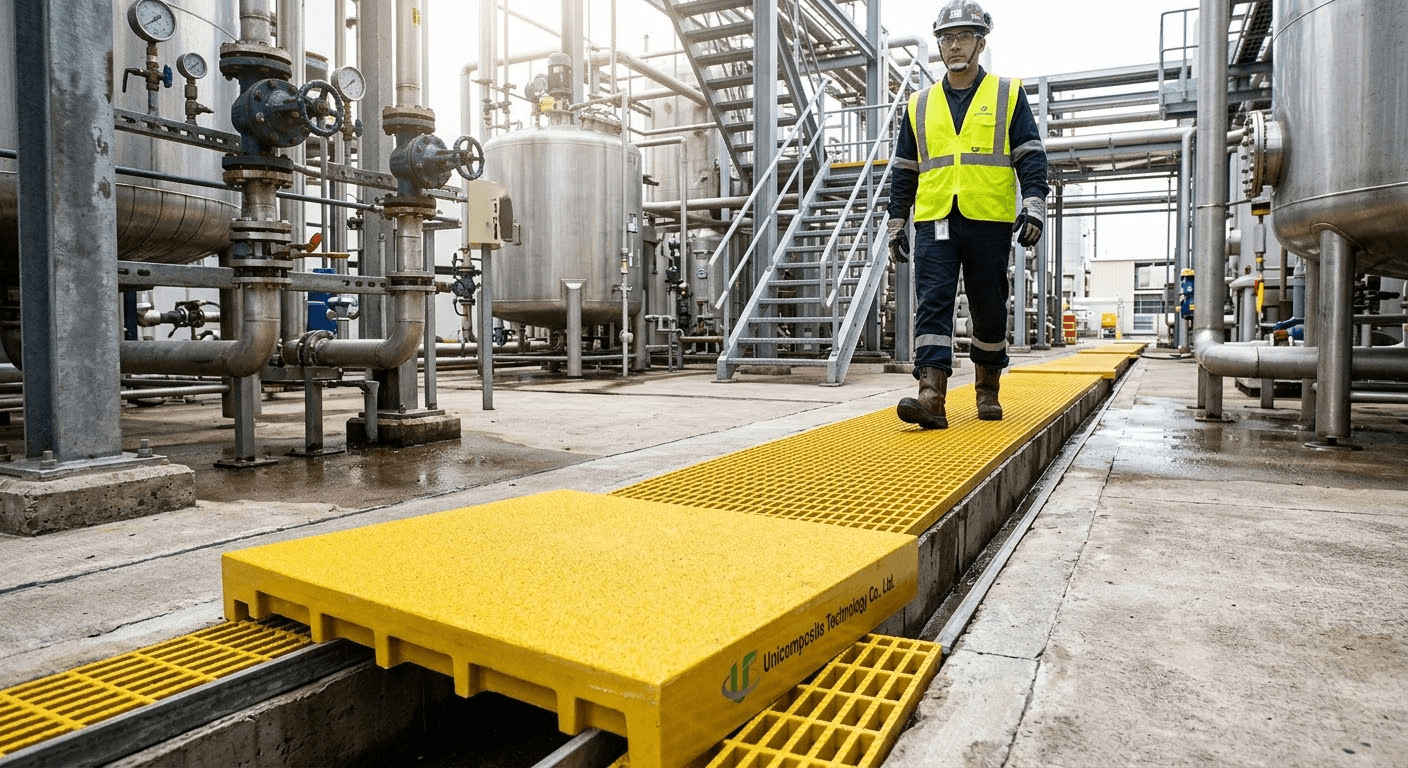
frp trench cover
What should buyers provide before ordering FRP trench covers?
Buyers should provide trench dimensions, clear span, expected load, traffic type, traffic frequency, chemical exposure, indoor or outdoor use, surface requirement, resin preference, quantity, cutting details, packaging needs, and installation method. These details help suppliers recommend the right FRP trench cover plate for safe and efficient use.
For example, a pedestrian walkway cover and a forklift traffic cover should not use the same assumptions. A cable trench in a power facility and a chemical drainage trench may also require different material priorities.
Final specifications should be verified against project load requirements, site safety rules, chemical exposure, installation method, and supplier provided product data before approval.
Buying Checklist for OEM and Bulk Buyers
For OEM, contractor, distributor, and project buyers, the RFQ should turn site conditions into measurable requirements. A vague inquiry such as “need FRP trench cover” often leads to incomplete quotes. A stronger inquiry defines the trench, load, environment, surface, customization, and delivery expectations.
Use the table below as a practical RFQ checklist:
| Requirement | What to Provide | Why It Matters |
|---|---|---|
| Trench size | Width, length, depth, clear span | Determines panel size and support needs |
| Load requirement | Pedestrian, cart, maintenance, vehicle, or custom load | Guides thickness and structure |
| Traffic frequency | Occasional access or repeated daily traffic | Helps assess durability needs |
| Environment | Chemical, moisture, UV, temperature | Guides resin system selection |
| Surface type | Gritted, molded, covered, or custom finish | Affects safety and usability |
| Panel details | Thickness, mesh size, color, cutouts | Supports fit and installation |
| Quantity | One project, bulk order, or repeat program | Affects production planning |
| Packaging | Pallet, bundle, carton, or export packing | Supports logistics and resale |
| Documentation | Product specs, drawings, inspection needs | Supports buyer approval |
Unicomposite Technology Co., Ltd, based in Nanjing, China, manufactures FRP and GRP composite products and supplies standard and customized composite profile and system solutions. Its capabilities include pultrusion, pulwinding, SMC and BMC compression molding, hand lay up, and vacuum infusion.
For trench cover requirements, that capability connects directly to FRP grating, covered panels, cut to size parts, anti slip surfaces, custom colors, labeling, bulk packaging, and OEM supply. Buyers that need repeatable dimensions, project specific surfaces, export packing, or private label programs should define those requirements before production.
A complete RFQ helps the factory confirm feasibility, reduce rework, and avoid approval delays.
Common Mistakes When Buying FRP Trench Covers
The first mistake is choosing by price only. A low price can hide a weak resin system, insufficient thickness, poor surface finish, or unsuitable panel structure. That can increase replacement costs later.
The second mistake is ignoring chemical exposure. If a facility handles acids, alkalis, oils, cleaning agents, wastewater gases, or salt exposure, the buyer should disclose those conditions early. Resin selection depends on the environment.
The third mistake is failing to confirm load and span. A cover may fit the trench opening but perform poorly if the unsupported span or traffic load is higher than expected.
The fourth mistake is using general FRP grating where a more specific cover plate is needed. Some trench openings require cutouts, edge treatment, covered surfaces, custom thickness, or installation hardware.
The fifth mistake is missing installation details. Buyers should tell suppliers whether the cover will sit on a frame, rest on concrete edges, be removable, or require fastening. These details affect panel sizing and usability.
Avoiding these mistakes turns a basic purchase into a better long term asset decision.
Final Recommendation
FRP trench cover plates are a strong option for industrial drainage, utility access, walkways, platforms, wastewater facilities, chemical plants, factories, municipal trenches, and wet service environments.
Key takeaways:
- Use FRP trench covers where corrosion, moisture, chemicals, or electrical insulation are part of the site risk.
- Confirm trench dimensions, clear span, load type, traffic frequency, resin system, surface finish, and installation method before ordering.
- Compare FRP, steel, and aluminum based on full service conditions, including safety, maintenance, and handling.
- For OEM or bulk supply, define color, cutting, packaging, labeling, quantity, documentation, and repeat order expectations early.
[Contact Unicomposite for a custom FRP trench cover plate quote →]


