 info@unicomposite.com


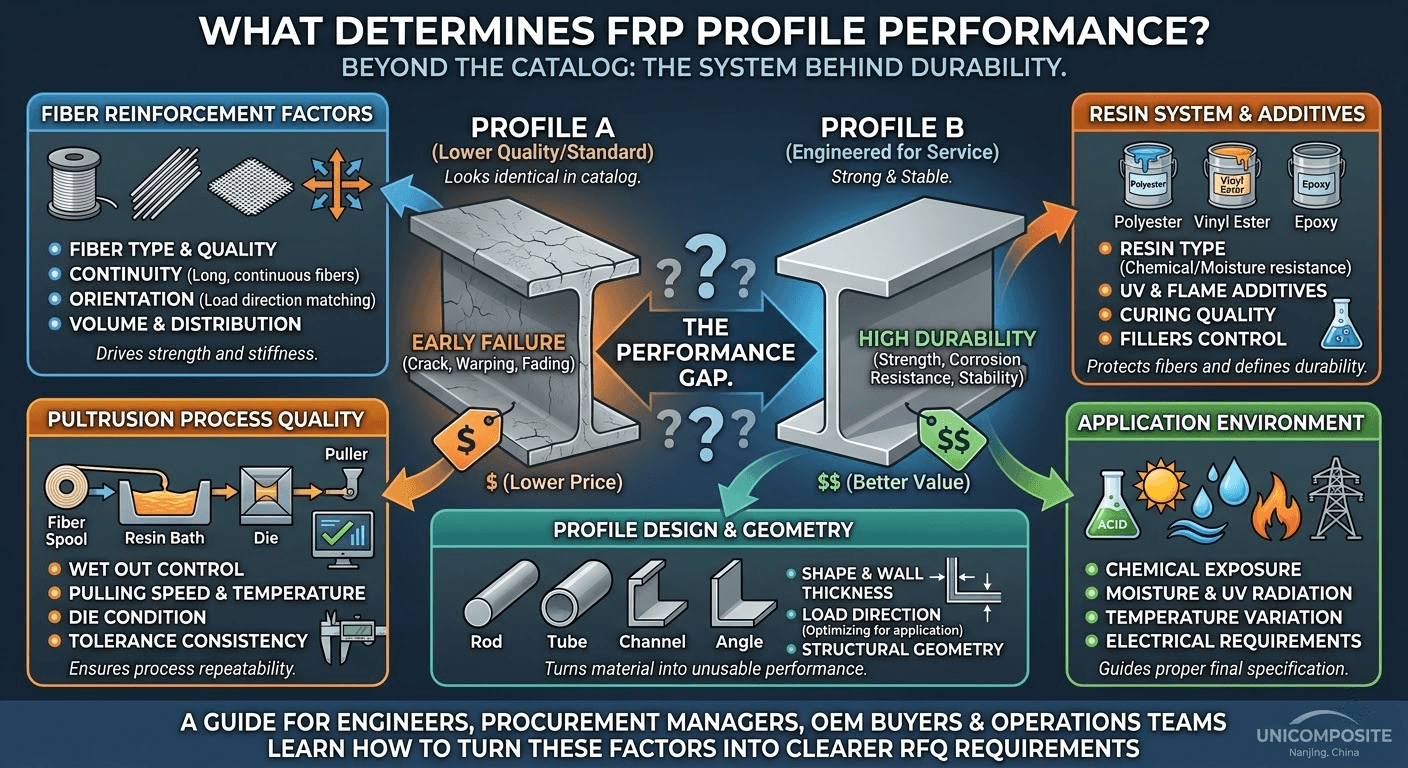
Two FRP profiles can look identical in a catalog. They may share the same shape, color, and basic dimensions. In service, one profile may hold its strength, resist corrosion, and stay dimensionally stable for years, while another may crack, warp, fade, or fail too early.
That gap rarely comes from a single issue. FRP profile performance depends on the full material and manufacturing system: fiber reinforcement, resin matrix, fiber orientation, fiber volume, pultrusion control, curing quality, profile geometry, surface finish, and the actual operating environment.
For engineers, procurement managers, OEM buyers, and operations teams, understanding these factors makes sourcing safer and more predictable. This guide explains the key performance variables and shows how buyers can turn them into clearer RFQ requirements.
what affectsfrp profileperformance
What Determines FRP Profile Performance?
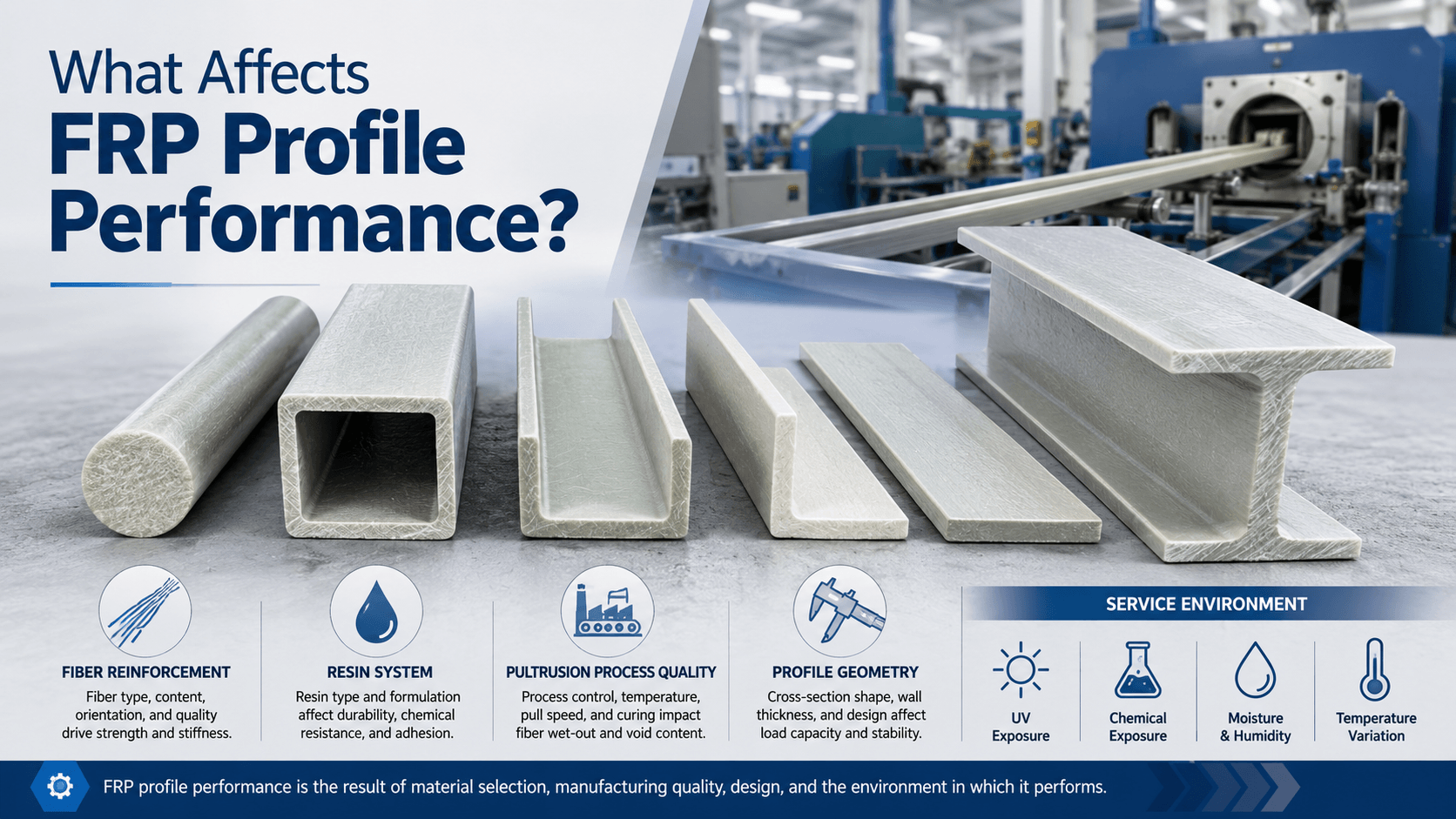
FRP profiles are composite parts made from reinforcing fibers and resin. The fiber provides much of the strength and stiffness, while the resin binds the structure together and protects the reinforcement from moisture, chemicals, UV exposure, and service conditions.
In pultruded FRP profiles, continuous fibers are pulled through resin and formed through a heated die into a consistent cross section, such as rods, tubes, channels, angles, I beams, or custom shapes. This process supports strong lengthwise performance, repeatable dimensions, and efficient production for standard or custom profiles.
What factors affect FRP profile performance?
FRP profile performance is affected by fiber type, fiber continuity, fiber orientation, fiber volume, resin system, pultrusion quality, curing control, profile geometry, surface finish, dimensional tolerance, and application environment. Buyers should evaluate these factors together because one weak point can reduce strength, durability, or service life.
For example, high quality glass fiber will not deliver expected performance if resin impregnation is poor. A strong resin system may still fail early if the profile geometry does not match the load direction. Good FRP design depends on alignment between material, process, shape, and application.
This is why FRP profiles from different manufacturers can perform differently even when their dimensions look similar.
Fiber Reinforcement Factors
Fiber reinforcement is the structural backbone of an FRP profile. In many pultruded profiles, continuous glass fiber reinforcement gives the product high strength along the pulling direction. Fiber continuity, alignment, and content therefore have a direct effect on performance.
Fiber length matters because continuous or long fibers provide stronger reinforcement than short or poorly distributed fibers. For structural profiles, buyers should review the reinforcement architecture, not only the word “fiberglass” in the product description.
Fiber orientation also matters. Pultruded profiles usually perform best along the length of the profile because the fibers run continuously in that direction. If the application involves bending, torsion, impact, or multi directional loads, the profile may need additional reinforcement layers, mats, veils, or design adjustments.
Why does fiber orientation matter in FRP profiles?
Fiber orientation matters because FRP profiles are direction sensitive materials. Continuous fibers provide the strongest performance along their alignment direction, while off axis loads may require mats, stitched fabrics, or modified reinforcement design. Buyers should match fiber orientation with actual load direction, span, and installation conditions.
Even fiber distribution also affects quality. Uneven fiber concentration can create weak zones, resin rich areas, or inconsistent mechanical behavior. In field applications, engineers often trace profile problems back to poor reinforcement consistency, poor load matching, or unclear specification requirements.
Fiber quality sets the foundation. The resin system determines how well that reinforcement survives the environment.
Resin System and Additive Selection
The resin matrix protects the fibers, transfers loads, and defines many durability characteristics of the final FRP profile. Common resin choices include polyester, vinyl ester, and epoxy systems, with each suited to different performance expectations.
Polyester resin is often used for general purpose applications where cost control matters. Vinyl ester resin is commonly selected for stronger chemical resistance in more aggressive environments. Epoxy resin may be chosen where higher mechanical performance, bonding, or dielectric requirements are important.
The table below shows how resin selection affects buyer decisions:
| Resin Factor | How It Affects Performance | Buyer Checkpoint |
|---|---|---|
| Resin type | Influences corrosion resistance, strength, and cost | Confirm polyester, vinyl ester, or epoxy |
| UV additives | Improve outdoor weathering resistance | Ask for an outdoor use formulation |
| Flame retardant additives | Support fire performance requirements | Specify flame retardant needs in the RFQ |
| Fillers | Affect cost, processing, weight, and properties | Avoid unclear filler heavy formulations |
| Curing quality | Impacts hardness, stability, and service behavior | Request process and quality control details |
How does resin affect FRP profile performance?
Resin affects FRP profile performance by controlling chemical resistance, moisture resistance, UV stability, flame retardancy, temperature tolerance, and bonding between fibers. The wrong resin system can reduce durability even when the profile has good reinforcement, so buyers should specify the service environment before ordering.
Additives should follow the actual site conditions. Outdoor applications may need UV resistance. Electrical environments may require dielectric performance. Chemical plants, wastewater facilities, coastal structures, and cooling towers may need stronger corrosion resistance than basic general purpose profiles can provide.
Resin selection should follow the operating environment and project requirements.
Pultrusion Process Quality
After material selection, manufacturing control becomes the next major performance factor. Pultrusion quality affects fiber wet out, curing, dimensional tolerance, surface appearance, straightness, and consistency across production batches.
In a controlled pultrusion process, fibers pass through resin, align with the profile direction, and move through a heated die that shapes and cures the part. Pulling speed, resin viscosity, temperature control, die condition, and curing time all influence the final product.
Unicomposite Technology Co., Ltd, based in Nanjing, China, manufactures FRP and GRP composite products using processes including pultrusion, pulwinding, SMC and BMC molding, hand lay up, and vacuum infusion. For FRP profiles, pultrusion is especially relevant because it supports continuous fiber alignment, stable cross sections, repeatable dimensions, and scalable production for rods, tubes, angles, channels, beams, and custom profiles.
The table below shows key process checkpoints buyers can use during supplier evaluation:
| Process Factor | Performance Impact | What Buyers Should Ask |
|---|---|---|
| Fiber wet out | Reduces voids and dry fiber zones | How is resin impregnation controlled? |
| Pulling speed | Affects cure consistency and surface quality | Is production speed adjusted by profile type? |
| Die temperature | Influences curing and dimensional stability | How is temperature monitored? |
| Surface veil | Improves surface finish and weathering layer | Is a veil required for outdoor use? |
| Tolerance control | Supports fit, assembly, and repeat orders | What dimensional tolerances are available? |
Poor process control can produce profiles that look acceptable at first glance but underperform in installation or long service. For OEM buyers, tolerance consistency can matter as much as headline strength.
A capable supplier should explain how the production process supports the performance requirements of the part.
Profile Design and Structural Geometry
FRP profile shape affects strength, stiffness, installation behavior, and load capacity. A round rod, square tube, channel, angle, flat strip, and I beam each distributes loads differently. Geometry can make the same material perform very differently.
Wall thickness matters. Thin walls may reduce cost and weight, but they can also reduce stiffness or impact resistance. Thicker sections can improve structural performance, although they may increase weight and affect processing or cost.
Load direction also shapes the design decision. A profile used as a support beam needs different engineering logic from a profile used as a cable bracket, handrail component, ladder rail, grating support, or OEM part.
How should buyers match FRP profile design to application?
Buyers should match FRP profile design to load direction, span, connection method, chemical exposure, temperature, installation method, and service life expectations. The profile shape, wall thickness, fiber orientation, and resin system should work together for the actual application instead of relying only on generic catalog dimensions.
Many sourcing problems begin with incomplete application details. A buyer may request a size without explaining the load, span, environment, or attachment method. That forces the supplier to quote a profile that may fit dimensionally but miss the real performance target.
Profile geometry turns material potential into usable engineering performance.
Environmental and Application Conditions
Material, process, and geometry only create reliable results when they match the environment. Chemical exposure, moisture, UV radiation, temperature variation, electrical requirements, abrasion, and impact can all change the right specification.
A wastewater facility may prioritize corrosion resistance and moisture performance. A power utility may prioritize dielectric properties and dimensional stability. A cooling tower may require corrosion resistance, weathering performance, and structural reliability in a wet service environment.
The table below connects application environments with performance priorities:
| Application Environment | Main Risk | FRP Profile Priority |
|---|---|---|
| Chemical plant | Acid, alkali, fumes, spills | Resin selection and corrosion resistance |
| Wastewater facility | Moisture, H2S, outdoor exposure | Resin durability and surface protection |
| Power utility | Electrical exposure, weathering | Dielectric performance and UV resistance |
| Cooling tower | Heat, moisture, corrosion | Structural stability and resin durability |
| Marine or coastal site | Salt, humidity, UV exposure | Corrosion resistance and weathering package |
In one anonymized wastewater project scenario, the buyer first requested a standard FRP channel by size only. After reviewing moisture exposure, chemical odor, outdoor UV, and support span, the specification shifted toward a more suitable resin system, a surface veil, and a thicker profile geometry. The change reduced the risk of early surface degradation and improved confidence before bulk ordering.
Final profile selection should be confirmed against actual load, span, connection method, chemical exposure, temperature range, safety requirements, and project engineering review.
These site details should not stay in an engineering note. They need to appear directly in the RFQ.
frp profile performance
FRP Profile Performance Checklist for Buyers
Material, process, geometry, and environment only become useful when buyers translate them into purchasing requirements. A clear RFQ helps suppliers quote profiles that match the real performance need.
Buyers should define the application, profile type, dimensions, load conditions, environment, resin preference, tolerance, surface finish, color, length, packaging, and testing requirements. They should also request mechanical property data, dimensional tolerance details, resin system confirmation, surface finish information, flame retardant or dielectric requirements where applicable, and relevant inspection or testing records.
Use the checklist below when preparing a technical inquiry:
| Factor | What to Check | Why It Matters |
|---|---|---|
| Fiber reinforcement | Type, continuity, orientation, content | Drives strength and stiffness |
| Resin system | Polyester, vinyl ester, epoxy, additives | Controls corrosion and durability |
| Profile geometry | Shape, wall thickness, cross section | Affects load capacity and installation |
| Tolerance | Dimensional consistency and straightness | Supports assembly and repeat orders |
| Surface finish | Veil, color, UV layer, coating | Improves weathering and appearance |
| Environment | Chemical, moisture, UV, temperature | Guides resin and design selection |
| Testing need | Mechanical, dielectric, flame, corrosion | Supports project approval |
| Customization | Length, color, packaging, branding | Helps OEM and distributor programs |
For B2B buyers, the goal is simple: reduce ambiguity before quotation. A clear RFQ helps the supplier recommend the correct profile and helps the procurement team compare offers more fairly.
Better specifications also reduce disputes after delivery.
Common Mistakes When Choosing FRP Profiles
The most common mistake is choosing by price alone. Low cost profiles may look attractive in early procurement, but weak resin selection, poor fiber consistency, or loose tolerance control can create higher long term costs.
Another mistake is ignoring resin system. A general purpose profile may work indoors, yet fail faster in chemical, coastal, wastewater, or high UV environments. Buyers should always describe the application environment before confirming material.
A third mistake is using one profile across different conditions without checking performance requirements. The same FRP channel may suit a dry indoor support frame, but an outdoor chemical environment may require a different resin system, surface finish, or wall thickness.
In one anonymized OEM sourcing case, the buyer originally specified only profile dimensions. After adding load direction, operating temperature, mounting method, and chemical exposure to the RFQ, the supplier recommended a revised resin system and wall thickness. That clarification reduced sampling delays and improved confidence before bulk production.
Good sourcing starts with complete performance context.
Final Recommendation
FRP profile performance depends on the interaction between material, process, design, and environment. No single factor tells the full story.
Key takeaways:
- Fiber reinforcement and orientation drive strength, stiffness, and load direction performance.
- Resin selection controls chemical resistance, UV stability, flame retardancy, moisture resistance, and long term durability.
- Pultrusion quality affects fiber wet out, curing, tolerance, surface finish, and repeatability.
- Profile geometry and application conditions should guide the final specification, including load, span, connection method, chemical exposure, temperature, safety requirements, and testing needs.
For custom FRP profiles, Unicomposite can support buyers with pultrusion based profile manufacturing, standard and custom composite shapes, and application driven specification discussions for industrial projects.


