Introduction
North American highway bridge decks reinforced with conventional steel rebar in high-deicing-salt environments require their first major rehabilitation within 20–35 years of construction — not because the concrete fails, but because chloride ions from road salt penetrate the concrete cover, reach the steel reinforcement, and initiate the electrochemical corrosion reaction that expands the steel section, cracks the concrete from within, and triggers spalling that compromises structural integrity. In northern US states and Canadian provinces where documented salt application rates reach 15–20 tonnes per lane-kilometre per winter in high-use highway corridors, bridge deck initiation periods run 10–20 years and propagation to structural rehabilitation triggers within 20–35 years of construction. The Federal Highway Administration estimates that corrosion-related bridge deterioration costs North American infrastructure owners tens of billions of dollars annually — a cost driven almost entirely by the incompatibility of steel reinforcement with the chloride-aggressive environments that bridges, parking structures, and marine infrastructure routinely occupy.
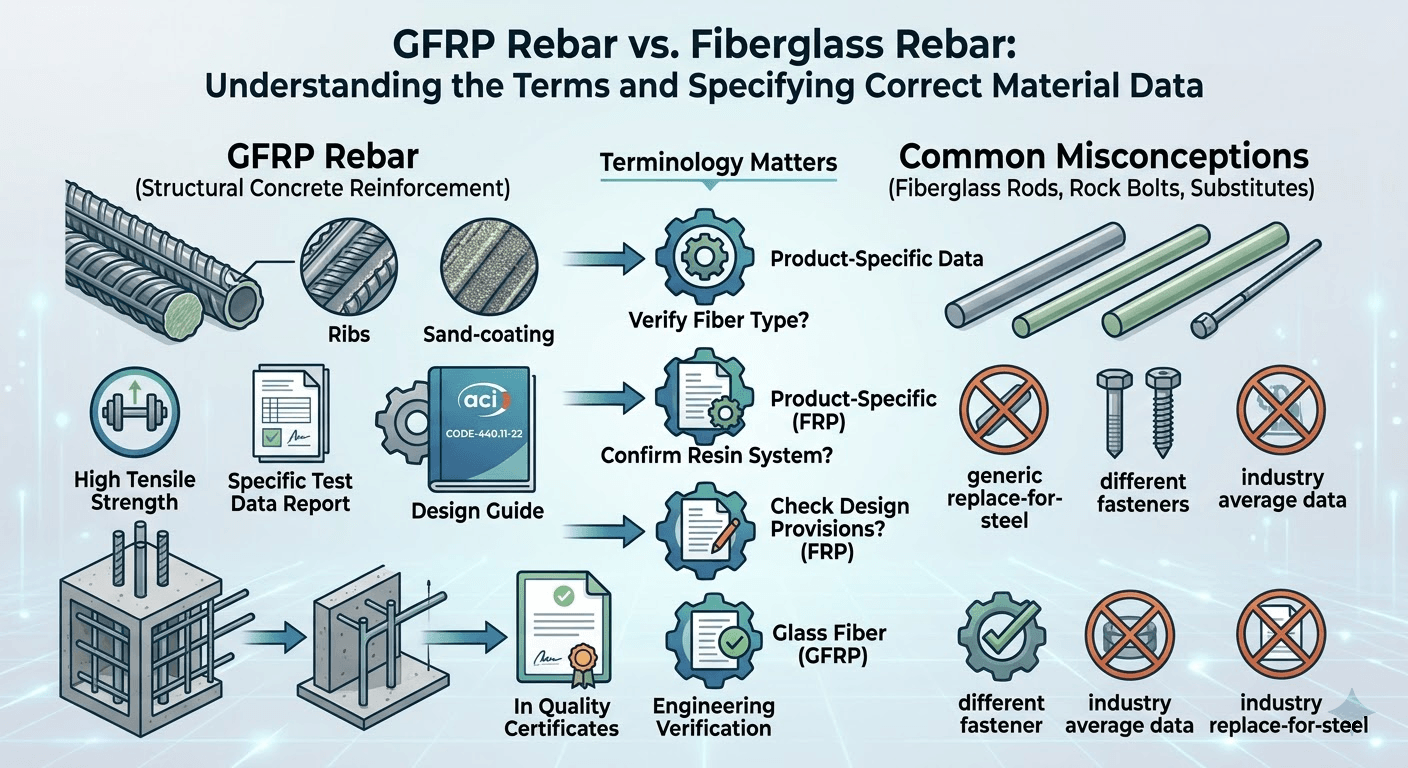
GFRP rebar eliminates this failure mechanism at the reinforcement level. Glass fiber reinforced polymer rebar does not corrode, does not respond to chloride or sulfate ions, and does not create the expansive corrosion products that fracture concrete cover — properties that are structural and permanent, not dependent on concrete cover depth or coating condition. The specification guidance, design standard references, and performance data in this article draw on GFRP rebar design and supply experience spanning bridge deck, marine infrastructure, chemical plant, and MRI facility construction programs for B2B customers in North American and international markets. It gives structural engineers and procurement managers a technical framework for specifying FRP rebar — covering material composition, mechanical properties, design standard requirements, material comparison, and application fit across bridge, marine, chemical plant, and electromagnetic-sensitive concrete infrastructure.

built to last where steel corrodes
What Is FRP Rebar? Material Composition and Manufacturing Basis
Understanding why GFRP rebar performs differently from steel — and how those differences affect structural design — begins with the material system and manufacturing process that determines both its properties and its limitations.
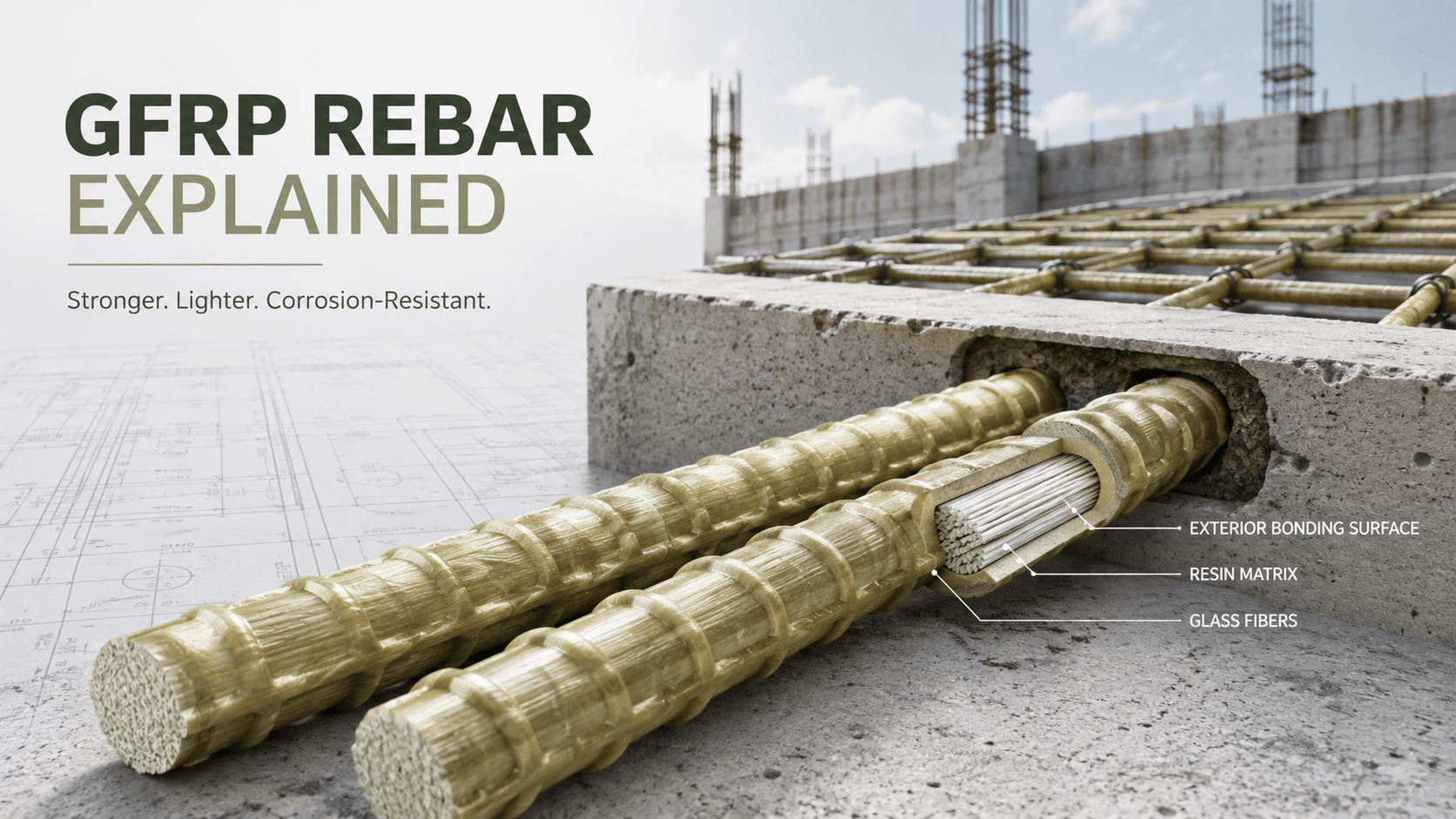
Material Composition: Glass Fiber, Resin Matrix, and Surface Deformation
GFRP rebar consists of longitudinal glass fiber reinforcement — E-glass fiber in standard production, ECR-glass (corrosion-resistant) in the most aggressive exposure specifications — embedded in a thermosetting resin matrix that binds the fiber system, protects the glass from the alkaline concrete pore solution, and provides the composite bar’s chemical inertness. Fiber volume fraction runs 50–65% of the bar cross-section — a parameter that directly determines tensile strength and elastic modulus, and that varies between manufacturers and bar sizes even at the same nominal diameter.
Surface deformation on GFRP rebar achieves the concrete bond that steel rebar achieves through cold-rolled ribs. Three surface types are in common production: helical fiber wrap applied during pultrusion, sand-coated outer surface bonded to the pultruded bar after forming, and ribbed profile produced by the die geometry. Each achieves bond strength through a different mechanism — mechanical interlock for ribbed, increased surface roughness and friction for sand-coated, and combined mechanical and adhesion for helical wrap — and bond performance differs between surface types in ways that affect development length calculation per ACI 440.1R.
Resin system selection — vinyl ester, epoxy, or polyester — determines the bar’s resistance to the alkaline pore solution of concrete (pH 12.5–13.5) and to the chloride and sulfate ions present in the most aggressive exposure environments. Vinyl ester is the standard specification for structural GFRP rebar in North American infrastructure applications; polyester is generally not recommended for structural GFRP rebar in concrete per ACI 440.1R guidance on long-term durability.
Manufacturing Process: Pultrusion and Surface Texturing
Pultruded GFRP rebar is produced by pulling glass fiber rovings through a resin bath and a heated die that aligns the fiber longitudinally through the bar cross-section — producing consistent fiber alignment and cross-section geometry that translates directly to consistent mechanical property performance across every bar in a production run. This dimensional consistency is the structural design requirement: development length and splice length are calculated from published property data, and property consistency across the supplied bars is the manufacturing quality parameter that makes those calculations valid.
Surface texturing is applied either during pultrusion — by wrapping rovings helically around the bar as it exits the die — or after pultrusion by bonding a sand-coated surface to the bar. Sand-coated bars have a larger effective diameter than the nominal bar size, and development length per ACI 440.1R must be calculated from the actual bonded surface geometry rather than the nominal diameter — a detail that affects bar placement drawings and splice zone dimensions on project-specific reinforcement details.
Fiber volume fraction — not bar diameter alone — determines GFRP rebar tensile strength and elastic modulus. Engineers who have reviewed GFRP rebar from multiple suppliers at the same nominal diameter consistently find meaningful variation in mechanical properties between products sharing the same diameter label. The correct procurement approach specifies minimum tensile strength and elastic modulus per ASTM D7957 and requires certified test records confirming that the supplied bars meet the specified minimums — not simply specifying a bar size and assuming property equivalence across suppliers.
FRP Rebar Types: GFRP, CFRP, and BFRP — When Each Is Specified
GFRP (glass fiber reinforced polymer) rebar is the standard specification for corrosion resistance applications in North American infrastructure — bridge decks, parking structures, marine concrete, and chemical plant slabs — where the primary driver is eliminating chloride-induced corrosion over a 50–75 year design life at competitive installed cost.
CFRP (carbon fiber reinforced polymer) rebar achieves elastic modulus approaching steel (100–150 GPa) — making it the specification for prestressed concrete and applications where GFRP’s lower stiffness creates serviceability problems that cannot be resolved by increasing reinforcement ratio. CFRP rebar unit cost runs significantly higher than GFRP, which limits its use to applications where the modulus advantage justifies the cost premium.
BFRP (basalt fiber reinforced polymer) rebar is an emerging alternative with mechanical properties intermediate between GFRP and CFRP. North American infrastructure design codes — ACI 440.1R, CSA S807 — do not yet provide the same level of BFRP-specific design guidance as for GFRP, and procurement programs requiring code-compliant design should confirm BFRP applicability with the project structural engineer before specification.
Key Mechanical and Physical Properties
GFRP rebar’s mechanical properties differ from steel in ways that directly affect structural design — understanding these differences determines whether the specification achieves the intended structural performance or produces an under-designed section that fails at the serviceability limit state before reaching ultimate strength.
The table below summarizes the key mechanical and physical properties of GFRP rebar relevant to structural design and infrastructure procurement:
| Property | GFRP Rebar | Grade 60 Steel Rebar | Design Implication |
|---|---|---|---|
| Tensile Strength | 600–1,000+ MPa | 420 MPa (yield) | GFRP exceeds steel yield — but fails without yield plateau |
| Elastic Modulus | 40–55 GPa | 200 GPa | 4–5× lower stiffness: deflection and crack width govern design |
| Failure Mode | Linear elastic — brittle rupture | Ductile — yield plateau before fracture | ACI 440.1R methodology required; no direct steel substitution |
| Density | ~2.1 g/cm³ | 7.85 g/cm³ | ~75% weight reduction — handling and logistics advantage |
| Chloride Resistance | Excellent — electrochemical immunity | Poor — chloride threshold triggers corrosion initiation | Eliminates primary concrete deterioration mechanism |
| Electromagnetic Properties | Non-magnetic, non-conductive | Ferromagnetic, conductive | Required in MRI facilities and RF-sensitive infrastructure |
| Thermal Expansion (longitudinal) | 6–10 µm/m·°C | ~12 µm/m·°C | Closer to concrete CTE — reduced thermal stress at rebar-concrete interface |
Tensile Strength and Linear Elastic Failure Mode
GFRP rebar achieves tensile strength in the range of 600–1,000+ MPa depending on fiber type, fiber volume fraction, and resin system — exceeding Grade 60 steel’s 420 MPa yield strength in direct comparison. This tensile strength advantage does not translate to direct substitution for steel reinforcement. GFRP rebar fails in a linear elastic mode without a yield plateau — it deforms proportionally to applied load up to rupture, without the ductile yielding that steel undergoes before fracture.
This failure mode difference is why ACI 440.1R requires a fundamentally different design approach from ACI 318 for GFRP-reinforced concrete. ACI 440.1R applies an environmental reduction factor (CE) to the guaranteed tensile strength — CE = 0.70 for GFRP bars in concrete exposed to earth and weather, CE = 0.75 for GFRP bars in concrete not exposed to earth and weather — and designs sections for a tension-controlled failure mode where concrete crushing governs before bar rupture. Engineers specifying GFRP rebar for the first time should treat ACI 440.1R not as a modification of ACI 318 but as a parallel design methodology with different governing equations, different development length calculations, and different minimum reinforcement ratio requirements.
Elastic Modulus: The Critical Difference from Steel
GFRP rebar’s elastic modulus — 40–55 GPa — is approximately one-fifth that of steel at 200 GPa. This stiffness difference is the most operationally significant mechanical property distinction for structural design. At the same reinforcement ratio as an equivalent steel-reinforced section, a GFRP-reinforced section deflects 4–5 times more under the same service load — making deflection and crack width the governing design criteria for most GFRP rebar concrete sections, rather than ultimate strength.
GFRP rebar development lengths per ACI 440.1R typically run 15–25% longer than equivalent steel development lengths per ACI 318, requiring longer lap splices and affecting bar placement drawing dimensions — a practical implication that must be confirmed with the structural engineer before finalizing bar cut length specifications for project delivery. ACI 440.1R designs for serviceability by requiring higher reinforcement ratios than equivalent steel sections and by providing modified deflection and crack width calculation procedures that account for the reduced bar stiffness.
Engineers who attempt to directly substitute GFRP bars for steel bars at the same diameter and spacing — without recalculating for the elastic modulus difference — produce sections that satisfy ultimate strength requirements while failing serviceability limits at service load levels. This is the most common specification error in GFRP rebar projects, and it is a design process failure, not a material failure.
Corrosion Immunity, Electromagnetic Transparency, and Weight
GFRP rebar’s corrosion immunity is electrochemical — glass fiber composite has no metallic component to participate in the oxidation-reduction reaction that drives steel corrosion in the presence of chloride ions, oxygen, and moisture. There is no corrosion threshold to exceed, no passive film to break down, and no expansive corrosion product to generate — the immunity is structural and applies equally whether the bar is fully embedded in dense concrete or in cracked concrete with direct chloride access.
The non-magnetic and non-conductive properties of GFRP rebar derive from the same glass fiber and polymer composition that provides corrosion immunity. In MRI suite construction, steel rebar within the specified exclusion zone around the magnet bore creates image artifact and magnetic field distortion that affects diagnostic image quality — a clinical requirement that mandates GFRP rebar in the structural concrete within the MRI suite. At approximately 2.1 g/cm³ — roughly 75% lighter than steel at 7.85 g/cm³ — GFRP rebar in large-diameter sizes provides a meaningful installation labor and crane requirement reduction on marine and offshore concrete structures where reinforcement handling is a significant construction cost component.
FRP Rebar vs. Steel Rebar: Full Specification Comparison
The engineering decision between GFRP and steel rebar requires comparing seven specification dimensions — mechanical performance, corrosion behavior, design standard requirements, lifecycle cost, and application-specific regulatory requirements — not unit bar cost alone.
The table below compares GFRP FRP rebar and Grade 60 steel rebar across the key specification dimensions for infrastructure B2B procurement:
| Specification Dimension | GFRP FRP Rebar | Grade 60 Steel Rebar |
|---|---|---|
| Tensile Strength | 600–1,000+ MPa | 420 MPa (yield) |
| Elastic Modulus | 40–55 GPa | 200 GPa |
| Failure Mode | Linear elastic — brittle rupture | Ductile — yield plateau before fracture |
| Corrosion in Chloride Environment | None — electrochemical immunity | Progressive — initiation at chloride threshold, then accelerating section loss |
| Design Standard | ACI 440.1R, ASTM D7957, CSA S807 | ACI 318, ASTM A615 |
| Electromagnetic Properties | Non-magnetic, non-conductive | Ferromagnetic, conductive |
| 50-Year Lifecycle Cost (marine / deicing salt) | Lowest — no corrosion rehabilitation | High — deck rehabilitation or replacement within 20–35 years |
Structural Performance and Design Standard Requirements
ACI 440.1R (Guide for the Design and Construction of Structural Concrete Reinforced with FRP Bars) provides the complete North American design methodology for GFRP rebar concrete structures. The environmental reduction factor CE — 0.70 for GFRP bars in concrete exposed to earth and weather, 0.75 for GFRP bars in concrete not exposed to earth and weather — reduces the guaranteed tensile strength (ffu*) from ASTM D7957 testing to the design tensile strength used in structural calculations. Development length, splice length, and minimum bend radius requirements for GFRP rebar differ from ACI 318 steel values and must be calculated per ACI 440.1R — not adapted from steel tables.
ASTM D7957 (Standard Specification for Solid Round Glass Fiber Reinforced Polymer Bars for Concrete Reinforcement) defines the minimum mechanical property requirements — guaranteed tensile strength, elastic modulus, and ultimate strain — that GFRP rebar must meet for structural procurement compliance. CSA S807 provides the equivalent Canadian standard. Procurement programs specifying GFRP rebar should require ASTM D7957-compliant test records from the supplier confirming that the supplied bars meet the specified guaranteed properties — not manufacturer catalog values, which may be based on mean test results rather than the guaranteed minimum that ACI 440.1R design uses.
Corrosion Performance and 50-Year Lifecycle Cost
Steel rebar chloride-induced corrosion in bridge deck and parking structure environments follows a documented two-stage deterioration timeline: an initiation period during which chloride ions diffuse through the concrete cover to the bar surface, and a propagation period during which active corrosion generates expansive corrosion products that crack and spall the concrete. In northern US states and Canadian provinces where salt application rates reach 15–20 tonnes per lane-kilometre per winter in high-use corridors, bridge deck initiation periods run 10–20 years and propagation to structural rehabilitation triggers within 20–35 years of construction.
GFRP-reinforced bridge deck structures in documented North American inspection programs — with service histories now extending beyond 20 years in high-deicing-salt environments — show no corrosion-driven concrete deterioration and no projected rehabilitation requirement within the 75-year design life. The 50-year total ownership cost comparison consistently favors GFRP: the higher unit bar cost at installation is recovered within the first avoided deck rehabilitation cycle, typically within 20–30 years in high-salt exposure environments, after which the remaining service life represents compounding lifecycle cost advantage over steel.
When Steel Remains the Correct Specification
GFRP rebar’s lower elastic modulus makes it unsuitable as a direct substitute for steel in prestressed concrete without specialty design provisions — the elastic modulus governs prestress loss calculations in a way that GFRP’s lower stiffness cannot compensate for through increased reinforcement ratio. Compression-dominant structural members where steel’s ductility and compressive strength govern the failure mode also do not benefit from GFRP substitution — GFRP rebar contributes minimal compressive resistance and is not counted in compression capacity per ACI 440.1R. Seismic design in high-seismic zones requires explicit engineering judgment about GFRP’s linear elastic failure mode and the absence of ductile energy dissipation that steel yielding provides — applications in high-seismic regions should be reviewed against the specific seismic design provisions and local code adoption status before GFRP specification.

gfrp rebar
Application Scenarios: Where FRP Rebar Performs Best
Steel rebar’s corrosion behavior in chloride environments and its electromagnetic conductivity create the four application categories below — each representing a project type where GFRP’s advantages are not incremental improvements over steel but structural and lifecycle requirements that steel cannot satisfy at competitive 50-year total cost.
Bridge Decks and Parking Structures: Deicing Salt Chloride Exposure
In one 22-year post-construction inspection program at a northern US interstate highway bridge where Unicomposite-supplied GFRP rebar was installed in the deck sections alongside conventional steel rebar in the approach slabs at the same time, inspection cores at year 22 confirmed no measurable chloride concentration at the GFRP bar surface and no visual or mechanical evidence of bar degradation. The steel-reinforced approach slabs on the same bridge required full deck rehabilitation at year 18 — involving lane closure, concrete removal to bar depth, and full deck resurfacing — at a rehabilitation cost per lane-metre that exceeded the original GFRP rebar premium on the deck sections by a factor of 4.1. The GFRP deck sections carried zero maintenance cost in the same 22-year period and project no rehabilitation requirement within their 75-year design life.
Parking structure top decks and exposed ramp sections experience the most aggressive deicing salt exposure in the structure. Chloride surface concentrations on parking structure top decks in northern climates can reach 3–5 kg/m³ from direct vehicle undercarriage carry-in — exceeding typical bridge deck surface concentrations in equivalent geographic locations by a factor of 2–3. GFRP rebar in parking structure top deck sections eliminates the rehabilitation cycle that represents the largest maintenance cost item in parking structure asset management programs.
Marine and Coastal Infrastructure: Tidal and Splash Zone Concrete
Seawall, pier, and harbor concrete structure in the tidal and splash zone combines continuous chloride exposure, wet-dry cycling that concentrates chloride ions at the concrete surface, and biological fouling that produces organic acids — the combination that creates the most aggressive steel corrosion environment in any concrete application. Steel rebar concrete cover requirements for aggressive marine exposure reach 75–100 mm to achieve design life targets, reducing structural section efficiency and increasing concrete dimensions and weight.
In one coastal seawall replacement program where the original steel-reinforced concrete sections had required replacement within 22 years due to spalling from rebar corrosion in the splash zone, the replacement structure was designed with GFRP rebar and a 75-year design life — with ECR-glass fiber and vinyl ester resin specified for the splash zone sections per ACI 440.1R exposure category guidance. GFRP rebar allows reduced cover depth of 35–50 mm without corrosion risk, maintaining structural section efficiency and reducing concrete volume in sections where weight matters for foundation loading — partially offsetting the GFRP bar premium at installation in sections where concrete material cost is significant.
Chemical Plant and Wastewater Treatment: Chemically Aggressive Concrete
Chemical plant secondary containment slabs, wastewater treatment basin walls, and process area concrete floors operate in environments where sulfate and acid attack degrades the concrete matrix itself — and where steel rebar corrosion, initiated by the same aggressive chemistry, accelerates structural deterioration beyond the concrete degradation rate alone. GFRP rebar in chemically aggressive concrete eliminates the reinforcement corrosion mechanism, allowing concrete section maintenance and repair programs to address concrete degradation without the structural emergency created by simultaneous rebar corrosion and concrete spalling.
Electromagnetic-Sensitive Facilities: MRI Rooms and Toll Systems
MRI suite structural concrete requires non-magnetic, non-conductive reinforcement within the Faraday cage zone of the MRI installation — typically the full floor slab, walls, and ceiling of the MRI suite. In one hospital MRI suite construction program, the structural engineer specified GFRP rebar for all concrete within the 5-meter exclusion zone around the magnet bore after initial steel-reinforced slab test sections showed measurable magnetic field distortion during equipment commissioning — a distortion that required full slab demolition and reconstruction with GFRP rebar before the MRI system could be calibrated to diagnostic specification. GFRP rebar satisfies the structural reinforcement requirement without electromagnetic interference, making it the standard specification for MRI suite slab and wall construction in hospital and imaging center programs throughout North America.
RFID-enabled infrastructure — automated toll booth structures, license plate recognition systems, and wireless access control in building concrete — specifies GFRP rebar where the RF signal must penetrate the structural concrete without the attenuation that steel reinforcement creates at the signal frequencies used in these systems.
Resin System and Glass Fiber Selection for Concrete Service
Beyond the bar diameter and fiber type, resin system and glass fiber selection determine the long-term durability of GFRP rebar in the alkaline and chloride environment inside concrete — and these selections feed directly into the ACI 440.1R design parameters that govern structural adequacy.
Vinyl Ester vs. Epoxy Resin: Alkaline Concrete Pore Solution Resistance
Concrete pore solution at pH 12.5–13.5 hydrolyzes glass fiber surfaces over time unless the resin matrix provides effective encapsulation. Vinyl ester resin provides the standard level of alkaline resistance for structural GFRP rebar in North American infrastructure applications — it is the resin system for which the most ACI 440.1R CE factor data exists and against which the standard’s environmental reduction factors were calibrated. Epoxy resin provides additional alkaline resistance for the most demanding long-term exposure conditions, but the CE factor framework applies to all GFRP bars regardless of resin system.
ACI 440.1R Table 8.2 assigns CE values by fiber type and exposure category — CE = 0.70 for GFRP bars in concrete exposed to earth and weather, CE = 0.75 for GFRP bars in concrete not exposed to earth and weather. These values are design conservatisms applied to all GFRP bars in their respective exposure categories. Buyers should specify minimum CE values and require the supplier to confirm which ACI 440.1R exposure category the supplied bars are designed for, and to provide the ASTM D7705 alkaline conditioning durability records that support the CE category claim — not simply specify a resin type and assume CE compliance.
E-Glass vs. ECR-Glass: Corrosion Resistance in Alkaline and Chloride Environments
Standard E-glass fiber in GFRP rebar with proper vinyl ester or epoxy resin encapsulation provides adequate durability for most structural concrete applications covered by ACI 440.1R. ECR-glass (corrosion-resistant glass) fiber provides improved inherent resistance to the alkaline concrete pore solution through a modified glass composition with reduced boron oxide content — specified for applications with the most aggressive long-term exposure conditions, very long design lives (75–100 years), or where the consequence of reinforcement degradation over the full design life is particularly severe.
The ECR-glass premium over E-glass is modest compared to the total installed bar cost in most infrastructure programs. For projects requiring 75-year or longer design life in aggressive marine or chemical exposure — the application category where the coastal seawall replacement program referenced above specified ECR-glass — the additional cost represents low-cost design life insurance relative to the total structure value.
Custom FRP Rebar Specification and B2B Procurement
GFRP rebar supply adaptability — in diameter, length, surface deformation type, resin system, and fiber type — makes it applicable across the full range of infrastructure concrete reinforcement requirements.
Diameter Range, Length, and Surface Deformation Options
Standard GFRP rebar production covers #3 (9.5 mm) through #10 (32 mm) imperial sizing and equivalent metric diameters, covering the reinforcement range required for slab, beam, column, and wall concrete sections in most infrastructure applications. Custom lengths are available cut to project specifications — reducing field cutting on large infrastructure projects where consistent bar length requirements allow pre-cut supply.
Unicomposite Technology Co., Ltd. — an ISO 9001-certified FRP manufacturer operating an 18,000 m² production facility in Nanjing — supplies pultruded GFRP rebar for infrastructure B2B customers in North American and international markets. Standard production covers vinyl ester resin with E-glass fiber in standard imperial diameters; ECR-glass and epoxy resin formulations are available for project-specific requirements confirmed at inquiry.
Resin System, Fiber Type, and Environmental Reduction Factor Documentation
Resin system selection determines whether the bar achieves its rated durability in the concrete service environment — vinyl ester for standard structural service per ACI 440.1R, epoxy or ECR-glass for the most aggressive exposure conditions and longest design life requirements. This is a structural durability decision, not a procurement cost optimization. CE factor confirmation from ASTM D7957 test records is a separate structural design requirement: the structural engineer needs the supplier’s ASTM D7957 guaranteed tensile strength and ASTM D7705 alkaline conditioning records to confirm the CE category before design calculations are complete — not after bars are delivered to site.
Available documentation includes ASTM D7957 tensile strength and elastic modulus records, ASTM D7705 alkaline conditioning durability records, fiber volume fraction confirmation, and the CE supporting test data required for ACI 440.1R design compliance. Specify the required design standard and CE exposure category at inquiry to confirm documentation availability before order placement.
MOQ, Lead Time, and Project Certification Requirements
Standard diameter configurations from existing production tooling ship within 4–6 weeks from order confirmation, based on standard production scheduling — confirmed timing is provided at inquiry. Custom diameter, specialty resin, or ECR-glass configurations extend lead time to 6–10 weeks from specification sign-off. ISO 9001 manufacturing certification is available; project-specific certification packages including ASTM D7957 compliance records, CE documentation, and structural design support data are assembled at inquiry based on the project’s specified standard.
Conclusion
GFRP rebar earns its specification in chloride-aggressive and electromagnetically sensitive concrete infrastructure through four operational advantages that determine total structural ownership cost over the 50–75 year design life:
- Elastic modulus difference from steel requires ACI 440.1R design — not direct substitution: GFRP rebar at the same diameter as steel is not structurally equivalent. Deflection and crack width govern most GFRP-reinforced sections at service load, requiring higher reinforcement ratios and development lengths typically 15–25% longer than equivalent steel per ACI 440.1R. Engineers who treat GFRP as a drop-in steel replacement produce sections that fail serviceability limits — a design process failure that the material specification alone cannot prevent.
- Resin system selection determines whether the bar achieves its rated durability in the concrete environment: Vinyl ester covers standard infrastructure service; epoxy or ECR-glass is required for the most aggressive marine and chemical exposure with 75-year or longer design life targets. This is a structural durability decision made at specification — not a procurement cost option.
- CE factor confirmation from ASTM D7957 test records is a structural design requirement, not a post-procurement documentation step: The structural engineer needs the supplier’s guaranteed tensile strength and alkaline conditioning records to confirm the CE category before design calculations are complete. Specifying bars and requesting documentation after delivery creates schedule risk on infrastructure projects where reinforcement placement cannot proceed without confirmed CE compliance.
- 50-year lifecycle cost comparison must include avoided rehabilitation — not just bar unit cost: Documented bridge deck inspection programs confirm GFRP-reinforced sections with zero maintenance cost at 22-year inspections, against equivalent steel-reinforced sections requiring full deck rehabilitation at year 18 at a per-lane-metre cost exceeding the original GFRP premium by a factor of 4.1. The lifecycle cost crossover point in high-salt exposure environments falls within 20–30 years — after which every avoided rehabilitation cycle represents compounding cost advantage through the remaining design life.
[Contact Unicomposite — ISO 9001-certified GFRP rebar manufacturer with ACI 440.1R design documentation and ASTM D7957 test record support — with your bar diameter, project exposure category, required design standard, and quantity to receive an FRP rebar specification and supply proposal →]
Frequently Asked Questions
GFRP rebar’s elastic modulus — 40–55 GPa — is approximately one-fifth that of steel at 200 GPa, which means a GFRP-reinforced section at the same reinforcement ratio as an equivalent steel section deflects 4–5 times more under service load. ACI 440.1R requires higher reinforcement ratios and modified deflection and crack width calculations for GFRP rebar sections — design procedures that differ fundamentally from ACI 318 steel design, not a modification of it. Direct substitution without ACI 440.1R recalculation produces sections that satisfy ultimate strength but fail serviceability limits.
Standard GFRP rebar production covers #3 (9.5 mm) through #10 (32 mm) imperial sizing, covering the reinforcement range for slab, beam, column, and wall sections in most infrastructure applications. Development lengths per ACI 440.1R typically run 15–25% longer than equivalent steel development lengths per ACI 318 — requiring longer lap splices and affecting bar placement drawing dimensions. Provide the bar size, surface deformation type, and concrete compressive strength at inquiry to confirm the ACI 440.1R development length for the specific bar and project configuration.
Vinyl ester resin with ECR-glass fiber is the standard specification for marine splash zone concrete with 75-year or longer design life requirements — ECR-glass provides improved inherent alkaline resistance through its modified composition compared to standard E-glass, and vinyl ester provides the resin encapsulation performance calibrated to ACI 440.1R CE = 0.70 for concrete exposed to earth and weather. ASTM D7705 alkaline conditioning durability records supporting the CE category should be requested from the supplier at inquiry before structural design is finalized.
ACI 440.1R-compliant procurement requires ASTM D7957 guaranteed tensile strength and elastic modulus test records — confirming that the supplied bars meet the specified guaranteed minimums (not mean values) — and ASTM D7705 alkaline conditioning records supporting the CE category used in the structural design. ISO 9001 manufacturing certification and fiber volume fraction records are also available. Specify the required ACI 440.1R exposure category and design tensile strength at inquiry to confirm documentation availability before order placement.
GFRP rebar in high-seismic design zones requires explicit structural engineering review — GFRP’s linear elastic failure mode and absence of the ductile energy dissipation that steel yielding provides in seismic events must be addressed by specific design provisions. ACI 440.1R does not fully resolve seismic design with GFRP for all structural systems in high-seismic zones, and local code adoption status varies by jurisdiction. GFRP is used in seismic zones in non-primary lateral force resisting systems — slabs, non-moment-frame elements, and foundations — where ductility requirements are less stringent. Confirm seismic applicability with the project structural engineer before specifying GFRP rebar in Seismic Design Categories C through F.
info@unicomposite.com