 info@unicomposite.com


FRP grating and steel grating can both be suitable structural walking-surface systems when the selected product is verified against the project requirements. FRP is often evaluated when corrosion exposure, panel mass, or electrical requirements matter. Steel may remain practical when an established structural design, fabrication method, fire requirement, impact condition, or connection system governs. Compare identified products under the same loads, supports, environment, acceptance criteria, and document requirements before choosing between them.
The main practical difference is the material system. FRP, or fiber-reinforced polymer, combines reinforcing fibers with a polymer matrix, while steel grating uses metallic load-bearing bars and connecting members. This affects corrosion mechanisms, panel mass, electrical behavior, stiffness, fabrication, fire response, and maintenance planning. It does not establish allowable span, slip performance, service life, or total cost by itself; those conclusions require data for the proposed product and project conditions.
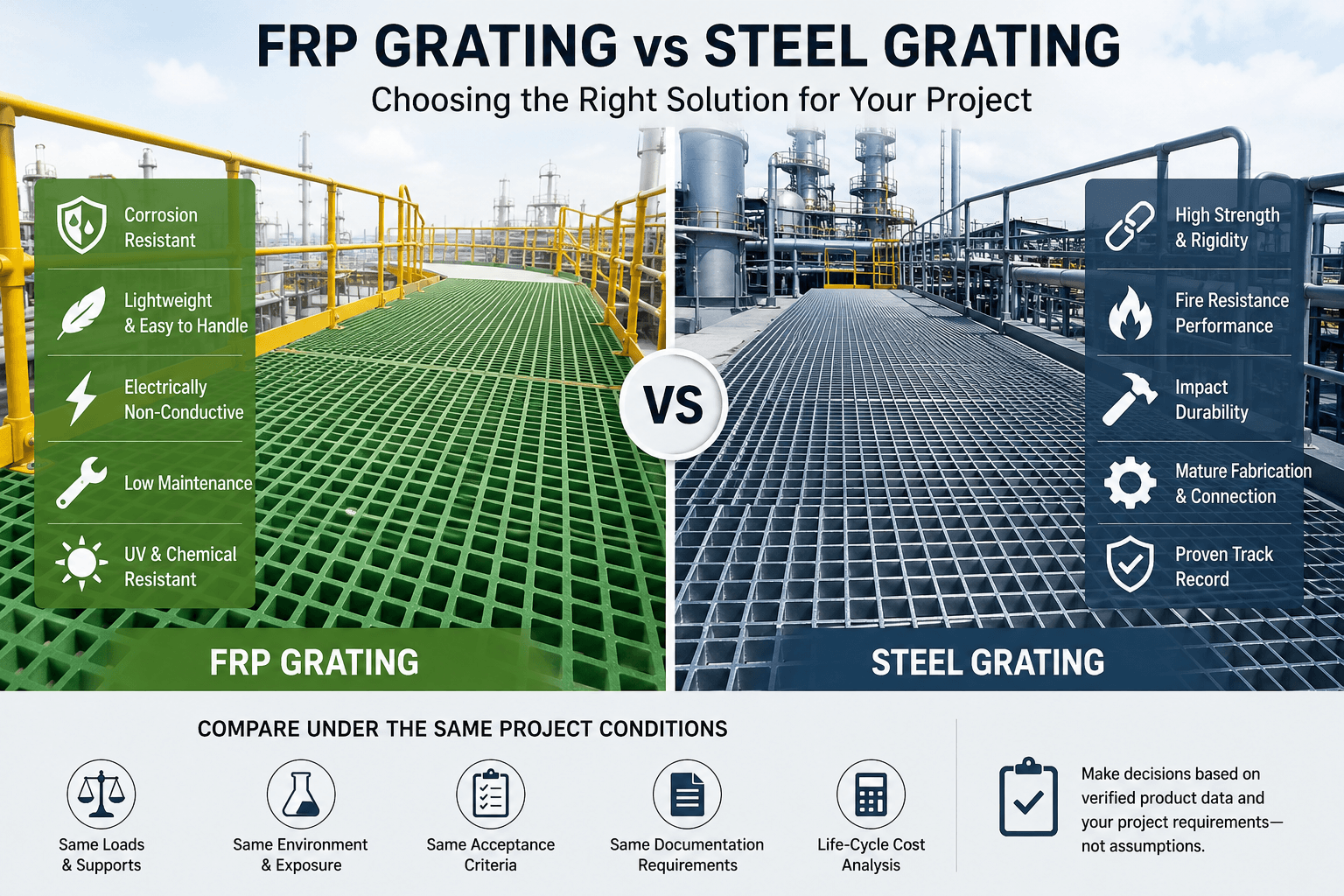
frp grating vs steel grating
FRP Grating vs Steel Grating at a Glance
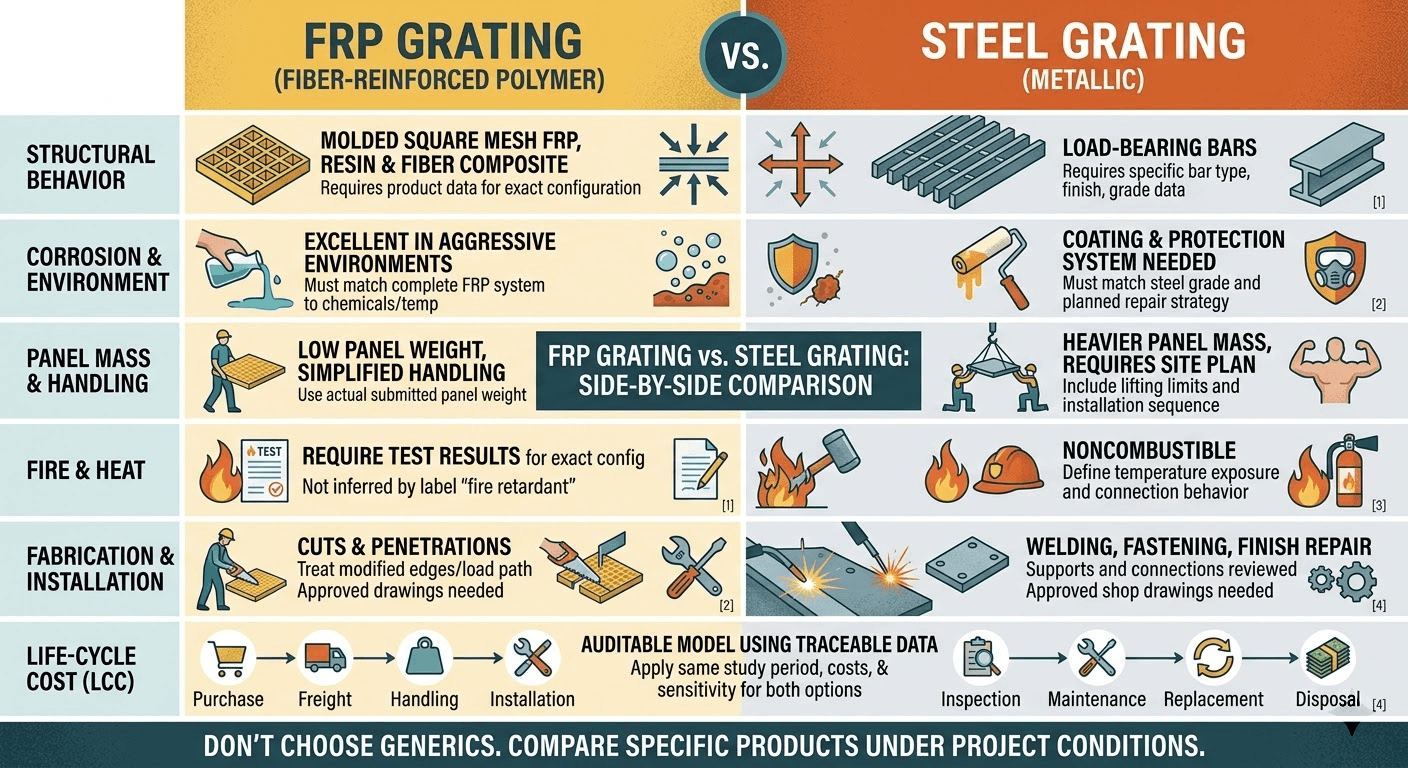
| Comparison point | FRP grating review | Steel grating review | Evidence needed for a fair comparison |
|---|---|---|---|
| Structural behavior | Identify construction, bearing direction, section, panel assembly, and product-specific data | Identify bar type, spacing, cross members, material grade, finish, and product-specific data | Same support layout, load cases, acceptance criteria, units, and safety basis |
| Corrosion and environment | Match the complete FRP material system to chemicals, temperature, UV, cleaning, and exposure mode | Match the steel grade and protective system to the same exposure and planned repair strategy | Material identification, exposure schedule, compatibility or corrosion-control evidence, and inspection plan |
| Panel mass and handling | Use the submitted panel weight and final panelization | Use the submitted panel weight and final panelization | Panel schedule, lifting and access constraints, installation sequence, and site safety plan |
| Fire and heat | Require results for the exact FRP configuration and applicable test method | Define steel temperature exposure, coating behavior, and project fire requirements | Applicable code or specification, test reports, and acceptance limits |
| Electrical requirements | Do not infer insulation, conductivity, or antistatic behavior from the term FRP | Account for steel’s electrical conductivity within the project safety design | Product-specific electrical data and the responsible engineer’s acceptance criteria |
| Walking surface | Evaluate the exact top surface under relevant dry, wet, oily, worn, or contaminated conditions | Evaluate the exact plain, serrated, or coated surface under the same conditions | Test method, surface identity, condition, result, and maintenance plan |
| Fabrication and installation | Review cuts, penetrations, remaining load path, edge condition, supports, and fasteners | Review cuts, welding or fastening, protective-finish repair, supports, and connections | Approved shop drawings, method statement, inspection points, and competent-person review |
| Life-cycle cost | Include purchase, freight, handling, installation, inspection, maintenance, outage, replacement, and disposal assumptions | Use the same cost categories, study period, discount basis, and risk assumptions | Traceable quantities, unit costs, schedules, maintenance scenarios, and sensitivity analysis |
The useful question is therefore not simply, “Why choose FRP over metal grating?” It is, “Which grating configuration satisfies this project’s design and procurement requirements?”
When Should FRP or Steel Stay on the Shortlist?
FRP grating deserves further evaluation when corrosion-control work, restrictive lifting or access conditions, or defined electrical requirements materially affect the project. Steel deserves further evaluation when the project already has a verified steel design and connection basis or when fire, temperature, impact, fabrication, or local supply requirements favor an identified steel system. These are screening rules, not final material recommendations.
Keep a candidate on the shortlist only if its exact configuration can satisfy the complete design and procurement basis. Missing load, material, test, installation, or acceptance information should be resolved before selection rather than replaced with a generic material advantage.
1. Start With Loads, Supports, and Acceptance Criteria
Start with the structural duty, not the material name. OSHA requires walking-working surfaces to support their maximum intended load and to be inspected and maintained in a safe condition.[1] That requirement applies to the finished surface in service, not to a generic material label.
For each candidate, record:
- the uniform, concentrated, line, wheel, impact, and other applicable load cases;
- clear span, support width, bearing direction, panel joints, edges, and openings;
- strength, deflection, vibration, serviceability, and owner-defined acceptance criteria;
- the governing code, specification, standard edition, and approval authority; and
- the exact product drawing, revision, load table, calculation, or test report used.
Compare like with like. FRP and steel have different stiffness characteristics, so equal panel depth or a similar appearance does not establish equal deflection behavior. Use load and deflection data for the exact panel construction. A span from one FRP panel cannot be combined with the depth, surface, or material of another. The same rule applies to steel bar size, spacing, material grade, finish, and connection details. If the two submittals use different span definitions, load orientation, support conditions, units, or deflection limits, align those assumptions before drawing a conclusion.
ASTM F3059-24, for example, is a specification for FRP gratings used in marine construction and shipbuilding.[2] Its title and scope show why a standard reference must be checked for applicability. Citing a standard name alone does not establish that a proposed product complies with it.
2. Compare Corrosion Exposure as a Complete System
Corrosion comparison should evaluate the complete FRP material system against the complete steel protection system under the same exposure schedule. For steel, identify the grade, coating or other protection system, cut-edge and connection treatment, inspection method, repair process, and expected exposure. FRP does not rust by the same electrochemical mechanism, but its polymer matrix and reinforcement system still require compatibility evidence for the actual chemical, temperature, UV, cleaning, immersion, splash, and wear conditions.
TWI describes GRP as glass reinforcement within a polymer matrix and identifies light weight and resistance to aggressive environments as general material attributes.[3] Those general attributes support placing FRP on a project shortlist; they do not prove that every FRP grating is compatible with every chemical or temperature.
Create one exposure schedule for both candidates:
| Exposure input | Record this information | Comparison output |
|---|---|---|
| Chemical agents | Name, concentration where applicable, mixtures, cleaning chemicals, and contaminants | Evidence accepted for the exact FRP material system and steel protection system |
| Temperature | Normal, upset, cycling, localized heat, and duration | Product-specific limits and applicable test or design basis |
| Exposure mode | Indoor, outdoor, immersion, splash, vapor, condensation, or intermittent washdown | Defined degradation mechanism and inspection points |
| Wear and traffic | Foot traffic, carts, vehicles, dropped objects, abrasion, and cleaning method | Surface, section, protection, and replacement assumptions |
| Required service outcome | Appearance, structural capacity, electrical behavior, hygiene, or another owner criterion | Acceptance statement and responsible approval authority |
A sentence such as “FRP is corrosion resistant” is too broad for procurement. A usable conclusion identifies the proposed material system, the exposure, the evidence reviewed, and any limitations.
3. Treat Weight as a Project Input, Not a Marketing Percentage
FRP composites are generally lightweight compared with steel, but a fixed percentage does not describe every grating panel.[3] Panel depth, geometry, top configuration, size, connections, and required capacity all affect the delivered weight.
Use actual submittal weights to evaluate:
- transport and unloading;
- access through doors, hatches, or congested plant areas;
- manual-handling limits and the lifting plan;
- temporary works and installation sequencing;
- supporting-structure reactions; and
- the number and size of field joints.
Lower panel mass may simplify part of the logistics, but it does not remove the need for a site-specific handling and installation plan. Compare the final panel schedule rather than the density of raw FRP and steel alone.
4. Keep Fire, Electrical, Slip, and Impact Questions Separate
Fire, electrical, slip, and impact performance answer different project questions. Treating them as one list of “FRP advantages” can conceal critical differences between products.
Fire and temperature
Do not infer fire performance from color, resin family, or the term fire retardant. Define the required test method, specimen or assembly, rating or acceptance value, smoke requirement where applicable, exposure condition, and report scope. Steel also needs a project-specific fire and temperature review; noncombustibility does not by itself establish load-bearing performance at the required temperature or the behavior of coatings and connections.
Electrical behavior
Steel is electrically conductive. FRP configurations can be designed for different electrical behavior, and conductive or antistatic constituents may alter the result. Use tested values for the exact proposed configuration and integrate them into the project’s grounding, bonding, hazardous-area, and electrical safety design. This article does not declare any Unicomposite grating electrically insulating, conductive, or antistatic.
Slip resistance
Slip performance belongs to the complete walking surface under the expected condition. Compare the exact FRP and steel surfaces using the same test method and relevant dry, wet, contaminated, and worn conditions. A label such as gritted, concave, or serrated is a surface description, not a test result.
Impact and localized damage
Define dropped-object, wheel, impact, abuse, and cutout conditions separately from uniform load. Establish inspection and replacement criteria for each material. Do not turn ductility, toughness, or crack resistance into a blanket claim without a defined product, load, condition, and verification method.
5. Compare Fabrication and Installation Scope Before Comparing Price
FRP and steel require different fabrication tools, connection methods, and treatment of modified edges or surfaces. Installation cost therefore needs to come from the actual panel layout, quotation scope, and method statement. The two options are not commercially comparable if one quotation includes final panelization, drawings, fasteners, edge details, protective-finish work, documentation, or site services that the other excludes.
Before price comparison, align:
- final panel dimensions and quantity;
- support and bearing details;
- penetrations, openings, toe plates, nosings, and other interfaces;
- fastening or connection scope;
- shop versus field fabrication;
- treatment of cut or damaged surfaces;
- packing, freight, unloading, lifting, and access assumptions;
- installation method, inspection hold points, and acceptance records; and
- exclusions, responsibilities, and drawing revisions.
Do not use the old shortcut that FRP “can be cut at will” or that it never needs special installation controls. Cuts can change the load path or edge condition, and fabrication methods introduce material-specific safety and quality requirements. Use approved drawings and instructions for the selected product.
frp grating vs steel gratingjpg
6. Build a Life-Cycle Cost Comparison That Can Be Audited
Purchase price alone does not determine which option costs less for the project. The Federal Highway Administration describes life-cycle cost analysis as an engineering economic tool for comparing the differential costs of project alternatives.[4] A credible FRP-versus-steel comparison applies the same study period, discount basis, quantities, operating assumptions, and uncertainty treatment to both options.
Include these cost categories:
| Cost category | Inputs to document | Common comparison error |
|---|---|---|
| Acquisition | Panels, accessories, drawings, testing, packaging, and freight | Comparing different product or document scopes |
| Installation | Labor, lifting, access, temporary works, permits, and outage time | Applying a generic labor-saving percentage |
| Inspection | Method, frequency assumption, access, records, and responsible party | Assuming either material requires no inspection |
| Planned maintenance | Cleaning, coating or protection work, fastener work, repairs, and downtime | Assigning zero maintenance without a plan |
| Unplanned events | Damage, chemical upset, coating failure, impact, and emergency access | Omitting uncertainty or using an invented failure rate |
| Replacement and end of study | Removal, replacement, disruption, residual value, and disposal | Assuming a service life without evidence |
Run sensitivity cases for the inputs that can change the decision, such as coating-repair frequency, outage cost, lifting access, freight, inspection effort, and replacement timing. The result should show which assumptions drive the choice, not merely a single total with hidden inputs.
7. Use a Traceable Decision Record
Finish the comparison with a short approval record. It should identify both product configurations, drawing revisions, loads, supports, exposure schedule, tests and standards reviewed, installed scope, life-cycle cost assumptions, unresolved exceptions, and the person or authority accepting the decision.
Procurement and design review checklist
- Are the FRP and steel candidates identified by exact product and drawing revision?
- Do both candidates use the same support layout, loads, units, and acceptance criteria?
- Is bearing direction clear on the panel layout?
- Are every opening, cutout, unsupported edge, and connection shown?
- Does the exposure schedule include chemicals, temperature, UV, cleaning, wear, and upset conditions?
- Are fire, electrical, slip, and impact requirements linked to applicable evidence?
- Do quotations include the same panelization, accessories, documentation, freight, and installation boundaries?
- Does the life-cycle model disclose its study period, costs, maintenance scenarios, and sensitivity cases?
- Are exceptions recorded and accepted by the responsible project authority?
Prepare an FRP Grating Project Review
Explore our fiberglass grating options. To discuss a project, send us the application, panel and support drawings, clear spans, load cases and acceptance criteria, openings and cutouts, surface and environmental requirements, required standards or submittals, quantity, and destination. We will use these inputs to define the quotation scope and identify the product and document requirements that still need to be resolved. The specific configuration, materials, surface, documentation, commercial terms, and delivery scope will be established during review and quotation.
References
- Occupational Safety and Health Administration, “1910.22 – General requirements.” https://www.osha.gov/laws-regs/regulations/standardnumber/1910/1910.22
- ASTM International, “ASTM F3059-24: Standard Specification for Fiber-Reinforced Polymer (FRP) Gratings Used in Marine Construction and Shipbuilding.” https://store.astm.org/f3059-24.html
- TWI, “What are Glass Reinforced Plastic (GRP) Composites?” https://www.twi-global.com/technical-knowledge/faqs/what-are-glass-reinforced-plastic-grp-composites
- Federal Highway Administration, “Life-Cycle Cost Analysis.” https://www.fhwa.dot.gov/infrastructure/asstmgmt/lcca.cfm


