 info@unicomposite.com


Introduction
Industrial facilities are under constant pressure to keep people safe, control risk, and extend the life of critical assets. That is why many engineers and buyers are moving away from traditional steel grating and toward customized fiberglass grating that is tailored to their sites, loads, and environments. Instead of forcing a project to fit stock panels, they are shaping the grating solution around how the plant actually operates.
Customized fiberglass grating is FRP (fiberglass-reinforced plastic) grating engineered to your requirements—resin system, panel size, mesh pattern, surface finish, color, and fabrication—rather than simply cutting down whatever happens to be in stock. For B2B buyers in power utilities, wastewater treatment, marine, and OEM sectors, this level of control can translate into longer service life, fewer shutdowns, and lower lifecycle cost.
Unicomposite, an ISO-certified professional pultrusion manufacturer in China, supports this shift with its own factory and experienced production lines. The company produces standard pultruded fiberglass profiles and custom composite parts widely used in electricity, landscaping, wastewater treatment, cooling towers, agriculture, aquaculture, and marine projects—turning the idea of customization into something repeatable and dependable.

customized fiberglass grating
Understanding Customized Fiberglass Grating and Its Use Cases
Standard vs Customized Fiberglass Grating
Standard fiberglass grating usually means molded or pultruded panels produced in common sizes with a few typical thicknesses, mesh patterns, and resin options. It works well when spans, loads, and environments are predictable and you can tolerate some cutting and waste.
Customized fiberglass grating, by contrast, is configured around your project:
-
Non-standard panel sizes to reduce off-cuts and on-site labor
-
Resin systems matched to chemicals and temperatures
-
Mesh patterns or mini-mesh chosen for tools, heels, or carts
-
Pre-cut openings and perimeter framing for pipes and equipment
When more than roughly a quarter of every panel will be cut away or heavily modified, experienced specifiers often treat that as a signal that customization may be more efficient overall.
Fiberglass vs Steel and Aluminum Grating in Industrial Environments
Steel and aluminum grating are strong and familiar, but they bring corrosion, weight, and electrical conductivity issues. Fiberglass grating is inherently corrosion-resistant, electrically non-conductive, and significantly lighter, which reduces installation time and the size of support structures. In corrosive environments, maintenance teams frequently report that fiberglass walkways outlast steel with only basic cleaning, while avoiding repeated blasting and repainting cycles.
Key Design Variables You Can Customize
Resin Systems, Fire Ratings, and Chemical Resistance
The resin system is the backbone of customized fiberglass grating performance. Typical choices include:
-
General-purpose orthophthalic resin for light industrial use
-
Isophthalic resin for better chemical and moisture resistance
-
Vinyl ester resin where strong acids, alkalis, or solvents are present
-
Fire-retardant formulations to meet specific flame-spread requirements
A practical approach is to start with a list of chemicals, their maximum concentrations, and operating temperatures. Suppliers can then recommend a resin compatible with your environment and local fire regulations. Many engineers treat this as a “gate” decision: if the resin is wrong, everything else about the grating is irrelevant.
Panel Dimensions, Mesh Pattern, and Load Capacity
Panel thickness, span, and mesh pattern determine how the grating behaves under load. With customized fiberglass grating, you can refine all three:
-
Thickness and bar geometry tuned for pedestrian traffic, light vehicle loads, or equipment
-
Mesh patterns (for example, 38 × 38 mm, 25 × 25 mm, mini-mesh) adjusted for deflection limits and comfort
-
Support layout matched to existing steel or concrete structures
Many engineers work with a target maximum deflection such as “span divided by 200” at full design load and then back-calculate the required thickness and span so the grating feels solid underfoot without overspecifying every panel.
Surface Finish, Anti-Slip Performance, and Color Coding
Surface and color significantly influence both safety and usability. Gritted surfaces deliver aggressive slip resistance in wet or oily areas, while concave or smooth surfaces suit applications where cleaning or bare-foot traffic is important. Color coding—yellow for edges and hazards, green for safe routes, grey for general areas—supports visual management and helps workers read the plant at a glance.
Engineering and Procurement Considerations for B2B Buyers
Defining a Clear Project Specification
A strong specification is the key to getting accurate quotations and avoiding surprises later. At minimum, engineers should define:
-
Design loads (uniform and point loads)
-
Maximum spans and support layout
-
Environmental conditions (chemicals, UV, temperature, splash or immersion)
-
Required fire performance and any applicable standards
-
Preferred surface finish and color
-
Fixing method and special fabrication such as cutouts or handrail integration
Even a simple layout drawing paired with a one-page spec can save multiple rounds of clarification and keep all bidders aligned.
Standards, Certifications, and Quality Assurance
Industrial buyers increasingly expect fiberglass grating to be traceable and tested. That usually means mechanical testing to documented methods for strength and stiffness, fire performance data where required by code, and material certificates for critical projects. Working with an ISO-certified manufacturer such as Unicomposite helps ensure these controls are in place and that the grating delivered to site matches the properties quoted on paper.
Cost, Lead Time, and Lifecycle Economics
Customization does not automatically mean higher cost, but it does change the cost structure. Custom panel sizes can reduce waste and installation labor, while tailored resin and thickness may slightly increase material price. Forward-looking buyers compare initial cost, expected service life in the actual environment, and maintenance and replacement costs over that life; on corrosive sites, FRP grating often outlasts steel through multiple replacement cycles, so the combination of longer life and reduced downtime frequently makes the lifecycle cost more attractive.
How Unicomposite Supports Customized Fiberglass Grating Projects
From Design Consultation to Prototyping
A good supplier is more than a panel vendor; it is a project partner. Unicomposite typically supports customers by reviewing site conditions, drawings, and design loads; proposing suitable profiles, resin systems, and surface finishes; providing samples or small trial sections where needed; and finalizing a panel schedule and fabrication plan aligned with installation methods.
On one cooling-tower retrofit, for example, the client initially requested a standard panel layout. After a design review, Unicomposite recommended a slightly different span and panel size, which reduced the number of supporting beams and made installation faster. The change did not increase material usage, but it simplified field work and helped the project finish on schedule.
Manufacturing Capabilities and Industry Applications
Beyond standard pultruded profiles, Unicomposite offers related processes such as Pulwound, SMC/BMC, and hand lay-up products. This breadth of capability allows them to produce customized fiberglass grating panels and supporting profiles, integrate grating with handrails, ladders, and structural members, and serve sectors including:
-
Electricity and power distribution
-
Landscaping and public spaces
-
Wastewater treatment and process plants
-
Cooling tower construction
-
Agriculture, aquaculture, and marine applications
For OEM customers, having one partner for both standard profiles and special parts simplifies logistics and quality control.
Manufacturer’s View: Common Design Mistakes to Avoid
Having reviewed many projects over the years, Unicomposite’s engineers see the same issues again and again:
-
Underestimating chemical exposure – Only considering normal operating conditions and not cleaning chemicals, spills, or emergency scenarios.
-
Ignoring support layout early – Selecting a panel thickness first, then discovering that existing beams require an awkward span or excessive deflection.
-
Leaving fixing details to installers – Failing to specify clips, fasteners, and edge treatments, which can lead to inconsistent performance and rattling panels.
Addressing these points in the design stage protects budgets and makes the grating system feel intentional rather than improvised.
Case Snapshot: Replacing Corroded Steel Walkways
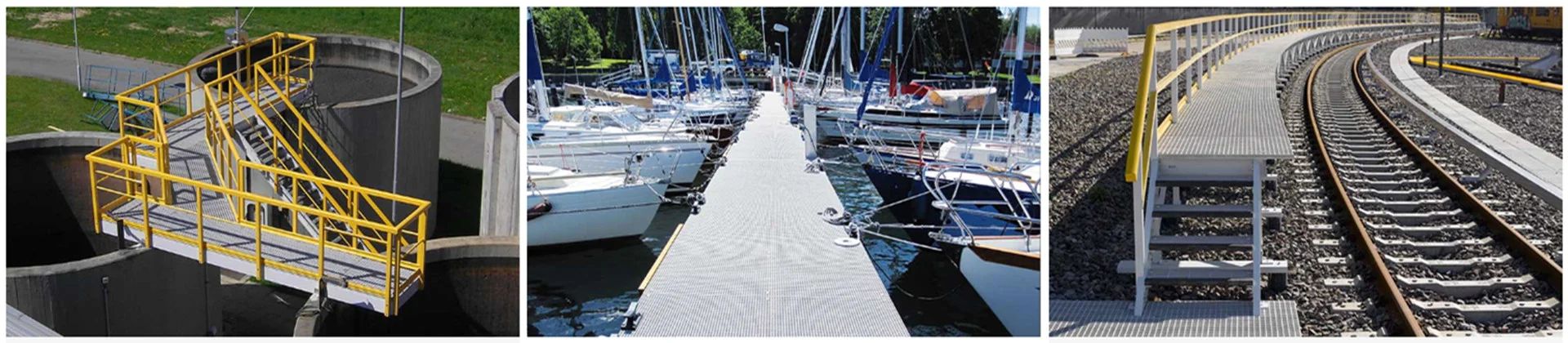
Consider a generic wastewater treatment plant experiencing rapid corrosion on galvanized steel walkways above clarifiers. Frequent patching and replacement were increasing both maintenance hours and safety risks. The facility switched to customized fiberglass grating with a chemical-resistant resin, gritted surface, and yellow nosing for stair treads. Panels were supplied in custom sizes to match existing supports, minimizing site cutting. After installation, the maintenance team reported far fewer unplanned interventions and more secure footing in wet weather, helping justify the investment over several years of operation.
Practical Checklist for Specifying Customized Fiberglass Grating
Technical Checklist for Engineers and Designers
Before you approach suppliers, confirm:
-
Design loads, maximum deflection criteria, and span limits
-
Environmental exposure (chemicals, UV, temperature, splash or immersion)
-
Required resin type and fire performance level
-
Preferred mesh pattern, panel thickness, and surface finish
-
Color requirements and any visibility or safety coding
-
Fixing details, edge banding, and cutouts for equipment
This list becomes the backbone of your technical specification and keeps different bidders aligned.
Commercial Checklist for Buyers and Project Managers
Commercially, focus on:
-
Minimum order quantities and price breaks
-
Standard and expedited lead times
-
Packaging, labeling, and shipping requirements
-
Warranty terms and expected service life
-
Documentation: test reports, certificates, and installation instructions
Asking the same set of questions to each potential supplier makes it easier to compare offers and select the partner best aligned with your project risk profile.
Conclusion
For industrial projects where safety, uptime, and long-term value matter, customized fiberglass grating offers a flexible way to match the product to the environment instead of compromising on your design. By carefully specifying resin systems, dimensions, surface finish, and fabrication, engineering teams can deliver walkways, platforms, and access systems that perform reliably for years.
Partnering with an experienced, ISO-certified FRP manufacturer like Unicomposite adds another layer of confidence. Their combination of pultrusion expertise, custom fabrication, and application knowledge helps transform a rough concept into a practical, buildable solution. Fiberglass is not the answer for every scenario—extreme temperatures or very heavy wheel loads may still call for steel—but for many corrosive, electrically sensitive, or access-oriented applications, it provides an attractive balance of performance and lifecycle cost.
When you are ready to upgrade from corroding steel or limited stock panels, sharing your drawings and requirements with a specialist supplier is an efficient next step. That conversation often reveals optimization opportunities you cannot see just by paging through a catalog.
Frequently Asked Questions
1. What information should I prepare before requesting a quote for customized fiberglass grating?
At a minimum, gather your design loads, spans, environmental conditions, fire performance needs, preferred surface finish, and any cutouts or special details. A simple layout drawing plus a short written specification will help suppliers respond quickly and accurately.
2. Is customized fiberglass grating suitable for vehicle traffic?
Fiberglass grating can be designed for certain vehicle loads, but not all systems are appropriate for heavy trucks or forklifts. Your supplier and structural engineer should verify the panel thickness, span, and support structure needed for your specific wheel loads.
3. Are there situations where steel grating is still a better choice than fiberglass?
Yes. Extremely high temperatures, very heavy impact or wheel loads, or environments where coatings are strictly controlled may still favor steel. In many mixed facilities, it is common to use fiberglass in corrosive or electrically sensitive zones and steel in areas where its strength and temperature resistance are more critical.


