 info@unicomposite.com


Introduction
Specifying the wrong resin system in an industrial pipe application does not announce itself immediately. Polyester FRP pipe installed in a concentrated sulfuric acid environment, or in a high-voltage electrical insulation application where dielectric consistency matters, performs adequately for months — then begins to degrade at the resin-fiber interface in ways that visual inspection cannot detect until structural integrity is already compromised. By the time engineers identify the failure mode, the cost of replacement, downtime, and secondary damage typically exceeds the original material saving many times over.
Epoxy FRP pipe addresses the performance ceiling that polyester resin systems reach in chemically aggressive and electrically demanding environments. The specification framework in this article draws on epoxy FRP pipe design and supply experience spanning chemical processing, electrical insulation, and industrial infrastructure applications, developed through custom pipe production for utility and OEM customers in North American and international markets. It gives procurement engineers a technical framework for evaluating epoxy FRP pipe — covering resin chemistry, key performance properties, material comparison data, and application fit — so that resin system selection is based on service condition matching rather than unit price comparison.
smart industrial pipe specification
Epoxy Resin Chemistry: Why It Produces a Superior Pipe Matrix
The performance differences between epoxy and polyester FRP pipe trace directly to differences in molecular structure and cure chemistry. Understanding the mechanism behind each advantage helps engineers specify with confidence rather than defaulting to the lowest-cost option.
Polar Hydroxyl Groups and Ether Bonds: The Adhesion Mechanism
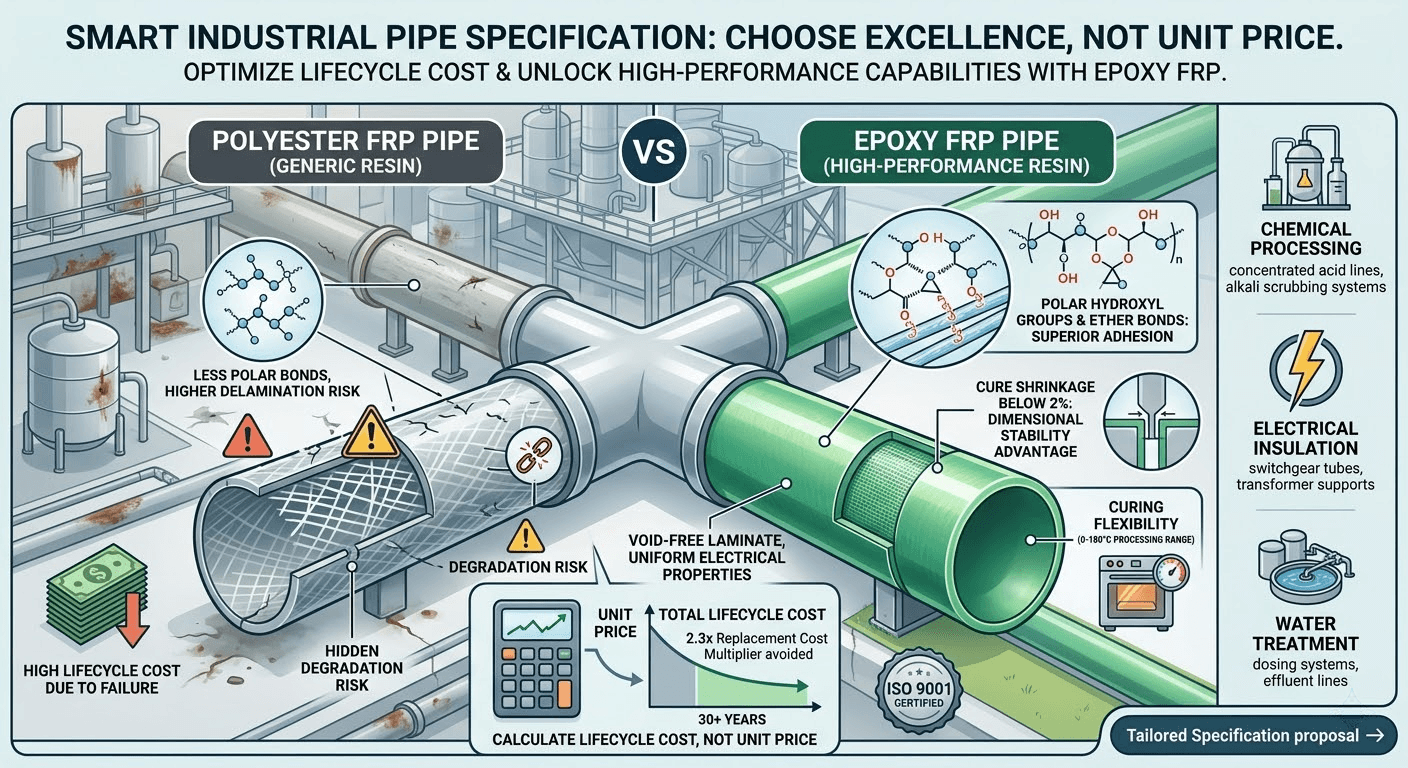
Epoxy resin molecules contain polar hydroxyl groups and ether bonds distributed along the molecular chain. These polar functional groups create strong secondary bonding forces with a wide range of substrates — glass fibers, metal fittings, concrete pipe supports, and joining compound surfaces. The practical result is a resin-to-fiber interface that maintains adhesion under cyclic pressure loading, thermal expansion cycling, and chemical exposure conditions that cause progressive delamination in lower-polarity resin systems.
For pipe-to-fitting connections, this adhesion advantage is operationally significant. Engineers specifying epoxy FRP pipe for flanged or bonded joint systems consistently find that the adhesive bond strength at the connection point matches or exceeds the tensile capacity of the pipe wall itself — which is the design outcome that eliminates the joint as the weakest link in the system.
The molecular adhesion mechanism is not something that surface treatment of a polyester resin pipe can replicate. It is a structural property of the epoxy matrix, present through the full wall thickness.
Cure Shrinkage Below 2%: Dimensional Stability Advantage
Epoxy resin systems cure through an addition reaction — epoxy groups open and react with the curing agent without releasing water or volatile byproducts. This mechanism produces cure shrinkage below 2%, compared to 5–8% for unsaturated polyester resins, which cure through a free-radical mechanism that releases styrene during polymerization.
Lower cure shrinkage has direct consequences for pipe fabrication precision. In tight-tolerance applications — flanged assemblies, multi-section installations with close-fit joints, and custom insulation tube geometries — dimensional variation caused by cure shrinkage introduces fit-up problems that require machining correction or generate residual stress at joints. Epoxy’s sub-2% shrinkage eliminates most of this dimensional drift, particularly in wall thicknesses above 5 mm where polyester shrinkage generates measurable internal stress that affects long-term fatigue performance.
Dimensional stability at the fabrication stage is a direct input to system reliability over the service life — not a manufacturing convenience.
Curing Temperature Flexibility: 0–180°C Processing Range
Epoxy resin systems accept a wide range of curing agents, each of which sets the processing temperature and determines the final crosslink density — and therefore the thermal and chemical resistance of the cured laminate. Aliphatic amine curing agents enable cure at ambient temperatures approaching 0°C, supporting field fabrication and repair in cold climates without heated enclosures. Aromatic amine and anhydride curing agents require elevated cure temperatures (typically 120–180°C) but produce a higher crosslink density that extends the pipe’s continuous service temperature ceiling and improves chemical resistance to aggressive solvents.
This processing flexibility means epoxy FRP pipe can be optimized for the installation environment rather than accepting a fixed property profile. A chemical plant requiring on-site pipe joining in an unheated facility specifies a different curing agent system than a manufacturer producing precision insulation tubes in a controlled factory environment — and both applications use the same base resin platform.
Curing agent selection — not resin brand — is the chemistry decision that most directly determines whether an epoxy FRP pipe meets its performance targets in service.
Key Performance Properties of Epoxy FRP Pipe
Beyond the resin chemistry fundamentals, six performance properties differentiate epoxy FRP from polyester and steel alternatives in the industrial environments where epoxy specification is justified. Each property addresses a specific failure mode or operational requirement that drives the upgrade decision.
The table below summarizes the key performance properties of epoxy FRP pipe relevant to industrial procurement specification:
| Property | Epoxy FRP Pipe | Typical Value / Range | Operational Significance |
|---|---|---|---|
| Cure Shrinkage | <2% | vs. 5–8% for polyester | Dimensional precision, joint integrity |
| Tensile Strength | High | 200–350 MPa (per ASTM D2105) | Primary structural load capacity |
| Flexural Modulus | High | 15–25 GPa (per ASTM D790) | Deflection control in unsupported spans |
| Dielectric Strength | Excellent | 15–25 kV/mm | Electrical insulation pipe applications |
| Chemical Resistance | Superior | Broad acid/alkali/solvent range | Aggressive fluid conveyance |
| Continuous Service Temp. | Elevated | Up to 120–150°C (cure-dependent) | High-temperature process environments |
Chemical Resistance: Acids, Alkalis, and Solvent Environments
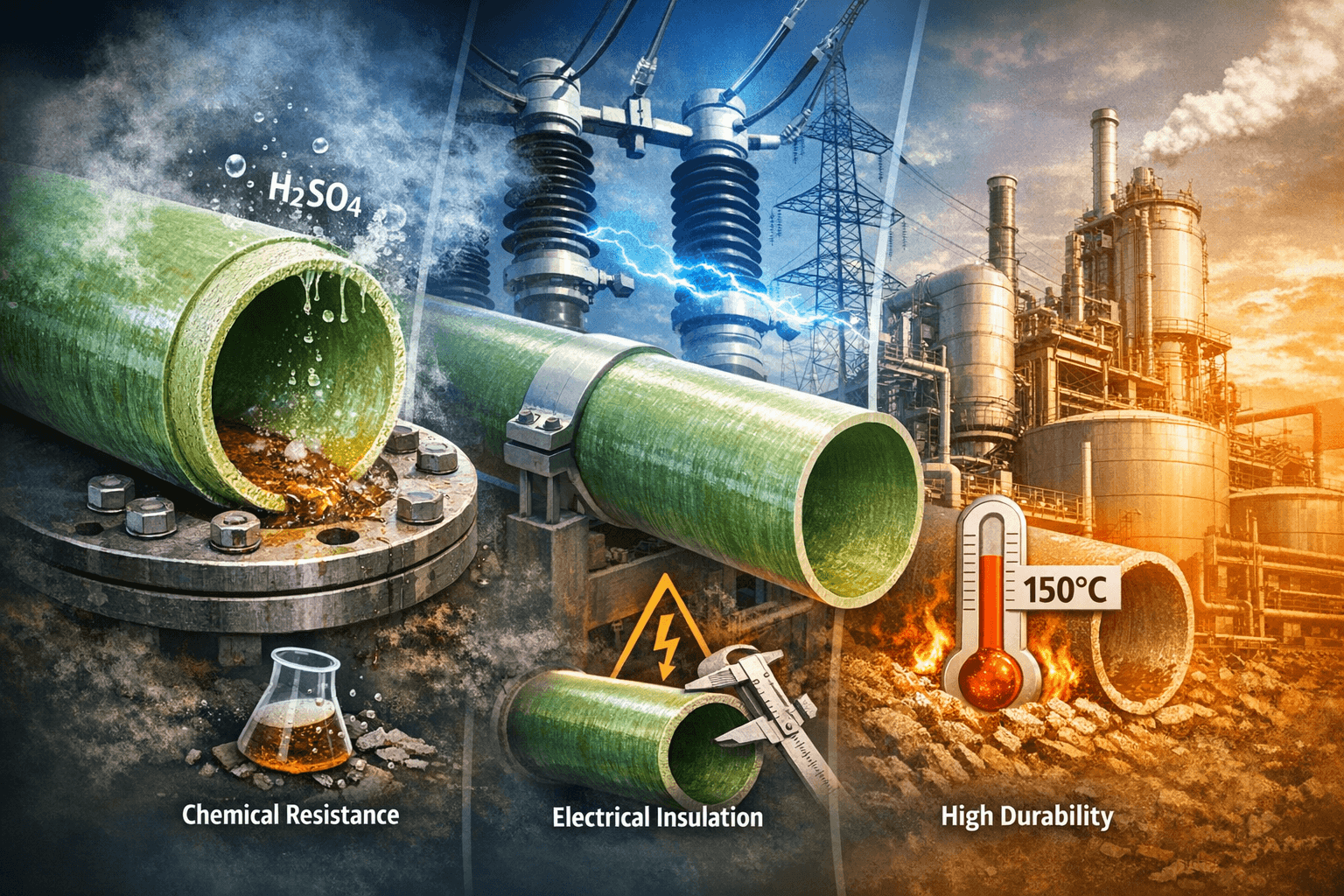
Epoxy FRP pipe resists a broader range of chemical exposures than polyester FRP, particularly in concentrated acid and solvent environments where polyester resin hydrolysis becomes the limiting factor. Epoxy systems maintain structural integrity in contact with sulfuric acid at concentrations up to 70% at temperatures up to 60°C, and hydrochloric acid across standard industrial concentration ranges at ambient to moderate temperature service — conditions that cause progressive degradation of polyester laminates within 12–24 months.
The chemical resistance ceiling for any FRP pipe depends on three variables acting together: resin system, fiber sizing chemistry, and operating temperature. Chemical exposure at elevated temperatures accelerates diffusion through the resin matrix — a condition that requires an epoxy system with an anhydride or aromatic amine curing agent rather than an ambient-cure aliphatic formulation. Buyers specifying epoxy FRP pipe for hot chemical service should provide both the fluid composition and the maximum continuous operating temperature at the inquiry stage, not after order placement.
Dielectric Strength and Electrical Insulation Properties
Cured epoxy resin systems produce a pipe wall with high volume resistivity, excellent surface leakage resistance, and strong arc resistance — properties that make epoxy FRP the preferred pipe material for high-voltage electrical infrastructure. Dielectric strength in the range of 15–25 kV/mm through the cured laminate wall supports use in switchgear insulation tubes, transformer support components, and high-voltage bus bar insulation systems where polyester FRP’s lower and less consistent dielectric performance creates design risk.
The consistency of dielectric properties through the full pipe wall cross-section — not just at the surface — is what matters in electrical insulation applications. Epoxy’s low shrinkage and high crosslink density produce a void-free laminate with uniform electrical properties, whereas higher-shrinkage polyester systems can introduce microcracking and residual porosity that creates localized dielectric weak points under sustained electrical stress.
Mechanical Properties: Tensile, Flexural, and Impact Performance
Epoxy FRP pipe achieves tensile strengths of 200–350 MPa per ASTM D2105, depending on fiber type, fiber volume fraction, and manufacturing process. Flexural modulus runs 15–25 GPa per ASTM D790 for pultruded configurations — where fiber rovings are aligned longitudinally through the die — making pultruded epoxy FRP well-suited for structural pipe, insulation tube, and long-span fluid conveyance applications where axial load or bending governs the design.
Filament-wound epoxy FRP pipe orients fibers at controlled angles to the pipe axis — typically 55° for internal pressure optimization — which maximizes hoop strength and pressure rating. Procurement engineers specifying epoxy FRP pipe for pressure service should request burst pressure test data per ASTM D2996 or ISO 14692, matched to their operating pressure and design safety factor requirements.
The manufacturing process choice — pultrusion vs. filament winding — determines the mechanical property profile more than resin formulation alone.
epoxy frp pipe
Epoxy FRP Pipe vs. Polyester FRP vs. Steel: Specification Comparison
Material cost is the starting point for most pipe specification comparisons. It is rarely the ending point when service conditions, maintenance requirements, and replacement frequency are factored into the total cost calculation. The comparison below covers the six dimensions where the choice between epoxy FRP, polyester FRP, and steel most significantly affects lifecycle cost and system reliability.
The table below compares epoxy FRP pipe, polyester FRP pipe, and carbon steel pipe across the key specification dimensions for industrial pipe procurement:
| Specification Dimension | Epoxy FRP Pipe | Polyester FRP Pipe | Carbon Steel Pipe |
|---|---|---|---|
| Chemical Resistance | Superior — broad acid/alkali/solvent | Good — moderate chemical environments | Poor — requires lining or coating |
| Dielectric Properties | Excellent — high-voltage insulation rated | Moderate — not rated for HV insulation | None — electrically conductive |
| Cure Shrinkage / Dimensional Precision | <2% — tight-tolerance fabrication | 5–8% — dimensional correction often needed | N/A — machined to tolerance |
| Corrosion Resistance | Excellent — no protective coating needed | Good — suitable for mild chemical service | Poor — requires galvanizing or coating |
| Max. Continuous Service Temp. | Up to 150°C (anhydride cure) | Up to 80–100°C | High — 400°C+ |
| Material Cost | Higher than polyester FRP | Lower | Lowest for standard grades |
| Total Lifecycle Cost (aggressive environments) | Lowest — 30+ year service life | Medium — replacement in 5–15 years | Highest — corrosion maintenance costs |
When Epoxy FRP Outperforms Polyester FRP
Three service conditions consistently drive the upgrade from polyester to epoxy FRP pipe: concentrated chemical exposure above the polyester resistance ceiling, electrical insulation requirements that demand consistent dielectric properties through the full pipe wall, and dimensional precision requirements where polyester shrinkage introduces unacceptable variation.
Engineers who have managed pipe replacement programs in chemical processing facilities recognize a consistent pattern: polyester FRP pipe specified as a cost-saving measure performs well for 3–7 years in mild chemical service, then reaches its resistance limit as process chemistry intensifies or operating temperatures increase. The re-specification to epoxy FRP that follows the first replacement cycle typically costs more in total than epoxy specification at the outset — once downtime, installation labor, and secondary system damage are included in the comparison.
When Steel Remains the Better Choice
FRP pipe — whether epoxy or polyester — has service condition limits that steel does not. Engineers who have reviewed FRP pipe failure reports consistently find that the failure mode in most high-pressure FRP applications is not resin degradation — it is a wall thickness specification that assumed a lower safety factor than the actual pressure cycling demanded. Operating pressures above approximately 1,500 psi, continuous service temperatures above 150°C, and mechanical impact environments where FRP’s lower elongation at break creates fracture risk are all conditions where steel remains the correct specification.
Procurement engineers who receive a recommendation for epoxy FRP pipe in a high-pressure or high-temperature application should request explicit confirmation that the proposed wall thickness and winding angle have been pressure-rated and temperature-rated for their specific service conditions — not just for a generic application category.
Honest material selection matches service conditions to material capability — not material preference to procurement familiarity.
Industrial Application Scenarios
The material comparison above identifies where epoxy FRP outperforms alternatives on paper — the three application scenarios below translate those performance differences into the operational contexts where specification engineers encounter them most frequently.
Chemical Processing and Corrosive Fluid Conveyance
Epoxy FRP pipe is specified in chemical processing facilities for concentrated acid lines, alkali scrubbing systems, solvent recovery circuits, and chemical transfer systems where the combination of chemical aggressiveness and pressure cycling eliminates polyester FRP as a viable option. The most common upgrade trigger in this sector is a polyester FRP pipe failure in a hydrochloric acid or sodium hydroxide line operating at temperatures above 60°C — a condition where polyester hydrolysis accelerates to the point where the pipe wall loses structural integrity within a single maintenance cycle.
In one anonymized chemical plant case, a dilute sulfuric acid line operating at 45°C experienced two polyester FRP pipe replacements within eight years. Re-specification to epoxy FRP pipe with an anhydride-cured resin system — formulated within the confirmed chemical resistance envelope for that fluid and temperature — produced a system still performing within specification at the eleven-year inspection point, with no wall thickness loss detected by ultrasonic testing. The total cost of the two polyester replacement cycles, including downtime and installation labor, exceeded the original epoxy FRP specification cost by a factor of 2.3.
Electrical Insulation Pipe and Custom Composite Insulation Components
High-voltage switchgear, power transformer support structures, and bus bar insulation systems require pipe materials that maintain consistent dielectric properties under sustained electrical stress, thermal cycling, and occasional fault current exposure. Epoxy FRP pipe meets these requirements where polyester FRP cannot be reliably specified — because polyester’s higher void content and lower crosslink density introduce dielectric inconsistency that creates failure risk in high-voltage service.
Unicomposite Technology Co., Ltd. — an ISO 9001-certified FRP manufacturer operating an 18,000 m² production facility in Nanjing — supplies custom epoxy composite insulation pipe to power utility and OEM customers across North American and international markets. Custom configurations include non-standard diameters, precision-machined end fittings, and specific resin system selections matched to voltage class and service temperature requirements. The engineering team conducts a Design for Manufacturability review at the inquiry stage to confirm resin system selection before production begins.
Water Treatment and Industrial Infrastructure
Municipal and industrial wastewater treatment facilities specify epoxy FRP pipe for chemically aggressive effluent lines, chemical dosing systems, and corrosion-resistant structural pipe where the combination of biological activity, pH variation, and chemical dosing creates conditions that deteriorate steel and concrete pipe within a single maintenance generation. Field performance records from epoxy FRP pipe installations in municipal wastewater environments document service lives exceeding 30 years in applications where equivalent unlined steel pipe required full replacement within 12 years due to internal corrosion — a lifecycle cost differential that justifies the epoxy FRP material premium within the first replacement cycle avoided.
The weight advantage of FRP — typically 25–30% of equivalent steel pipe mass per linear meter — also reduces installation cost in large-diameter wastewater infrastructure, where pipe handling, trenching depth, and support structure sizing are all influenced by pipe weight.
Specification and Ordering Parameters for B2B Buyers
With the application fit conditions established, the practical question becomes how to convert a performance requirement into a procurement specification — which is where dimensional, resin system, and process parameters must align with actual service conditions.
Dimensional Specifications: Diameter, Wall Thickness, and Length
Standard epoxy FRP pipe production covers inner diameters from 25 mm to 600 mm in pultruded configurations, with filament-wound pipe extending to larger diameters for pressure vessel and infrastructure applications. Wall thickness is specified as a function of operating pressure, pipe diameter, and chemical exposure severity — not as a fixed catalog value. Buyers should provide operating pressure (maximum and working), pipe span between supports, and fluid density at the inquiry stage to receive a wall thickness recommendation backed by structural calculation.
Custom lengths are standard practice in epoxy FRP pipe supply. Specifying exact pipe lengths for a project reduces field labor and eliminates cut-end sealing requirements that introduce potential corrosion initiation sites in chemical service applications.
Resin System and Curing Agent Selection for Application Requirements
In practice, the most common source of epoxy FRP pipe specification errors is not manufacturing quality — it is incomplete service condition data provided at the inquiry stage. Engineers who specify “epoxy FRP pipe, 100 mm ID, schedule 40 wall equivalent” without providing fluid composition, operating temperature, and pressure class routinely receive a pipe that meets the dimensional specification but was formulated for a different chemical environment than the one it enters. The result is a performance failure that is attributed to material quality when the actual cause is specification incompleteness.
Buyers should provide the following at the inquiry stage: fluid type and concentration, continuous operating temperature, cyclic temperature range, operating pressure, electrical requirements (voltage class if applicable), and installation environment. Providing this data at inquiry — not after order placement — is the step that ensures the curing agent system, fiber sizing, and wall construction are matched to the actual service conditions.
Manufacturing Process: Pultrusion vs. Filament Winding for Epoxy FRP Pipe
Pultrusion produces epoxy FRP pipe with maximum axial tensile and flexural properties, making it the preferred process for structural insulation tube, cable conduit, and gravity-flow fluid conveyance pipe. Filament winding produces pipe with superior hoop strength and pressure rating — the correct process for pressurized fluid service above approximately 150 psi. Buyers specifying filament-wound epoxy FRP pipe for pressure service should request burst pressure test data per ASTM D2996 or ISO 14692, confirmed at the design review stage.
Typical lead times based on standard production scheduling run 3–5 weeks from order confirmation for standard configurations, extending to 6–8 weeks for custom dimensions or non-standard resin systems. Confirmed timing is provided at the inquiry stage.
Conclusion
Epoxy FRP pipe earns its specification premium through four performance advantages that determine total lifecycle cost in demanding industrial environments:
- Resin chemistry advantage: Epoxy’s polar molecular structure, sub-2% cure shrinkage, and wide curing temperature range produce a pipe wall with superior adhesion, dimensional precision, and property consistency compared to polyester alternatives — advantages that are structural, not surface-applied, and that do not degrade with service time.
- Application fit conditions: Specify epoxy FRP where service conditions include concentrated chemical exposure above polyester’s resistance ceiling, electrical insulation requirements that demand dielectric consistency through the full pipe wall, or dimensional precision requirements that polyester shrinkage cannot satisfy. Specify steel where operating pressure or temperature exceeds FRP’s confirmed service limits.
- Curing agent selection is the critical specification decision: It determines — more than any other single parameter — whether epoxy FRP pipe performs as intended in chemical or high-temperature service. It requires complete service condition data at the inquiry stage, not after order placement.
- Calculate lifecycle cost, not unit price: Epoxy FRP pipe in aggressive chemical or electrical service consistently delivers lower total cost than polyester FRP or coated steel when replacement frequency, maintenance overhead, and downtime are included in the comparison period. The anonymized case data in this article documents a 2.3× cost multiple for polyester replacement cycles versus original epoxy specification — a ratio that holds consistently across documented chemical processing replacement programs.
Frequently Asked Questions
Provide the fluid type, concentration, and maximum continuous operating temperature at the inquiry stage — chemical compatibility is resin system and temperature dependent, not a fixed property of “epoxy FRP” as a category. Unicomposite’s engineering team will confirm the appropriate curing agent system and, where required, reference accelerated immersion test data for the specified fluid and temperature combination. Do not rely on generic chemical resistance charts that omit temperature and concentration qualifiers.
Tensile strength is tested per ASTM D2105 for pultruded pipe configurations. Flexural modulus is tested per ASTM D790. For filament-wound pressure pipe, burst pressure and long-term hydrostatic strength are tested per ASTM D2996 or ISO 14692, depending on the destination market. Unicomposite provides test certificates referencing the applicable standard upon request — specify the required standard at inquiry to ensure documentation matches your project quality requirements.
Yes — both inner diameter and wall thickness are configurable to project requirements. Pultruded epoxy FRP pipe covers inner diameters from 25 mm to 600 mm in standard production; filament-wound configurations extend to larger diameters for pressure and infrastructure applications. Provide your required inner diameter, wall thickness basis (operating pressure and fluid data), and project quantity at inquiry to receive dimensional confirmation and lead time.
Pultrusion aligns fibers longitudinally, maximizing axial tensile strength and flexural stiffness — the correct process for structural insulation tube, conduit, and gravity-flow pipe. Filament winding places fibers at controlled angles (typically 55° for pressure service), maximizing hoop strength and pressure rating. The primary selection criterion is load direction: axial-dominant applications use pultrusion; internal pressure-dominant applications use filament winding. If your application involves both, provide the full load case at inquiry and Unicomposite’s engineering team will recommend the appropriate process and wall construction.
The full design and manufacturing workflow operates under ISO 9001 certification, covering resin system selection, fiber specification, production process control, and dimensional inspection. Product-specific certifications — including dielectric test records for insulation pipe applications and pressure test certificates for filament-wound pipe — are available upon request. Regulatory compliance documentation for specific destination markets (UL, CSA, CE) should be confirmed at inquiry based on application requirements.


