 info@unicomposite.com


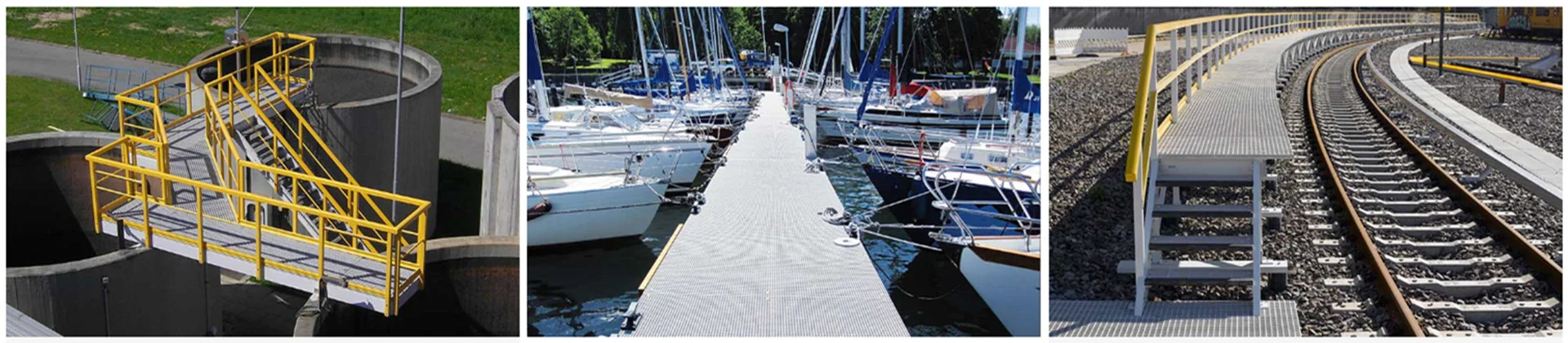
Introduction
Corrosion quietly destroys industrial infrastructure. According to NACE International, corrosion-related costs exceed $2.5 trillion globally each year — and elevated walkways, platforms, and decking systems are among the first casualties. If your facility operates near saltwater, processes chemicals, or runs live electrical equipment, the material you specify for flooring directly determines how much you spend on maintenance over the next two decades.
FRP fiberglass decking has moved from niche alternative to the material of choice for demanding industrial environments. This guide walks you through how FRP is constructed, how it compares to steel and aluminum on the metrics that matter to engineers and procurement teams, and how to match the right product type to your specific application.

frp fiberglass decking
What Is FRP Fiberglass Decking?
FRP fiberglass decking consists of glass fiber reinforcements embedded in a polymer resin matrix — typically polyester, vinyl ester, or phenolic — formed into structural panels through either a pultrusion or molded grating process. The choice between these two manufacturing methods significantly affects the panel’s mechanical behavior and the applications it suits best.
Pultrusion vs. Molded Grating: Two Construction Methods
Both methods produce corrosion-resistant, lightweight decking, but their structural profiles differ in important ways.
The table below compares the key characteristics of pultruded FRP panels and molded FRP grating to help you match the right product to your load requirements:
| Characteristic | Pultruded FRP Panels | Molded FRP Grating |
|---|---|---|
| Load direction strength | High — primarily unidirectional | Bidirectional — equal in both axes |
| Typical tensile strength | 207–310 MPa | 103–172 MPa |
| Surface options | Gritted, concave-top, smooth | Gritted top, open mesh |
| Best-fit applications | Elevated walkways, bridge decking, heavy linear loads | Platforms with omnidirectional foot traffic, stair treads |
| Panel customization | Custom lengths, profiles, colors | Custom mesh sizes, resin systems |
| Weight (typical) | 3.5–5.5 kg/m² | 2.8–4.5 kg/m² |
Pultruded panels perform best when loads run in a predictable direction — think pedestrian walkways spanning structural beams. Molded grating distributes loads more evenly in all directions, making it preferable for large open platforms where traffic patterns are unpredictable.
Material Composition and Applicable Standards
The resin system you select determines chemical compatibility as much as the fiber reinforcement does. Standard polyester resin suits general industrial use. Vinyl ester resin — the more common choice in chemical processing and marine environments — offers substantially better resistance to acids, alkalis, and solvents. Phenolic resin is specified where fire performance is the overriding concern.
Key standards to request documentation for when evaluating suppliers:
- ASTM E84 — Surface burning characteristics (flame spread and smoke development)
- ASTM D638 — Tensile properties of the FRP laminate
- ASTM C581 — Chemical resistance of thermosetting resins
- OSHA 1910.23 — Walking/working surfaces (slip coefficient requirements)
Always request third-party test reports rather than relying on product datasheets alone. Self-reported data without independent verification is a procurement risk.
Performance Properties That Define Long-Term Value
Material selection decisions made at the design stage determine maintenance budgets for 20 years or more. Two performance dimensions consistently drive the choice toward FRP fiberglass decking in high-demand environments: corrosion resistance and structural integrity under dynamic loads.
Corrosion and Chemical Resistance
Carbon steel grating begins corroding from the moment its protective coating is breached — and in coastal or chemical environments, that timeline is measured in months, not years. FRP does not corrode. The resin matrix is inherently non-reactive to most industrial chemicals, and there is no coating layer to fail.
In field installations at facilities processing sulfuric acid or sodium hydroxide, engineers frequently document that vinyl ester FRP panels show no measurable degradation after immersion testing per ASTM C581 for periods exceeding 12 months. That same environment would require galvanized steel grating to be replaced every 3–5 years.
Procurement managers sourcing for coastal facilities — ports, offshore platforms, aquaculture operations — should note that FRP carries no risk of galvanic corrosion when used alongside aluminum structural members, a failure mode that regularly affects steel grating installations in saltwater splash zones.
Structural Load Capacity and Slip Resistance
A common misconception is that FRP trades strength for corrosion resistance. In reality, pultruded FRP panels regularly achieve tensile strengths of 207–310 MPa — comparable to structural aluminum and sufficient for most pedestrian and light-vehicle platform loads.
For slip resistance, FRP panels are available with a factory-applied aluminum oxide grit surface that meets OSHA’s minimum slip coefficient of 0.5 for wet conditions. In a substation project in a humid coastal region, the facility’s safety team specifically selected grit-surface FRP decking for transformer access platforms because the non-conductive surface eliminated both slip and shock hazard — two problems that previously required separate solutions.
The combination of adequate strength and inherent safety properties makes FRP the structurally sound choice, not just the chemically resistant one.

FRP Fiberglass Decking vs. Steel and Aluminum
Beyond individual properties, procurement teams need a consolidated view across the factors that affect total cost of ownership. The table below provides a direct comparison of FRP fiberglass decking against the two most common alternatives:
The following comparison covers the six dimensions that most frequently drive material selection decisions in industrial platform and decking projects:
| Evaluation Dimension | FRP Fiberglass Decking | Carbon Steel Grating | Aluminum Grating |
|---|---|---|---|
| Weight (typical) | 3.5–5.5 kg/m² | 12–18 kg/m² | 5–8 kg/m² |
| Corrosion resistance | Excellent — no coating required | Poor to moderate — requires galvanizing or painting | Good — limited by galvanic risk |
| Maintenance frequency | 10+ years, cleaning only | 3–5 years recoating/replacement | 5–8 years in marine environments |
| Estimated lifecycle cost | Low | High | Moderate |
| Dielectric properties | Fully non-conductive | Conductive | Conductive |
| Customization flexibility | High — resin, color, mesh, profile | Moderate | Moderate |
The lifecycle cost advantage of FRP compounds over time. A steel grating system may carry a lower initial material cost, but when you account for coating labor, shutdown time during replacement cycles, and safety incidents linked to corroded surfaces, FRP consistently delivers a lower total cost over a 15–20 year facility lifecycle.
Industrial Applications Where FRP Decking Delivers the Most Value
FRP fiberglass decking is not the right choice for every project — extremely heavy dynamic loads (forklifts, heavy rolling stock) may still favor structural steel. But for the following application categories, FRP consistently outperforms conventional alternatives.
Marine, Dock, and Offshore Installations
Salt spray, tidal splash, and constant humidity create the harshest possible environment for ferrous metals. A Gulf Coast petrochemical terminal that replaced 2,400 m² of steel grating on elevated walkways with pultruded FRP panels extended maintenance intervals from 18 months to over 8 years — with no structural degradation observed at inspection.
The lightweight nature of FRP panels also matters here: offshore and dock installations often involve crane lifts or confined-access assembly, where reducing panel weight directly reduces installation cost and risk.
Chemical Processing and Wastewater Treatment Platforms
Vinyl ester FRP is chemically compatible with sulfuric acid, sodium hydroxide, chlorine solutions, and a wide range of industrial solvents that would rapidly destroy galvanized steel. For wastewater treatment facilities, where panel replacement requires decommissioning active process areas, the extended service life of FRP directly translates into fewer operational disruptions.
The panels’ light weight allows a two-person crew to handle and install standard 1,220 × 3,660 mm panels without mechanical lifting equipment — a meaningful labor cost reduction in facilities with restricted access.
Power Utilities and Substation Flooring
For electrical utilities, FRP’s dielectric properties are the deciding factor. FRP fiberglass decking does not conduct electricity, which makes it the only appropriate material for access platforms in live-equipment bays, transformer areas, and switchgear rooms.
Unicomposite supplies FRP structural systems — including decking, cable trays, and ladder systems — to power utility clients across North America and Asia-Pacific. Operating under ISO 9001 certification from a 18,000 m² manufacturing facility in Nanjing, the company provides both standard catalog panels and fully engineered custom solutions with documented ASTM compliance.
Customization and Installation Considerations
Specifying FRP decking is not a one-size-fits-all exercise. Standard panel formats — 1,000 × 3,000 mm and 1,220 × 3,660 mm — fit many applications, but custom grating pitch, bar depth, resin system, and surface texture can all be adjusted to match specific load, chemical exposure, or regulatory requirements.
On the installation side, FRP panels connect to existing structural steel subframes using standard clip-and-bolt fastening systems — no welding, no hot work permits, no specialist labor. Experienced fabricators pre-cut panels to ±1 mm tolerance, which reduces field trimming and can cut on-site installation time by up to 40% compared to in-field steel cutting operations.
When developing your specification, confirm the following with your supplier: resin system compatibility with site-specific chemicals, third-party fire rating documentation, load test reports relevant to your span and load case, and lead time for custom configurations.
Conclusion
FRP fiberglass decking consistently outperforms steel and aluminum across the dimensions that matter most for long-term industrial platform performance: corrosion resistance, maintenance burden, lifecycle cost, and safety in electrically sensitive environments. Here are the key decisions to take away from this guide:
- Match the construction method to your load case. Pultruded panels for high directional loads; molded grating for omnidirectional traffic.
- Specify the resin system by chemical exposure, not just price. Vinyl ester costs more upfront; it costs far less over a 15-year period in aggressive environments.
- Request third-party test documentation. ASTM D638, ASTM E84, and ASTM C581 results from an independent lab should be non-negotiable in your procurement process.
- Calculate lifecycle cost, not just unit cost. Steel grating’s lower initial price rarely survives a 10-year total cost of ownership analysis in corrosive environments.
- Plan for customization lead time. Standard panels ship quickly; custom configurations require engineering review — build this into your project schedule.
[Contact Unicomposite for a custom FRP fiberglass decking specification and quote →]
Frequently Asked Questions
Vinyl ester resin is the standard recommendation for applications involving acids, alkalis, or solvents. It offers significantly better chemical resistance than standard orthophthalic or isophthalic polyester resins. For your specific chemicals, request an immersion compatibility chart from your supplier before finalizing the specification.
Pultruded FRP panels typically support uniform distributed loads of 2.5–7.5 kN/m², depending on panel depth, span length, and grating pitch. Suppliers should provide load/deflection tables specific to the panel series you are evaluating — do not rely on generic ratings without confirming the span conditions match your project.
Properly specified FRP decking can meet OSHA 1910.23 slip-resistance requirements (gritted surface, slip coefficient ≥ 0.5) and ASTM E84 Class 1 flame spread ratings. Certification scope varies by product line; always request test documentation specific to the panel series, not the manufacturer’s entire catalog.
Standard panel sizes in common configurations generally ship within 3–5 business days from stock. Custom configurations — non-standard mesh pitch, specialty resin systems, pre-cut panels, or non-standard colors — typically require 15–25 production days after engineering approval. Factor this into project scheduling, particularly for offshore or remote site deliveries.
In most cases, yes. FRP panels use clip-and-bolt fastening systems compatible with standard steel I-beam and channel subframes. Your supplier should confirm bearing bar spacing and fastener specifications match your existing structure. If subframe span exceeds panel load table recommendations, intermediate support members may be required — this is a straightforward engineering calculation your supplier can assist with.


