 info@unicomposite.com


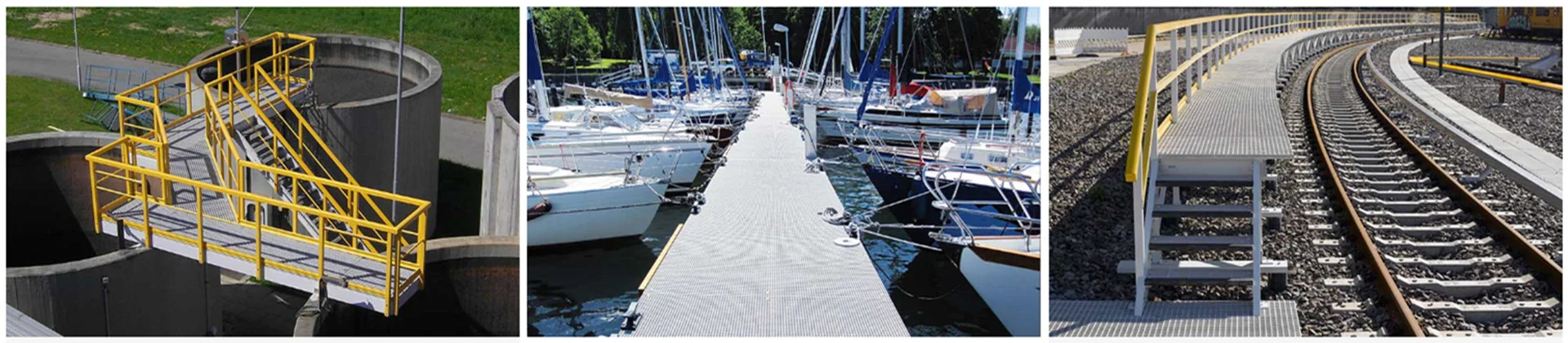
Introduction
Steel equipment enclosures in outdoor industrial environments require their first full recoating within 5–7 years of installation in coastal and chemically aggressive atmospheres. By year 15, documented infrastructure maintenance programs record active corrosion at seam welds, fastener penetrations, and panel edges — the locations where coating adhesion fails first under thermal cycling and moisture infiltration. Based on documented infrastructure maintenance cost records from coastal utility substation and chemical plant enclosure inspection programs, total recoating and inspection costs for steel equipment enclosures over a 30-year service life regularly reach 50–70% of the original enclosure installation cost — before operational disruption from access, isolation, and reinstatement is included.
Fiberglass enclosures eliminate this maintenance cycle at the material level. Glass fiber reinforced polymer does not corrode, does not require recoating, and does not conduct electricity — three properties that address the three most common failure modes in steel equipment shelter across electrical utilities, telecommunications, chemical plant, and marine infrastructure applications. Unicomposite Technology Co., Ltd. — an ISO 9001-certified FRP manufacturer operating an 18,000 m² production facility in Nanjing — supplies pultruded FRP enclosure systems and structural profiles to utility, telecommunications, and industrial B2B customers in North American and international markets, drawing on manufacturing experience across permanent, modular, and custom enclosure configurations for corrosive and electrically sensitive installation environments.
This article gives utility engineers and procurement managers a technical framework for specifying fiberglass enclosures — covering construction types, performance specifications, material comparison, and application fit — so that enclosure material selection is based on total ownership cost and service condition matching rather than upfront unit price.
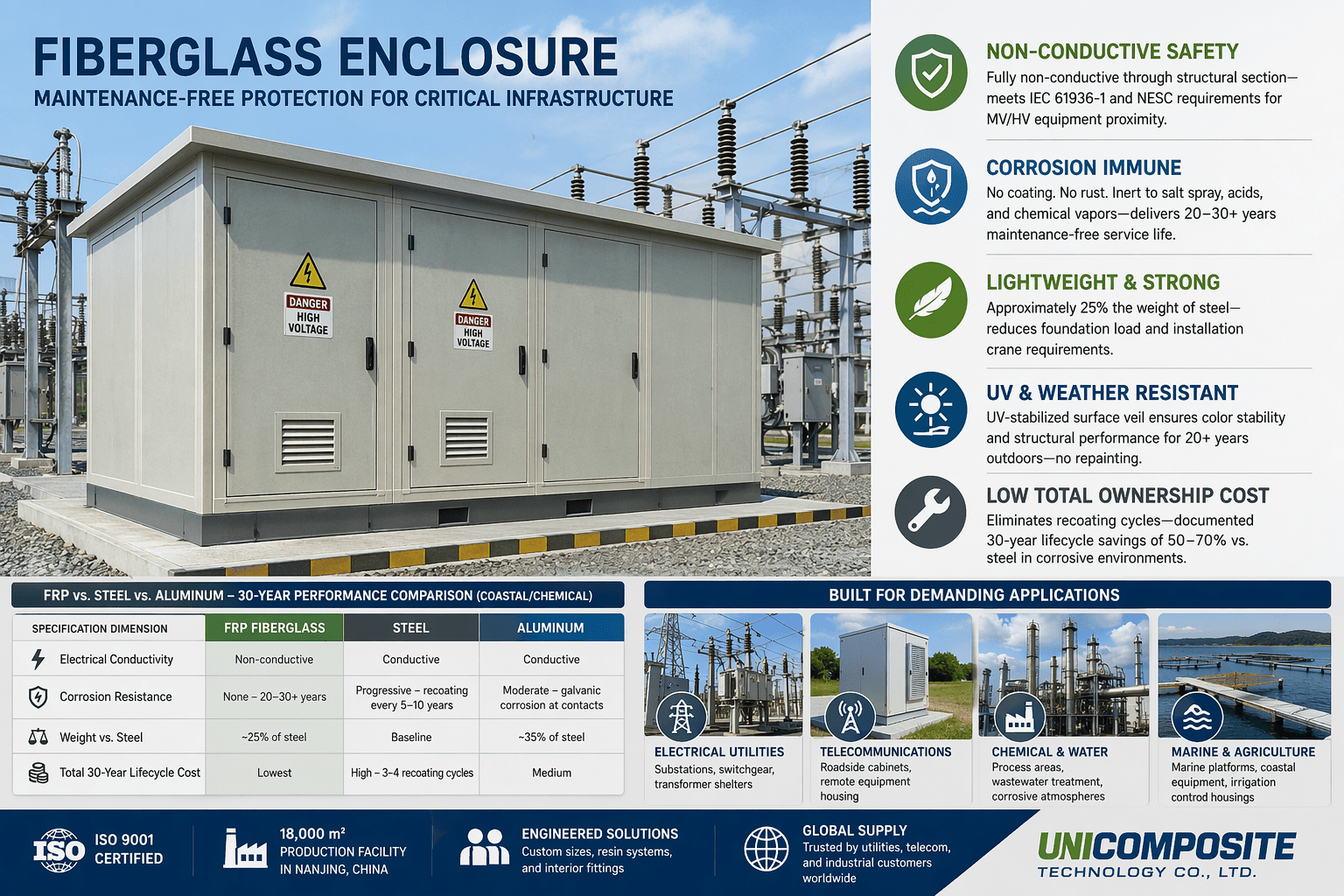
fiberglass enclosures
What Is a Fiberglass Enclosure? Material and Construction Basis
Understanding why fiberglass enclosures outperform steel and aluminum in corrosive and electrically sensitive environments begins with understanding the material system and manufacturing process that determines their structural and service performance.
Material Composition: Pultruded FRP Profiles and Panel Construction
Fiberglass enclosure framing is built from pultruded FRP structural profiles — channel sections, angle sections, square tube, and flat plate — produced by pultrusion: a continuous manufacturing process that aligns glass fiber rovings longitudinally through a resin bath and a heated die, producing a constant cross-section with consistent fiber volume fraction and wall thickness. The thermosetting resin matrix — polyester for standard outdoor atmospheric service, vinyl ester for coastal, chemical, and high-humidity environments — binds the fiber system and provides chemical inertness and electrical non-conductivity. A UV-stabilized surface veil on exposed profiles and panels prevents surface fiber blooming and color degradation under sustained solar exposure.
Pultrusion’s dimensional consistency is critical for modular enclosure framing systems. Every profile length off the same die produces identical cross-section dimensions, which means field assembly uses standard fastener patterns and connection hardware without dimensional adjustment or custom fitting. This production consistency also means that structural performance — bending stiffness, axial load capacity, and connection strength — is repeatable across every bay added to a modular enclosure system.
FRP enclosure systems weigh approximately 25% of equivalent steel prefabricated structures at the same framing section size — a weight reduction that directly reduces foundation loading requirements and changes the installation crane and handling equipment specification. In remote and access-restricted installation sites — utility substations, coastal marine platforms, rooftop equipment shelters — this weight reduction determines whether the enclosure can be installed within available crane capacity and site access constraints.
Why FRP Replaces Steel and Aluminum in Corrosive and Electrical Environments
Steel enclosure coating failure in outdoor atmospheric environments follows a documented timeline. Zinc primer and topcoat systems on steel panel enclosures begin degrading at seam welds and fastener penetrations within 3–5 years of installation in coastal salt spray environments. Full recoating requires enclosure isolation, surface preparation, coating application, and cure time — a maintenance sequence that creates operational access challenges for energized electrical equipment shelter that cannot be de-energized for extended periods. Each recoating cycle in a live electrical enclosure program runs 15–25% of the original enclosure installation cost, based on documented infrastructure maintenance cost records from coastal utility substation and chemical plant enclosure programs.
Aluminum enclosures eliminate the steel corrosion failure mode but introduce two limitations in electrical infrastructure environments. Galvanic corrosion from contact with dissimilar metals — steel fasteners, copper grounding conductors, and galvanized cable trays — creates accelerated aluminum surface degradation at every metal-to-metal contact point. More critically, aluminum is electrically conductive — which creates the same eddy current and induced voltage risk as steel for enclosure structures adjacent to high-voltage power infrastructure.
FRP’s non-conductivity and corrosion immunity are structural properties — not surface-applied coatings or treatments. The glass fiber and thermosetting resin matrix are non-conductive through their full section thickness, so there is no conductive substrate beneath a non-conductive coating, and no coating that can breach or degrade to expose a conductive core. The corrosion immunity is chemical: the resin matrix is inert to atmospheric acids, salt aerosol, and chemical vapors present in the environments where steel and aluminum enclosures fail by corrosion. Neither property requires maintenance to remain effective over the enclosure service life.
Fiberglass Enclosure Types and Configurations
FRP enclosure systems cover four primary configuration types — each suited to different equipment shelter requirements, installation permanence, and size flexibility.
The table below identifies the four FRP enclosure configurations and their primary application parameters:
| Configuration | Construction Method | Installation Type | Primary Application | Key Advantage |
|---|---|---|---|---|
| Permanent Structural Enclosure | Pultruded profile framing + FRP panel infill | Foundation-mounted | Electrical substation, switchgear shelter, transformer housing | Maximum structural rigidity; custom floor plan |
| Portable Modular Panel Assembly | Knock-down panel system with bolted connection | No foundation required | Construction site equipment, temporary power, disaster recovery | Relocation without foundation work |
| Expandable Modular System | Standardized bay modules with common connection detail | Foundation or slab | Growing equipment installations, expandable control rooms | Bay addition without full structure replacement |
| Profile Joint Custom Enclosure | Standard FRP structural sections — channel, angle, tube | OEM integration | Custom equipment housings, non-standard geometry | Full geometric flexibility; OEM custom design |
Permanent Structural Enclosures: Foundation-Mounted Equipment Shelter
Permanent FRP enclosure systems use pultruded structural profile framing — typically channel or I-section members for the primary frame with flat FRP panel infill — bolted and bonded into a rigid structure mounted on a concrete foundation or steel slab. This configuration provides the structural performance required for high-wind exposure, equipment impact load, and the long service life that utility and industrial infrastructure demands.
Foundation loading from FRP enclosure structures runs approximately 25% of equivalent steel prefabricated equipment shelter at the same footprint — a reduction that allows shallower foundation design in sites with marginal soil bearing capacity, and eliminates the heavy lift crane requirement that steel prefab shelter delivery and installation requires in restricted access locations.
Portable and Modular Panel Assembly
Modular FRP panel enclosure systems use a knock-down panel assembly with bolted connection details that allow full structure disassembly and relocation without foundation demolition. Each panel ships in standard sizes that fit within vehicle load limits without specialist transport, and field assembly requires standard hand tools rather than welding or specialist structural connection equipment.
The portable configuration addresses a recurring project requirement in temporary power infrastructure: equipment shelter that must be installed, operated for a defined program period, and relocated to the next site — without the foundation and demolition cost that permanent steel shelter creates at each site.
Expandable Enclosure Systems: Configurable Footprint
The procurement decision that most determines long-term expandable enclosure ownership cost is not bay count or footprint size — it is interior fitting standardization. Expandable FRP enclosure systems use standardized bay modules with a common framing connection detail that allows additional bays to be added to an existing enclosure structure without replacing the primary frame, but the value of that expandability depends entirely on whether interior fittings were standardized at the initial procurement stage.
In one equipment shelter expansion program at an industrial chemical plant, retrofitting non-standard cable entry gland patterns and mounting rail configurations into a completed three-bay FRP enclosure that had been specified without a standardized interior fitting layout cost 4.2 times the original interior fitting specification cost — confirming that interior fitting standardization at initial procurement is the single highest-value enclosure planning decision. Buyers specifying expandable enclosures should provide the maximum planned equipment footprint and interior fitting requirements at initial inquiry, not at the expansion stage.
Pultruded Profile Joint Enclosures: Custom-Assembled from Standard Sections
Profile joint enclosures assemble FRP enclosure structures from standard pultruded section types — channel, angle, flat bar, and square tube — connected through standard mechanical joint details rather than custom tooled panel systems. This approach provides full geometric flexibility for non-standard equipment footprints that standard modular panel systems cannot accommodate, and is the preferred approach for OEM manufacturers who need custom equipment housing geometries at production volumes below the tooling threshold for custom panel systems.
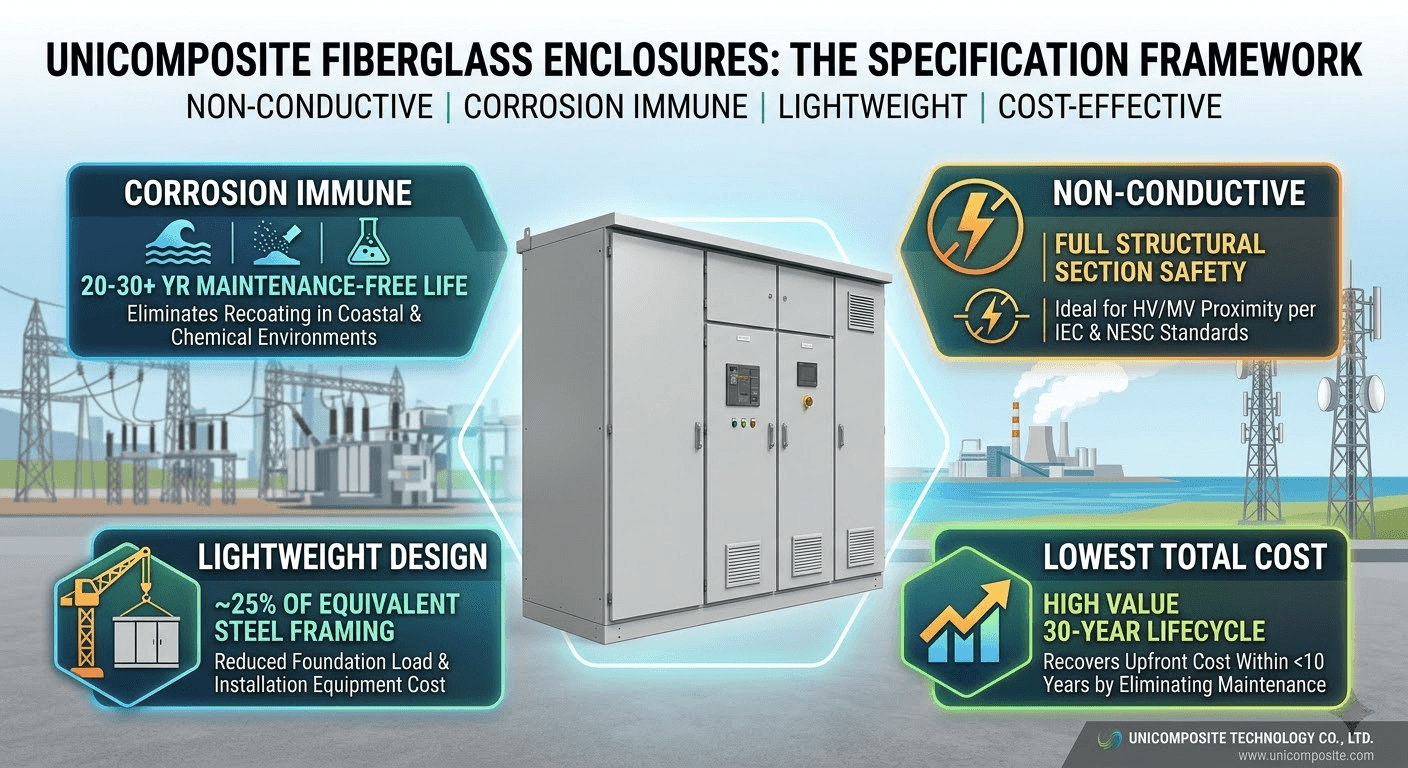
unicomposite fiberglass enclosures
Key Performance Specifications
Five performance properties differentiate fiberglass enclosures from steel and aluminum alternatives in the outdoor and industrial environments where equipment shelter must perform without maintenance for 20–30 year infrastructure service lives.
The table below summarizes the key performance specifications of pultruded FRP enclosure systems relevant to utility and industrial B2B procurement:
| Property | FRP Enclosure | Standard Value / Range | Operational Significance |
|---|---|---|---|
| Electrical Conductivity | Non-conductive | Full structural section; dielectric throughout | Required near HV/MV equipment per IEC 61936-1 and NESC; eliminates induced voltage risk |
| Corrosion Resistance | Excellent — no coating required | Inert to atmospheric acid, salt spray, chemical vapor | 20–30+ year maintenance-free in corrosive environments |
| UV Resistance | High — UV-stabilized surface veil | Color stability 20+ years | No repainting; structural properties unaffected by UV |
| Impact Resistance | Good — elastic recovery | IK rating per IEC 62262 — request test record at inquiry | Maintains enclosure integrity without permanent deformation |
| Weight vs. Steel | ~25% of equivalent steel framing | Application-dependent | Reduced foundation load; smaller installation crane requirement |
| Thermal Expansion | ~14 µm/m·°C | vs. ~12 µm/m·°C for steel | For footprints >6 m or temperature swings >40°C, specify flexible joint sealant |
Electrical Non-Conductivity: Safe Near High-Voltage Equipment
Non-conductive enclosure structure is a requirement in utility infrastructure specifications referencing IEC 61936-1 for power installations exceeding 1 kV, and in NESC (IEEE C2) clearance requirements in North American utility applications. Conductive metal enclosure framing within specified distances of live busbars, transformer terminals, and overhead conductors creates induced voltage paths during normal operation and fault current paths during electrical fault events. Buyers should confirm the applicable standard and clearance zone at the project specification stage before enclosure material selection is finalized — the clearance requirement varies by voltage class and jurisdiction.
FRP enclosure framing is non-conductive through its full structural section — not just at the surface. There is no conductive substrate beneath a non-conductive coating, and no corrosion pathway that exposes a conductive core over time. This property satisfies electrical clearance requirements inherently, without the insulated base mount systems and periodic insulation integrity testing that conductive metal enclosures require when installed in proximity to live electrical equipment.
Corrosion Immunity: Outdoor Atmospheric, Coastal, and Chemical Exposure
FRP enclosure framing and panel materials are chemically inert to the atmospheric acids, salt aerosol, industrial chemical vapors, and UV radiation present in the outdoor and industrial environments where equipment shelter must perform for decades. There is no zinc primer to deplete, no topcoat to breach, and no base metal to oxidize — the corrosion immunity is through-material, present at every exposed surface and cut edge.
Steel enclosure coating integrity in coastal environments degrades at a documented rate: zinc primer depletion at seam welds within 3–5 years, topcoat failure at fastener penetrations within 5–8 years, and active corrosion at panel edges within 8–12 years in high-salinity environments. Each recoating cycle in an energized electrical enclosure requires equipment isolation, access scaffolding, surface preparation, coating application, cure, and re-energization — a maintenance sequence whose total cost runs 15–25% of the original enclosure installation cost per cycle, based on documented coastal utility substation and chemical plant enclosure maintenance records.
Impact Resistance, UV Stability, and Thermal Performance
FRP enclosure framing and panels resist wind-borne debris, low-velocity vehicle proximity impact, and deliberate mechanical loading through elastic deformation and recovery rather than permanent plastic deformation. Impact resistance is classified per IEC 62262 impact protection ratings — buyers should request the specific IK class test record for the enclosure configuration at inquiry, rather than relying on a descriptive material comparison.
UV-stabilized surface veil on FRP enclosure exterior surfaces prevents surface fiber blooming and color change under prolonged solar exposure without repainting. For large enclosure footprints above 6 m in longest dimension, or sites with seasonal temperature swings above 40°C, panel joint sealing should be specified with flexible sealant rated for the enclosure’s thermal expansion range — confirm the panel joint sealing specification at inquiry for large footprint configurations where thermal movement at panel joints is a practical engineering consideration.
Fiberglass Enclosure vs. Steel vs. Aluminum: Full Specification Comparison
The procurement decision between FRP, steel, and aluminum enclosure structures depends on service environment, electrical safety requirements, maintenance access, and total ownership cost over the infrastructure service life.
The table below compares FRP fiberglass enclosures, steel prefabricated enclosures, and aluminum enclosures across the key specification dimensions for utility and industrial B2B procurement:
| Specification Dimension | FRP Fiberglass Enclosure | Steel Enclosure | Aluminum Enclosure |
|---|---|---|---|
| Electrical Conductivity | Non-conductive — full section | Conductive | Conductive |
| Corrosion in Coastal/Chemical Environments | None — 20–30+ year maintenance-free | Progressive — recoating every 5–10 years | Moderate — galvanic corrosion at metal contacts |
| Weight | ~25% of steel | Baseline | ~35% of steel |
| Foundation Loading | Light — shallow foundation feasible | Heavy — engineered foundation required | Light-moderate |
| Impact Resistance Rating | IK class per IEC 62262 — request test record | High — steel mass provides resistance | Moderate |
| Security Rating (ballistic/forced entry) | Not rated for high-security applications | Rated — steel mass provides resistance | Moderate |
| Total 30-Year Lifecycle Cost (coastal/chemical) | Lowest | High — 3–4 recoating cycles | Medium — galvanic corrosion management |
When FRP Is the Required Specification
FRP fiberglass enclosures become the operationally required specification in two conditions: electrical safety requirements that mandate non-conductive enclosure structure adjacent to live MV/HV equipment per IEC 61936-1 or NESC, and service environments where steel coating maintenance creates a recurring lifecycle cost that FRP eliminates entirely over the infrastructure design life.
In coastal, chemical plant, and industrial atmospheric environments where steel enclosure maintenance programs run 50–70% of original installation cost over 30 years, FRP’s higher unit enclosure cost is typically recovered within the first avoided recoating cycle — at 5–10 years in aggressive environments — after which every avoided recoating cycle represents compounding cost advantage through the remaining service life.
When Steel or Aluminum Remains the Right Specification
FRP fiberglass enclosures are not universally superior for every equipment shelter application. High-security applications — electrical utility enclosures requiring ballistic resistance or forced-entry rating to specific standards, and telecommunications enclosures in high-vandalism urban environments requiring impact resistance above FRP’s elastic deformation limit — specify steel for its mass and plastic deformation energy absorption in forced-entry scenarios.
In non-corrosive inland environments with low atmospheric acid loading and no electrical non-conductivity requirement, steel enclosures’ lower unit cost and established supply chain may produce a lower 30-year total cost where maintenance access is straightforward and recoating cycles are infrequent. Matching material selection to actual service conditions — rather than defaulting to either FRP or steel — is the specification discipline that produces infrastructure reliability and cost efficiency.
Application Scenarios: Where Fiberglass Enclosures Perform Best
Outside those specific high-security and low-corrosion-risk scenarios, the four application environments below illustrate where FRP fiberglass enclosures’ non-conductivity, corrosion immunity, and lightweight construction deliver operational advantages that steel and aluminum cannot match without ongoing maintenance programs.
Electrical Utilities: Switchgear, Transformer, and Substation Shelter
Electrical utility substation equipment shelter combines the two conditions where FRP fiberglass enclosures deliver their strongest operational return: electrical non-conductivity requirements from proximity to live MV/HV equipment, and corrosive atmospheric exposure from coastal siting or industrial pollution.
In one coastal electrical utility substation program where Unicomposite supplied FRP enclosure structures alongside contractor-specified steel shelter units on the same 220 kV switching station adjacent to a tidal estuary, FRP and steel enclosures were installed simultaneously. At the 15-year scheduled inspection, FRP enclosure framing showed zero coating degradation, zero section corrosion, and zero maintenance requirement. The steel enclosure structures on the same site required complete recoating at year 6 — requiring 4-day equipment isolation per structure for surface preparation and coating cure — a second partial recoating at year 12, and panel section replacement on two structures due to seam corrosion, at a combined maintenance cost per structure exceeding 60% of the original enclosure installation cost.
Telecommunications: Roadside Cabinet and Remote Equipment Housing
Roadside telecommunications enclosures in unattended remote locations face the practical maintenance challenge that makes steel enclosure lifecycle cost most problematic: coating inspection and maintenance requires specialist access to sites that may have no permanent access road, are located in traffic management zones, or are in coastal environments where salt spray and humidity accelerate coating degradation between maintenance visits. FRP enclosures in these locations require no coating maintenance for their full service life — reducing maintenance visits to equipment service rather than enclosure upkeep.
In one coastal telecommunications infrastructure program covering 43 roadside equipment cabinets installed across a 120-kilometer coastal highway corridor, FRP enclosures specified for salt spray exposure zones eliminated the annual cabinet inspection program required for galvanized steel cabinets in the same corridor — reducing per-cabinet annual maintenance cost by removing all enclosure-related site visits from the program schedule.
Chemical Plant and Wastewater Treatment: Corrosive Atmosphere Equipment Shelter
Chemical plant equipment shelter in process areas exposes enclosure framing and panels to acid vapor, chemical wash from cleaning operations, and solvent evaporation — environments where steel enclosure coating life is measured in months in the most aggressive zones. FRP enclosure systems with vinyl ester resin formulations resist concentrated acid and alkali vapor exposure inherently, without the coating maintenance program that creates health and safety management requirements when recoating in live chemical process areas.
Field inspection records from FRP enclosure installations at wastewater treatment facilities confirm service lives exceeding 20 years in facilities where steel enclosure replacement cycles run 8–12 years — driven by the combination of hydrogen sulfide vapor corrosion and high-humidity condensation cycling that concentrates at enclosure seams and ventilation openings.
Agriculture and Marine: Outdoor Equipment Protection in Extreme Environments
Marine platform and coastal aquaculture equipment shelter exposes enclosures to the most aggressive corrosion environment — continuous salt spray, tidal humidity cycling, and biological fouling — where steel enclosure coating service life is shortest and maintenance access is most difficult. FRP enclosures in marine environments eliminate the coating maintenance program entirely, removing the highest per-visit cost item from offshore and coastal installation maintenance budgets.
Agricultural equipment housings in greenhouse and outdoor irrigation environments specify FRP for UV resistance and moisture immunity — two properties that determine enclosure service life in high-solar radiation and high-humidity agricultural environments. The through-color FRP panel construction eliminates the repainting requirement that steel and aluminum agricultural enclosures generate in high-UV outdoor exposure, maintaining appearance and weatherproof performance without scheduled maintenance.
Custom Specification and B2B Procurement
FRP fiberglass enclosure systems’ adaptability — in footprint, framing section, panel material, resin system, and interior fitting — makes them applicable across the full range of utility, telecommunications, chemical plant, and agricultural equipment shelter requirements.
Size, Configuration, and Interior Fitting Options
Standard modular FRP enclosure bay dimensions run from 1,200 mm × 1,200 mm footprint through 3,000 mm × 6,000 mm single-bay configurations, with custom footprints available through profile joint enclosure construction for non-standard equipment dimensions. Interior specification options include cable entry glands in standard and custom diameter patterns, DIN rail and mounting rail systems at standard heights, ventilation louvers with insect and weather screens, and access door configurations from single-leaf to double-leaf with locking hardware.
Buyers specifying FRP enclosures for equipment programs with planned expansion should provide the maximum planned equipment footprint and interior fitting requirements at initial inquiry rather than specifying to current equipment dimensions. The interior fitting standardization decision made at initial procurement determines whether future expansion is a straightforward bay addition or a costly retrofit program — as the chemical plant expansion program observation above confirms.
Resin System Selection and Surface Finish
Polyester resin covers standard outdoor atmospheric service — general industrial environments, inland telecommunications, agricultural equipment housing — at ambient to moderate chemical exposure conditions. Vinyl ester resin is specified for coastal, marine, chemical plant, and wastewater treatment environments where polyester resin’s chemical resistance ceiling is approached within the design service life.
Color is compounded into FRP panel production — producing a through-color panel that does not require repainting when surface abrasion occurs in service or during installation. Standard colors include grey, green, and off-white; RAL color matching is available for infrastructure programs with specific visual identity or regulatory color requirements.
MOQ, Lead Time, and Certification Documentation
Standard modular enclosure configurations from existing production tooling ship within 4–6 weeks from order confirmation, based on standard production scheduling — confirmed timing is provided at inquiry. Custom footprint configurations or non-standard profile sections extend lead time to 7–9 weeks from specification sign-off.
Available certification documentation includes dielectric strength test records, impact resistance test data per IEC 62262, UV weathering performance records, and ISO 9001 manufacturing certification covering the full production process. Specify required certification standards at inquiry to ensure documentation matches the project’s quality and regulatory compliance requirements.
Conclusion
Fiberglass enclosures earn their specification in electrical utility, telecommunications, chemical plant, and outdoor industrial equipment shelter through four operational advantages that determine total infrastructure ownership cost:
- Non-conductivity satisfies electrical safety requirements per IEC 61936-1 and NESC without engineering workarounds: FRP enclosure framing is non-conductive through its full structural section — satisfying MV/HV proximity requirements inherently, without insulated base mounts, clearance engineering, or periodic insulation integrity testing. The property is structural and permanent.
- Corrosion immunity eliminates the recoating lifecycle that makes steel enclosures expensive to own: Documented enclosure programs in coastal and chemical plant environments confirm FRP structures requiring zero maintenance at 15-year inspections where steel structures required two full recoating cycles at combined maintenance cost exceeding 60% of original installation cost — a differential that compounds through each avoided recoating cycle in the remaining service life.
- In access-restricted installation sites — coastal substations, remote telecommunications locations, rooftop equipment shelters — FRP’s 25% weight advantage changes what installation equipment is required, not just what foundation depth is specified: This logistics cost reduction belongs in the procurement cost comparison, not just the structural specification, particularly on sites where crane mobilization cost exceeds enclosure material cost.
- Specify by service environment and electrical requirement, not by unit enclosure cost: The 30-year total ownership cost calculation in coastal, chemical, and electrically sensitive environments consistently recovers FRP’s higher unit cost within the first avoided recoating cycle — procurement decisions based on unit enclosure price alone systematically undervalue FRP’s maintenance-free service life advantage.
[Contact Unicomposite — ISO 9001-certified FRP enclosure manufacturer with custom configuration and resin system engineering support — with your equipment type, site exposure, enclosure dimensions, and quantity to receive a specification and supply proposal →]
Frequently Asked Questions
FRP enclosure framing is non-conductive through its full structural section — satisfying the clearance and non-conductivity requirements referenced in IEC 61936-1 for power installations exceeding 1 kV and in NESC (IEEE C2) North American utility specifications. The non-conductivity property is structural: there is no conductive substrate beneath a surface coating, and no degradation pathway that exposes a conductive core over the enclosure service life. Buyers should confirm the applicable regulatory standard and clearance zone for their specific voltage class and jurisdiction at the project specification stage.
Vinyl ester resin is the standard specification for coastal, marine, and chemical exposure environments — it provides superior resistance to salt water hydrolysis, acid aerosol, and biological acid from fouling organisms compared to polyester resin. Polyester covers standard outdoor atmospheric service in non-coastal and non-chemical environments where vinyl ester’s additional cost is not justified by the exposure severity. Provide the site location, distance from coastline, and any known chemical exposure at inquiry to confirm the appropriate resin system.
Standard modular bay configurations run from 1,200 × 1,200 mm through 3,000 × 6,000 mm single-bay footprints, with custom footprints available through profile joint enclosure construction. Interior options include cable entry glands, DIN and mounting rails, ventilation louvers, and single or double-leaf access doors with locking hardware. For enclosure programs with planned expansion, provide the maximum intended equipment footprint and interior fitting requirements at initial inquiry — standardizing interior fittings at the initial procurement stage is the single decision that most affects long-term enclosure ownership cost.
FRP enclosure panel and framing impact resistance is classified per IEC 62262 impact protection ratings. Buyers should request the specific IK class test record for the enclosure configuration at inquiry — the test record specifies the applied impact energy, acceptance criterion, and testing laboratory. For high-vandalism roadside telecommunications applications or equipment shelter in heavy industrial environments, confirm the required IK class with the project’s security and environmental exposure specification before enclosure selection.
Standard modular configurations ship within 4–6 weeks from order confirmation based on standard production scheduling — confirmed timing is provided at inquiry. Custom footprint or specialty resin configurations extend lead time to 7–9 weeks from specification sign-off. Available documentation includes dielectric strength test records, IEC 62262 impact resistance test data, UV weathering performance records, and ISO 9001 manufacturing certification. Specify required certification standards at inquiry to confirm documentation availability before order placement.


