 info@unicomposite.com


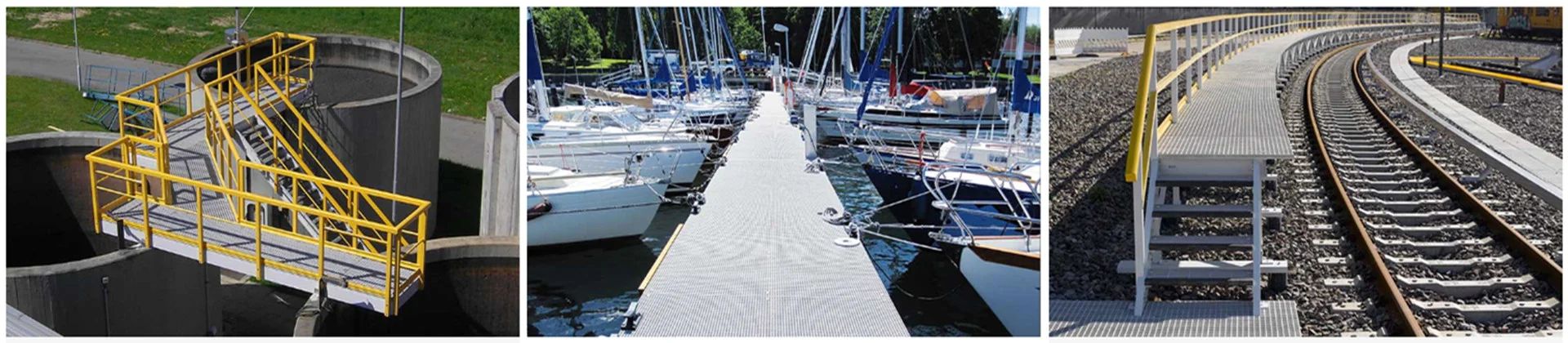
Introduction
Fiberglass grating cuts faster than steel grating, requires no welding equipment, and needs no post-cut zinc coating or paint application. Most installation crews discover this within the first hour on site and conclude that FRP grating is straightforward to work with. They are correct — with one exception that field installation guides almost universally omit.
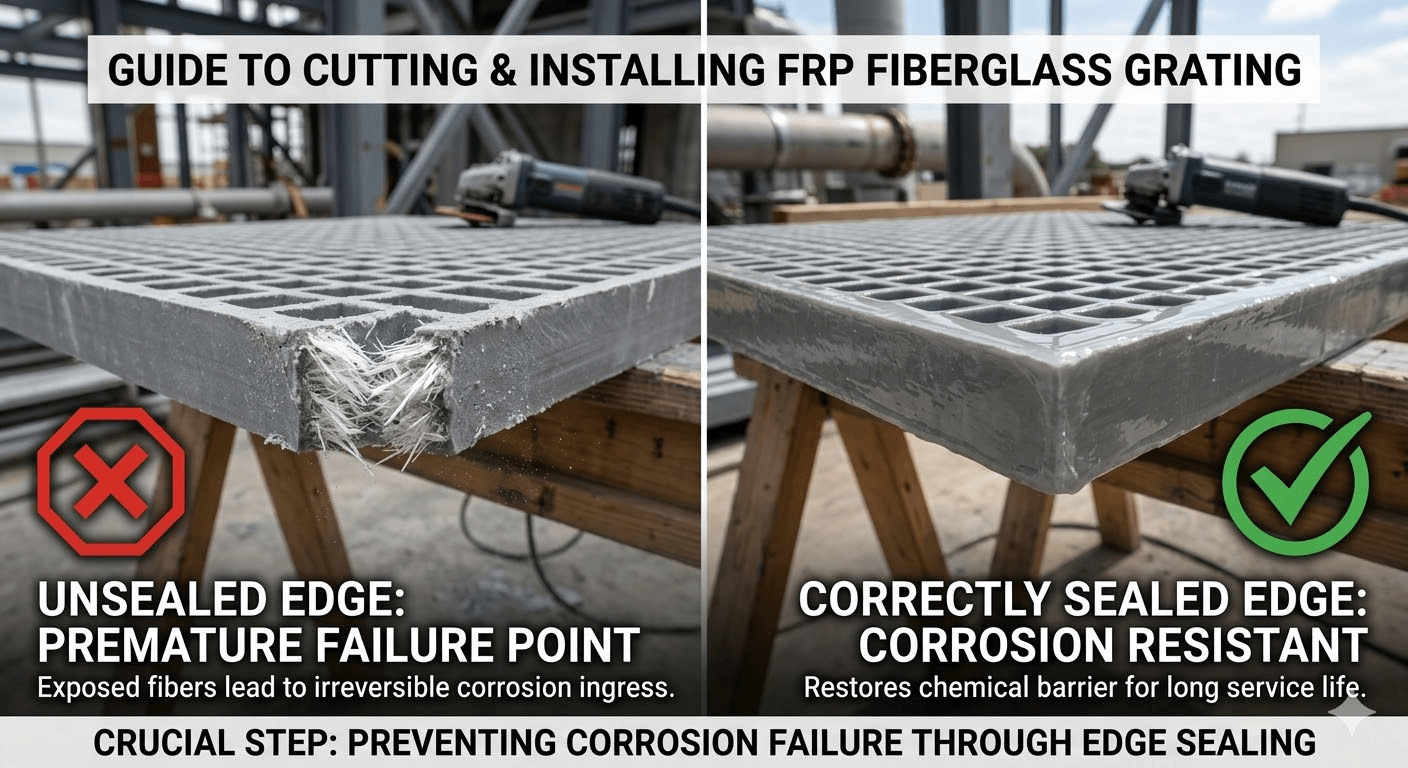
Skipping edge sealing after cutting is the single most common cause of premature corrosion failure in FRP grating installations. The cut face exposes bare glass fiber that the resin matrix no longer protects. In corrosive service environments, that unsealed face becomes the initiation point for chemical ingress that progressively undermines the surrounding composite — a failure mode that costs nothing to prevent and is irreversible once it begins.
This guide gives installation engineers and procurement managers a complete on-site reference for cutting, drilling, and finishing FRP fiberglass grating. You will find tool selection with specific specifications, the four cutting methods, standard dimensional tolerances, the edge sealing procedure that restores cut surface corrosion resistance, and the PPE requirements that apply under North American occupational safety standards.
Unicomposite manufactures FRP pultruded and molded grating panels for chemical processing, wastewater, marine, and industrial platform applications across North America and Europe. The cutting tolerances in this guide reflect dimensional requirements validated across these application environments — particularly the ±1.0 mm/m squareness tolerance, which is tighter than many generic FRP fabrication references specify and is set at that level because racked panels in grating arrays create uneven drainage patterns and concentrated point loads at the support rail interface.
frp fiberglass grating guide
1. Why Cutting FRP Grating Differs from Cutting Steel
1.1 The Material Difference That Changes Every Tool Choice
FRP grating is a thermoset composite — glass fiber reinforcement locked in a cured resin matrix that cannot be softened, bent, or welded after cure. The resin matrix governs both the material’s structural performance and its corrosion resistance. Cutting methods that generate excessive heat at the cut face damage this matrix, producing delamination, fiber pull-out, and a ragged edge that compromises both dimensional accuracy and the corrosion barrier the resin provides.
Standard steel-tooth saw blades and ferrous metal cutting discs are the wrong tools for FRP grating. They generate heat through friction at the blade tooth interface — heat that melts the resin locally, fuses glass fiber dust into the cut line, and leaves an irregular edge that cannot be sealed cleanly. The correct tools use abrasive action: silicon carbide (SiC) or diamond-coated abrasive discs cut through the composite through micro-scale abrasion, maintaining cut edge temperature below the resin’s heat deflection threshold.
The practical advantage over steel grating is real. No hot-work permits. No post-cut welding. No zinc spray or paint application over the cut area. FRP cutting is complete after a single additional step — edge sealing — that requires only a brush and compatible resin. Understanding why that step cannot be skipped is the necessary foundation for everything that follows.
1.2 The Edge Sealing Requirement — Why It Cannot Be Skipped
FRP grating’s corrosion resistance is a bulk property of the resin-fiber composite, concentrated in the outer resin-rich surface layer — typically 0.25–0.5 mm thick — that provides the primary chemical barrier between the service environment and the glass fiber reinforcement beneath. Cutting removes this barrier at the cut face entirely. The exposed glass fiber that remains is not chemically inert: sustained exposure to acids, alkalis, and moisture degrades the fiber-matrix interface, reducing structural strength and creating pathways for chemical ingress that extend progressively inward from the cut edge.
In Unicomposite’s evaluation of returned panels from chemical processing and marine installations, grating panels that failed prematurely consistently showed unsealed cut edges as the primary failure initiation point — a pattern directly traceable to installation practice rather than any deficiency in the grating material itself. The failure timeline in moderately aggressive service environments — direct acid or alkali contact at the cut face, or continuous water immersion — runs 3–5 years for unsealed edges versus 20+ years for correctly sealed panels. In mild-exposure environments such as outdoor structural platforms with rain exposure but no chemical contact, unsealed edges may perform for 8–10 years before visible degradation initiates. The corrosive conditions that most commonly justify specifying FRP over steel are also the conditions that make edge sealing most critical.
Edge sealing restores the cut surface’s corrosion resistance using a compatible resin applied by brush over the cut face. The operation takes 5–15 minutes per panel depending on panel size and cut edge length. It is not optional in any chemical, marine, outdoor, or wet service environment — the only exception is dry indoor structural applications with no chemical exposure.
2. Tools for Cutting Fiberglass Grating
2.1 Straight-Line Cutting: Recommended Tools and Specifications
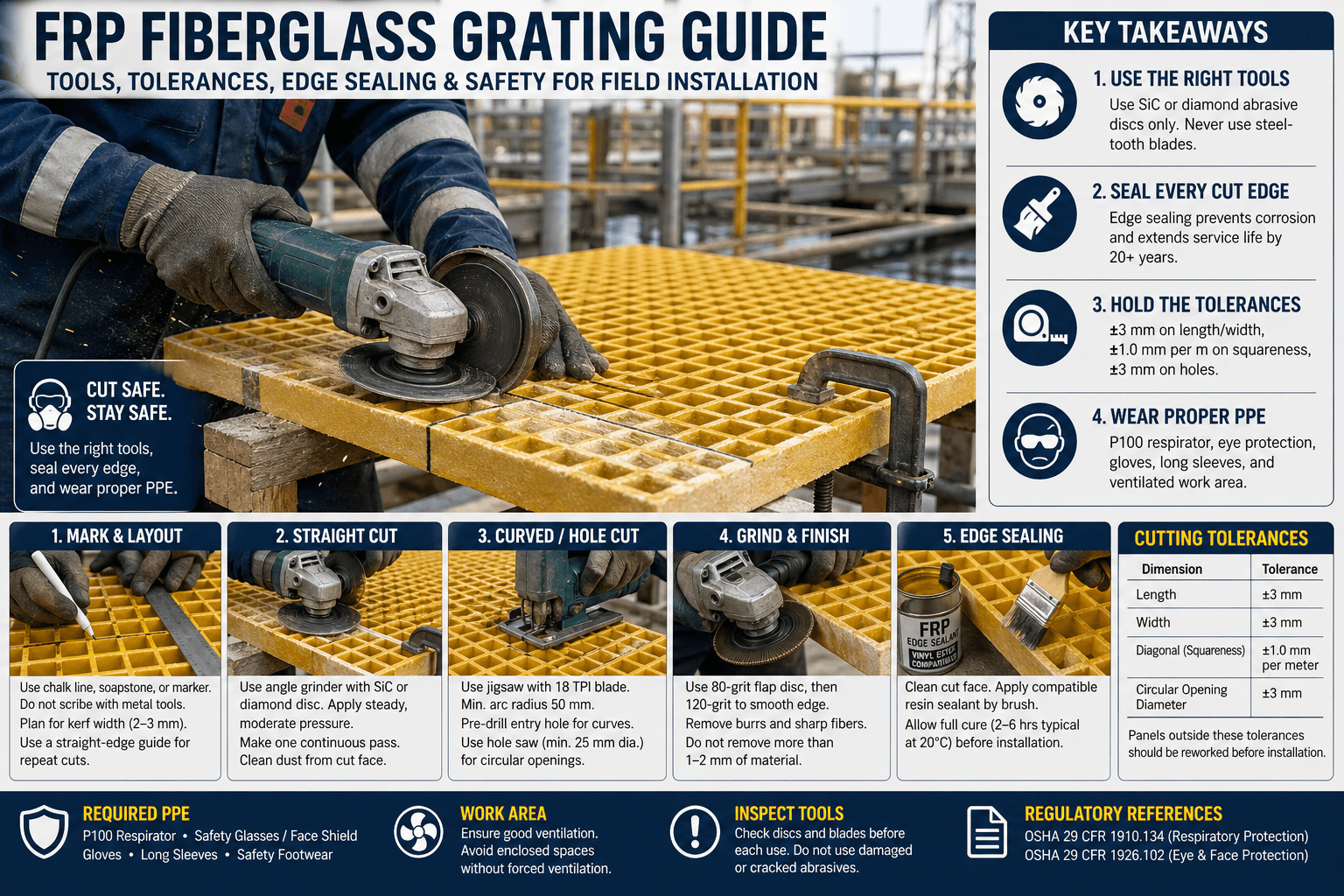
The angle grinder with an abrasive disc is the correct primary tool for straight-line cuts in FRP grating — fastest cut speed, cleanest edge, and compatible with the range of panel thicknesses encountered in standard grating specifications. Disc specification: 4.5–9 inch silicon carbide (SiC) or diamond-coated abrasive disc rated to a minimum of 8,000 RPM. This minimum matches the free-speed rating of standard 4.5-inch angle grinders and ensures the disc’s structural rating exceeds the tool’s operating speed — a disc rated below the grinder’s free speed is a fragmentation hazard at operating RPM.
Do not use standard ferrous metal cutting discs, wood-cutting blades, or any abrasive product not specifically rated for composite or masonry cutting. These generate excessive heat, produce poor edge quality, and contaminate the cut face with metallic particles that interfere with resin sealant adhesion.
The circular saw with a silicon carbide or diamond-coated blade is the recommended secondary tool for high-volume straight cuts or where a guide fence is needed to maintain cut line accuracy across multiple panels. For field situations where neither tool is available, a fine-tooth hacksaw blade (metal-cutting specification, minimum 24 TPI) cuts thin panels adequately — acceptable for low-volume or temporary work, not for production installation.
2.2 Curved and Irregular Cuts
Jigsaw with a bi-metal or high-speed steel (HSS) blade at fine tooth pitch (minimum 18 TPI) is the correct tool for curved cuts, arc sections, and irregular panel openings. The reciprocating saw with equivalent blade specification handles rougher curved cuts where edge finish is less critical.
The minimum recommended arc radius for curved cuts in FRP grating is 50 mm. Arcs tighter than 50 mm create stress concentrations at the cut boundary that can initiate cracking under repeated load cycles — particularly relevant for panels in traffic-bearing or vibration-prone applications. If the design requires openings with tighter geometry, drill a series of overlapping holes to approximate the curve rather than forcing the saw to cut a radius below this threshold.
2.3 Drilling and Hole Cutting
Electric drill with a silicon carbide or diamond-coated hole saw is the correct tool for clean circular openings — pipe penetrations, fastener clearance holes, and anchor points. Hole saw minimum diameter: 25 mm. Attempting to drill openings smaller than 25 mm with a standard hole saw risks delamination at the hole perimeter; use a carbide-tipped step drill for smaller holes, progressing to final diameter in multiple passes. Specify carbide-tipped step drills rather than standard HSS — HSS step drills dull after 3–5 holes in glass fiber composite and produce increasingly ragged hole perimeters as the cutting edge degrades.
Drill speed setting: low RPM, high torque. High-speed drilling generates heat at the bit tip that damages the resin matrix immediately surrounding the hole. Always clamp a scrap timber block against the grating underface before drilling to prevent tear-out on the exit side.
The table below provides a complete cutting tool reference for the four standard FRP grating cut types:
| Cut Type | Recommended Tool | Blade/Disc Specification | Do NOT Use | Notes |
|---|---|---|---|---|
| Straight line | Angle grinder | 4.5–9″ SiC or diamond disc, min. 8,000 RPM rated | Steel-tooth cutting discs; wood blades | Circular saw with SiC blade as secondary option |
| Curved/arc | Jigsaw | Bi-metal or HSS blade, min. 18 TPI | Standard wood-cutting blades | Min. arc radius 50 mm |
| Circular hole | Drill + hole saw | SiC or diamond hole saw, min. 25 mm dia. | Standard steel hole saws; HSS step drills | Back-plate timber block to prevent tear-out; use carbide step drills for holes <25 mm |
| Grinding/finish | Angle grinder + flap disc | 80-grit then 120-grit flap disc | Wire wheels; metal grinding wheels | Do not remove more than 1–2 mm from cut face |
3. Cutting Methods and Field Procedures
The four sub-sections below address each stage of the cutting workflow in sequence — if you are completing a specific cut type rather than reading the full guide, go directly to Section 3.2 for straight cuts, Section 3.3 for curves and holes, or Section 3.4 for edge finishing.
3.1 Marking and Layout
Mark cut lines with chalk line, soapstone marker, or permanent marker. Do not scribe lines with metal tools — metal scribing damages the resin-rich surface layer and creates stress risers at the mark line. In Unicomposite’s installation experience, scribed panels installed in vibration environments show micro-cracking initiating at scribe marks within the first service year — the same stress concentration mechanism that makes tight arc radii a structural concern applies at any surface damage that penetrates the resin layer.
Verify all dimensions against the tolerance specifications in Section 4 before marking, and plan the cut line to allow for the kerf width of the cutting tool — typically 2–3 mm for abrasive disc cuts. For repeat cuts to the same dimension, fabricate a straight-edge guide from timber or aluminum angle stock and clamp it to the panel as a fence. This eliminates re-measurement error across multiple panels and significantly improves cut line consistency compared to freehand cutting.
3.2 Straight-Line Cutting Procedure
Clamp the panel securely on both sides of the cut line before starting the tool. Unsupported grating panels vibrate during cutting, reducing edge quality, increasing dust generation, and creating a control hazard. Apply consistent, moderate forward pressure during the cut — forcing the tool increases heat generation, disc wear, and the risk of disc deflection. Let the abrasive action do the work at the tool’s rated speed.
Complete each cut in a single continuous pass where possible. Stopping and restarting mid-cut creates step discontinuities in the cut face that are difficult to seal uniformly and may fall outside the squareness tolerance. Immediately after completing each cut, remove accumulated dust from the cut face using a brush or brief burst of compressed air — resin sealant does not bond reliably over a layer of cutting dust.
3.3 Curved and Hole Cutting Procedure
For curved cuts, pre-drill a clearance hole at the start point of the cut to give the jigsaw blade an entry point without forcing it through the panel face from the edge. Mark the curve clearly before starting the cut, and follow the marked line at a controlled feed rate — the jigsaw blade requires consistent forward pressure to maintain cut line accuracy in composite material.
For pipe penetration holes, mark the circle using a compass or hole template. Drill the hole saw to the marked line in a single pass with the back-plate support block in position. After drilling, use a round file or die grinder with a carbide burr to clean up the hole perimeter — remove any frayed fiber and bring the edge to a consistent diameter before sealing.
3.4 Grinding and Edge Finishing
Use a portable angle grinder with a flap disc or a hand file to remove burrs and sharp fiber projections from cut edges before sealing. Start with 80-grit to remove major irregularities, finish with 120-grit for a smooth surface that accepts resin sealant with full adhesion. Do not over-grind — removing more than 1–2 mm of material from the cut face changes the panel dimension, may push the panel outside cutting tolerance, and removes composite material that contributes to edge structural integrity.
how to cut fiberglass grating
4. Cutting Tolerances for FRP Fiberglass Grating
Dimensional accuracy at the cut determines fit-up quality at the installation point. Panels cut outside tolerance require rework — forcing an out-of-tolerance panel into position introduces installation stress at the connection point that reduces the grating’s long-term load performance.
In Unicomposite’s installation support experience, the most common consequence of forced out-of-tolerance panels is uneven bearing contact at the support frame — visible as panel rocking or a gap at one support rail under live load. This contact irregularity concentrates dynamic load at the high-contact points, accelerating fatigue at the panel-to-support interface and reducing the effective service life of the connection detail, even when the panel body itself remains undamaged. Reworking a cut panel on site takes minutes; replacing a failed connection detail in a corrosive environment takes days.
The standard cutting tolerances for FRP pultruded and molded grating panels are:
| Cut Dimension | Tolerance | Application |
|---|---|---|
| Length direction | ±3 mm | Standard panel length cuts |
| Width direction | ±3 mm | Standard panel width cuts |
| Diagonal (squareness) | ±1.0 mm per meter of panel length | Ensures panels lay flat without racking |
| Circular opening diameter | ±3 mm | Pipe penetrations, anchor holes |
Tolerance values per Unicomposite standard installation specification. Panels with cut dimensions outside these tolerances should be reworked or replaced — do not force out-of-tolerance panels into position.
Achieving consistent tolerances across multiple panels requires a straight-edge guide for length and width cuts, a diagonal measurement check (corner-to-corner) before finalizing each cut panel, and a calibrated steel tape measure. Fabric tape measures stretch under tension and introduce cumulative error across a panel array that compounds the difficulty of maintaining the squareness tolerance.
5. Edge Sealing After Cutting
5.1 When Edge Sealing Is Mandatory and When It Is Optional
Edge sealing is mandatory in any chemical, marine, outdoor, wet, or splash-zone environment — which describes the majority of industrial FRP grating installations. The corrosive environments where FRP grating is most commonly specified over steel are precisely the environments where unsealed cut edges fail earliest. The two categories represent the same installation: the corrosive conditions that justify FRP over steel also make edge sealing non-negotiable.
Edge sealing is optional only in dry, indoor, non-chemical environments where the grating functions purely as a structural flooring element with no chemical or moisture exposure. Even in these environments, sealing adds negligible time and cost relative to any later remediation if the service classification changes.
5.2 Edge Sealing Procedure
Select a compatible resin sealant matching the grating’s resin system — polyester sealant for polyester grating, vinyl ester sealant for vinyl ester grating. Using an incompatible resin system creates an adhesion boundary between the sealant and the panel matrix that fails under thermal cycling, defeating the purpose of sealing entirely.
Clean the cut face with a brush or compressed air immediately before applying sealant — any dust, moisture, or contamination on the cut face reduces sealant adhesion. Apply the sealant by brush in a single continuous coat, ensuring full coverage with no dry spots or voids. The sealant should flow into any surface pores on the cut face rather than sitting on top of accumulated particulate.
Allow full room-temperature cure before installation. For standard polyester sealant systems, cure typically runs 2–4 hours at 20°C. Vinyl ester sealant systems generally require 4–6 hours at 20°C, or 1–2 hours with a 40–60°C post-cure — confirm against the specific sealant supplier’s technical data sheet before scheduling installation, as formulations vary. After cure, the sealed face should appear uniformly glossy — matte or patchy areas indicate incomplete coverage and require a second coat before the panel is installed.
6. Safety Requirements for On-Site FRP Grating Cutting
6.1 Required Personal Protective Equipment
Cutting FRP grating generates two simultaneous hazards: airborne glass fiber dust and cutting disc or blade fragments. Both require dedicated PPE. The standard N95 construction dust mask is insufficient for glass fiber particulate — glass fiber dust particles are fine enough to bypass N95 filtration and cause respiratory irritation with sustained inhalation.
Respiratory protection: NIOSH-approved P100 half-face respirator or equivalent for all cutting, drilling, and grinding operations. P100 filtration captures glass fiber particulate at the particle size generated by abrasive disc cutting. Full-shift use is required whenever cutting operations continue for more than a few minutes.
Eye protection: Safety glasses rated to ANSI Z87.1 as the minimum standard; full-face shield preferred when using angle grinders, which generate disc fragments and composite particulate in a wider arc than jigsaws or circular saws.
Skin protection: Long-sleeve work clothing and nitrile or leather gloves for all cutting and panel-handling operations. Glass fiber fragments embed in skin on contact and cause irritation that resolves slowly — bare-hand contact with cut panels is not acceptable.
Footwear: Closed-toe safety footwear with puncture-resistant soles — cutting disc fragments and sharp panel edges present foot laceration and crush hazards on any active cutting site.
6.2 Work Environment Requirements
Cutting must occur in a well-ventilated area — outdoors or with active mechanical ventilation extracting dust away from the operator’s breathing zone. Enclosed spaces without forced ventilation accumulate glass fiber particulate rapidly to concentrations that exceed safe exposure limits even with P100 respiratory protection; adequate ventilation reduces the PPE burden and the post-shift cleanup requirement simultaneously.
Inspect all cutting discs and blades before each use. Cracks, chips, or visible damage to abrasive discs require immediate disc replacement — a damaged disc can fragment at operating speed with sufficient energy to penetrate standard eye protection. This inspection takes less than thirty seconds and is the single most important equipment check before any FRP cutting operation begins.
The applicable North American regulatory references for FRP grating cutting operations are OSHA 29 CFR 1910.134 (respiratory protection program requirements) and OSHA 29 CFR 1926.102 (eye and face protection in construction). Both standards apply to on-site cutting of fibrous composite materials.
Conclusion
FRP fiberglass grating is one of the easiest structural materials to cut and install on site — when the correct tools are selected and the post-cut sealing step is treated as a standard installation requirement rather than an optional finishing detail. Four takeaways for installation teams and procurement managers specifying FRP grating for field assembly:
- Silicon carbide or diamond abrasive discs only — never steel-tooth blades. The wrong cutting tool damages the resin matrix, produces poor edge quality, and generates more dust. The right tool cuts cleaner, faster, and leaves a face that seals correctly.
- Seal every cut edge before installation in any corrosive or outdoor environment. Unsealed cut edges are the most common cause of premature FRP grating failure — not material quality, not design error. A brush-applied resin coat eliminates this failure mode entirely.
- Hold the cutting tolerances. ±3 mm on length and width, ±1.0 mm/m on squareness — panels cut outside these specifications should be reworked before installation. Forced joints concentrate dynamic load at the support interface and reduce the connection’s service life, even when the panel body performs correctly.
- FRP grating’s installation advantages over steel — no hot-work, no post-cut corrosion treatment, no specialist equipment — are fully realized only when edge sealing and proper PPE are treated as standard steps rather than optional finishing details. The material saves time and cost at installation; the installation practice determines whether those savings are preserved over the service life.
Frequently Asked Questions
An angle grinder with a 4.5-inch silicon carbide abrasive disc is the most practical single tool for on-site FRP grating cutting — it handles straight cuts, can be used for rough curved cuts, and is available on virtually every industrial job site. If an angle grinder is not available, a fine-tooth hacksaw (minimum 24 TPI metal-cutting blade) cuts thin panels adequately for low-volume work, though edge quality and speed are significantly lower. Do not attempt to use standard steel-tooth circular saw blades — they generate heat that damages the resin matrix and produce poor edge quality.
In any chemical, marine, outdoor, wet, or splash-zone environment, edge sealing is mandatory — not optional. The cut face exposes bare glass fiber that the resin matrix no longer protects, and in corrosive service environments, an unsealed face becomes the primary failure initiation point within 3–5 years. Use a resin sealant compatible with the grating’s resin system (polyester sealant for polyester grating, vinyl ester sealant for vinyl ester grating) and allow full cure before installation. Edge sealing is the only step where skipping it directly reduces the panel’s service life.
The standard tolerances are ±3 mm on length and width, ±1.0 mm per meter of panel length on diagonal squareness, and ±3 mm on circular opening diameters. These tolerances ensure correct fit-up at the support frame without installation stress. Panels cut outside tolerance should be reworked before installation — forcing out-of-tolerance panels into position concentrates dynamic load at the high-contact support points and accelerates fatigue at the connection detail.
The minimum requirements are a NIOSH-approved P100 respirator (not a standard N95 dust mask — glass fiber dust particles bypass N95 filtration), ANSI Z87.1-rated safety glasses (full-face shield preferred for angle grinder use), long-sleeve work clothing, and nitrile or leather gloves. Cutting must occur in a well-ventilated area — enclosed spaces without forced ventilation accumulate glass fiber particulate above safe exposure limits rapidly. OSHA 29 CFR 1910.134 and 29 CFR 1926.102 apply to on-site FRP cutting operations.
The minimum practical hole diameter using a hole saw is 25 mm — smaller holes risk delamination at the hole perimeter from the rotating edge. For holes smaller than 25 mm, use a carbide-tipped step drill progressing to final diameter in multiple passes; specify carbide-tipped rather than standard HSS step drills, as HSS dulls rapidly in glass fiber composite and produces increasingly ragged hole perimeters after 3–5 holes. Always clamp a timber back-plate against the grating underface before drilling to prevent tear-out on the exit side.


