Epoxy Pultruded Profiles: When to Specify Over Polyester

time:2026-4-28

Introduction

Most FRP procurement specifications default to polyester resin. It’s cheaper, it processes easily, and it performs adequately across a wide range of general structural applications. The problem is that “adequate for general applications” is not the same as “adequate for electrical infrastructure, high-load structural service, or chemically aggressive environments.” In those conditions, polyester fails in predictable ways: premature creep under sustained load at elevated temperature, dielectric breakdown under electrical stress, resin matrix cracking where transverse loads exceed the fiber-matrix bond strength.

A simplified replacement cost model — accounting for material re-procurement, installation labor, access and scaffold costs, and process downtime — consistently yields a total replacement cost of 4–6× the original material cost difference between epoxy and polyester profiles. The exact multiplier varies by installation environment and labor market, but the directional conclusion holds across most industrial and infrastructure applications: the epoxy cost premium at purchase is the smallest cost in the sequence if the wrong resin is specified.

This guide gives engineers and procurement managers a clear, criteria-based framework for making that evaluation. You will find the three specification triggers, a resin comparison matrix, the five highest-value application categories for epoxy pultruded profiles, and a specification checklist that produces a purchase document the supplier is bound to deliver against.

Unicomposite Technology Co., Ltd produces pultruded profiles in polyester, vinyl ester, and epoxy resin systems at its 18,000 m² manufacturing facility in Nanjing, China. The selection guidance in this article reflects direct production experience across all three resin systems — not a single-resin manufacturer’s perspective on which option is best.

Epoxy Pultruded Profiles: When to Specify Over Polyester

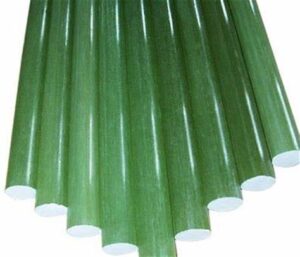
epoxy pultruded profiles


1. Epoxy vs. Polyester in Pultrusion: What the Properties Actually Mean

1.1 Core Property Differences

The performance difference between epoxy and polyester pultruded profiles is not simply a matter of degree — it is a difference in the fundamental mechanism of resin-fiber interaction. Epoxy resin forms a stronger chemical bond to glass fiber surfaces than polyester, directly improving transverse tensile strength and interlaminar shear strength. These are the properties that govern performance under off-axis loading and in fatigue service — conditions that longitudinal tensile strength tests do not capture.

Thermal performance diverges significantly between the two systems. Standard polyester pultruded profiles carry a heat deflection temperature (HDT) in the 70–100°C range. Epoxy systems extend this to 120–150°C depending on hardener chemistry — a critical distinction for profiles in electrical enclosures, process environments, or outdoor structural service where solar gain and ambient temperature can push surface temperatures well above 80°C under sustained load.

Dimensional precision is another differentiator that procurement specifications frequently overlook. Epoxy cure shrinkage runs below 2%; polyester shrinkage ranges from 2–8%. Epoxy pultruded profiles therefore hold tighter dimensional tolerances, produce better surface finish, and maintain more consistent cross-sectional geometry — relevant for close-tolerance connection details and for profiles used as precision insulation components in electrical assemblies.

1.2 The Three Specification Triggers

Three service conditions individually justify a serious evaluation of epoxy over polyester. When two or more are present simultaneously, epoxy is the default specification unless cost constraints are genuinely overriding.

Trigger 1 — Service temperature above 80°C. Polyester’s HDT limitations become structurally relevant above this threshold. Under sustained mechanical load at temperatures approaching the HDT, polyester matrix creep accelerates and stiffness degrades. Epoxy profiles maintain structural integrity where polyester softens — and the failure in polyester is typically gradual and invisible until deflection or dimensional drift triggers a system-level failure.

Trigger 2 — High transverse or off-axis structural load. Epoxy’s superior fiber-matrix adhesion produces meaningful differences in transverse bending strength and fatigue resistance. Standard pultruded profiles are strongest in the longitudinal fiber direction; loads applied transversely or at connection points rely on the resin matrix and fiber-matrix bond. In applications with combined loading, vibration, or cyclic stress, this difference determines service life.

Trigger 3 — Dielectric performance requirement. Epoxy pultruded profiles achieve higher dielectric strength and lower dielectric constant than equivalent polyester profiles. This is the standard specification for electrical insulation components in power infrastructure — not because polyester lacks dielectric properties, but because epoxy maintains those properties under the combination of elevated temperature and sustained electrical stress that polyester cannot.

The table below compares the key performance properties of the three most common pultruded resin systems; mechanical values reflect ASTM D638 (tensile) and ASTM D790 (flexural) test conditions at ambient temperature unless otherwise noted:

Property Epoxy Polyester Vinyl Ester
Longitudinal tensile strength (ASTM D638) 350–550 MPa 300–450 MPa 310–480 MPa
Transverse bending strength High (superior fiber-matrix bond) Moderate Moderate–High
Heat deflection temperature 120–150°C (hardener-dependent) 70–100°C 100–120°C
Dielectric strength (ASTM D149, 3.2 mm in oil) 20–40 kV/mm 15–25 kV/mm 15–28 kV/mm
Cure shrinkage <2% 2–8% 1–4%
Chemical resistance (alkalis) Excellent Moderate Good
Chemical resistance (strong acids) Good Poor Excellent
Relative material cost index 1.8–2.5× 1.0× 1.3–1.7×

Understanding which properties align with your service conditions is the necessary first step — the application sections below translate these property differences into specific procurement decisions.


2. Primary Applications of Epoxy Pultruded Profiles

The five application categories below represent epoxy pultrusion’s strongest performance and cost case. If you are evaluating epoxy for a specific industry, locate your application in the quick-reference table below, then read the corresponding sub-section for the governing technical rationale.

Application Category Primary Trigger Sub-Section
Electrical and power infrastructure Dielectric + thermal 2.1
High-load structural (platforms, trusses) Transverse load + ILSS 2.2
Chemical processing structural components Alkali resistance + load 2.3
Transportation and OEM manufacturing Fatigue / cyclic load 2.4
Energy and renewable infrastructure Thermal cycling + UV 2.5

2.1 Electrical and Power Infrastructure

Electrical infrastructure is epoxy pultrusion’s highest-value application category, and the one where specifying polyester creates the most serious long-term risk. Transformer insulation spacers, high-voltage insulator mandrels, cable protection tubes, switchgear components, and substation support structures all require the combination of dielectric strength, thermal stability under electrical stress, and dimensional consistency that epoxy delivers and polyester cannot sustain.

The failure mechanism in polyester electrical insulation components is partial discharge at elevated temperature. Under sustained electrical stress, partial discharge events erode the resin matrix progressively — a degradation process that does not appear in short-term dielectric testing but dominates long-term field failure patterns in distribution and transmission infrastructure.

In Unicomposite’s project intake experience, the most common replacement inquiry for electrical infrastructure profiles follows a consistent timeline: polyester insulation spacers or cross arm components show no performance anomaly in the first 3–5 years, then exhibit accelerated degradation in years 6–10 as thermal cycling and electrical stress compound. The failure is rarely attributed to the resin specification in the initial replacement inquiry — it is usually described as “weathering” or “aging.” Detailed inspection consistently traces the degradation to partial discharge erosion at the fiber-matrix interface — a condition the original polyester specification could not prevent, and that epoxy’s higher cross-link density and thermal stability suppress.

In North American power utility applications, FRP cross arms, pole-mounted insulation brackets, and hot stick cores require epoxy resin systems for compliance with ANSI C29 series standards and IEC 61109. Specifying polyester for these components is not simply a performance compromise — in many utility procurement specifications, it is a non-compliant substitution. Epoxy is not the premium option in electrical infrastructure: it is the correct option.

2.2 High-Load Structural Applications

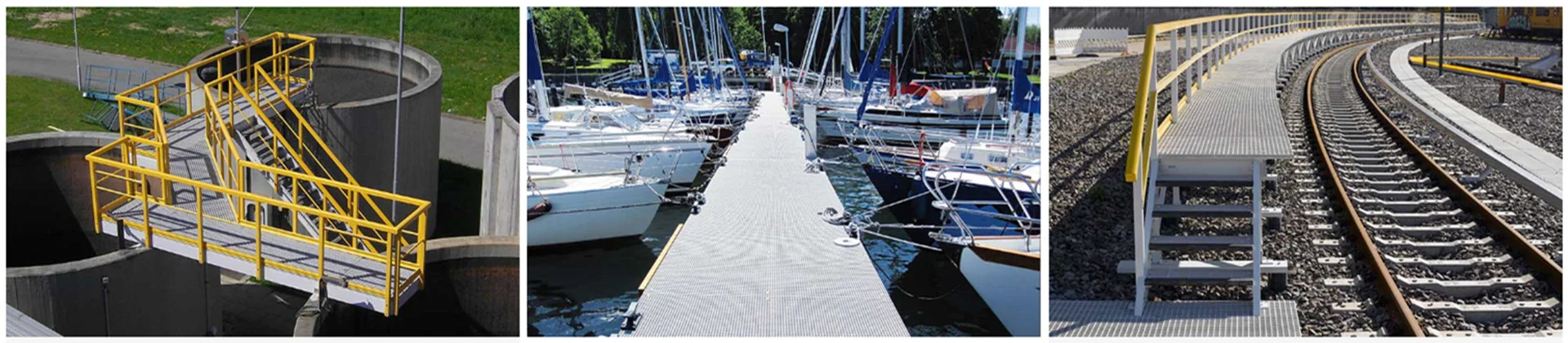
Beyond electrical service, epoxy’s structural advantage becomes decisive wherever profiles carry significant transverse or combined loads. Bridge inspection platforms, heavy industrial walkways, structural trusses in corrosive environments, and modular platforms in offshore and chemical plant settings all subject FRP profiles to loading conditions that exploit the resin matrix rather than the longitudinal fiber.

Epoxy pultruded profiles achieve interlaminar shear strength (ILSS) typically 30–50% higher than polyester profiles at equivalent fiber volume fraction. ILSS governs performance at connection points, at support interfaces, and under combined bending and shear — the loading conditions that most commonly initiate failure in structural FRP assemblies. In high-load applications where profiles span significant distances or carry dynamic loads, this difference in ILSS is the primary structural justification for the epoxy cost premium.

Epoxy pultruded I-beams at equivalent load-bearing capacity to carbon steel weigh approximately 25% of the steel equivalent. In weight-constrained installations — offshore platforms, elevated walkways with limited foundation capacity, mobile or relocatable structures — this weight advantage combined with epoxy’s structural performance makes FRP the enabling technology, not merely an alternative material. Understanding the load path through your profile geometry is the foundation for deciding whether epoxy’s ILSS advantage is structurally decisive for your application — which is where the application-specific sections below become most useful.

2.3 Chemical Processing Structural Components

Resin selection for chemical processing environments involves a trade-off that the table in Section 1 captures directly: vinyl ester leads on strong acid resistance; epoxy leads on mechanical performance and alkali resistance. For structural components in chemical plants — handrails, platforms, grating support frames, pipe racks — the loading and thermal conditions frequently tip the specification toward epoxy even in environments where vinyl ester would be selected for the primary corrosion barrier.

In Unicomposite’s supply experience across chemical processing and wastewater customers, the specification pattern that most reliably predicts premature replacement is polyester profiles installed in alkali wash environments — NaOH concentrations above 10% at temperatures above 50°C routinely produce visible matrix degradation within 3–5 years, a pattern consistent across alkali service projects in Unicomposite’s supply history. The replacement inquiry consistently arrives with a description of “surface crazing” or “whitening” — both of which are polyester matrix hydrolysis at the fiber-matrix interface, not surface weathering. The correct specification for this service condition is epoxy or vinyl ester, depending on whether structural load or chemical barrier is the primary requirement.

For environments involving both concentrated acid contact and high structural loads, the correct specification is typically a vinyl ester primary corrosion barrier with an epoxy structural core — achievable in a single pultruded profile through hybrid resin layering, where the outer resin-rich surface uses vinyl ester and the structural fiber bed uses epoxy.

2.4 Transportation and OEM Manufacturing

The chemical processing applications above are governed by the interaction of structural load and chemical environment. Transportation applications present a different challenge — the governing variable shifts from chemical exposure to cyclic mechanical fatigue, where epoxy’s advantage operates through a completely different mechanism.

Fatigue resistance is epoxy’s decisive advantage in transportation applications. Commercial vehicle structural members, refrigerated trailer frames, and composite leaf springs all experience cyclic loading from road vibration and impact — conditions where crack propagation through an epoxy resin matrix is significantly slower than through polyester under equivalent cyclic stress amplitude. Under road vibration loading at typical commercial vehicle duty cycles, polyester composite structural members may develop matrix micro-cracking within 5–7 years of service. An equivalent epoxy profile under the same loading shows substantially less matrix fatigue damage over the same period — a difference that matters in applications where structural inspection and replacement carry significant downtime and labor costs.

ASTM D3479 governs tension-tension fatigue testing of polymer matrix composite materials — the relevant test standard for cyclic load service life prediction in transportation applications. Request D3479 fatigue data alongside the standard D638 and D790 mechanical reports when specifying epoxy profiles for cyclic load service.

Custom cross-section availability makes epoxy pultrusion practical for OEM applications: epoxy profiles are available in all standard pultruded geometries plus tooled custom sections for OEM assemblies where standard profiles don’t match the design intent.

2.5 Energy and Renewable Infrastructure

Solar mounting structures, wind turbine nacelle support components, and offshore platform cable management systems all experience the thermal cycling and UV exposure conditions that distinguish long-life renewable energy infrastructure from standard industrial applications. Epoxy profiles with UV-stable surface veils maintain mechanical properties through the thermal cycling — ranging from -40°C to +80°C in many North American installation environments — that progressively degrades polyester matrix integrity at the fiber-resin interface over 20–25 year design service lives.

The thermal cycling failure mechanism in polyester is cumulative micro-cracking at the fiber-matrix interface, driven by differential thermal expansion between glass fiber and the resin matrix. Epoxy’s stronger fiber-matrix bond resists this micro-cracking initiation — a property difference that does not show up in ambient-condition mechanical testing but dominates performance at end of service life in outdoor thermal cycling environments.

The table below maps each application to the recommended resin system, primary specification trigger, and governing standard:

Application Recommended Resin Primary Trigger Key Standard Notes
Electrical infrastructure (HV insulators, cross arms) Epoxy Dielectric + thermal ANSI C29, IEC 61109 Polyester non-compliant in many utility specs
High-load structural (platforms, trusses) Epoxy Transverse load + ILSS ASTM D4385, D3917 30–50% ILSS advantage over polyester
Chemical processing (alkali or solvent service) Epoxy or hybrid VE/epoxy Alkali resistance + load ASTM D638, D790 Vinyl ester for strong acid barrier; epoxy for structure
Transportation OEM (cyclic load applications) Epoxy Fatigue resistance ASTM D3479 (fatigue test) Governs tension-tension fatigue life prediction
Renewable energy (outdoor thermal cycling) Epoxy + UV-stable veil Thermal stability + UV ASTM D790, D149 Specify UV-stable surface veil type explicitly

3. How to Specify Epoxy Pultruded Profiles Correctly

3.1 Required Specification Parameters

A purchase order that specifies “epoxy pultruded profile” without further definition leaves the supplier significant latitude — latitude that can result in a profile that passes dimensional inspection but underperforms on the thermal or mechanical properties the specification intended to capture.

Four parameters must appear in every epoxy profile specification. First, resin system with hardener type: specify amine-cured epoxy (HDT 100–120°C) or anhydride-cured epoxy (HDT 130–150°C) where thermal performance is a design requirement — these are meaningfully different products at elevated temperature, not interchangeable. Second, fiber reinforcement: specify E-glass or ECR (corrosion-resistant) glass, and set a minimum fiber volume fraction — typically 55–65% for structural profiles — where mechanical load performance is specified. Third, profile geometry: provide a dimensional drawing with tolerances per ASTM D3917. Fourth, performance requirements: cite the ASTM test methods for the properties being specified — D638 for tensile, D790 for flexural, D695 for compressive, D149 for dielectric strength, and D2583 Barcol hardness as a non-destructive cure verification check.

Epoxy Pultruded Profiles: When to Specify Over Polyester

epoxy vs polyester pultrusion

3.2 Standards Reference for North American Projects

ASTM D4385 (Standard Classification System for Pultruded Shapes Made from Thermosetting Resins) is the correct classification framework for specifying resin type and reinforcement architecture in North American FRP procurement documents — reference it as the classification basis and specify the appropriate resin and reinforcement class designations.

ASTM D3917 governs dimensional tolerances for pultruded profiles and should be referenced in every geometric specification. ASTM D149 is mandatory for any electrical insulation application. ANSI C29 series and IEC 61109 apply to composite insulator and cross arm applications in power utility infrastructure. ASTM D3479 applies where fatigue service life is a design criterion.

3.3 Common Specification Errors to Avoid

Three specification errors account for the majority of epoxy profile procurement failures in the field. First, specifying “epoxy resin” without hardener type where HDT is a design requirement — amine and anhydride systems have meaningfully different thermal performance, and a supplier delivering the lower-cost amine system is technically compliant with an incomplete specification. Second, omitting fiber volume fraction — profiles at 40% and 60% fiber volume fraction will both be described as “epoxy pultruded,” but their transverse mechanical properties differ substantially. Third, not requesting Barcol hardness test data — Barcol hardness is a rapid, non-destructive cure verification method per ASTM D2583 that confirms the epoxy resin achieved full cross-linking; under-cured epoxy profiles underperform on all mechanical and thermal properties, and this condition is not visible in dimensional inspection alone.


Conclusion

Epoxy pultruded profiles are not a universal upgrade from polyester — they are the correct specification for specific, identifiable service conditions. Four takeaways for procurement decisions:

  1. Three triggers justify epoxy specification. Service temperature above 80°C, high transverse or off-axis structural load, and dielectric performance requirements each individually warrant epoxy evaluation. Two or more present simultaneously makes epoxy the default.
  2. Resin system alone is not a complete specification. Hardener type, fiber volume fraction, and applicable ASTM test methods must all appear in the purchase document. An incomplete epoxy specification produces a technically compliant but underperforming profile.
  3. The three specification triggers in this guide are not edge cases. They describe the majority of FRP structural and electrical applications in power infrastructure, chemical processing, and offshore environments. Epoxy is not a specialty resin for unusual projects — it is the correct resin for a defined and growing set of mainstream industrial specifications.
  4. Request Barcol hardness data and cure process records with every delivery. Full cure verification per ASTM D2583 is the non-destructive quality check that confirms the epoxy resin will perform to its rated properties. A supplier who cannot provide these documents cannot demonstrate process control.

As power infrastructure modernization, offshore renewable development, and chemical plant life extension programs drive demand for higher-performance FRP structural components, epoxy resin pultrusion is shifting from a specialty specification to a standard engineering choice in these environments.

[Contact Unicomposite for epoxy pultruded profile specifications, samples, and test reports →]


Frequently Asked Questions

Q1: What is the lead time difference between epoxy and polyester pultruded profiles?

Standard polyester profiles in common geometries are typically available from stock or on short production runs of 2–4 weeks. Epoxy profiles require production-to-order in most cases — lead times of 4–6 weeks for standard cross-sections in amine-cured systems, and 6–8 weeks for anhydride-cured systems or custom geometries. For projects with fixed installation windows, communicate the delivery requirement at the inquiry stage so the manufacturer can advise on production scheduling before a purchase order is placed.

Q2: Can epoxy pultruded profiles be made in custom cross-sections, and what information is needed?

Yes — epoxy resin is compatible with all standard pultrusion tooling geometries, and custom cross-sections are achievable with tooling lead times of 4–8 weeks depending on profile complexity. To initiate a custom profile inquiry, provide a dimensioned cross-section drawing with tolerances, the required length, the mechanical and thermal performance requirements (with applicable ASTM test references), and the service environment description (chemical media, temperature range, load conditions). This information allows the manufacturer to confirm tooling feasibility, recommend hardener chemistry, and provide a firm lead time.

Q3: How do I verify that an epoxy pultruded profile is fully cured at incoming inspection?

The standard non-destructive cure verification method is Barcol hardness testing per ASTM D2583 — a spring-loaded indenter that measures surface hardness, which correlates directly with resin cure completion. Fully cured epoxy pultruded profiles typically achieve Barcol hardness values of 50–60 depending on resin system; values significantly below this range indicate incomplete cure. Request the manufacturer’s Barcol hardness data and specify a minimum acceptance value in the purchase order — this provides a contractually enforceable cure quality standard that dimensional inspection alone cannot deliver.

Q4: Are epoxy pultruded profiles certified for electrical insulation applications in North American utility projects?

Compliance with ANSI C29 series standards (for composite cross arms and insulators) requires third-party testing and certification — not all FRP profile manufacturers hold this certification for their epoxy product lines. Before specifying epoxy profiles for power utility electrical insulation applications, confirm that the manufacturer can provide ANSI C29 test data or IEC 61109 qualification documentation for the specific profile geometry and resin system. Request test certificates at the inquiry stage, not at delivery — certification documentation gaps are not resolvable after the order is placed.

Q5: At what point does the epoxy cost premium become economically justified relative to polyester?

The economic justification depends on the service condition. For electrical insulation applications, epoxy is the only compliant option in most utility specifications — the cost comparison with polyester is irrelevant. For structural applications where one or more of the three triggers is present, a simplified replacement cost model consistently shows payback within the first maintenance cycle: the 4–6× total replacement cost multiplier (material, labor, access, downtime) applied to the cost difference between epoxy and polyester profiles means that a single avoided replacement event recovers the epoxy premium many times over. For applications where none of the three triggers applies, polyester remains the correct specification regardless of the epoxy cost position.

Share this article: