Unicomposite supplies two kinds of fiberglass grating: molded grating and pultruded grating, for floors, platforms, walkways, catwalks, stair treads and trench covers where corrosion, weight or electrical conductivity make steel a poor fit.
Founded in 1998Own factory, 13,000 m²We reply within 24 hours (UTC+8)

| Feature | Molded FRP Grating | Pultruded FRP Grating |
|---|---|---|
| Construction | One-piece interwoven mesh, formed in a mold from unsaturated polyester resin and continuous fiberglass roving | Load-bearing profiles made by pultrusion, connected by cross members |
| Glass fiber content | About 30–35% of total weight | About 60–70% |
| Strength direction | Bi-directional mesh in square-mesh panels; confirm permitted bearing directions from the drawing | Load-bearing profile direction must be identified on the layout |
| Surface options | Concave, smooth, gritted, solid-top (diamond top or gritted top) | Smooth, corrugated, gritted, solid-top |
| Thickness | 13 mm to 65 mm (0.5–2.6 in); 50–65 mm are heavy duty | 25 mm to 76.2 mm (1.0–3.0 in); 25, 38 and 50 mm are the common depths for long-span, heavy-load use |
| Panel size | Fixed panel sizes, set by the mould | Fixed width; length cut to order, up to about 12 m |
| Typical use | Platforms, walkways, drain covers, stair treads | Longer spans, where product data supports it |
Neither construction is automatically better. The right choice depends on the support layout, loads, openings, surface and service environment, and it should be checked against data for the exact product configuration. For a step-by-step comparison, read Molded vs Pultruded FRP Grating.
Molded grating is made with an unsaturated polyester resin matrix, available in orthophthalic, isophthalic, vinyl ester, phenolic and bisphenol-A formulations, reinforced with continuous fiberglass roving. For pultruded grating, ask us for the resin options.
| Resin System | Typically Chosen For |
|---|---|
| Orthophthalic polyester | General-purpose use and mild corrosive conditions |
| Isophthalic polyester | Industrial environments that need better corrosion resistance than general-purpose resin |
| Vinyl ester | More aggressive chemical exposure, such as chemical plants and plating lines |
| Phenolic | Projects where fire and smoke requirements are a priority; tell us the standard and rating you need and we will confirm what documentation is available |
| Bisphenol-A | Chemical-resistant formulation; ask us whether it suits your chemical and temperature |
General guidance only. Resin suitability depends on the chemical, concentration, temperature and duty. Tell us your conditions and we will recommend a resin system and confirm what test or compatibility data is available.
Molded grating is made from continuous fiberglass roving and resin, heat cured in a mold, layer by layer, to the required thickness and panel size. The one-piece interwoven mesh means there is no mechanical joint between bearing bars. Square-mesh panels offer load capacity in two directions and good panel utilization.
Surface options: concave, smooth, gritted, and solid-top covers (diamond top or gritted top). Mini-mesh and micro-mesh patterns and heavy-duty panels are also available. A surface name describes the finish and is not a test result; if you need a tested slip-resistance value, tell us the test method and acceptance value and we will confirm what documentation is available.

| Mesh Size (mm) | Thickness (mm) | Weight (kg/m²) | Open Area |
|---|---|---|---|
| 38.1 × 38.1 | 13–65 (50, 60, 65 heavy duty) | 6.1–52.0 | 52–80% |
| 40 × 40 | 25, 30, 40 | 12.1–19.2 | 67% |
| 50.8 × 50.8 | 13–50 | 5.8–23.5 | 78–82% |
| 83 × 83 | 25, 40 | 6.0–9.6 | 84% |
| Mini mesh (13 to 20 mm) | 14–40 | 10.5–23.7 | 30–42% |
| 25.4 / 26 mm mesh | 15–50 | 6.8–28.5 | 55–60% |
| 53.5 × 53.5 | 13, 15 | 7.5–8.7 | 64–66% |
| Rectangular mesh (e.g. 25 × 100, 38.1 × 152.4, 60 × 220) | 25–50 | 7.2–41.0 | 48–78% |
Nominal values from our spec sheet. Bar thickness, centre distances and further sizes are in the molded grating spec sheet (PDF). Confirm the exact configuration for your project before ordering.
Pultruded grating is manufactured by the pultrusion process: continuous fiberglass rovings and mats are drawn through resin baths and pre-formers, wrapped with a synthetic veil and pulled through a heated die. Glass fiber content is about 60–70%. Its strength is unidirectional, so the load-bearing direction has to be aligned with the supports. Surface options: smooth, corrugated, gritted and solid-top. Learn more in What Is Pultruded Grating?
Panels have a fixed width, and length is cut to order, up to about 12 m. Thickness runs from 25 mm to 76.2 mm (1.0–3.0 in); 25, 38 and 50 mm are the common depths for long-span, heavy-load use.

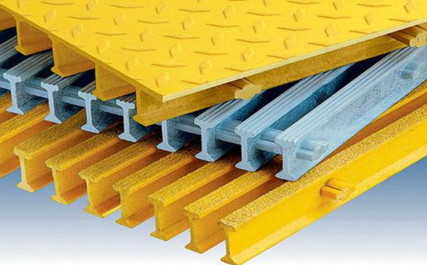

| Series | Thickness (mm) | Thickness (in) | Open Area | Weight (kg/m²) | Weight (lb/ft²) |
|---|---|---|---|---|---|
| I series (e.g. I-4010, I-5015, I-6015, I-3320) | 25–50 | 1.0–2.0 | 33–60% | 11.2–22.1 | 2.3–4.5 |
| T series (T-1210 to T-3815) | 25, 38 | 1.0–1.5 | 12–38% | 10.2–19.6 | 2.1–4.0 |
| HL series (HL-4020, HL-5020, HL-6020) | 50 | 2.0 | 40–60% | 43.5–70.4 | 8.9–14.4 |
| HI series (HI-4710 to HI-4730) | 25.4–76.2 | 1.0–3.0 | 47% | See spec sheet | See spec sheet |
Nominal values from our spec sheet; inch and pound figures are rounded conversions. Exact beam sizes, dimensions and every model are in the pultruded grating spec sheet (PDF). Confirm the exact configuration, span and load for your project.
Need help choosing mesh, thickness or resin? Send your span and load details and we will check them and quote.
Get a Technical QuotePerformance depends on the resin system, panel construction and exposure. Tell us the chemicals, temperatures and duty, and we will match the material system to your conditions.
Different industrial environments call for different combinations of construction, mesh opening, surface and resin. These are typical starting points, not a specification:
| Application & Industry | Typical Starting Point |
|---|---|
| Chemical Plants & Metal Plating Lines | Molded or pultruded grating in vinyl ester or bisphenol-A resin for aggressive chemical exposure; gritted or concave surface. |
| Wastewater & Water Treatment | Isophthalic polyester or vinyl ester molded grating for platforms, walkways and trench covers; solid-top panels where a closed surface is needed. |
| Marinas, Docks & Offshore Platforms | Mini-mesh molded grating with a gritted or concave surface, where small objects must not drop through. Tell us your slip-resistance requirement. |
| Long-Span Industrial Walkways & Catwalks | Pultruded I-series or HL-series, often used where longer spans are needed. Check product data for the exact span and load. |
| Stair Treads, Ramps & Ladders | Molded or pultruded grating with a gritted anti-slip top. Confirm stair tread panel details with us. |
| Power Substations, Rail & Infrastructure | Non-conductive FRP grating for cable trenches, safety fencing and walkways around electrical equipment; phenolic resin is available where low-smoke requirements apply. |
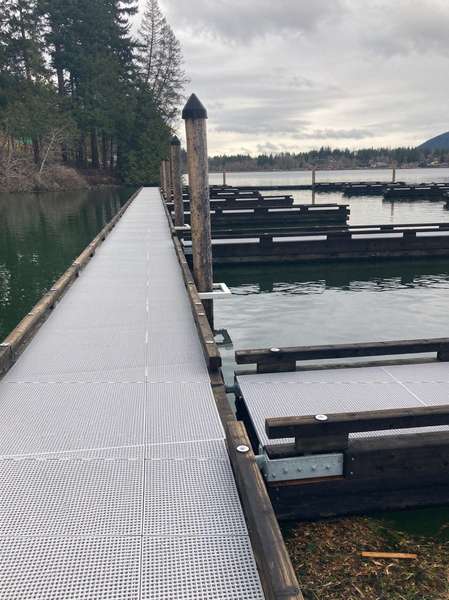
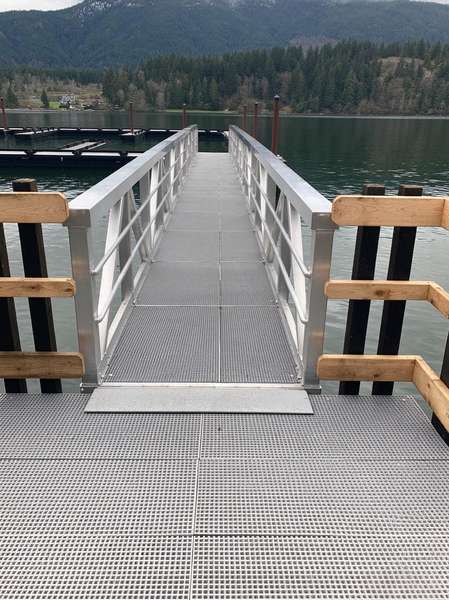
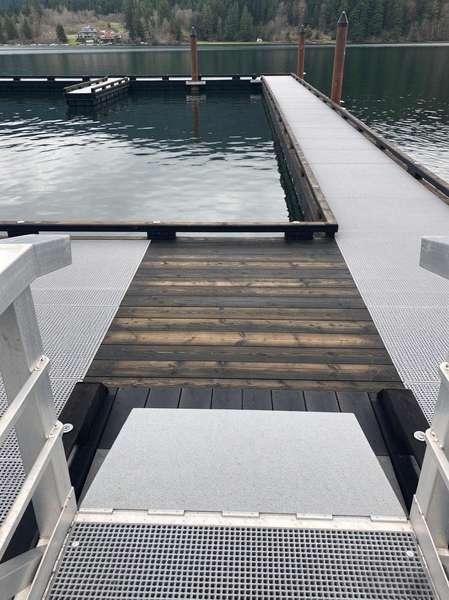
Mini-mesh FRP grating used for dock walkways.
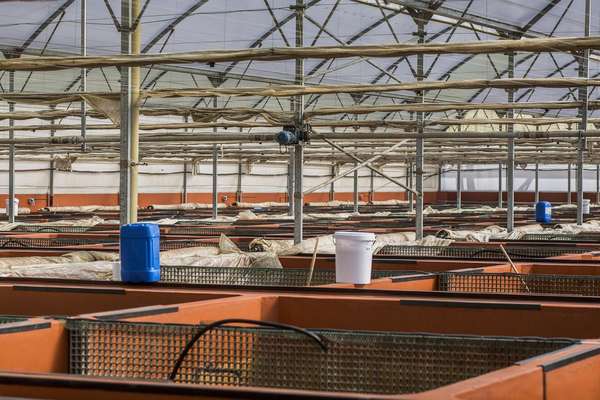
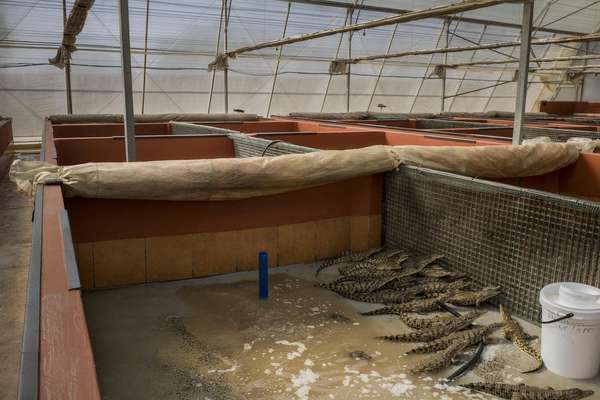
FRP grating used as fencing for crocodile farming.
Selecting grating comes down to a few inputs. Having them ready shortens the quotation:
Comparing with steel? A quick summary:
| Criteria | FRP Grating | Steel Grating |
|---|---|---|
| Corrosion | Does not rust; resin is chosen for the chemical exposure | Needs coating or galvanizing, and maintenance in corrosive areas |
| Weight | Lighter, easier to carry and install | Heavier, usually needs lifting equipment |
| Electrical | Non-conductive and non-magnetic | Conductive |
| Stiffness and temperature | Check span, deflection and temperature limits for the exact product | Generally stiffer and suited to higher temperatures and heavy traffic |
Read the full guide: FRP Grating vs Steel Grating. Pricing factors are explained in Fiberglass Grating Prices Explained.
Have your project specs or layout ready? Email your drawings to info@unicomposite.com or describe the project in the form below. We reply within 24 hours.
Request a QuotePanels are installed with fixing clips and can be cut on site with suitable tools. See Choosing and Installing Fiberglass Grating Clips and Cutting and Installation Tips.
Founded in 1998 in Nanjing, China, Unicomposite operates its own 13,000 m² factory with molding equipment (including heating and cooling systems) and pultrusion lines. Having both molded and pultruded production in-house allows us to supply grating together with matching FRP handrail systems, fiberglass decking, and pultruded structural profiles.


Send your requirements through the form below, or email your drawings to info@unicomposite.com. We reply within 24 hours (China Standard Time, UTC+8).
This site is protected by reCAPTCHA and the Google Privacy Policy and Terms of Service apply.


 info@unicomposite.com



