 info@unicomposite.com


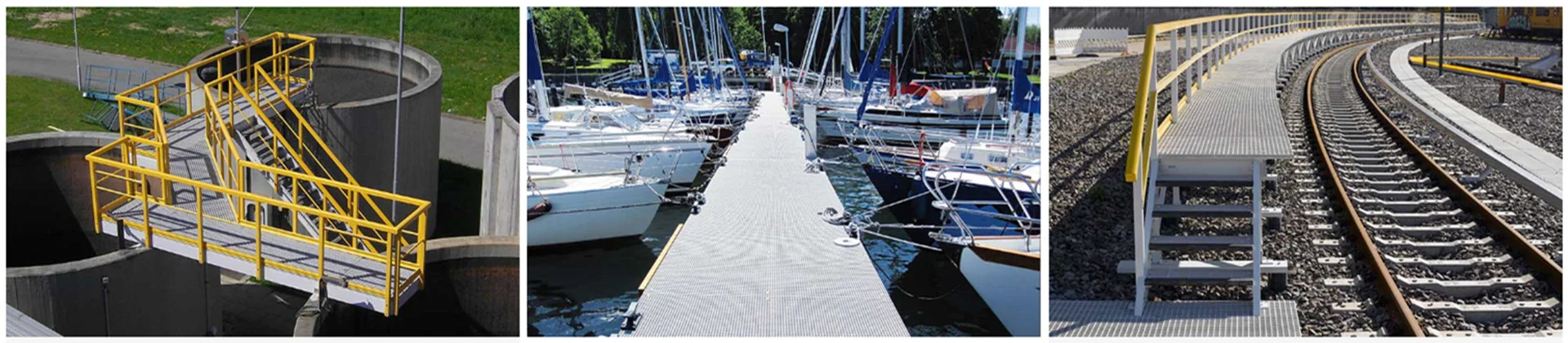
Introduction
Steel structural members in direct hot water contact zones inside operating cooling towers corrode at 3–5 times the rate of equivalent steel in standard outdoor atmospheric exposure, based on documented steel structure inspection records from cooling tower maintenance programs. The combination of 40–60°C water temperature, chemical treatment agents — biocides, scale inhibitors, and chlorine at concentrations required for Legionella control — and continuous wetting and drying cycles creates a corrosion environment that depletes protective coatings within 2–4 years and initiates base metal section loss well before the cooling tower reaches its design service life. Unplanned structural replacement during peak cooling demand — when tower shutdown means immediate production interruption for the process facilities the tower serves — is the cost consequence that most procurement teams underestimate when specifying cooling tower structural material by upfront unit cost rather than total ownership cost.
FRP pultruded profiles and grating eliminate this failure mode at the material level. The specification guidance and performance data in this article draw on FRP cooling tower profile and grating design and supply experience spanning power plant, chemical plant, HVAC, and retrofit cooling tower programs for B2B customers in North American and international markets. It gives cooling tower engineers and procurement managers a technical framework for specifying FRP pultruded profiles and grating — covering the corrosion environment, FRP component types, performance specifications, material comparison, and application fit across power generation, chemical processing, HVAC, and retrofit programs.
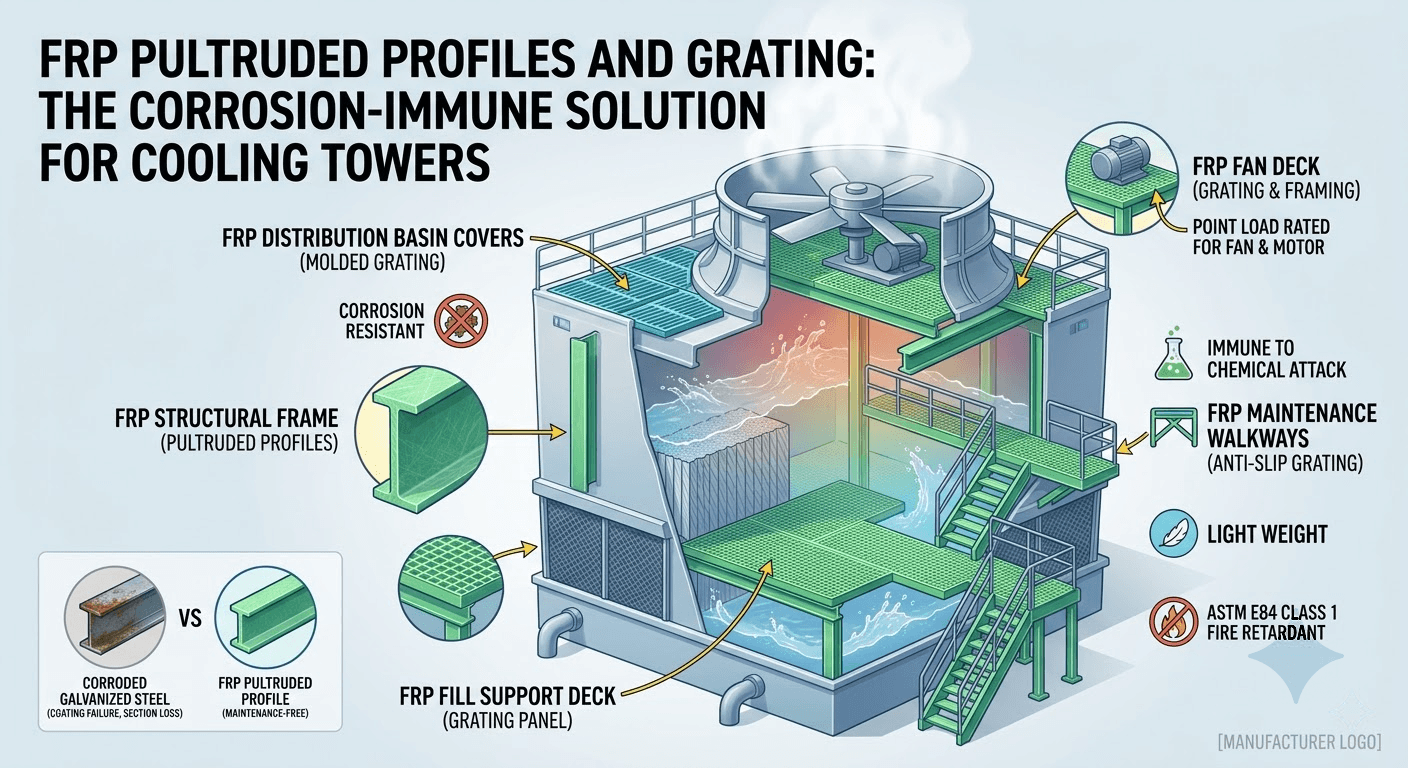
frp pultruded profiles and grating
Why Cooling Towers Demand Corrosion-Resistant Structural Materials
The cooling tower structural environment is not comparable to standard outdoor atmospheric exposure. Engineers who have inspected cooling tower steel structures at the end of their first maintenance cycle consistently describe a corrosion pattern that surprises teams accustomed to outdoor steel performance.
The Corrosion Environment Inside a Cooling Tower
Cooling tower structural members in the hot water contact zone operate in continuous exposure to water at 40–60°C, chemical treatment agents at concentrations required for effective biological control, and the aerosol drift generated by the air-water contact that the tower’s cooling function creates. The combination of elevated temperature — which accelerates electrochemical corrosion rates relative to ambient conditions — and chemical treatment agents including chlorine and oxidizing biocides produces steel section loss rates documented at 3–5 times the rate of equivalent steel in standard outdoor atmospheric service, based on documented steel structure inspection records from cooling tower maintenance programs.
The hot water contact zone — where distribution basin structure, fill support framing, and lower tower structural members sit in continuous or cyclic contact with chemically treated water — is where cooling tower steel fails first. Coating inspection programs on steel cooling towers consistently identify coating failure at seam welds and connection hardware within 2–4 years of installation in this zone, initiating active corrosion that progresses to structural section loss within 5–10 years.
How Steel, Wood, and Concrete Fail in Cooling Tower Service
Steel cooling tower structure in the hot water contact zone follows a documented degradation sequence. Zinc primer and topcoat systems fail at seam welds and fastener penetrations within 2–4 years under combined chemical and thermal attack. Once coating integrity fails, base metal corrosion initiates and progresses at an accelerated rate — the elevated temperature that makes the cooling tower function also accelerates electrochemical corrosion once the coating barrier is compromised. Galvanic corrosion at mixed-metal connections — steel frame to galvanized grating, aluminum fan components to steel structure — adds a second corrosion mechanism operating independently of coating condition.
Wood cooling tower structure — historically Douglas fir, redwood, or pressure-treated pine — fails through biological decay, dimensional instability from cyclic wetting and drying, and fire risk from proximity to fill media and fan motor heat sources. Biological decay in wet-zone wood members reduces structural section without visible external indication until the member fails under load — the failure mode that drove the shift to FRP in cooling tower fill and lower structure beginning in the 1990s.
Concrete cooling tower basin structure fails when chloride and sulfate ions from chemical treatment water penetrate the concrete cover and initiate rebar corrosion, generating expansive corrosion products that crack and spall the concrete section from within. On rooftop cooling tower installations, concrete basin weight also constrains replacement options when the original structure requires replacement — creating a structural loading problem that FRP’s weight advantage directly resolves.
FRP’s Material Advantage: Structural Immunity to the Cooling Tower Environment
FRP’s corrosion immunity in cooling tower service is chemical inertness — not coating resistance. The glass fiber reinforcement and thermosetting resin matrix of pultruded FRP profiles and grating are chemically unaffected by the water temperatures, biocide concentrations, and chlorine levels used in standard cooling tower water treatment programs. There is no zinc layer to deplete, no base metal to oxidize, and no coating system that can fail under cyclic wetting and drying — the corrosion immunity is through-material and permanent.
The resin system selection, however, determines which service environments FRP achieves its rated service life and which require upgraded formulations. Engineers specifying FRP for cooling tower applications should treat the resin decision as a service condition match — not a cost optimization. Isophthalic polyester resin covers standard power plant and HVAC cooling water at normal chlorine and biocide treatment concentrations, where 30+ year structural service life is achievable. Vinyl ester resin is required for chemical plant and refinery cooling towers where process chemical contamination creates exposure conditions exceeding isophthalic polyester’s chemical resistance ceiling — reducing polyester FRP service life to 5–7 years in aggressive chemistry. The additional material cost of vinyl ester over polyester resin is recovered within the first avoided replacement cycle in aggressive chemical cooling water service, making resin system matching the highest-return procurement decision in FRP cooling tower specification.
FRP Components Used in Cooling Tower Construction
FRP pultruded profiles and grating replace steel, wood, and concrete across five structural zones of the cooling tower — each zone has distinct load, corrosion, and access requirements that determine the appropriate FRP component type.
The table below identifies the five FRP cooling tower component types and their primary specification parameters:
| Component | FRP Type | Typical Specification | Application Zone | Key Requirement |
|---|---|---|---|---|
| Structural frame members | Pultruded I-section, square tube, box section | 100×100 mm – 200×200 mm | Main frame, cell dividers, bracing | Load class per cell dimensions and wind zone; section modulus confirmation |
| Walkway and fan deck grating | Molded or pultruded FRP grating | 38–50 mm depth, 38×38 mm grid | Maintenance walkways, fan deck | FR grade (ASTM E84 Class 1); anti-slip surface |
| Fill support deck | Pultruded flat bar grating panel | 30–38 mm depth, C load class | Fill media support structure | Distributed fill load + point load from maintenance access |
| Distribution basin cover | Molded FRP grating | 25–30 mm depth, 50×50 mm grid | Water distribution zone | Chemical resistance matched to basin water chemistry |
| Fan ring and motor platform | Pultruded grating and profile framing | 38–50 mm depth, point load rated | Fan assembly support | Point load check at fan mounting positions; vibration resistance |
Structural Frame: Pultruded Beams, Columns, and Bracing
Pultruded FRP structural profiles — I-sections, square hollow sections, and box sections — replace steel frame members across the primary structural zones of the cooling tower: vertical columns, horizontal beams, cross-bracing, and cell divider framing. Profile sizing is determined by the cooling tower cell dimensions, fan assembly weight, wind loading zone, and the section modulus and flexural stiffness (EI) required to match the structural performance of the steel members being replaced. Buyers should request the supplier’s section modulus and EI table for the specific profile dimensions before structural design, as FRP section properties differ from steel at the same nominal section size — confirming equivalence requires working from the FRP section’s actual EI values, not section size alone.
Connection details in FRP cooling tower frames use stainless steel 316-grade hardware rather than carbon steel bolts — eliminating the galvanic corrosion mechanism at structural connections that initiates localized corrosion and loosening in wet cooling tower environments. FRP gusset plate connections, bonded and mechanically fastened, provide the moment transfer and shear resistance required at column-beam connections without introducing metal-to-metal contact at the most stress-concentrated points in the structural frame.
Walkway Grating: Anti-Slip Maintenance Access
FRP grating on cooling tower walkways, fan decks, and maintenance platforms must satisfy two requirements simultaneously: anti-slip surface performance on surfaces that are continuously wet from drift and water contact, and flame-retardant (FR) rating for grating adjacent to fan motor assemblies, electrical drive components, and fill media.
Standard cooling tower walkway grating specifications run 38–50 mm depth with concave anti-slip surface on the top bar, gritted anti-slip surface, or through-color anti-slip surface in FR-grade formulations. The FR rating — ASTM E84 Class 1 or equivalent — is not optional for cooling tower installations where ignition sources from fan motor heat and electrical arc risk are present in proximity to the grating. Non-FR-rated grating in these zones fails fire safety specifications for most cooling tower equipment manufacturers and owner-specified procurement standards.
Fill Support Deck and Distribution Basin Cover
Fill support grating in the lower tower structure carries the weight of the fill media — typically 15–25 kg/m² for standard film fill — plus the maintenance access loading from inspection personnel walking on the fill support deck. Load class selection for fill support grating must account for both distributed fill weight and the concentrated point load from a maintenance technician plus tools — confirm the applicable point load specification against CTI STD-137 or the relevant cooling tower structural design standard for the project jurisdiction.
Distribution basin FRP grating cover operates in direct contact with concentrated chemical treatment water at the basin — the zone where chlorine and biocide concentrations are highest before dilution through the tower. Resin system selection for basin cover grating must match the tower’s water treatment chemistry: isophthalic polyester for standard HVAC and power plant treatment programs, vinyl ester for chemical plant service where treatment concentrations or pH are elevated.
Fan Deck and Fan Ring Structure
Fan deck grating and profile framing carry three simultaneous loading conditions: the static weight of the fan assembly mounted on the fan ring, the dynamic vibration loading transmitted through the fan ring into the deck structure during operation, and the maintenance personnel access loading when fan inspection and motor service requires crew access to the fan deck.
The fan deck load class specification is the single most common source of cooling tower structural failure attributed to material inadequacy rather than specification error. In one documented cooling tower fan deck failure investigation at a chemical plant cooling tower, the fan deck grating had been specified to a personnel access distributed load class of 500 kg/m² — adequate for maintenance crew access — without a separate verification of the fan assembly point load at the motor mounting positions on the deck. The grating failed under fan vibration loading at year 3, requiring emergency cell shutdown during peak cooling demand. The replacement specification included a point load check at 680 kg concentrated load at the motor mount position — a design check that the original procurement specification did not require. Buyers specifying FRP fan deck grating should request a point load capacity confirmation from the supplier at the specific span and connection geometry of the installation, in addition to the distributed load class confirmation per CTI STD-137 or equivalent.
Key Performance Specifications for FRP Cooling Tower Components
Four performance properties govern FRP specification in cooling tower applications — each addresses a specific failure mode that drives premature structural replacement in steel and wood cooling tower structures.
The table below summarizes the key performance specifications for FRP pultruded profiles and grating used in cooling tower construction:
| Property | FRP Standard Value | Key Specification Parameter | Cooling Tower Significance |
|---|---|---|---|
| Chemical Resistance — Isophthalic Polyester | Standard power plant and HVAC cooling water | Resin type confirmation vs. water chemistry report | 30+ year service in standard chlorinated cooling water |
| Chemical Resistance — Vinyl Ester | Chemical plant and refinery cooling water | Required where polyester ceiling exceeded | Prevents 5–7 year polyester failure in aggressive chemistry |
| Fire Retardancy | ASTM E84 Class 1 or equivalent | FR grade certification record | Required for fan deck, motor proximity, and fill zone |
| Service Temperature | 60–80°C continuous | Confirm at inquiry for >80°C applications | Covers full hot water contact zone temperature range |
| Grating Load Class | Per CTI STD-137 or ANSI/AISC | Section modulus, span, distributed + point load | Fan deck point load check prevents most common unplanned shutdown |
| Profile Section Modulus | Per supplier section table | EI and S values for structural design | Confirms FRP profile substitution maintains structural equivalence to steel |
Corrosion Resistance: Resin System Selection by Water Chemistry
The single most consequential specification decision in FRP cooling tower procurement is resin system selection — determining whether the FRP installation achieves its rated 30-year service life or fails within 5–7 years due to resin-water chemistry mismatch. Isophthalic polyester resin covers standard chlorinated cooling water at the biocide and scale inhibitor concentrations used in power plant and HVAC service. Its chemical resistance ceiling is exceeded in cooling water carrying chemical plant process contamination — acid pH below 5, chlorine concentrations above standard biocide treatment levels, or solvent carry-over from process operations.
Vinyl ester resin provides the extended chemical resistance required in these aggressive environments. Its higher cost over polyester resin is justified by the avoided replacement cost in chemical plant and refinery cooling tower service — where polyester FRP replacement within the first cooling tower design life period represents a total cost significantly exceeding the vinyl ester premium at initial procurement.
Structural Performance: Load Class and Section Properties
FRP grating load class for cooling tower applications follows the same structural calculation methodology as steel grating — span, point load, distributed load, and safety factor determine the required section modulus and depth. Buyers should confirm the applicable load standard at inquiry: CTI STD-137 for cooling tower-specific structural design in North American applications, ISO 14122-3 for walkway grating in international projects, with the specific load case for fan deck point load addressed as a separate design check from personnel access distributed load.
Profile section modulus and flexural stiffness (EI) data from the supplier’s published section tables must be confirmed against the design loads before FRP profile selection for structural frame replacement. FRP section properties differ from steel at the same nominal section size — confirming equivalence requires working from the FRP section’s actual EI values, not from the section size alone.
Fire Retardancy: FR Rating for Cooling Tower Applications
FR-rated FRP grating — conforming to ASTM E84 Class 1 or equivalent — is required for all grating in proximity to fan motor assemblies, electrical drive components, and fill media in cooling tower installations. Non-rated grating in these zones fails the fire safety specifications of most cooling tower equipment manufacturers and owner-specified procurement standards. FR rating is a production specification — the flame-retardant additive is incorporated into the resin formulation during manufacturing, not applied as a surface treatment — so the FR rating applies through the full grating cross-section and cannot be compromised by surface wear or abrasion.
Service Temperature: FRP in Hot Water Contact Zones
Standard pultruded FRP grating and profiles are rated for continuous service to 60–80°C — covering the full operating temperature range of the hot water contact zone in standard cooling tower service. High-temperature applications above 80°C — found in some industrial process cooling and waste heat rejection towers — require specialty resin formulations; confirm the specific service temperature at inquiry for applications above the standard range.
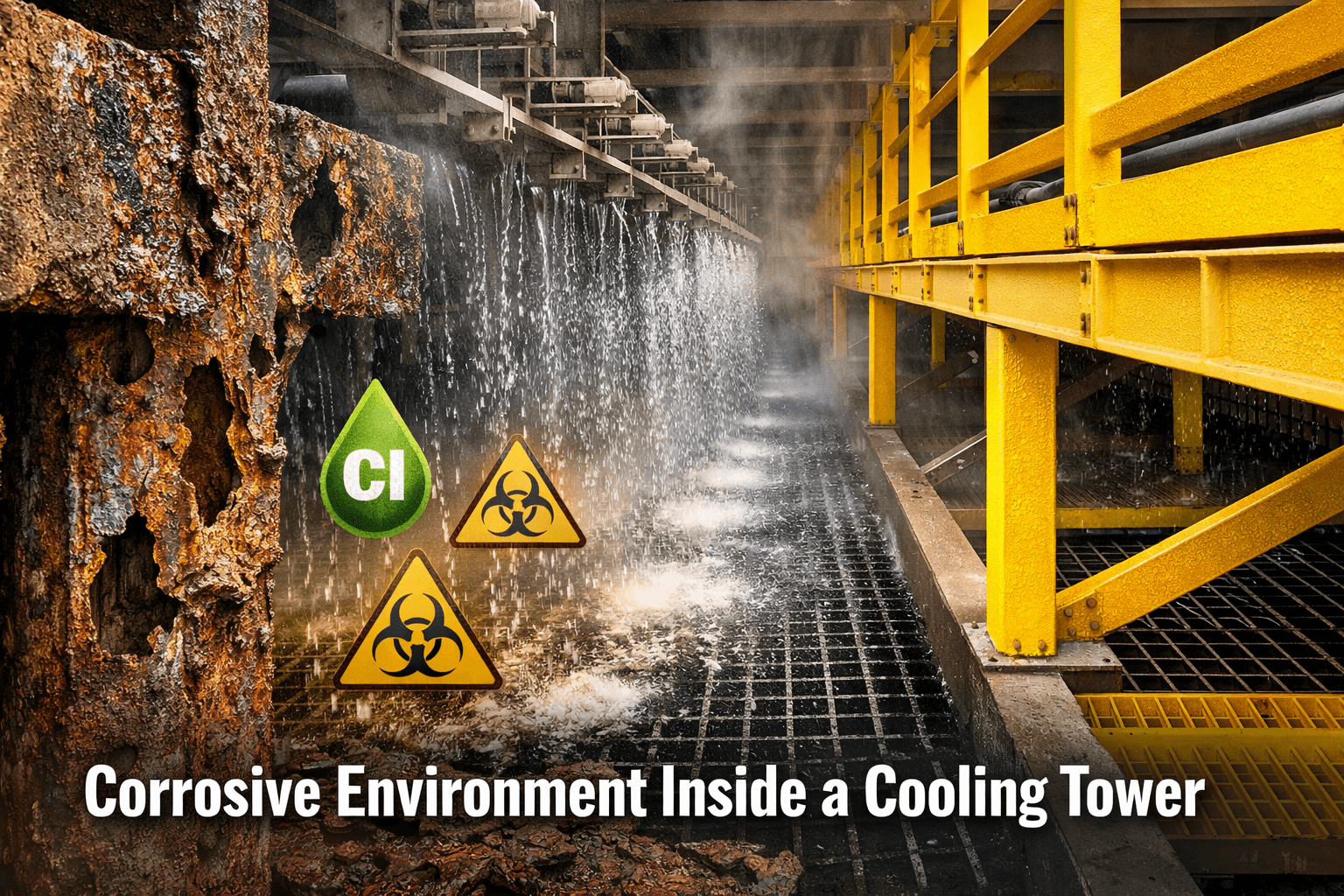
corrosive environment inside a cooling tower
FRP vs. Steel vs. Wood: Full Specification Comparison
The procurement decision between FRP, steel, and wood cooling tower structure depends on water chemistry, maintenance access, fire risk, and total ownership cost over the tower’s design service life. The comparison below covers seven dimensions where the three materials diverge most significantly in cooling tower service.
The table below compares FRP pultruded profiles and grating, galvanized steel, and treated wood across key specification dimensions for cooling tower B2B procurement:
| Specification Dimension | FRP Pultruded | Galvanized Steel | Treated Wood |
|---|---|---|---|
| Corrosion in Hot Water / Chemical Zone | None — 30+ year maintenance-free (polyester) or 20+ year (vinyl ester) | Progressive — coating failure 2–4 years; section loss 5–10 years | Biological decay; dimensional instability under cyclic wetting |
| Fire Risk | FR grade available — ASTM E84 Class 1 | Non-combustible | High — fire risk from proximity to fill and motor |
| Weight | ~25% of steel | Baseline | ~40% of steel (wet weight higher) |
| Retrofit Compatibility | Direct member substitution with matched section | Welding and hot work required in live tower | Custom carpentry fabrication required |
| Maintenance | None required | Periodic inspection and recoating | Periodic inspection; decay treatment; replacement |
| Total 30-Year Lifecycle Cost (chemical plant service) | Lowest | High — 3–4 recoating cycles + unplanned shutdown risk | High — multiple replacement cycles |
| Environmental / Regulatory | Inert — no leaching | Zinc leaching into basin water | CCA treatment restrictions in some North American jurisdictions |
When FRP Is the Required Specification
FRP becomes the operationally required specification in three conditions: chemical plant and refinery cooling water where vinyl ester FRP is the only structural material achieving 20+ year service life in aggressive chemistry; rooftop HVAC cooling tower replacement where FRP’s 25% weight advantage over steel eliminates building structural deck reinforcement required for equivalent steel loading; and any zone where FR-rated structural material adjacent to electrical, motor, and fill media components is a specified requirement.
Unicomposite Technology Co., Ltd. — an ISO 9001-certified FRP manufacturer operating an 18,000 m² production facility in Nanjing — supplies pultruded FRP profiles and grating for cooling tower structural frame, walkway, fill support, and fan deck applications. Standard and custom profile sections across isophthalic polyester and vinyl ester resin systems are available, with FR certification, section modulus and EI documentation, and chemical resistance records for cooling tower B2B procurement programs.
When Steel or Wood Remains the Right Specification
FRP structural profiles have load and stiffness limits that steel does not. Very large cooling tower cells — cell widths above 12 m — or high wind zone structural loads may require steel section modulus that FRP cannot match at competitive cost without a hybrid FRP-steel design. Procurement engineers should conduct the structural calculation using actual FRP section properties — not assume dimensional equivalence to steel — before committing to a full FRP frame specification on large-cell tower structures.
Legacy wood cooling tower structures approaching end of life can benefit from partial FRP component replacement — replacing wood fill support grating, walkway decking, and structural bracing with FRP while retaining serviceable primary wood framing — as a cost-effective life extension strategy before full tower replacement is required.
Application Scenarios: Where FRP Cooling Tower Profiles Perform Best
Steel’s structural advantage in large-cell high-wind applications is real — and outside those specific structural load conditions, the four application environments below show where FRP’s corrosion immunity, FR rating, and weight advantage deliver operational returns that steel and wood cannot sustain over the tower’s design service life.
Power Plant Cooling Towers: High-Volume Water Circulation
In one 440 MW power plant cooling tower program where FRP pultruded grating and structural bracing were installed alongside galvanized steel reference members in the same cell at the same time, the 15-year scheduled inspection found FRP components with zero coating degradation, zero section loss, and zero connection hardware corrosion. The galvanized steel reference members in the same cell required full recoating at year 4 — requiring cell isolation and shutdown during peak summer cooling demand — partial connection hardware replacement at year 8 due to galvanic corrosion at mixed-metal connections, and beam section replacement at year 12 due to section loss below the 75% remaining section acceptance criterion. The combined maintenance cost for the steel reference members over 15 years exceeded the original FRP cost differential by a factor of 3.2 — converting a material unit cost saving into a net liability within the first maintenance cycle.
Chemical Plant and Refinery: Aggressive Chemical Treatment Environments
Chemical plant cooling towers receiving process chemical contamination — acid pH from scrubber carry-over, elevated chlorine from supplemental disinfection, or solvent contamination from process leaks — require vinyl ester FRP as the only structural material achieving commercially viable service life in these environments. Vinyl ester FRP grating and profiles in chemical plant cooling towers with pH-adjusted and elevated-chlorine cooling water have documented service records exceeding 20 years in environments where isophthalic polyester FRP failed within 5–7 years and galvanized steel required replacement within 8–12 years.
HVAC and Commercial Building: Rooftop and Ground-Level Installation
Rooftop cooling tower replacement programs increasingly specify FRP for the structural weight advantage that eliminates building deck reinforcement requirements. A standard steel cooling tower replacement on a commercial building rooftop requires structural engineering assessment of the deck loading capacity and often requires deck reinforcement before the steel replacement tower can be installed — adding cost and construction time. FRP cooling towers at 25% of equivalent steel weight typically fall within the original deck design loading allowance, eliminating the deck reinforcement requirement and its associated cost and project delay.
Cooling Tower Retrofit: Replacing Steel and Wood with FRP
FRP cooling tower retrofit programs replace corroded steel or decayed wood structural members with FRP profiles fabricated to match the existing connection geometry — enabling member-for-member replacement without full tower disassembly or basin dewatering beyond the affected zone. In retrofit programs supplied by Unicomposite, pre-drilled profiles cut to project-specific lengths allowed cell-by-cell structural member replacement during planned maintenance shutdowns without the full tower disassembly that field-drilled connections would require — reducing the field cutting operations in the active tower environment where cutting dust contaminating the basin or fill media creates additional maintenance requirements.
The retrofit sequence — structural assessment, member mapping, FRP profile selection by section and resin system, pre-fabrication to project dimensions, and phased replacement during planned maintenance shutdown — allows cooling tower structural life extension without the capital cost of full tower replacement on a schedule synchronized with planned maintenance rather than driven by emergency structural failure.
Custom Specification and B2B Procurement
FRP cooling tower profile and grating supply adaptability — in section type, resin system, FR grade, depth, and prefabrication — makes FRP applicable across the full range of new construction and retrofit cooling tower programs.
Profile Types, Grating Grades, and Resin System Options
Standard pultruded FRP section catalog covers I-beam, square hollow section, channel, angle, flat bar, and round tube in standard sizes — with custom die sections available for non-standard cell geometry or retrofit member matching. Grating options cover molded FRP grating (bi-directional load distribution, standard grid patterns) and pultruded FRP grating (higher axial load capacity, variable bar spacing) in standard depths from 25 mm through 50 mm, with FR grade available as a production specification across both grating types.
Resin system selection — isophthalic polyester for standard service, vinyl ester for chemical and high-chlorine service — should be confirmed at inquiry based on the cooling tower water chemistry report rather than defaulted to the lower-cost option.
Custom Fabrication: Cut-to-Size, Notching, and Pre-Drilled Connections
Project-specific fabrication options include cut-to-length profiles with pre-drilled bolt patterns matching existing structural connections, grating panels notched for column clearance and penetration fitting, and fan ring profile assemblies pre-fabricated to the specific fan diameter and motor mount geometry. These pre-fabrication services reduce field cutting operations in the active tower environment — eliminating the contamination risk that field-generated cutting dust creates in basin water and fill media.
MOQ, Lead Time, and Technical Documentation
Standard profile and grating configurations from existing production tooling ship within 4–6 weeks from order confirmation, based on standard production scheduling — confirmed timing is provided at inquiry. Custom section or pre-fabrication programs extend lead time to 6–10 weeks from drawing approval. Available documentation includes section modulus and EI data tables for structural design, chemical resistance records for the specified resin system, FR certification per ASTM E84 or equivalent, and ISO 9001 manufacturing certification covering the full production process.
Conclusion
FRP pultruded profiles and grating earn their specification in cooling tower construction through four operational advantages that determine total structural ownership cost:
- Resin system selection determines whether FRP achieves 15 or 30+ year cooling tower service life: Isophthalic polyester covers standard power plant and HVAC service; vinyl ester is required for chemical plant and refinery cooling water where polyester’s chemical resistance ceiling is exceeded. Getting this decision right at procurement prevents the most expensive FRP failure mode — resin-chemistry mismatch — at a cost difference that is recovered within the first avoided replacement cycle.
- FR-grade grating is non-negotiable in motor, electrical, and fill media proximity zones: ASTM E84 Class 1 FR-rated grating in fan deck and fill zone applications is a safety specification, not a cost option — non-rated grating fails the fire safety standards of most cooling tower equipment manufacturers and owner specifications in these zones.
- In cooling tower procurement, the fan deck grating specification is the single decision that most commonly determines whether the tower delivers its rated service life or experiences an unplanned shutdown within the first maintenance cycle: The error is almost always specifying to personnel distributed load without a separate point load check at fan assembly mounting positions — a design check that CTI STD-137 addresses and that must be explicitly confirmed with the supplier before fan deck grating selection is finalized.
- Lifecycle cost calculation for cooling tower structural material must include steel recoating and shutdown cost, not just material unit cost: Documented power plant cooling tower inspection programs show FRP structural components requiring zero maintenance at 15-year intervals where steel required recoating at year 4 and partial replacement at year 12 — at combined maintenance cost exceeding the original FRP cost differential by a factor of 3.2.
[Contact Unicomposite — ISO 9001-certified FRP cooling tower profile and grating manufacturer with custom section and resin system engineering support — with your cooling tower cell dimensions, water chemistry, component zone, and quantity to receive a specification and supply proposal →]
Frequently Asked Questions
Vinyl ester resin is the standard specification for chemical plant and refinery cooling towers where process carry-over creates acid pH, elevated chlorine concentrations, or solvent contamination in the cooling water. Isophthalic polyester resin’s chemical resistance ceiling is exceeded in these environments, with documented service life reduction to 5–7 years — where vinyl ester achieves 20+ years in equivalent service. Provide the cooling water chemistry report — pH range, chlorine concentration, and any process chemical contamination — at inquiry to confirm the appropriate resin system before procurement.
ASTM E84 Class 1 or equivalent is the standard FR rating specification for cooling tower grating in proximity to fan motor assemblies, electrical drive components, and fill media. FR grade is a production specification incorporated into the resin formulation during manufacturing — not a surface treatment — so the rating applies through the full grating cross-section regardless of surface wear. Request the FR certification test record at inquiry to confirm the specific standard and test method used.
Fan deck grating load class requires two separate design checks: a distributed load check for maintenance personnel access loading, and a separate point load check at the fan assembly motor mounting positions on the deck. The point load check — typically 600–750 kg concentrated load at specific mounting positions — governs fan deck grating selection in most cooling tower configurations and is the design check most often omitted from initial procurement specifications. Provide the fan assembly weight, motor mount position geometry, and grating span at inquiry; CTI STD-137 provides the applicable design methodology for cooling tower-specific structural load determination.
Yes — FRP pultruded profiles for cooling tower retrofit programs are available cut to project-specific lengths with pre-drilled bolt patterns matching existing structural connection hardware. This pre-fabrication service eliminates field drilling in the active tower environment, where cutting dust and swarf contaminating the basin water or fill media creates additional maintenance requirements. Provide structural drawings or dimensional schedules at inquiry; lead time for pre-fabricated retrofit profiles extends to 6–10 weeks from drawing approval.
Available documentation includes section modulus (S) and flexural stiffness (EI) data tables for structural design confirmation, chemical resistance records for the specified resin system against the project’s cooling water chemistry, FR certification per ASTM E84 or equivalent showing the specific Class 1 test result, and ISO 9001 manufacturing certification covering the full production process. Specify required certification standards at inquiry to confirm documentation availability before order placement.


