 info@unicomposite.com


Cast iron manhole cover theft costs municipal infrastructure departments more than the replacement cover itself. In urban districts with high scrap metal prices, a single theft event generates three compounding costs: the replacement cover, emergency labor to restore safe access within hours of the report, and traffic management during the repair. In high-theft urban environments, some municipal districts report replacing individual covers three to five times within a 12-month period — at a cumulative cost that exceeds the original installation cost many times over, while the safety risk of an uncovered access shaft persists between the theft event and the repair response.
SMC fiberglass manhole covers eliminate this failure mode at the material level. A thermosetting composite with no metal content has no scrap recycling pathway — and no recycling pathway means no theft motive. The specification guidance in this article draws on SMC fiberglass manhole cover design and supply experience spanning municipal infrastructure, industrial facility, and utility access applications, developed through custom cover production for B2B customers in North American and international markets. It gives procurement engineers and municipal infrastructure buyers a technical framework for evaluating SMC fiberglass manhole covers — covering material construction, performance properties, load rating standards, and custom specification options — so that cover selection is based on total ownership cost and service condition matching rather than unit price comparison.
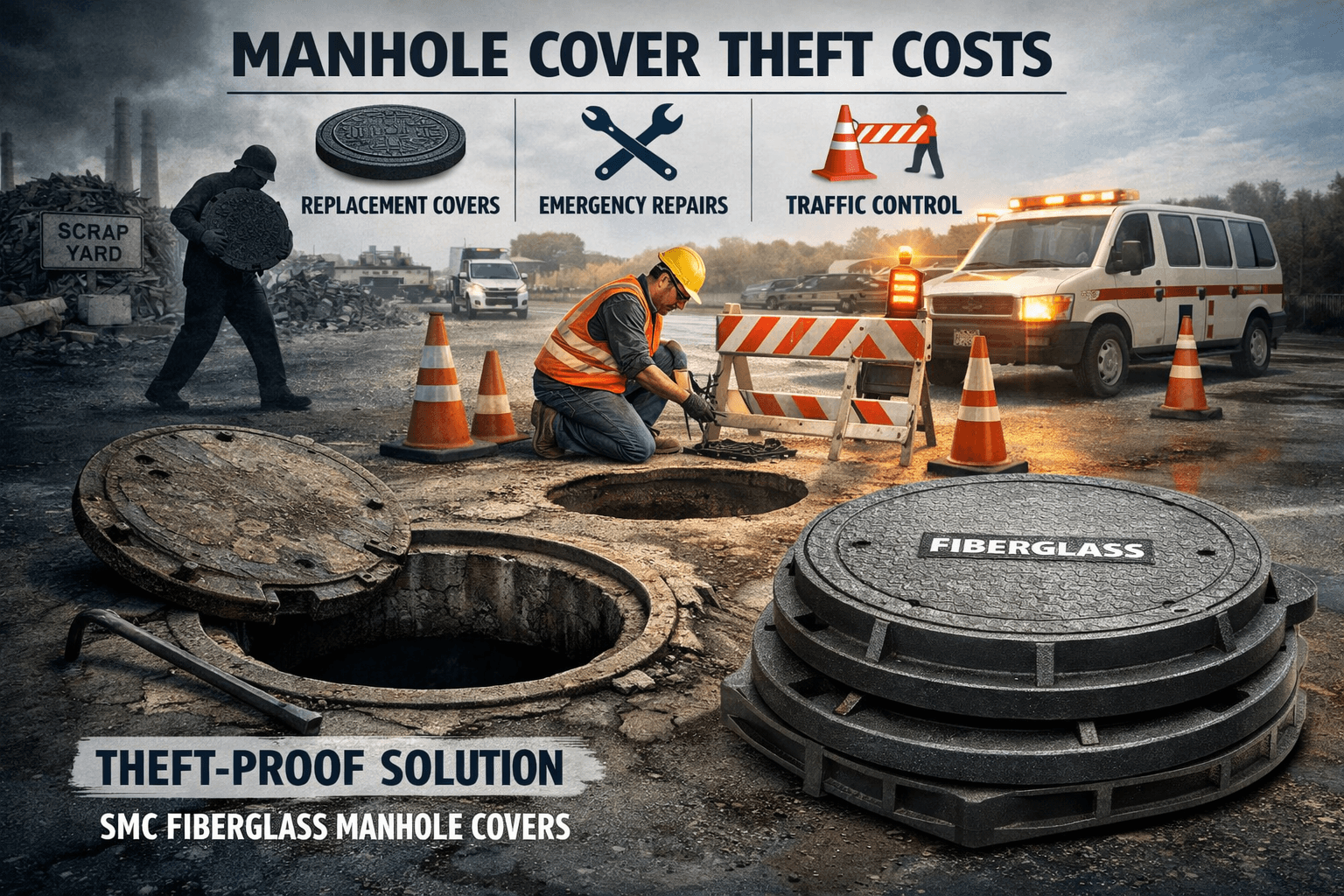
SMC fiberglass manhole cover theft prevention
What Is an SMC Fiberglass Manhole Cover? Material and Manufacturing Basis
Understanding why SMC fiberglass manhole covers perform differently from cast iron begins with understanding how they are manufactured. The process is not incidental — it directly determines the structural consistency and performance characteristics that distinguish SMC from alternative materials.
SMC Compression Molding: How the Process Determines Performance
Sheet Molding Compound (SMC) is a pre-impregnated composite material: chopped glass fiber mat combined with a thermosetting resin system and mineral filler, consolidated into a sheet form that is then placed into a heated steel mold and compressed under high pressure. The heat and pressure simultaneously flow the SMC into the mold geometry, cure the resin, and consolidate the fiber-resin-filler system into a void-free, dimensionally stable component.
The compression molding process produces consistent wall thickness and load distribution across the full cover geometry — a structural uniformity that hand layup cannot achieve because compaction pressure and cure conditions are tool-controlled rather than operator-dependent. Every cover produced from the same mold and SMC formulation exhibits the same fiber distribution, resin content, and dimensional profile — which is the manufacturing basis for consistent load performance across a production batch.
The mold geometry defines surface texture, relief pattern, and dimensional tolerances in a single operation. There is no secondary finishing step that introduces variation — what comes out of the mold is the finished product.
Material Composition: Glass Fiber Reinforcement, Resin Matrix, and Filler System
A standard SMC fiberglass manhole cover formulation contains glass fiber reinforcement at 25–35% by weight, a thermosetting resin matrix (typically unsaturated polyester or vinyl ester), and a mineral filler system — commonly calcium carbonate — that contributes to surface hardness, dimensional stability, and cost optimization without significantly affecting structural performance at standard loading levels.
The glass fiber content determines structural performance. Higher fiber content increases flexural strength and impact resistance; lower fiber content reduces material cost but narrows the available load class range. The resin matrix determines chemical resistance and temperature performance — vinyl ester systems extend service life in chemically aggressive underground environments where polyester reaches its exposure limit.
The anti-theft property requires no design feature and no surface treatment. SMC is a thermosetting composite: once cured, the polymer matrix cannot be re-melted or reprocessed. There is no scrap metal value, no recycling pathway, and therefore no economic motive for theft — the property is inherent to the material chemistry, not added by the designer.
SMC Manhole Cover Types: Heavy, Light, and General Classification
SMC fiberglass manhole covers are produced in three load-capacity classifications that align with EN 124 traffic zone requirements:
- Heavy type: Designed for motor vehicle roads and parking areas subject to full axle loading — corresponds to D400 and above load classes.
- Light type: Specified for pedestrian-only zones, green areas, bicycle lanes, and sidewalks where no motorized vehicle access occurs — corresponds to A15 and B125 load classes.
- General type: Suitable for mixed-use zones where occasional vehicle overrun is possible — corresponds to C250 load class in standard specification.
Selecting the correct type at the procurement stage — based on the actual traffic environment rather than the assumed zoning designation — is the specification decision that most directly prevents premature cover failure in service.
Key Performance Properties of SMC Fiberglass Manhole Covers
Six performance properties differentiate SMC fiberglass manhole covers from cast iron, concrete, and polymer concrete alternatives in municipal and industrial infrastructure. Each property addresses a specific operational or lifecycle cost risk that drives the specification upgrade decision. The table below summarizes the key performance properties of SMC fiberglass manhole covers relevant to municipal and industrial B2B procurement:
| Property | SMC Fiberglass Manhole Cover | Standard Value / Range | Operational Significance |
|---|---|---|---|
| Load Class Range | A15 to F900 | Per EN 124-1:2015 | Covers pedestrian to heavy-duty highway applications |
| Ultimate Load Capacity | 50T (D400 class) | vs. 36T for standard cast iron | Higher structural margin above rated test load |
| Service Temperature | -50°C to +100°C | Continuous service | Full performance across outdoor and underground temperature ranges |
| Corrosion Resistance | Excellent | No rust, no oxidation | Maintenance-free in aggressive soil and groundwater environments |
| Anti-Theft | Inherent — no scrap value | Thermosetting composite | No replacement cycles due to theft in normal urban environments |
| Weight vs. Cast Iron | 40–60% of cast iron mass | Typical for 600 mm D400 covers | Standard sizes installable without mechanical lifting equipment |
| Service Life | 50+ years | Based on field records and durability testing | No coating, no inspection cycles required in standard service |
Load Capacity: Traffic Load Rating Standards (EN 124 / AASHTO)
Load class specification is the single most consequential decision in manhole cover procurement — and the most common source of premature cover failure in municipal infrastructure. EN 124-1:2015 defines six load classes from A15 (pedestrian zones and areas accessible only to foot traffic) through F900 (heavy-duty roads, airport aprons, and areas subject to high-frequency heavy axle loading). Each class defines a design test load applied per the EN 124-1:2015 vertical load application test methodology: A15 requires 15 kN; D400 requires 400 kN sustained without structural failure.
SMC fiberglass manhole covers achieve structural load capacity through fiber reinforcement geometry and wall thickness — not through material mass as cast iron does. A D400-rated SMC cover designed for road traffic carries its load through engineered rib geometry and glass fiber distribution, at 40–60% of the mass of an equivalent cast iron cover. This is a structural engineering result, not a material shortcut.
In standardized load testing, SMC fiberglass covers at D400 class achieve ultimate load capacity of 50T — compared to 36T for standard cast iron covers at equivalent dimensions. This structural margin above the rated test load provides the safety buffer that procurement engineers should verify is documented in supplier test certificates, not assumed from load class designation alone.
The specification error that procurement engineers encounter most frequently is load class underspecification: A15 or B125 covers installed in zones that receive vehicle overrun — delivery vehicles mounting curbs, emergency vehicles accessing pedestrian areas, or utility vehicles accessing covers nominally rated for foot traffic only. Cover failure under a vehicle axle load is a safety incident, not a maintenance event. Providing the installation zone description — not just the assumed load class — at the inquiry stage is the input that prevents this error.
Anti-Theft by Material Design
In one municipal district managing a high-theft corridor where the same six cast iron covers on a commercial street had been replaced a combined 23 times over three years, replacement with SMC fiberglass covers on the same locations produced zero theft replacements in the following 18 months. The outcome was not the result of a locking mechanism — there were none — but of the complete absence of scrap metal value that makes cast iron covers economically attractive to collectors. This pattern holds consistently across documented municipal transition programs: when there is no scrap value, there is no theft.
Surface-applied anti-theft features on cast iron — welded retention pins, mechanical locking systems — address the symptom rather than the cause. They add maintenance complexity (locked covers require tools to open for routine utility access), reduce installation speed, and still leave the cover vulnerable when the locking mechanism is defeated. FRP’s anti-theft property requires no maintenance, no tooling for routine access, and cannot be defeated by any method that makes the cover economically attractive to a scrap metal collector.
Corrosion Resistance, Temperature Range, and Service Life
Underground environments expose manhole covers to soil chemistry, groundwater, root penetration, gas condensate, and the chemical residue of whatever the access shaft serves — wastewater, electrical conduit, gas distribution, or telecommunications. Cast iron corrodes in all of these environments without exception; in corrosion monitoring programs from municipal infrastructure inspection records in high-clay, low-pH soil environments, measurable section loss has been documented within 8–12 years at pH below 6.0.
SMC fiberglass composite does not corrode. The glass fiber and thermosetting resin matrix are chemically inert to the soil chemistry, groundwater composition, and gas condensate concentrations present in standard municipal underground environments. Service temperature range of -50°C to +100°C continuous covers the full range of outdoor installation conditions from arctic municipal infrastructure to industrial facility floors where process heat elevates ambient temperature.
The 50-year service life rating reflects a minimum rated service life of 15–20 years under standard traffic loading, with long-term field performance records from early commercial programs in the 1980s documenting continued service beyond 50 years in standard underground environments — providing genuine multi-decade field evidence rather than extrapolated accelerated aging data alone.
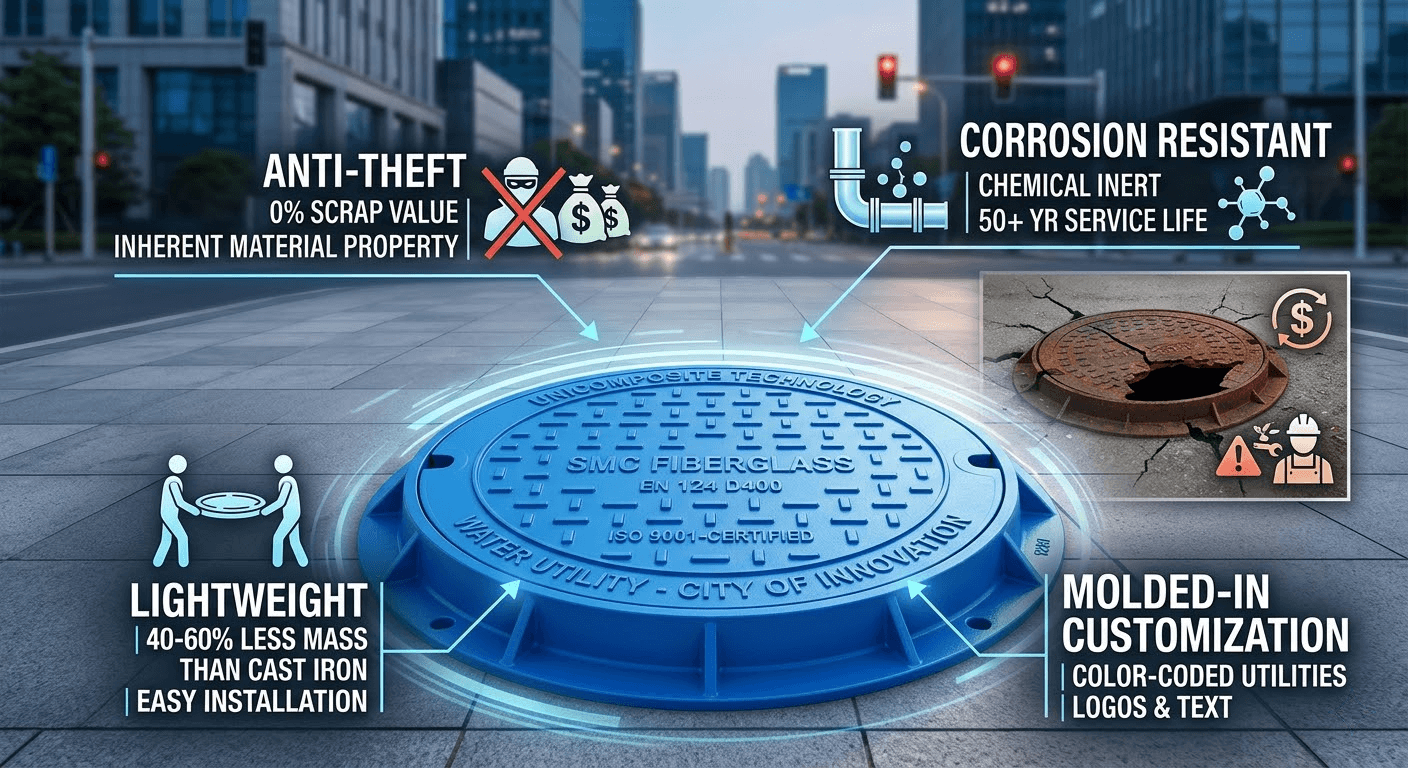
SMC composite manhole cover specifications
Fiberglass vs. Cast Iron vs. Polymer Concrete: Specification Comparison
The material comparison above establishes why SMC fiberglass is specified over cast iron in theft-risk, corrosion-critical, and weight-sensitive applications — the next question is how these material differences translate into procurement decisions across the full range of installation environments and ownership cost scenarios. The table below compares SMC fiberglass manhole covers, cast iron covers, and polymer concrete covers across the key specification dimensions for municipal and industrial B2B procurement:
| Specification Dimension | SMC Fiberglass | Cast Iron | Polymer Concrete |
|---|---|---|---|
| Theft Risk | None — no scrap metal value | High — scrap value drives urban theft | Low — no metal content |
| Weight (relative) | 40–60% of cast iron | Baseline | 80–100% of cast iron |
| Corrosion Resistance | Excellent — no degradation | Poor — requires coating in aggressive environments | Good — cement matrix vulnerable to acid |
| Ultimate Load Capacity | 50T at D400 class | 36T at D400 class | Typically D400 maximum |
| Load Class Range | A15–F900 (engineered) | A15–F900 (mass-dependent) | A15–D400 (typical limit) |
| Unit Cost vs. Cast Iron | 10–15% lower | Baseline | Similar to cast iron |
| Noise Under Traffic | Silent — no rebound | Metallic rattle at road speed | Silent |
| Color and Customization | High — molded-in color, text, logo | Low — cast marking only, cannot be colored | Moderate |
| Environmental Impact | Resource-saving, green production | High energy consumption, multi-pollutant | Moderate |
| Total Lifecycle Cost (aggressive environments) | Lowest — no maintenance | High — corrosion inspection and replacement | Medium — cement degradation in acid environments |
Weight, Installation Labor, and Handling Cost
Typical production weights for 600 mm clear opening D400 covers run 55–70 kg for cast iron and 25–35 kg for equivalent SMC fiberglass — a weight reduction that changes the installation crew requirement from two operators with mechanical lifting assistance to two operators working without equipment in standard field conditions.
In high-density urban installation programs where a crew installs or replaces dozens of covers per day, the labor cost difference compounds significantly across the program. Municipal infrastructure departments that have tracked installation cost per cover consistently find that the labor saving on FRP covers partially or fully offsets the unit price premium relative to cast iron — before theft replacement costs and corrosion maintenance are included in the comparison.
Total Lifecycle Cost: Maintenance-Free FRP vs. Cast Iron Replacement Cycles
Cast iron manhole covers in underground environments with pH below 6.0 or high moisture content begin showing measurable section loss within 8–12 years in documented inspection programs. By 15–20 years, corrosion-induced section reduction can reduce load capacity below the original load class rating — a structural safety deficit invisible to surface inspection and only detectable through load testing.
On a unit purchase price basis, SMC fiberglass manhole covers typically run 10–15% lower than equivalent cast iron covers — before maintenance, theft replacement, and installation labor are factored into the comparison. This unit price advantage, combined with the elimination of corrosion maintenance cycles and theft replacement events, produces a total lifecycle cost differential that favors FRP in any installation environment with a service horizon exceeding 10 years.
SMC fiberglass covers produce no metallic rattle under vehicle traffic. This operational detail drives re-specification decisions in residential and commercial zones where the acoustic impact of vehicle traffic over cast iron covers generates resident complaints and noise ordinance compliance pressure. Municipal engineers who have managed cover replacement programs in noise-sensitive urban zones consistently report FRP specification as the standard response to acoustic complaints — not as a premium option, but as the operationally correct solution.
When Cast Iron Remains the Right Specification
SMC fiberglass manhole covers are not universally superior to cast iron. Engineers who have reviewed FRP cover specification returns — cases where a project initially specified FRP but reverted to cast iron — consistently find the same trigger: F900 load class in high-frequency heavy vehicle zones where the FRP wall thickness required for the load rating produced a cover that was heavier and more expensive than the cast iron alternative. In these environments, cast iron’s mass contributes positively to stability, and the maintenance environment typically supports periodic inspection.
Material selection should always follow service condition matching. Procurement engineers specifying covers for extreme load applications — F900 highway, airport apron, port handling areas — should request F900-rated load test certificates from any FRP supplier and confirm that the specific cover design has been tested to the required load class, not just that the material category is capable of F900 in principle.
Custom Specification Options for B2B and Municipal Procurement
With the material selection justified and the load class framework established, the practical procurement question becomes how to configure the product to match the specific installation requirement — which is where SMC compression molding’s customization capability becomes a meaningful procurement advantage over cast iron and polymer concrete alternatives.
Size, Load Rating, and Opening Geometry Customization
Standard clear opening sizes for round covers run from 300 mm diameter for small utility access through 600 mm and 800 mm for standard municipal manholes, with rectangular and non-circular geometries available for utility-specific access requirements — cable trench covers, elongated valve access, and double-opening covers for large-diameter shafts.
Custom clear opening dimensions and frame geometries are achievable through custom tooling, with DFM review confirming structural feasibility before tooling investment is committed. Wall thickness and rib geometry are engineered to the specified load class for each custom size — a 1,000 mm rectangular cover rated D400 requires a different rib architecture than a 600 mm round cover at the same load class, and the DFM process confirms this geometry before production begins.
Surface Pattern, Color, Text, and Logo Options
SMC compression molding integrates surface pattern, color, embossed text, and logo into the cover in a single molding operation — no secondary painting, no adhesive labels, no features that abrade away under traffic or UV exposure. Slip-resistance tread patterns are molded into the top surface at tread depths appropriate for the specified traffic environment. Color is compounded into the SMC formulation before molding, producing a through-color cover where surface wear does not change the appearance.
Color-coding by utility type is a standard specification in many municipal procurement programs: blue for water, yellow for gas, green for telecom, red for electrical. Standard color libraries cover the most common municipal utility codes; custom color matching is available for programs with specific RAL or Pantone requirements. Embossed text — municipality name, utility identifier, load class marking, emergency contact — is molded simultaneously with the structural features.
Unicomposite Technology Co., Ltd. — an ISO 9001-certified composite manufacturer operating an 18,000 m² facility in Nanjing — produces SMC fiberglass manhole covers for B2B customers in North American municipal infrastructure, industrial facility, and utility markets. Custom tooling for non-standard sizes, load classes, or surface marking configurations is supported through a structured DFM review and qualification process.
Load Test Documentation and Certification Requirements
EN 124-1:2015 is the primary load class certification standard for manhole covers in international municipal procurement. A compliant EN 124 load test certificate should specify: the load class tested, the test load applied in kN, the deflection measured under load, the post-test inspection result confirming no structural failure, and the accreditation body whose test methodology was followed. Procurement managers should request this documentation before order confirmation — not after delivery — as a condition of the standard quotation process.
North American municipal procurement typically references AASHTO load standards or local specifications that may reference EN 124 equivalently. Buyers should specify the required certification standard and load class at the inquiry stage to ensure documentation matches project quality and regulatory requirements.
SMC Manhole Cover Manufacturing: Process Quality and Supplier Evaluation
Procurement managers sourcing SMC fiberglass manhole covers from a manufacturing supplier — rather than a distributor — gain direct access to tooling modification, custom formulation, and load test documentation that distribution channels cannot provide. Evaluating a supplier’s manufacturing capability before order placement prevents the most common B2B procurement risk in this product category: receiving covers that meet the catalog specification but were not manufactured to the load class actually required.
What to Verify in an SMC Manhole Cover Manufacturer
Four manufacturing capability indicators separate qualified SMC manhole cover suppliers from catalog distributors:
- In-house compression molding: The supplier operates their own heated steel molds and compression presses — not a reseller sourcing from a third-party manufacturer. Verify by requesting production facility documentation or visiting the facility for high-volume programs.
- Custom tooling capability: The supplier can design, fabricate, and qualify new mold tooling for non-standard sizes or surface configurations — confirmed through a DFM review process before tooling investment.
- Load test documentation: The supplier provides EN 124-1:2015 or AASHTO-equivalent load test certificates from accredited laboratories — not self-declared compliance statements.
- ISO 9001 certification: The manufacturing process operates under a documented quality management system that covers raw material inspection, in-process controls, and finished product verification.
Unicomposite Technology Co., Ltd. meets all four criteria: ISO 9001-certified SMC compression molding at an 18,000 m² production facility in Nanjing, with custom tooling support, DFM engineering review, and accredited load test documentation for B2B municipal and industrial customers in North American and international markets.
Procurement Process: What B2B Buyers Need to Specify at Inquiry
The cover specification process is where most procurement errors originate — not in the manufacturing or supply chain. Providing complete specification data at the inquiry stage is the step that ensures the supplied cover matches the installation environment and load requirement.
Technical Specification Checklist
A complete SMC fiberglass manhole cover inquiry should include: clear opening dimension (diameter for round, length × width for rectangular), frame external dimension if a specific frame size is required, load class or installation zone description, color (standard utility color code or RAL/Pantone reference), surface marking (text content and logo file if applicable), quantity by size and specification, and delivery destination for lead time calculation.
Providing the installation zone description — “pedestrian sidewalk adjacent to vehicle crossover point” rather than just “B125” — gives the supplier’s engineering team the context to flag potential misspecification before tooling or production begins. Requiring installation zone descriptions from the specifying engineer, not just assumed load class designations, is the procurement governance step that prevents the most common and most costly specification error in municipal cover procurement.
Lead Time, MOQ, and Standard vs. Custom Tooling
Standard size covers in standard load classes from existing tooling have the shortest lead times — typically 3–5 weeks from order confirmation based on standard production scheduling, with confirmed timing provided at inquiry — and the lowest MOQ, as tooling amortization is not a per-order cost. Custom sizes, non-standard load class combinations, or unique surface marking configurations require tooling design, fabrication, and a qualification load test before production begins, extending lead time to 8–12 weeks from DFM sign-off based on standard scheduling.
The tooling investment for a custom SMC cover mold is a one-time cost amortized across all subsequent orders from the same mold — economically justified for municipal programs with ongoing annual volume, but a significant per-unit cost for one-time small-quantity orders. Buyers should confirm tooling cost structure at inquiry and evaluate whether a standard size that meets the technical requirement is more cost-effective than a custom size for low-volume applications.
Conclusion
SMC fiberglass manhole covers earn their specification through four operational advantages that determine total ownership cost in municipal and industrial infrastructure:
- Anti-theft by material design: Thermosetting composite with no scrap metal value eliminates the theft replacement cycle that makes cast iron covers a recurring budget line item in urban infrastructure maintenance programs — without any locking mechanism, maintenance requirement, or access complication. Documented municipal transition programs confirm near-zero replacement frequency on routes where cast iron covers previously required multiple annual replacements.
- Procurement governance on load class: Require installation zone descriptions from the specifying engineer — not just assumed load class designations — as the input to cover procurement. Under-specifying load class in vehicle-accessible zones is the most common and most preventable cause of premature cover failure, and it is entirely avoidable at the specification stage.
- Total lifecycle cost calculation: SMC fiberglass covers deliver a unit price that runs 10–15% lower than cast iron, plus the elimination of corrosion inspection, theft replacement, and coating maintenance costs — making cast iron’s apparent cost position misleading for any installation with a service horizon exceeding 10 years.
- Custom specification process: Color, text, pattern, size, and load class are all configurable through SMC compression molding, with tooling investment amortized across program volume. Engaging the DFM review process before order placement — and providing installation zone description rather than assumed load class — ensures the structural design matches the actual service requirement.
[Contact Unicomposite — ISO 9001-certified SMC composite manufacturer with custom tooling and load test documentation support — with your opening dimensions, load class, installation zone, and quantity to receive a specification and supply proposal →]
Frequently Asked Questions
Provide the installation zone description — the type of traffic the cover will be exposed to, including any vehicle overrun scenarios — rather than relying on an assumed load class designation. EN 124-1:2015 defines six load classes from A15 (pedestrian only) through F900 (heavy highway and airport); Unicomposite’s engineering team will confirm the appropriate load class based on your installation zone description and flag any misspecification risk before production begins.
SMC is a thermosetting composite with no metal content and no scrap recycling pathway — making it economically unattractive to scrap metal collectors regardless of surface condition or installation method. No locking mechanism, retention pin, or security feature is required, and routine utility access does not require specialized tools. Municipal transition programs from cast iron to FRP covers on high-theft routes have documented near-zero theft replacement frequency in the first year following changeover.
Yes — color is compounded into the SMC formulation before molding, producing a through-color cover that does not fade or abrade away under traffic. Standard utility color codes (blue for water, yellow for gas, green for telecom, red for electrical) are available from existing compound formulations; custom RAL or Pantone color matching is available for program-specific requirements. Embossed text and logos are integrated into the mold geometry — provide text content and logo files at the inquiry stage for DFM review.
Request an EN 124-1:2015 load test certificate specifying the load class tested, the test load applied in kN, deflection measurement under load, post-test inspection result, and the accreditation body whose methodology was followed. For North American projects referencing AASHTO or local standards, specify the required standard at inquiry — Unicomposite provides test documentation upon request, and the required standard should be confirmed before order placement to ensure documentation matches your project quality requirements.
Standard size covers in standard load classes from existing tooling typically ship within 3–5 weeks from order confirmation, based on standard production scheduling — confirmed lead time is provided at inquiry. Custom sizes, non-standard load classes, or unique surface marking configurations require tooling fabrication and a qualification load test, extending lead time to 8–12 weeks from DFM sign-off. Tooling cost is a one-time investment amortized across the program volume; buyers specifying custom sizes for low-volume one-time orders should confirm whether a standard size meets the technical requirement before committing to custom tooling.
Unicomposite’s SMC compression molding process operates under ISO 9001 quality management certification, covering raw material fiber content verification, compression cycle parameter control, and dimensional inspection on every production batch. Load class compliance is verified through third-party load testing per EN 124-1:2015 before any new cover design enters production — not assumed from material category alone. Load test certificates specifying applied load, deflection result, and accreditation body are available for all standard production covers and required for custom designs before tooling approval.


