 info@unicomposite.com


Introduction
Slips and falls drain budgets through injuries, downtime, and claims on docks, plants, and public walkways. Two fixes dominate: fiberglass nonskid decking—factory panels with an integral abrasive surface—and grit paint—coatings with broadcast aggregate. This guide gives engineers, facility managers, and OEMs a clear, data-backed way to decide what works best in their environment and budget window.
Who we are: Unicomposite is an ISO-certificated pultrusion manufacturer with in-house fabrication of standard and custom FRP panels and profiles serving utilities, wastewater, cooling towers, marine, agriculture, aquaculture, and OEM platforms. Our field experience informs the practical details below.

fiberglass nonskid decking
What Is Fiberglass Nonskid Decking?
Construction & Surface Options
Pultruded or molded FRP panels embed hard abrasives (aluminum oxide or silicon carbide) into a cured wear layer. Because grit is integral, traction persists even after years of traffic, UV, salt, or chemicals. Resin systems include polyester (general purpose), vinyl ester (chemical duty), and epoxy (specialty).
Where It’s Used
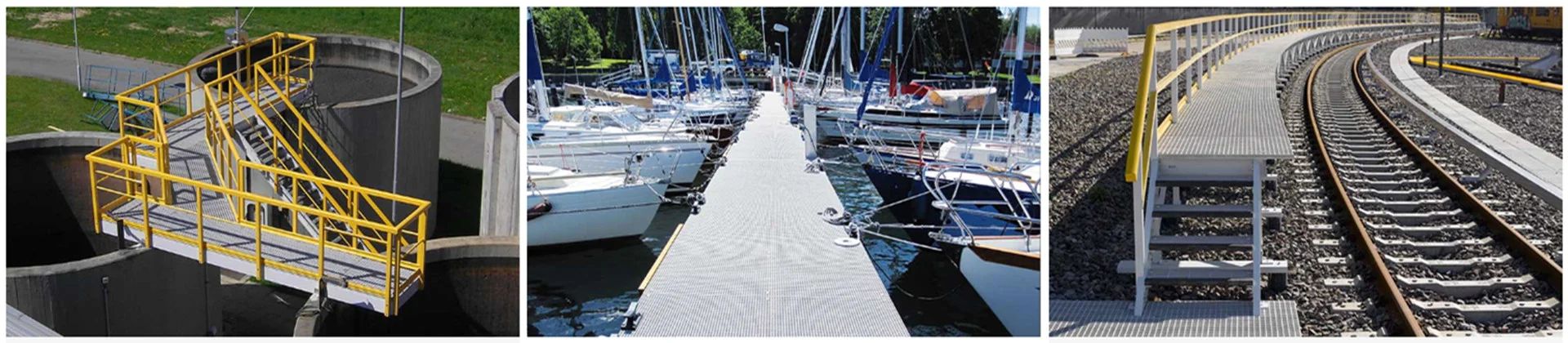
Marine pontoons and ramps, wastewater catwalks, cooling tower basins, substations, mezzanines, and OEM skids—anywhere corrosion resistance, dielectric safety, and low weight matter.
What Is Grit Paint?
System Anatomy
A typical coating stack: primer/base coat (epoxy or polyurethane), broadcast aggregate, then a sealer/topcoat. Performance depends on substrate prep, humidity/temperature at cure, and maintaining aggregate loading and film thickness.
Typical Use Cases
Fast upgrades on steel, concrete, or wood when budgets are tight and downtime must be minimal—especially indoors where UV and washdowns are limited.
Head-to-Head: Performance & Risk
Slip Resistance (Wet/Oily/Icy)
Integral-grit FRP maintains texture because aggregate is locked into a thick matrix. Broadcast grit can polish, thin, or disbond along traffic paths. Specify and verify traction using named methods such as ANSI/NFSI B101.3 (wet DCOF), ASTM E303 (pendulum), or ANSI A326.3 (where applicable). Target a wet COF ≥ 0.50 for mixed-use walkways and require post-install field checks.
Durability & Abrasion
Forklift turns, sand, and wave slap erode coatings first at high-load corners. FRP’s factory wear layer resists loss and can be ordered in coarse/medium/fine grits for the contaminant profile (mud/oil vs. clean interiors).
Chemicals, UV & Corrosion
FRP doesn’t rust. UV-stabilized top layers hold texture longer outside. Coatings can chalk or undercut if prep lapses; chemical attack can soften resins or sealers. See the quick compatibility matrix below.
Maintenance, Downtime & Recoat Cycles
Harsh outdoor service often pushes coatings to 6–24-month touch-ups or recoats; integral FRP surfaces commonly run 5+ years before any refresh. Fewer outages cut risk spikes that occur right before a recoat.
Structure & Span
Coatings add no structural capacity. FRP panels can span supports and carry pedestrian or light-equipment loads when sized correctly.
Compliance & Safety
Factory grit makes it easier to hold a specified COF over time. Add contrasting nosings for ADA/visibility where required and specify flame/smoke class for enclosed spaces.
Mini Span & Resin Selection Aids
Sample Pedestrian Span Guide (deflection limit L/200, uniformly distributed load ~4.8 kN/m²)
| Panel Thickness | Typical Span (mm) |
|---|---|
| 25 mm (1″) | 600–750 |
| 38 mm (1.5″) | 900–1,050 |
| 50 mm (2″) | 1,200–1,350 |
Note: Always request project-specific checks (support spacing, point loads, impact).
Quick Chemical Compatibility (indicative)
| Exposure | Polyester | Vinyl Ester | Epoxy |
|---|---|---|---|
| Chlorides / Salt Spray | Good | Excellent | Good |
| H₂S / Wastewater | Good | Excellent | Good–Excellent |
| NaOH (alkali) | Fair–Good | Good | Excellent |
| Dilute HCl / Acids | Fair | Good–Excellent | Good |
| Hydrocarbons / Solvents | Fair | Good | Good–Excellent |
Select resin by dominant exposure; ask for TDS and compatibility confirmation.
Installing for Performance
Day-of-Install Vignette
Crew of 3, battery impact drivers, carbide blades, dust control vac, and clip kit. Panels pre-cut; average cycle time ~18–25 minutes per panel (including fit, drill, seal edges, fasten, torque check). A 1,000 ft² ramp retrofit typically finishes in one weekend with staged access.
Substrate, Cutting & Fastening
Verify support flatness and drainage slope; allow thermal gaps. Use carbide tools and seal all field-cut edges. Follow clip spacing/torque; perform a post-install COF check and panel flatness survey.
Maintenance & Lifecycle
-
Cleaning: Detergent wash; avoid aggressive solvents unless approved.
-
Inspection: Monthly in marine/outdoor, quarterly indoors; look for localized polishing.
-
Repair: Swap a panel in minutes; localized re-grit for small spots. Keep spares for critical paths.
When Grit Paint Is Enough
Low-traffic interiors, temporary fixes, or a budget bridge to a planned capital retrofit.
Anonymized Case Study — Wastewater Catwalk
Before (coatings): Recoat every 12–18 months, ~16 hours downtime per lane, 6 slip reports/100k hours.
After (FRP panels): No recoats in 36 months, only washdowns, downtime 4 hours once for panel swap, 2 slip reports/100k hours (-67%).
Payback model: Savings from skipped recoats + reduced downtime recovered capex in 18–24 months.
Cost & ROI: TCO With Assumptions
Assumptions: Labor $65/hr, outage cost $250/hr, coating recoat at 18 months, panel price band mid-market.
-
Coating Path (per 1,000 ft² over 3 years): Materials $6,000 + Prep/Labor $7,500 + Downtime $4,500 + One recoat $9,000 = $27,000
-
FRP Path: Panels $38,000 + Install $6,000 + Downtime $2,000 + Touch-ups $1,000 = $47,000
Sensitivity: Add one extra recoat (+$9,000 materials/labor + $3,000 downtime) or a single moderate incident and the coating path surpasses FRP by year 3. Extend horizon to 5 years and FRP widens the lead.
Template Spec (Drop-In Paragraph)
Provide factory integral abrasive surface FRP decking. Verify wet COF ≥ 0.50 using ANSI/NFSI B101.3 (or ASTM E303 pendulum). UV-stabilized, chemical-resistant wear layer. Specify resin by exposure (polyester/vinyl ester/epoxy). Fire/smoke class per project code. Panels sized to meet deflection limit L/200 under stated loads. Seal field-cut edges. Submit TDS, test reports, and warranty.
Safety Considerations
-
PPE for FRP cutting (respirator, eye/skin protection); manage dust with HEPA vac.
-
Keep surfaces clean; schedule COF testing annually in harsh environments.
-
Snow/ice: use compatible de-icers; avoid metal chains that can gouge surfaces.
Why Partner with Unicomposite
Engineering & Fabrication. ISO-certificated pultrusion, custom widths/thicknesses, grit grades, and color coding; shop drawings, samples, and mock-ups accelerate approvals.
Procurement Confidence. Bulk programs, export packaging, and full documentation (TDS, SDS, QA certs, traction test reports) reduce change-order risk for utilities, industrials, and OEMs.
Conclusion
Choose fiberglass nonskid decking when durability, consistent wet traction, corrosion resistance, and lifecycle cost control are strategic. Use grit paint indoors, for low-risk areas, or as a short-term bridge. Send Unicomposite your span/load, exposure, and traffic data for a fast check, samples, and a site-specific TCO.
Frequently Asked Questions
1) How do I choose grit size?
Match to contaminants and footwear: coarse for mud/oil or outdoor boots; medium for mixed traffic; fine for clean interiors and easy washdowns.
2) Can panels be cut on site?
Yes—use carbide tools, control dust, and seal all cut edges. We can also deliver pre-cut kits with labeled hardware.
3) Will FRP meet fire/smoke codes?
Specify the required class for your jurisdiction; we supply panels formulated to meet typical industrial and transit needs with test data.
4) What if chemicals vary by zone?
Select resin by worst-case exposure and confirm with our compatibility chart and TDS; vinyl ester is the usual choice for wastewater/chemicals.
5) How long is the warranty?
Warranties vary by resin and grit system; typical terms cover materials/workmanship with exclusions for misuse. We provide sample language during submittals.


