 info@unicomposite.com


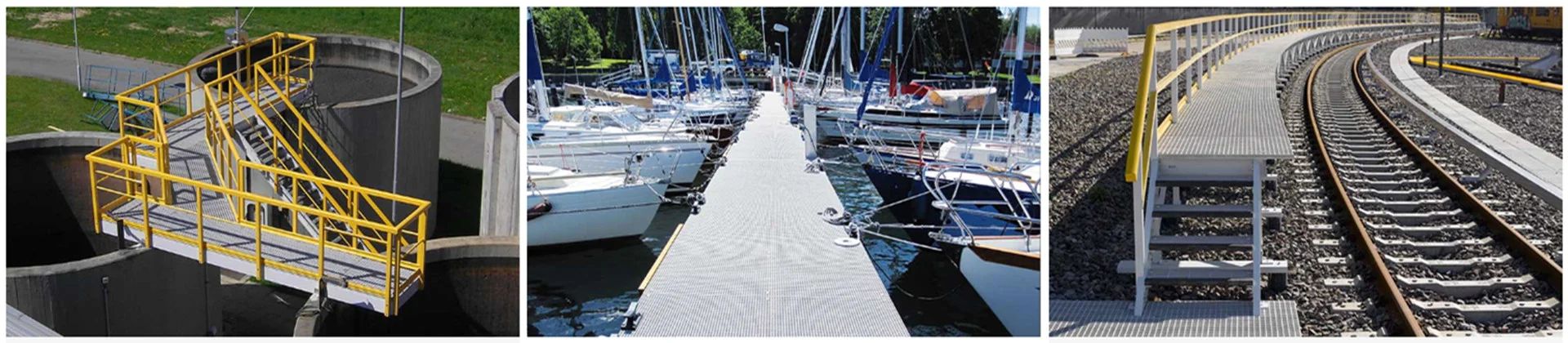
Introduction
Steel grating rusts, flakes paint, and forces shutdowns. When buyers say “rusty proof fiberglass grating,” they mean FRP panels that don’t corrode, keep traction in wet zones, and carry design loads without repainting cycles. This guide is for plant engineers, EPCs, and procurement teams who need safer platforms, walkways, and trench covers in corrosive or electrified areas. FRP grating is typically ~70% lighter than steel, enabling two-person handling and faster outages.
Field note: On a recent clarifier retrofit, our two-person crew lifted cut-to-size FRP panels, made edge trims with a 7-inch diamond-grit blade, sealed cuts with catalyzed resin, and finished anchor clips before lunch—no hot-work permits or repainting backlog.
Unicomposite—an ISO-certified pultrusion manufacturer—supports standard and custom FRP grating with application engineering, cut-to-size kits, QA traceability, and bulk supply across utilities, wastewater, cooling towers, marine, agriculture, and OEM assemblies.

rusty proof fiberglass grating
What Is Rusty Proof Fiberglass Grating?
1.1 Composition & Types
FRP grating combines E-glass reinforcements with thermoset resin. Two main families:
-
Molded: Bidirectional, square-mesh panels for multidirectional loads and complex cutouts.
-
Pultruded: Unidirectional bearing bars for longer spans and higher stiffness; tie-rods and cross-rods maintain geometry.
Common tops: concave, meniscus, and grit-top for wet/oily floors.
1.2 Resin Systems & Performance
-
Polyester: Cost-effective, general chemical resistance.
-
Vinyl ester: Strong resistance to acids/alkalis and higher temps—common in wastewater/chemical plants.
-
Phenolic: Prioritizes low flame/smoke and elevated heat.
Typical design touchpoints: fiber volume fraction ~50–65%; flexural modulus ~20–35 GPa. FRP offers dielectric strength on the order of ~10–15 kV/mm and a longitudinal thermal expansion of ~6–12 µm/m·°C (plan expansion gaps at panel joints).
Top Industrial Use Cases (Where It Excels)
2.1 Wastewater Treatment Platforms & Walkways
H₂S, chlorides, and spray corrode steel. FRP’s corrosion immunity and grit-top reduce slip events and eliminate paint cycles. Panels drop in fast over basins and channels.
2.2 Chemical Processing & Secondary Containment
For splash/spill zones and caustic wash areas, vinyl-ester grating preserves properties; band cut edges and use compatible clips for tank farm sumps.
2.3 Cooling Towers (Industrial & HVAC)
Humidity, drift, and biocides punish metals. Lightweight FRP lowers dead load, simplifies lifts, and resists rot; choose UV-stable grit for longevity.
2.4 Marine & Coastal Facilities
Salt spray and galvanic pairs wreck steel. FRP avoids galvanic corrosion on docks, catwalks, and gangways; color-coded edges aid visibility.
2.5 Power Generation & Substations
Non-conductive, non-sparking platforms are safer near energized gear and bus ducts; FRP is non-magnetic and RF-transparent.
2.6 Food & Beverage & Pulp/Paper
Hot-water washdowns and oils demand durable traction and easy cleaning. Fine/medium grit balances hygiene and slip resistance.
2.7 Mining & Industrial Processing
Abrasive fines and cart traffic call for heavy-duty grit, closer supports, and anti-uplift hardware.
Operator voice: “After swapping steel for FRP in our wet process aisle, weekly deck repairs disappeared—and the walking surface stayed sharp under slime.”
How to Specify Rusty Proof Fiberglass Grating (Buyer’s Checklist)
3.1 Loads, Spans & Deflection Criteria
Confirm uniform vs. point loads; set a comfort criterion like L/200 (or a 6–10 mm max deflection over common spans). Use manufacturer span tables and align supports accurately. (Illustrative example only: a 38 mm pultruded panel often targets ~0.25–0.40 in deflection at 36 in span under pedestrian loads; verify against supplier data.)
3.2 Surface & Safety
Match grit grade to conditions—fine (clean shoes), medium (wet floors), coarse (mud/ice). Add contrasting nosing and yellow hazard edges on leading lines and landings.
3.3 Resin, Fire, and Smoke
Map chemicals/temps to resin. Where codes apply, specify ASTM E84 Class A targets (flame spread ≤ 25; smoke ≤ 450) and note ASTM D635 (rate of burn) and ASTM D790 (flexural properties).
3.4 Electrical & EMI Considerations
Leverage dielectric properties around live equipment. Bonding/grounding is only needed at metal interfaces; avoid creating galvanic couples.
3.5 Hardware & Compatibility
Use stainless or FRP clips, hold-downs, and seaming bars that match corrosion class. Edge banding improves durability and keeps grit intact at cut faces.
Installation & Maintenance
4.1 Field Fabrication & Handling
Cut with carbide or diamond-grit blades; seal cut edges with catalyzed resin. Two people can often place panels that previously demanded a hoist.
4.2 Fasteners & Supports
Follow clip spacing guidance and include anti-uplift hardware (wind/jet areas). Allow for thermal expansion in panel gaps and anchor detailing.
4.3 Inspection & Lifecycle Care
Routine checks: grit wear, edge condition, clip tension. Cleaning is soap/water plus soft brushing—no blasting, no repainting.
Text schematic (top view):
Cost & ROI vs. Steel
5.1 First Cost vs. Total Cost
Initial material cost may be similar to or above painted steel, but FRP avoids multi-year coating cycles, galvanic fixes, and hot-work permits—shifting spend from recurring OPEX to one-time CAPEX with fewer outage days.
5.2 Transparent 5-Year ROI (Illustrative Example)
Assumptions: 250 ft² platform, coastal duty, one minor access outage/yr. (Not a quote.)
| Line Item | Steel (yrs 0–5) | FRP (yrs 0–5) |
|---|---|---|
| Material + fabrication (installed) | $14,000 | $17,000 |
| Coating/paint cycles (2x) | $6,000 | $0 |
| Patch repairs & galvanic mitigation | $2,500 | $300 |
| Scaffold/access & permits | $3,200 | $800 |
| Outage labor (extra day avoided with FRP) | $2,000 | $0 |
| 5-Year Total | $27,700 | $18,100 |
| Illustrative delta: ~35% lower five-year cost with FRP in corrosive service. Calibrate with your site’s labor rates, coating specs, and outage economics. |
Case Snapshot (Anonymized)
Situation: A coastal wastewater clarifier walkway suffered rust-through grid bars and frequent slip notices.
Solution: Vinyl-ester, grit-top pultruded FRP, dielectric hold-downs, color-coded edges; cut-to-size kit.
Results: Paint work orders fell sharply; slip notices dropped; reported payback in ~2–3 years from avoided coatings and shorter outages.
Safety & Compliance Notes
-
Slip resistance: Many facilities target wet DCOF ≥ 0.42; pendulum testing per ASTM E303 / EN 13036-4 provides auditable data.
-
Walking-working surfaces: Align with OSHA 1910.23 (guarding, openings, stair treads, nosing).
-
Chemicals & SDS: Verify resin compatibility against SDS and worst-case temperature; when in doubt, bias to vinyl ester or phenolic.
Why Partner with Unicomposite (De-Risk Your Project)
8.1 Engineering Support & Customization
Application engineering, span checks, drawing review, and cut-to-size kits that speed installation. Documentation packages support EPC approvals.
8.2 Manufacturing & QA
ISO-certified pultrusion lines with resin/fiber batch traceability and inspection protocols for consistent properties lot-to-lot.
8.3 Sector Experience
Proven supply for utilities, wastewater, cooling towers, marine, agriculture, aquaculture, and OEM assemblies—including integration with Pulwound/SMC/BMC parts.
Quick Selection Aids
Resin selection matrix (guide):
| Environment | Polyester | Vinyl Ester | Phenolic |
|---|---|---|---|
| General industrial (mild chemicals) | ✅ | △ | △ |
| Aggressive chemical splash/spill | △ | ✅ | △ |
| Elevated temp + low smoke/flame | △ | △ | ✅ |
| (✅=preferred, △=case-by-case with testing) |
Use-case cheat sheet:
| Use Case | Grating Type | Resin | Surface | Hardware Notes |
|---|---|---|---|---|
| Wastewater walkways | Pultruded 38–50 mm | Vinyl ester | Medium grit | Stainless clips; edge banding |
| Cooling tower decks | Molded 38 mm | Polyester/Vinyl ester | Medium grit | Anti-uplift clips; UV-stable |
| Marine docks | Pultruded 50 mm | Vinyl ester | Coarse grit | FRP or 316 SS hardware |
| Substations | Pultruded 38 mm | Polyester/Vinyl ester | Medium grit | Dielectric hold-downs |
| Food & beverage | Molded 25–38 mm | Polyester/Vinyl ester | Fine/medium grit | Hygiene-friendly edging |
Conclusion
Corrosive, wet, or energized environments are where rusty proof fiberglass grating outperforms steel: corrosion-immune, slip-resistant, dielectric, and quick to install. Share your loads, spans, chemicals, and environment. Unicomposite can return a spec review, span guidance, and a budgetary package tailored to your site.
Frequently Asked Questions
1) How long does FRP grating last in coastal or chemical service?
Service life commonly extends well beyond typical steel repaint cycles; durability depends on resin, UV exposure, and maintenance. Plan routine inspections and grit refresh only if severely abraded.
2) Can FRP grating handle wheeled carts or point loads?
Yes—specify pultruded bearing bars, confirm point-load criteria, and tighten support spacing. Use heavy-duty grit and anti-uplift hardware where traffic or wind loads demand it.
3) What tests or codes should I reference?
Typical references include ASTM D790 (flexural), ASTM E84 (flame/smoke), ASTM D635 (rate of burn), and slip testing per ASTM E303/EN 13036-4. For platforms/stairs, align with OSHA 1910.23.
4) How do I cut and finish FRP panels on site?
Use carbide or diamond-grit blades, collect dust, and seal cut edges with catalyzed resin. Pre-kit edges and hole patterns to reduce field work.
5) Will FRP create grounding issues near electrical gear?
FRP is non-conductive; bond only at metal transitions. Avoid mixing dissimilar metals that can create galvanic couples in wet areas.


