 info@unicomposite.com


Introduction
In sewage force main projects, the specification decision between carbon steel and FRP consistently follows the same pattern: engineers who have managed a steel force main replacement project — accounting for excavation, lining removal, contractor mobilization, and site reinstatement — become FRP specifiers for their next project. The total cost differential becomes visible only at replacement, not at initial procurement. By then, the 25-year carbon steel pipe has been in the ground for its full design life, and the neighboring FRP force main installed in the same year is still in service with no maintenance history.
This guide gives engineers and procurement managers the technical specifications, application criteria, standards references, and total cost framework to evaluate FRP filament wound pipe for infrastructure and industrial piping projects. You will find resin selection guidance, a direct comparison against steel and ductile iron, industry application criteria, and a specification checklist — everything needed to move from initial evaluation to purchase order.
Unicomposite Technology Co., Ltd manufactures FRP products across filament winding, pultrusion, and hand layup processes at an 18,000 m² facility in Nanjing, China. Unicomposite’s project teams encounter a consistent pattern in incoming FRP pipe inquiries: buyers who specify “FRP pipe” without defining resin system or pressure class typically arrive after a previous supplier delivered a product that failed its chemical compatibility requirement. The most common misspecification is polyester resin in vinyl ester service — a mismatch that becomes visible within 2–3 years of commissioning in acidic or chlorinated environments. The specification framework in this guide is designed to prevent that outcome.
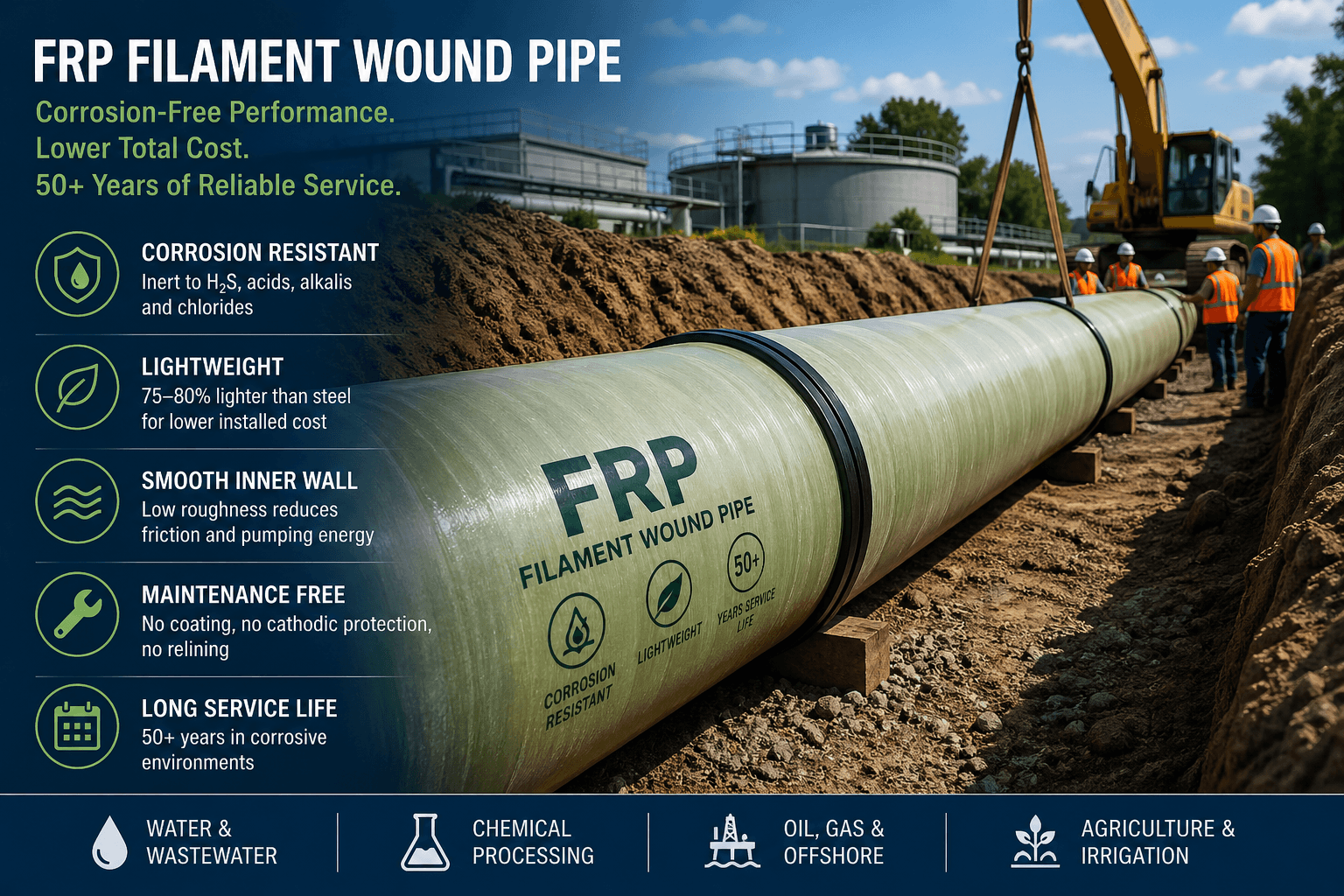
frp filament wound pipe
1. What Is FRP Filament Wound Pipe and How Is It Made?
1.1 The Filament Winding Process
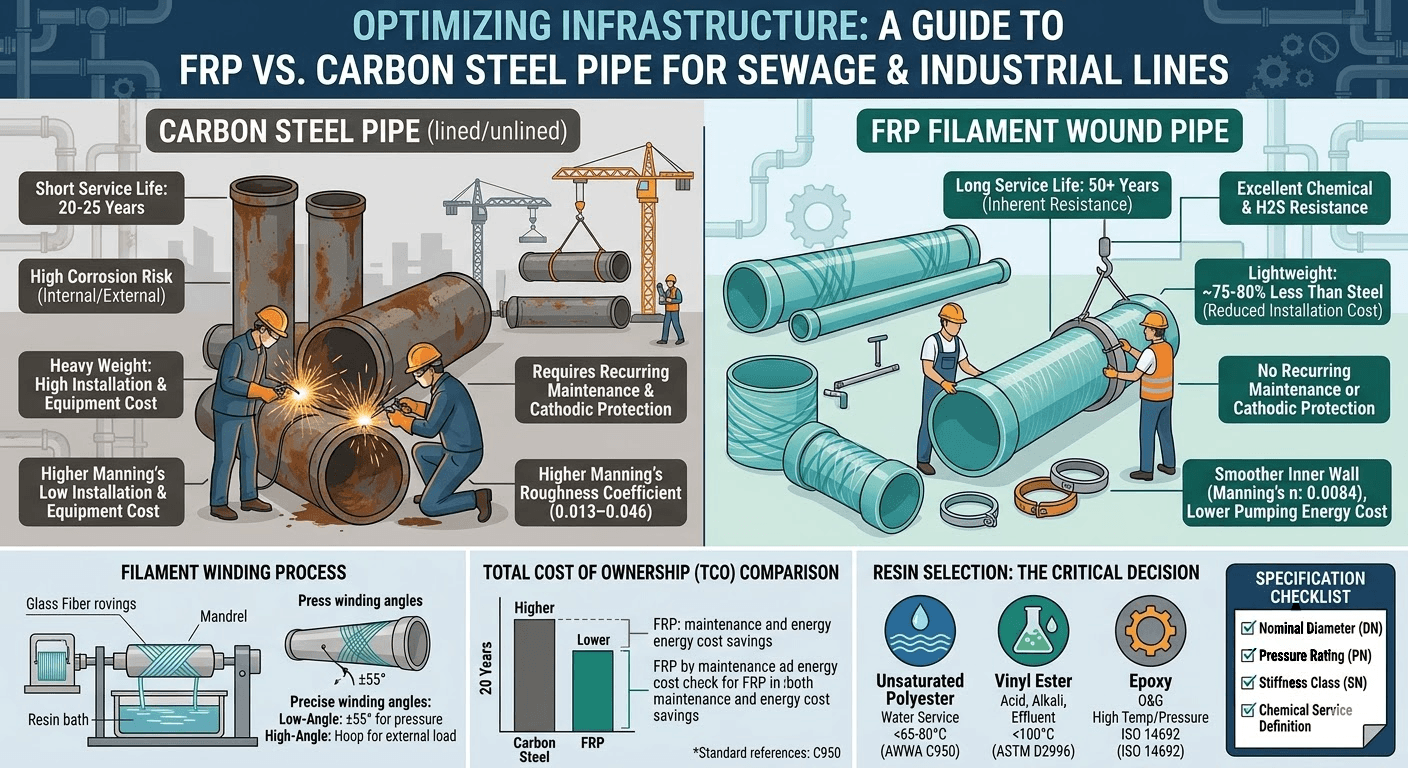
Filament winding produces FRP pipe by wrapping continuous glass fiber rovings — pre-impregnated with catalyzed resin — onto a rotating mandrel at precisely controlled angles. The winding angle is not an arbitrary manufacturing parameter. It directly determines the pipe’s mechanical character and suitability for specific service conditions.
Low-angle helical winding at ±55° optimizes combined axial and hoop strength, producing the balanced pressure resistance required for force mains and pressurized process lines. High-angle hoop winding concentrates circumferential strength, maximizing resistance to external soil pressure in deep-burial applications. Most pressure pipe specifications use a combination of winding angles to meet both internal pressure and external load requirements simultaneously.
After winding, the pipe cures on the mandrel at room temperature or under controlled heat, then the mandrel is extracted or dissolved — leaving a seamless, hollow cylinder with no weld seam, no heat-affected zone, and no joint-line corrosion initiation point. In corrosive service environments, weld seams are the first point of material degradation in steel piping systems. FRP filament wound pipe eliminates this failure mode entirely.
1.2 Resin Systems and Their Performance Implications
Resin system selection is the single most consequential specification decision for FRP filament wound pipe. The winding architecture can be modified in an engineering revision. The resin system cannot — it is locked in at manufacture and determines the pipe’s chemical compatibility for its entire service life.
Unsaturated polyester resin is the cost-effective baseline for water service, mild chemical environments, and atmospheric or buried non-aggressive applications. It processes reliably, cures at room temperature, and delivers adequate performance for the majority of municipal water infrastructure applications where the fluid is non-aggressive.
Vinyl ester resin is the correct specification for any service involving acids, alkalis, chlorinated media, or industrial effluent. Its epoxy-derived backbone provides significantly better hydrolytic stability and chemical resistance than polyester — the same performance advantage that makes vinyl ester the standard resin for FRP cable trays and corrosion-resistant profiles in chemical plant infrastructure. For sewage force mains, chemical transfer lines, and any service where the fluid composition includes aggressive species, vinyl ester is the defensible specification choice.
Epoxy resin delivers the highest mechanical performance and thermal resistance. Specify epoxy for oil and gas service, offshore piping systems, high-pressure applications, and any environment where bond-line integrity under sustained mechanical and thermal load is the primary design requirement. Epoxy-based FRP pipe meets ISO 14692 requirements for petroleum and natural gas industry piping — the international standard for offshore and subsea piping qualification.
2. Technical Specifications
2.1 Dimensional Range and Pressure Ratings
FRP filament wound pipe covers a diameter range from DN25 (approximately 1 inch) to DN3000 (approximately 120 inches). The cost and weight advantages over steel are most pronounced at large diameters — above DN600, the differential in material cost, installation labor, and long-term maintenance begins to dominate the total cost comparison decisively.
Standard pressure ratings run from PN6 to PN25 (0.6 to 2.5 MPa) for conventional designs. Higher ratings are achievable through increased wall thickness and modified winding schedules, engineered to project-specific requirements. Wall thickness is calculated from the combination of internal pressure, pipe diameter, burial depth and soil loading, and the chemical environment’s effect on the resin system’s long-term hydrostatic strength — not selected from a fixed table.
Stiffness class (SN) is the second structural parameter for buried pipe design, governing resistance to external soil and traffic loads. Standard buried pipe stiffness classes run SN2500, SN5000, and SN10000 (Pa) under AWWA C950 — SN5000 covers the majority of standard burial depth and traffic loading conditions; deeper burial or heavy traffic loading requires SN10000. The correct class depends on burial depth, soil type, and compaction conditions defined in the project geotechnical report.
2.2 Key Physical and Flow Properties
FRP filament wound pipe’s physical properties differ from steel in ways that affect not just corrosion performance but installation logistics, energy consumption, and cold-climate operability.
The operating temperature range for FRP filament wound pipe spans -70°C to 250°C, but this ceiling applies only to specific high-temperature epoxy resin systems under non-oxidizing conditions. Standard polyester-based FRP pipe is typically limited to 65–80°C in continuous liquid service; vinyl ester systems extend this to approximately 100°C. Always confirm the specific upper temperature limit against the resin supplier’s published heat deflection temperature (HDT) data for the intended service — do not apply the 250°C ceiling to a polyester or standard vinyl ester pipe specification.
The inner wall roughness coefficient of 0.0084 (Manning’s n) is one of FRP pipe’s most undervalued performance attributes. Concrete pipe carries a roughness coefficient of approximately 0.013; unlined carbon steel runs approximately 0.046. At equivalent flow velocity and diameter, FRP pipe’s smoother inner wall reduces friction head loss — directly lowering pump energy consumption over the system’s service life. At large diameters and high flow volumes, the cumulative energy saving over 20 years can offset a meaningful portion of the initial cost premium over steel.
Thermal conductivity of approximately 0.3 W/m·K — versus 50 W/m·K for carbon steel — has two practical consequences. In process piping, it reduces heat loss and may eliminate or reduce the insulation requirement. In cold-climate buried applications, it eliminates freeze cracking risk: the pipe’s low thermal conductivity combined with the inherent flexibility of the FRP composite prevents the brittle fracture mode that destroys cast iron and ductile iron pipe in freeze-thaw cycling environments.
The table below compares FRP filament wound pipe against the most commonly specified alternative pipe materials across the parameters most relevant to infrastructure and industrial procurement decisions:
| Parameter | FRP (Vinyl Ester) | Carbon Steel (lined) | Ductile Iron | Concrete |
|---|---|---|---|---|
| Corrosion resistance | Excellent (inherent) | Moderate (coating-dependent) | Poor–Moderate | Poor (H₂S attack) |
| Unit weight at DN300 (kg/m) | ~35 | ~185 | ~210 | ~290 |
| Inner roughness (Manning’s n) | 0.0084 | 0.013 (lined) | 0.013 | 0.013 |
| Maintenance requirement | None | High (recoat, cathodic prot.) | Moderate | Moderate–High |
| Approx. service life | 50+ years (correctly specified) | 20–25 years (corrosive env.) | 25–40 years | 30–50 years |
| Cathodic protection required | No | Yes (buried) | Yes (aggressive soil) | No |
| Max. continuous service temp. | 65–80°C (polyester); 100°C (VE); 250°C (high-temp epoxy) | 400°C+ | 350°C+ | 150°C |
| Pressure rating range | PN6–PN25+ | PN6–PN100+ | PN10–PN64 | PN6–PN16 |
3. Applications by Industry
The four industries below represent FRP filament wound pipe’s strongest total cost case — ranked roughly by the magnitude of the performance and cost advantage over competing materials.
3.1 Municipal Water and Wastewater Infrastructure
FRP filament wound pipe is particularly well-suited to sewage force mains, gravity sewer trunk lines, effluent discharge pipelines, and water transmission mains. The performance advantage in sewage service goes beyond simple corrosion resistance. Microbially induced corrosion (MIC) — driven by hydrogen sulfide (H₂S) gas produced by anaerobic bacteria in sewage — destroys unlined ductile iron and concrete pipe through sulfuric acid attack on the pipe crown, typically within 5–10 years of commissioning in warm, slow-velocity force mains. FRP is chemically inert to H₂S at all concentrations encountered in sewage service. The pipe does not corrode from the inside regardless of H₂S levels in the gas space above the liquid.
For potable water transmission, food-grade resin systems compliant with NSF/ANSI 61 are available — FRP maintains water quality without leaching concern across the full service life, eliminating the periodic water quality testing and lining inspection programs that apply to cement-lined ductile iron pipe.
3.2 Chemical Processing and Industrial Fluid Transfer
Vinyl ester FRP pipe handles the chemical media that most frequently exceed the capability of standard metallic piping: hydrochloric acid, dilute sulfuric acid, sodium hydroxide, sodium hypochlorite, chlorine gas, carbon dioxide-bearing streams, and a broad range of organic process fluids. These are precisely the environments where 316 stainless steel fails through pitting and stress corrosion cracking, and where carbon steel requires expensive alloy upgrades or short-cycle replacement.
In chemical plant piping systems, FRP filament wound pipe eliminates the need for expensive alloy materials — Hastelloy, titanium, or high-alloy stainless — in many acid and chlorinated service lines. In projects where FRP replaces a failed alloy line at equivalent diameter and pressure rating, the material cost reduction relative to Hastelloy or titanium typically falls in the 40–60% range — a figure that varies with alloy grade, pipe diameter, and current commodity pricing, but is directionally consistent across most acid and chlorinated service replacements. On a large-diameter chemical transfer main, this capital cost reduction is substantial before any maintenance saving is accounted for.
3.3 Oil, Gas, and Offshore Applications
Epoxy-based FRP pipe qualified to ISO 14692 is specified for produced water handling, seawater injection, firewater systems, and cooling water circuits on offshore platforms and floating production systems. The weight advantage is amplified in offshore applications: FRP pipe weighing 75–80% less than equivalent-diameter carbon steel reduces structural load on the platform deck and topsides structure — a constraint that becomes increasingly binding as operators seek to extend platform life beyond original design parameters.
The elimination of hot-work requirements for field joints is a separate safety and schedule benefit in offshore environments. FRP adhesive-bonded or mechanically coupled joints require no welding, no inert gas purging, and no post-weld inspection — reducing both permit requirements and the time-critical path for piping installation in commissioning schedules.
3.4 Irrigation and Agricultural Water Systems
Large-diameter low-pressure FRP transmission mains serve irrigation districts, agricultural water authorities, and aquaculture operations where long-distance water conveyance at low pressure is the primary requirement. FRP’s smooth inner wall delivers its roughness advantage most visibly in large-diameter, high-volume agricultural pumping systems — where even small reductions in friction head translate to meaningful annual energy savings across a pumping season.
Unicomposite supplies FRP piping and structural products to aquaculture facilities, agricultural greenhouse infrastructure, and irrigation water distribution networks. In these applications, the combination of FRP’s corrosion resistance, light weight, and smooth bore consistently delivers lower installed cost and longer service life than PVC or HDPE alternatives at larger diameters — where thermoplastic pipe loses its cost and weight advantage and FRP’s structural stiffness becomes the deciding factor.
The table below maps application type to the recommended resin system, pressure class, and primary performance advantage for each industry sector:
| Application | Recommended Resin | Pressure Class | Key Advantage Over Alternative | Reference Standard |
|---|---|---|---|---|
| Sewage force main | Vinyl ester | PN6–PN16 | MIC resistance; H₂S inert | AWWA C950 |
| Potable water transmission | Polyester (NSF/ANSI 61) | PN6–PN16 | No lining; maintains water quality | AWWA C950 |
| Chemical acid/alkali transfer | Vinyl ester | PN6–PN25 | Replaces alloy pipe at 40–60% lower material cost | ASTM D3517 |
| Oil and gas / offshore | Epoxy | PN10–PN25+ | ISO 14692 qualified; 75% weight reduction vs. steel | ISO 14692 |
| Agricultural irrigation main | Polyester or vinyl ester | PN6–PN10 | Smooth bore reduces pumping energy cost | ASTM D2996 |
4. FRP Filament Wound Pipe vs. Steel: Total Cost of Ownership
4.1 Installation Cost Advantages
The weight reduction from FRP pipe — typically 75–80% lighter than equivalent-diameter carbon steel — has direct and immediate installation cost consequences that procurement models frequently underestimate. Smaller lifting equipment, reduced crane hire duration, and lighter crew requirements per joint all reduce the installed cost relative to the material cost comparison alone. On a DN600 force main installation, the reduction in crane and equipment cost can offset 15–25% of the FRP material cost premium over steel before the pipe has been in service a single day.
The elimination of field welding is a separate and consistently underestimated cost and schedule benefit. FRP pipe joints use adhesive bonding, mechanical couplings, or flanged connections — no hot-work permits, no weld inspection, no post-weld heat treatment, and no radiographic or ultrasonic weld testing. In confined-space or congested-site installations where welding logistics are particularly burdensome, this advantage compounds significantly.
No lining or coating is required at installation. FRP’s corrosion resistance is inherent to the composite material, not applied to a surface. Eliminating internal lining application, cure time, and quality inspection from the installation schedule reduces both construction duration and the risk of lining defects that can void the pipe’s corrosion protection before it enters service.
4.2 20-Year Operating Cost Comparison
Carbon steel pipe in corrosive buried or chemical service carries a predictable maintenance cost structure: external coating inspection and touch-up every 3–5 years, full recoat every 8–12 years, cathodic protection system maintenance annually, and internal lining replacement in aggressive service at 10–15 year intervals. Each cycle requires excavation, surface preparation, application, cure, inspection, and backfill — labor-intensive operations whose cost grows with rising contractor rates over the pipe’s life.
FRP pipe’s maintenance requirement is periodic visual inspection only. No coating maintenance, no cathodic protection, no relining. The maintenance cost differential over 20 years typically exceeds the initial material cost premium for FRP over lined carbon steel in corrosive service environments.
The table below indexes total 20-year cost across five categories for a representative DN600 force main installation, with all values normalized to unlined carbon steel material cost = 1.0. Negative values indicate cost savings relative to the unlined steel baseline; all figures are generalized estimates for buried corrosive-service applications and vary by project conditions, regional labor rates, and chemical environment severity.
| Cost Category | FRP Pipe | Carbon Steel (lined) | Carbon Steel (unlined) |
|---|---|---|---|
| Material cost (index) | 1.4 | 1.0 | 0.8 |
| Installation labor (index) | 0.7 | 1.0 | 1.0 |
| Coating / lining — initial | 0 | 0.3 | 0 |
| Maintenance — 20 year (index) | 0.05 | 0.8 | 1.2 |
| Cathodic protection — 20 year | 0 | 0.4 | 0.4 |
| Energy savings (roughness-driven) | -0.15 | 0 | +0.3 |
| Total 20-year cost index | 2.0 | 3.5 | 3.7 |
All index values accumulate additively across categories. FRP’s total of 2.0 reflects its higher material cost offset by lower installation labor, zero maintenance, zero cathodic protection, and energy savings from lower wall roughness. Carbon steel (lined) total of 3.5 reflects lower material cost but significantly higher maintenance and cathodic protection cost over 20 years.
frp vs carbon steel pipe for sewage
5. Standards and Specification Requirements
Specifying to a recognized standard is the contractual mechanism that converts the performance and cost case in Section 4 into enforceable purchase terms — it defines the test basis, the quality control requirement, and the acceptance criteria the supplier must meet. A pipe specified as “FRP” without a standard reference gives the supplier latitude that the buyer cannot recover at incoming inspection.
5.1 North American Standards
ASTM D2996 (Standard Specification for Filament-Wound Fiberglass Pipe) is the primary mechanical test standard for North American projects, governing tensile strength, hydrostatic design basis, and dimensional tolerances. AWWA C950 (Standard for Fiberglass Pressure Pipe) is the governing standard for municipal water applications, specifying hydrostatic design basis, joint design requirements, and production quality control procedures. ASTM D3517 (Standard Specification for Fiberglass Pressure Pipe) covers industrial and chemical service applications where fluid chemistry and pressure requirements exceed the scope of the municipal water standard.
5.2 International Standards
ISO 14692 (Parts 1–4) governs FRP piping systems for petroleum and natural gas industry applications — the qualification standard for offshore, onshore oil and gas, and petrochemical plant piping. EN 1796 covers FRP piping systems for water supply in European municipal infrastructure specifications, based on unsaturated polyester resin systems and defining performance requirements for pressure classes and joint design.
5.3 How to Specify FRP Pipe Correctly
Four parameters must appear in every FRP pipe specification: nominal diameter (DN), pressure rating (PN), stiffness class (SN for buried applications), and chemical service definition (resin system plus the specific fluid media, concentration, and operating temperature). Missing any one of these parameters leaves the supplier free to make a substitution that may not match the service requirement.
The most common specification error is stating “FRP pipe” or “GRP pipe” without defining pressure class or resin system. A polyester pipe specified into vinyl ester service will degrade — and the buyer will have no contractual recourse if the specification did not define the resin system. This is the misspecification pattern Unicomposite’s project teams encounter most frequently in replacement inquiries, and it is entirely preventable at the purchase order stage.
Request the following documentation with every FRP pipe delivery: hydrostatic pressure test certificate per the applicable standard, resin batch records identifying the specific resin grade and lot, and a dimensional inspection report confirming diameter, wall thickness, and joint dimensions against the purchase specification.
Conclusion
FRP filament wound pipe is not a specialty material for unusual applications. It is the technically superior and economically rational choice for the majority of buried corrosive-service, large-diameter, and chemical transfer piping applications where steel’s maintenance cycle, coating requirements, and cathodic protection infrastructure drive total cost above FRP’s initial premium. Four specification takeaways:
- Resin system is the non-negotiable first decision. Polyester for water and mild service at temperatures below 65–80°C. Vinyl ester for acids, alkalis, and chlorinated media up to approximately 100°C. Epoxy for oil and gas, offshore, and high-temperature structural applications. Define this before the pipe is ordered — it cannot be changed afterward, and the most common field failures trace directly to this specification gap.
- Total cost of ownership, not material cost, is the correct comparison metric. FRP’s correctly specified 50-year maintenance-free service life eliminates cost categories that carbon steel carries throughout its service life. The TCO advantage in corrosive service typically exceeds the initial material cost premium within 8–12 years.
- Specify to standard. AWWA C950 for municipal water, ASTM D2996/D3517 for industrial, ISO 14692 for oil and gas. Include DN, PN, SN, and resin system in every specification — vague specifications produce variable results and leave the buyer without contractual recourse when performance falls short.
- Account for installation cost savings in the project budget. Weight reduction, elimination of field welding, and no-lining installation are three cost advantages that procurement models consistently undervalue relative to the material cost line item. On large-diameter projects, these savings can offset 20–30% of the FRP material cost premium before the pipe carries its first operating cycle.
As infrastructure replacement cycles accelerate and corrosion-related failures become increasingly costly to remediate, the total cost case for FRP piping continues to strengthen relative to conventional materials.
[Contact Unicomposite to specify FRP filament wound pipe for your project →]
Frequently Asked Questions
FRP filament wound pipe uses three primary joint types: adhesive-bonded bell-and-spigot joints, elastomeric seal (rubber ring) joints, and flanged connections. For buried pressure pipe, elastomeric seal joints are the most common choice — they accommodate angular deflection and thermal movement without requiring adhesive cure time in the trench, significantly accelerating installation. Adhesive-bonded joints provide higher joint stiffness and are preferred for above-ground installations or where joint rigidity is a design requirement. Flanged connections are used at equipment interfaces and valve stations.
Yes — FRP pipe manufactured with food-grade resin systems compliant with NSF/ANSI 61 is suitable for potable water transmission. NSF/ANSI 61 certification requires third-party testing to confirm that the pipe does not leach contaminants at concentrations that would affect water quality or safety. Specify NSF/ANSI 61 compliance explicitly in the purchase order and request the certification documentation with delivery; not all FRP pipe manufacturers maintain this certification for all resin systems.
AWWA C950 and ASTM D2996 both require hydrostatic pressure testing of finished pipe at the manufacturing facility — typically at 1.5× the rated working pressure for a defined hold period. For installed pipelines, field hydrostatic acceptance testing per the project specification is standard practice. Request the manufacturer’s factory hydrostatic test certificate with each pipe delivery, and retain it as part of the project quality record for insurance and warranty purposes.
Standard diameter FRP pipe in polyester or vinyl ester resin systems is typically available on production lead times of 3–6 weeks from order confirmation. Large-diameter pipe (above DN600), specialty epoxy systems, or project-specific wall thickness and winding schedule designs require 6–10 weeks for first production. For projects with fixed installation windows, communicate the required delivery date at the inquiry stage — most manufacturers can advise on the production schedule before a purchase order is placed.
Surface damage and minor through-wall defects in FRP pipe are repairable using hand layup patch techniques with compatible resin — the same resin system as the pipe base material. The damaged area is abraded, cleaned, and laminated with glass fiber and catalyzed resin, then allowed to cure before pressure is restored. For structural damage or large-diameter defects, a short replacement spool with flanged or coupled connections is typically more practical than a field repair. Always use the same resin system for repair as the original pipe specification — mixing resin systems at a repair location creates a chemical compatibility boundary that can become a preferential attack zone in corrosive service.


