 info@unicomposite.com


Introduction
Buying FRP for an industrial site is rarely “hard” at the quote stage. The pain shows up later—when a platform feels springy, a cutout starts cracking, or outdoor parts chalk and fade because the resin system wasn’t matched to the site.
Here’s the simplest truth most project teams learn the expensive way: “If it isn’t in the RFQ, it isn’t guaranteed.” This guide gives you a practical, buyer-friendly way to specify FRP Products & Project Services so you get predictable performance and fewer change orders.
Where a supplier has real project capability (example profile: Unicomposite, an ISO-certificated, factory-based pultrusion manufacturer offering standard pultruded fiberglass profiles plus custom options like Pulwound, SMC/BMC, and hand lay-up), you can often reduce interface risk—especially when your scope mixes standard profiles with custom composite parts.

frp products project services
What “FRP Products & Project Services” Includes
Treat this as two layers: components + execution support.
Products (common scope)
- Pultruded profiles: angles, channels, I-beams, tubes, flats/plates
- Systems: handrails, ladders, stairs, platforms, kickplates
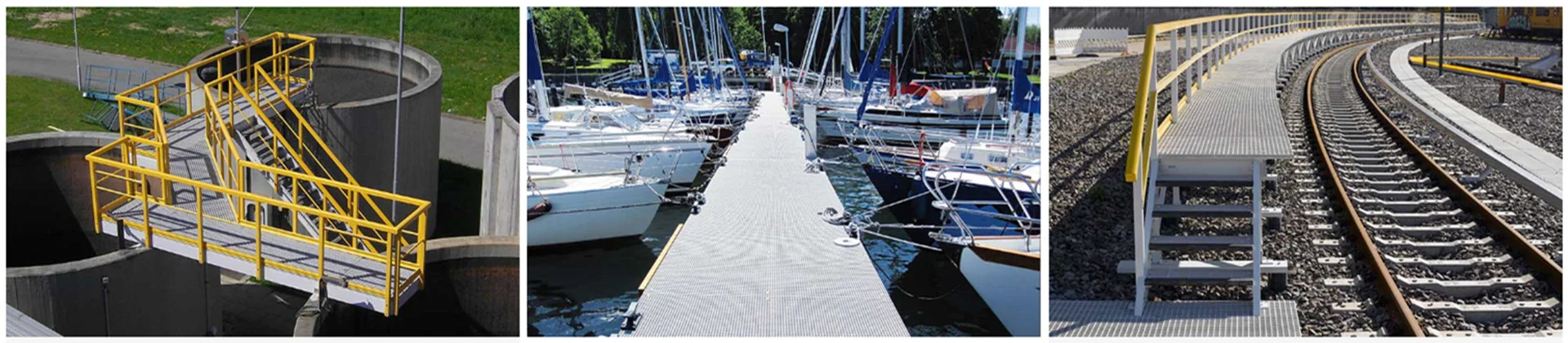
- Panels: molded/pultruded grating, stair treads, covers
- Utility components: insulating supports, brackets, cable-tray parts
- Custom composite parts/assemblies for job-specific interfaces
Project services (where projects win or lose)
- Converting site conditions into resin/surface requirements
- Confirming load/span/deflection and connection details
- Fabrication control: tolerances, hole patterns, cutouts, edge finishing
- QA documentation + revision-controlled production
- Packaging and install notes that prevent damage and rework
Why the “services” layer matters: corrosion-related risk is a real, global cost center—one widely cited estimate puts the global cost of corrosion around US$2.5 trillion (~3.4% of global GDP, 2013).
How to Choose the Right FRP Material System
“FRP” is a family, not a single material. Your outcome is driven by resin system + reinforcement architecture + surface protection.
Start with a site-to-spec translation
Write these down before you ask for a quote:
- Exposure: chemical media, concentration, temperature, splash vs immersion
- Indoor/outdoor + UV intensity
- Fire/smoke requirements (if your project spec calls for them)
A buyer mistake that creates non-comparable quotes: asking for “FRP” without stating the resin/performance requirement.
Know what pultrusion is optimized for
Pultrusion aligns fibers along the profile length, which supports repeatable dimensions and strong axial properties—great for constant cross-sections and scalable volume. For complex shapes, multi-directional loading, or curved geometry, other forming methods may fit better (SMC/BMC, hand lay-up, etc.).
One data point that helps explain pultrusion’s performance: composite literature commonly cites fiber volume fraction “typically in the range of 50–70%” for pultruded composites.
What to lock in (so performance is controllable)
- Resin requirement (and any UV/fire requirements)
- Surface requirement (veil/topcoat, anti-slip finish where needed)
- Dielectric documentation request if parts sit near live electrical zones
How to Spec FRP for Real Loads and Real Sites
The fastest red flag in a submittal review is missing the “three numbers”: load, span, deflection.
The exact order we review FRP submittals
If you want your RFQ to “force correctness,” follow this sequence:
- Environment → resin system + surface protection
- Use case → load type(s): pedestrian, cart, equipment point load, vehicle
- Structure reality → span(s) + support layout + deflection target
- Interfaces → connections, holes, cutouts, tolerances, edge finishing
- QA → traceability, inspection, revision control, packaging/install notes
Worked micro-example (numbers that prevent surprises)
Say you’re specifying a maintenance walkway panel with a 4 ft (48 in) span. A common “firmer feel” guideline for grating deflection is to limit deflection to SPAN/200, often referenced alongside a practical cap like 1/4 in under full live load.
- Deflection target = 48 in / 200 = 0.24 in (≈ 1/4 in)
- If the supplier can’t meet that target with the proposed panel, your options are usually:
- choose a deeper/stronger panel type,
- add intermediate support,
- change panel orientation/support spacing,
- or revise the load case (only if your engineer approves it).
That one line (span + deflection target) removes a ton of ambiguity.
Common rejection reasons (and how buyers fix them)
- Vague exposure (“chemical area”) → replace with media + temperature + exposure mode
- No deflection target → add SPAN/200 (or your project’s requirement) and confirm comfort/safety expectation
- Undefined cutouts → include cutout size/location + edge finishing + reinforcement/banding details
Limits & Safety Considerations
- The deflection guidance above is for static loads; impact/dynamic loads can increase deflection and risk at clips and cutouts.
- Treat cutouts, cantilevers, and concentrated loads as risk multipliers—they often need extra detailing (panel support, edge reinforcement, hold-down strategy).
- Final selection should follow your project specifications and qualified engineering approval, especially for safety-critical platforms, elevated walkways, and areas with vehicle loads.
How to Evaluate a Supplier’s Project Service Capability
When you buy in bulk, the real question is consistency: can the supplier repeat what you approved—batch after batch—with clean documentation?
What ISO-style quality should look like in your RFQ
ISO 9001 is widely described as a framework to establish, maintain, and continually improve a quality management system. As a buyer, translate that into deliverables you can request.
Supplier qualification mini-matrix
| Proof / Document | Why it matters | What “good” looks like |
|---|---|---|
| Drawing revision control | Prevents build-to-old-version mistakes | Quote references the exact revision/date |
| First-article / sample approval | Locks the target before volume | Signed-off sample tied to the drawing |
| Dimensional inspection records | Interfaces fail when tolerances drift | Critical dimensions measured + recorded |
| Batch traceability | Makes warranty/field issues solvable | Resin/fiber/lot tracking per shipment |
| Packaging & handling plan | FRP can be damaged by point impacts | Edge protection, stack rules, labeling |
If your project combines standard pultruded profiles with custom composite parts, a multi-process, factory-based supplier can simplify coordination (fewer handoffs, fewer “who owns this interface?” moments).
A Practical RFQ Checklist for Industrial Buyers
Use this to force apples-to-apples quotes.
Copy-paste RFQ checklist
- Application + environment: UV, temperature, chemical media + exposure mode
- Performance: load type/magnitude, span(s), deflection limit (e.g., SPAN/200)
- Material system: resin requirement, surface/anti-slip, dielectric needs
- Fabrication: tolerances, hole patterns, cutouts, edge finishing/banding
- Quantity + delivery: batch sizes, schedule, destination, packaging rules
- Quality/acceptance: traceability, inspection records, sample approval method
One useful span reality check often cited in engineer guidance: 1-inch deep molded grating is “typically” acceptable up to about 3 ft spans (with deeper panels used for longer spans). This is typical guidance—your loads may push you to a different selection.
Conclusion
Good FRP Products & Project Services come from controlling three things in writing:
- environment → resin/surface system, 2) site reality → load/span/deflection, 3) execution → QA + revision-controlled fabrication.
If you want a fast next step: paste the RFQ checklist into your next inquiry and require suppliers to respond line-by-line. That alone removes most of the “it looked fine on paper” surprises.
Frequently Asked Questions
Make every supplier quote the same inputs: resin system, surface finish, load/span/deflection, tolerances, and cutout/edge details. If any quote is missing a line item, treat it as “not included,” not “assumed.”
Pultrusion is excellent for constant cross-sections and scalable volume with consistent dimensions. If you need complex geometry, curved parts, or more multi-directional reinforcement, other forming methods can be a better fit.
Missing span and deflection expectations. Without a stated deflection limit, a supplier can meet thickness and still deliver a panel that feels too flexible for your site comfort and safety expectations.
At minimum: drawing revision control, first-article/sample approval, dimensional inspection for critical interfaces, batch traceability, and packaging/handling instructions. These documents make performance repeatable and field problems traceable.
Sometimes, but it needs rules: allowed tools, hole edge distances, cutout finishing, and whether reinforcement/banding is required. Cutouts are a common failure trigger, so treat them as engineered details, not afterthoughts.


