 info@unicomposite.com


Quick Answer
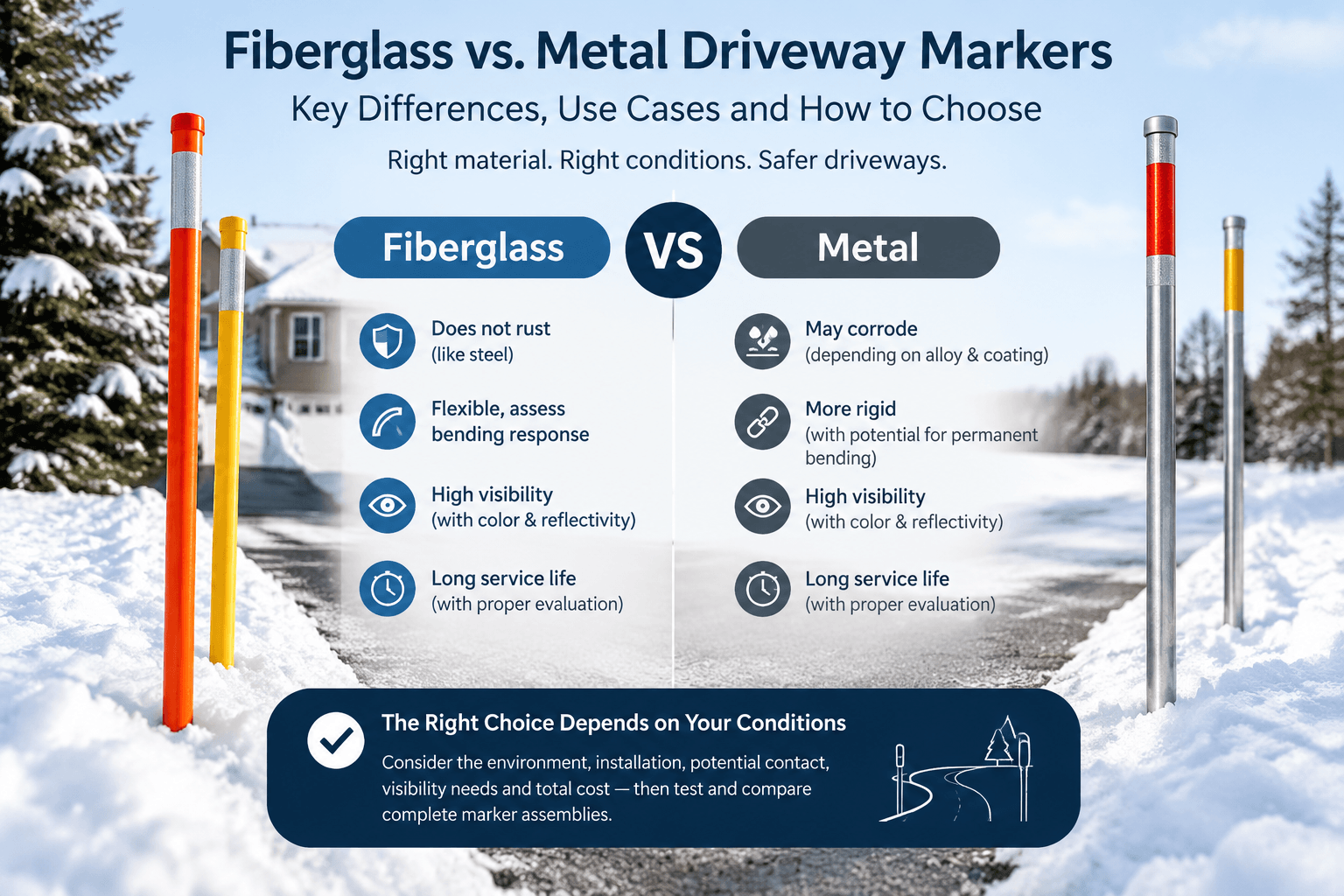
Fiberglass driveway markers—also called snow stakes or snow poles in winter applications—are often considered when buyers want a shaft that does not rust like steel and a bending response that can be evaluated for incidental contact. Metal markers may be more suitable when shaft rigidity or a particular mounting method is the priority. Neither material is automatically more durable: compare the complete marker assembly under the same installation, temperature, contact, visibility, and maintenance conditions.
For procurement teams, the practical answer is to define the operating conditions first, qualify samples with a repeatable test plan, and calculate cost from actual replacement and labor records. This guide provides that framework without assuming that one material will win every project.
fiberglass vs metal driveway markers
Fiberglass vs. Metal Driveway Markers: Key Differences
This quick comparison identifies the first questions to investigate. It does not rank either material or replace evaluation of the finished marker.
| Factor | Fiberglass | Metal |
|---|---|---|
| Corrosion mechanism | Does not rust like steel; the resin system, surface, color, and attachments still require evaluation | Depends on alloy, coating, cut ends, installation damage, and exposure |
| Contact response | Evaluate deflection, damage, and residual straightness | Evaluate rigidity, permanent bending, attachment damage, and exposed sharp conditions |
| Visibility | Determined by the complete visibility system, including color, exposed height, and reflective components | Same |
| Service life | Establish under the project’s exposure, installation, contact frequency, inspection, and replacement criteria | Same |
Start With the Marker’s Job, Not Its Material
A useful specification begins with what the marker must help an operator see and avoid. Record the boundary or hazard being marked, the viewing direction, typical snow depth, traffic or equipment exposure, installation surface, seasonal removal plan, and replacement threshold.
The distinction between private-site markers and public-road traffic-control devices also matters. The Federal Highway Administration’s MUTCD treats delineators as traffic-control devices with defined visibility and support considerations. A driveway stake is not automatically an MUTCD-compliant delineator merely because it is reflective or installed beside a roadway. Projects within a public right-of-way need the applicable agency’s requirements before a product is selected.[1]
For private drives, commercial lots, landscaped boundaries, and snow-removal routes, translate the job into observable requirements:
- The marker remains recognizable from the operator’s approach direction.
- Its installed height remains useful after expected snowfall and plowing.
- The shaft and attachment method tolerate the site’s expected contact events.
- Installation does not create an unacceptable hazard to people, vehicles, utilities, or equipment.
- Inspection and replacement can be completed within the owner’s maintenance plan.
A Decision Matrix for Fiberglass, Metal, Plastic, and Wood
The table below is a screening tool, not a product-performance warranty. Each candidate still needs to be checked as a finished assembly, including its shaft geometry, surface, reflective component, cap, point, and mounting hardware.
| Decision factor | Fiberglass candidate | Metal candidate | Plastic candidate | Wood candidate | Evidence to request or create |
|---|---|---|---|---|---|
| Response to incidental contact | Evaluate load, deflection, damage, and residual straightness; do not infer rebound from the word “fiberglass” | Evaluate permanent bending, attachment damage, and any exposed sharp condition | Evaluate cold-temperature response, permanent set, and fracture mode for the exact polymer and geometry | Evaluate cracking, splitting, and fastener damage | Same fixture, temperature, contact location, loading rate, cycles, and pass/fail criteria |
| Outdoor exposure | Does not rust like steel, but the resin system, surface, color, and attachments still require evaluation | Review alloy, coating, cut ends, scratches, salt exposure, and maintenance method | Review formulation, UV stabilization, temperature range, and color retention | Review species, treatment, moisture cycling, splitting, and decay conditions | Supplier documents plus representative exposure and inspection plan |
| Visibility | Shaft color and reflective component are separate design choices | Same | Same | Same | Day/night observation at defined distances, approach angles, headlamp conditions, and contamination states |
| Installation | Check point or mounting interface, soil compatibility, insertion method, and handling controls | Check driving or mounting method and deformation at the installed end | Check point strength and cold installation behavior | Check splitting and dimensional consistency | Trial installation in representative soil, pavement edge, base, or bracket |
| Maintenance | Inspect surface damage, fiber exposure, attachments, and loss of visibility | Inspect corrosion, coating damage, bends, attachments, and loss of visibility | Inspect cracking, whitening, permanent set, attachments, and loss of visibility | Inspect moisture damage, splitting, fasteners, and loss of visibility | Written inspection frequency and replacement triggers |
| Total cost | Use actual purchase, installation, inspection, loss, replacement, and disposal records | Same | Same | Same | Pilot-lot cost log over a defined operating period |
This matrix avoids a common procurement error: assigning a universal property to an entire material family. Fiberglass composites vary with reinforcement, resin, geometry, processing, exposure, and load direction. Metals vary by alloy, temper, section geometry, coating, and environment. Plastics vary by polymer and additives. Wood behavior varies by species, moisture condition, treatment, and defects.
Compare Impact and Bending Response Under the Same Conditions
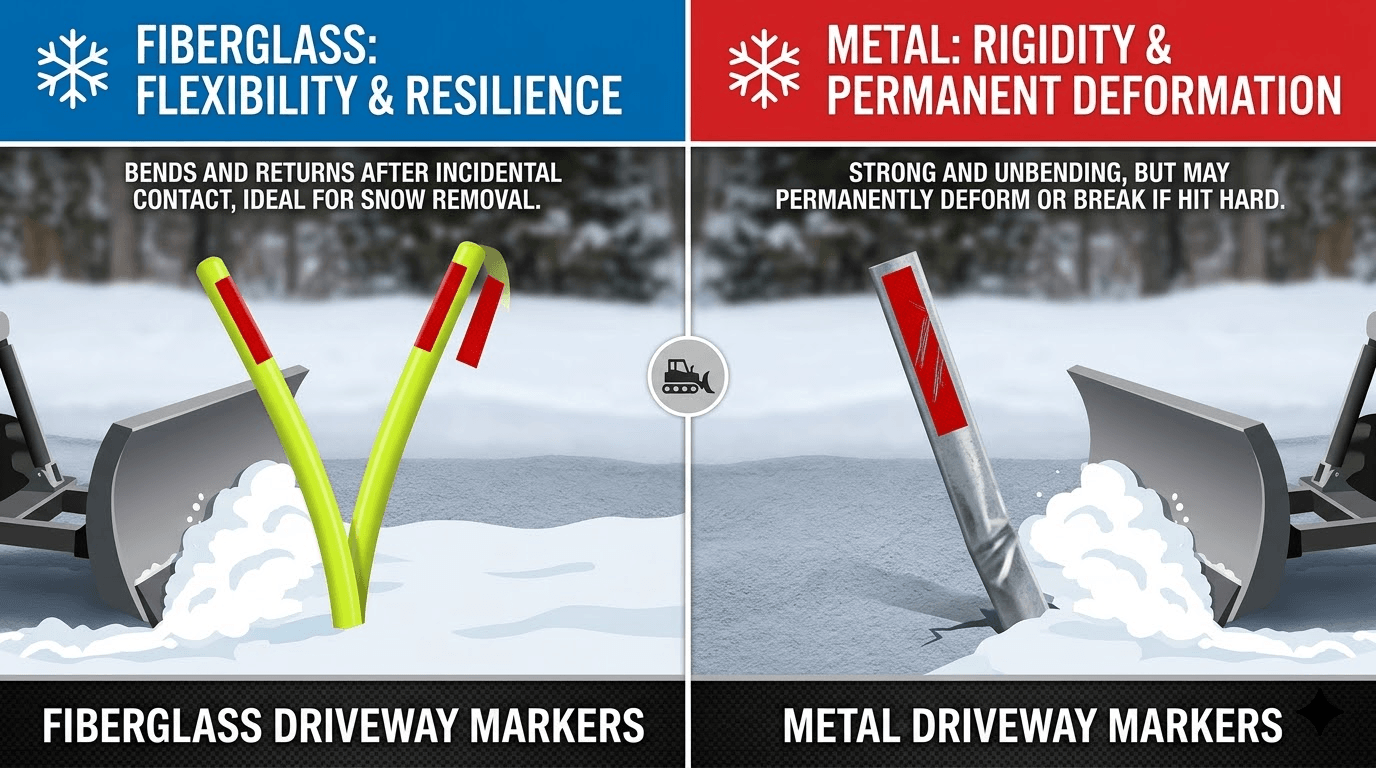
“Flexible,” “rigid,” and “rebound” are incomplete purchasing requirements. A marker can deflect without returning to its original position, survive one contact but accumulate damage under repeated contact, or remain intact while its reflective component or mounting interface fails.
For Routine Purchases
Start with four practical questions:
- Does the marker return to an acceptable position after contact?
- Does repeated contact create cracks, permanent bending, exposed fibers, sharp edges, or attachment damage?
- Does the reflective component remain attached and visible?
- Does the complete assembly behave acceptably at the project’s winter temperature?
The level of qualification can then be matched to the order size, exposure, operational risk, and procurement requirements. A routine private-site purchase may begin with documented samples and a small installation trial. A larger route or high-contact application can justify a more controlled and repeatable comparison.
ASTM D790 provides established methods for measuring flexural properties of reinforced and unreinforced plastics. Its scope also makes clear that measured properties are affected by factors such as specimen depth, temperature, atmospheric conditioning, and rate of straining.[2] A D790 value can help characterize a plastic or composite specimen, but it does not by itself predict the field performance of a complete driveway marker struck by plowing equipment.
Use a project-specific assembly test to answer the purchasing question:
- Define the contact event. Record contact height, direction, displacement or load, application rate, number of cycles, and whether the marker is installed in soil or a fixture.
- Condition samples. Test the materials at temperatures and moisture conditions relevant to the site. Do not compare a cold-conditioned sample with a room-temperature competitor.
- Measure more than breakage. Record peak load if equipment permits, maximum deflection, residual lean after a set recovery time, cracks, splinters, coating damage, sharp edges, cap loss, reflective-component damage, and fixture movement.
- Use multiple specimens. A single sample cannot show manufacturing variation or provide a reliable basis for a purchasing decision.
- Set pass/fail criteria before testing. Examples include maximum residual lean, no exposed sharp edge, reflective component retained, and continued visibility from the defined approach.
- Document the setup. Photographs, fixture dimensions, sample identification, temperature, cycle count, and observations make supplier comparisons repeatable.
For a high-contact route, a controlled site pilot is more informative than an unsupported “heavy duty” label. Install a limited quantity of each qualified candidate in comparable zones, map each location, and inspect them on the same schedule.
Compare Weathering as a System, Not a Claim
Outdoor durability cannot be established from the base material name. NIST research on polymer composites identifies ultraviolet radiation, temperature, humidity, moisture, and cyclic loading as conditions that can affect composite damage and durability.[3] This is why “fiberglass” alone does not prove a particular service life.
Accelerated exposure results also need context. ASTM G154 describes fluorescent-UV and water-exposure apparatus, but the practice does not prescribe a universal exposure that produces a specific service-life result. The exposure cycle and evaluation method must be selected for the material and application, and different devices should not be compared without demonstrated correlation.[4]
For fiberglass or plastic candidates, ask for the exact sample identification, exposure cycle, duration, temperature, moisture phase, property measured before and after exposure, and acceptance rule. Useful evaluations may include surface inspection, color change, retained flexural response, cracking, fiber exposure, or attachment retention. Do not convert hours in an accelerated apparatus directly into years outdoors unless a validated correlation exists for that material system and use condition.
For metal candidates, exposure review should include the alloy or steel grade, coating system, coating thickness or other specified control, treatment of cut ends, likely damage during installation, and deicing-salt conditions. FHWA corrosion guidance emphasizes that atmospheric corrosion depends on the metal, the environment, and protective measures; coatings are part of a corrosion-control system rather than proof of indefinite life.[5]
For wood candidates, moisture is a design variable rather than a side issue. The USDA Forest Service Wood Handbook explains the relationships among moisture content, shrinkage, swelling, and dimensional stability.[6] Species, treatment, seasoning, end condition, and wet-dry exposure therefore belong in the comparison.
Visibility Depends on the Complete Installed Marker
A bright shaft and a reflective component solve different parts of the visibility problem. Shaft color can support daytime recognition, while retroreflective material returns light toward its source under suitable geometry. Neither feature guarantees that an installed marker will be visible through every combination of snow, dirt, spray, approach angle, headlamp position, or background clutter.
Evaluate visibility with the actual assembly:
- Specify the viewing direction and observation distances.
- Record shaft color, exposed height, reflective-component location, width, and orientation.
- Observe samples in daylight, dusk, and darkness with representative vehicle lighting.
- Repeat observations after applying representative dirt, water, or snow contamination.
- Check both straight and curved approaches rather than only a front-on view.
- Define a replacement trigger for damaged, obscured, or missing reflective material.
ASTM D4956 covers flexible, non-exposed glass-bead-lens and microprismatic retroreflective sheeting used for traffic-control applications.[7] If a supplier cites that specification, verify the exact sheeting classification and documentation. A compliant sheeting component does not automatically certify the entire driveway-marker assembly, nor does it establish suitability for a public-road installation.
Installation Can Change the Result
The same shaft can behave differently when driven too deeply, installed into frozen ground, placed in loose fill, fixed in a rigid bracket, or struck near an attachment. Installation trials therefore belong in supplier qualification.
Record the substrate, pilot-hole method if used, insertion depth, setback, spacing, tool, and any damage found immediately after installation. Locate underground utilities before driving any stake. Keep markers clear of travel paths and other positions where the installed assembly could create a hazard. Where the work is near a public road, obtain the road authority’s placement and device requirements.
Calculate Total Cost From Field Records
The lowest unit price is not necessarily the lowest operating cost, and a higher-priced marker does not automatically last longer. Use the same cost categories and observation period for every candidate:
Total cost for the pilot period = purchase + freight + installation labor + inspection labor + maintenance + replacement material + replacement labor + removal and disposal − recoverable value
Also record the number of marker-days in service or another exposure basis that fits the project. Comparing 100 markers used for a full winter with 20 markers installed for one month produces a misleading replacement rate unless exposure is normalized.
Before declaring a winner, separate failure causes:
- Shaft fracture, permanent bend, split, or surface damage
- Reflective-component loss or visibility failure
- Cap, point, bracket, or adhesive failure
- Ground pullout or installation damage
- Plow removal, theft, landscaping activity, or untraceable loss
This classification prevents a mounting failure from being attributed to the shaft material and turns the next purchase into an evidence-based decision.
fiberglass vs metal driveway markers
A Repeatable Buyer Qualification Plan
Use this sequence when comparing fiberglass driveway markers with metal, plastic, or wood alternatives.
1. Write the operating profile
Document application, quantity, site map, snow conditions, temperature and moisture exposure, deicing chemicals, expected contact events, desired visibility, installation surface, seasonal storage, inspection interval, and authority requirements.
2. Build a comparable sample set
Ask each supplier to identify the sample’s shaft material, geometry, length, color, reflective component, point or mounting interface, cap, and any surface treatment. Test assemblies intended for the same job; do not compare a bare rod with a complete marker and call the result material performance.
3. Run bench and installation checks
Use the same conditioning, fixture, contact point, rate, cycle count, installation surface, and acceptance rules. Record failures and residual condition rather than relying on visual impressions alone.
4. Run a mapped site pilot
Divide the route into exposure zones such as straight boundaries, curves, entrances, obstacles, and high-contact areas. Distribute candidates across comparable zones, give every marker an ID, and record installation date and location.
5. Inspect on a fixed schedule
Use the same inspection form for all candidates. Photograph damage, record visibility status, classify the failure mode, and note replacement labor. Avoid changing the test population or acceptance rules midway through the pilot.
6. Approve by requirement, not by label
The purchasing output should state the approved assembly, application limits, installation method, inspection interval, replacement triggers, required supplier documents, and any unresolved conditions. “Fiberglass,” “metal,” or “heavy duty” is not a complete approval description.
Common Comparison Errors
- Using one universal lifespan. Service life changes with the exact assembly, exposure, contact frequency, installation, and replacement criteria.
- Treating flexibility as impact survival. Measure deflection, damage, and residual straightness under a defined event.
- Treating rust resistance as total weather resistance. A non-rusting shaft can still have weather-sensitive matrix, color, adhesive, cap, or reflective components.
- Comparing supplier tests with different conditions. A higher reported value is not meaningful until specimen geometry, conditioning, method, and acceptance criteria are aligned.
- Ignoring the mounting interface. Ground retention, brackets, points, caps, and adhesives can determine field failure.
- Using purchase price as ROI. Include installation, inspection, loss, replacement, and disposal on the same exposure basis.
- Assuming a reflective component qualifies the assembly. Verify the exact component documentation and the project’s authority requirements.
Prepare a Useful RFQ
Explore our fiberglass driveway markers when this material is a candidate for your project. Send us the application, quantity, expected snow depth, required length and geometry, color and visibility requirements, reflective-component requirements, installation or mounting method, expected temperature and weather exposure, plowing equipment or other equipment likely to contact the markers, packaging needs, destination, acceptance criteria, and requested documents. We will use these inputs to define the quotation scope and identify any product, sample, testing, documentation, and delivery requirements that need to be resolved in the quotation.
References
- Federal Highway Administration, 11th Edition of the MUTCD with Revision 1, December 2025.
- ASTM International, ASTM D790, Standard Test Methods for Flexural Properties of Unreinforced and Reinforced Plastics and Electrical Insulating Materials.
- National Institute of Standards and Technology, Polymer Composites.
- ASTM International, ASTM G154, Standard Practice for Operating Fluorescent Ultraviolet (UV) Lamp Apparatus for Exposure of Materials.
- Federal Highway Administration, Best Practices for Corrosion Control and Mitigation, FHWA-HRT-24-127.
- USDA Forest Service, Wood Handbook, Chapter 4: Moisture Relations and Physical Properties of Wood, 2021.
- ASTM International, ASTM D4956-26, Standard Specification for Retroreflective Sheeting for Traffic Control.


