 info@unicomposite.com


Introduction
Cooling towers operate in one of the most aggressive material environments in heavy industry. Continuous moisture, biocide and acid dosing, thermal cycling between ambient and 60°C+, and in many installations, direct exposure to chlorine or sulfuric acid pH correction chemicals — the combination degrades carbon steel in under a decade and challenges even galvanized coatings within five to eight years of commissioning.
The structural and fill-support components that hold a cooling tower together need to survive this environment for 20 to 30 years without corroding, warping, or triggering unplanned replacement shutdowns. FRP — fiberglass reinforced polymer — has become the dominant material specification for cooling tower structural components precisely because it eliminates the failure modes that drive the highest lifecycle costs in conventional steel and PVC installations.
This guide covers each major category of FRP cooling tower component, the specifications that govern material and resin selection, and the comparison data procurement teams need to evaluate FRP against the alternatives before placing a production order.

frp componentsbuilt for 20 30 yearsof reliable service
Why Cooling Tower Environments Demand FRP Over Conventional Materials
The case for FRP in cooling tower applications is not built on a single advantage. It is built on the simultaneous failure of conventional materials across three concurrent operating stresses that cooling towers impose on every structural component.
Continuous Moisture, Chemical Dosing, and Thermal Cycling
Carbon steel corrodes from the moment protective coatings are breached. In cooling tower environments, that timeline is compressed: the combination of continuous surface wetting, dissolved oxygen, and biocide chemistry accelerates galvanic and crevice corrosion at bolted connections, bracket interfaces, and any location where water pools. Field maintenance teams at industrial facilities consistently report that galvanized steel cooling tower structures require first major maintenance intervention at year five to eight — recoating, replacement of corroded fasteners, and in some cases structural member replacement at load-bearing frame nodes.
Chemical dosing compounds the problem. Chlorine-based biocides, pH-correction acids, and scale inhibitors attack metallic surfaces and degrade standard PVC fittings over time. Thermal cycling — the daily and seasonal temperature differential between cold inlet air and warm process water — creates repeated expansion and contraction stress at bolted connections, accelerating fatigue in metallic assemblies that FRP’s lower thermal expansion coefficient largely avoids.
FRP eliminates all three failure modes at the material level, not through protective coatings that eventually fail.
FRP’s Corrosion Resistance and Structural Stability Under Service Conditions
FRP’s corrosion resistance in wet chemical environments is not a marketing claim — it is testable. ASTM C581 (Standard Practice for Determining Chemical Resistance of Thermosetting Resins) provides the standard immersion test methodology; buyers should request C581 test data for the specific resin system against the chemicals present at their installation site, not rely on generic product datasheets.
Structurally, FRP maintains its mechanical properties across the service temperature range typical of industrial cooling towers: -40°C to +120°C for standard vinyl ester laminates, with higher upper limits available in phenolic resin systems where fire performance is the primary design driver. Unlike metallic materials, FRP does not experience corrosion-driven cross-section reduction over its service life — the structural properties present at installation remain essentially constant through year 25 under normal operating conditions.
Understanding what FRP resists — and under which specific chemical and thermal conditions — is the foundation for selecting the right resin system and profile geometry, which is exactly where the next section begins.
FRP Components Used in Cooling Tower Construction
Cooling towers use FRP across multiple distinct component categories, each with different structural requirements, load profiles, and surface finish specifications. The table below provides a system-level overview before each component category is addressed in detail.
The following table maps FRP component types to their typical specifications, installation position, the conventional material they most commonly replace, and comparative service life estimates under standard industrial cooling tower operating conditions (vinyl ester resin, chemical dosing within normal biocide parameters, operating temperature below 60°C):
| Component Type | Typical FRP Profile/Product | Installation Position | Replaces | Service Life: FRP vs. Conventional* |
|---|---|---|---|---|
| Structural frame members | Pultruded channels, angles, I-beams (50–300 mm) | Primary load-bearing frame | Galvanized steel | 25–30 yr vs. 8–15 yr |
| Fill and basin support | Molded or pultruded FRP grating (25–50 mm depth) | Fill deck, basin floor, access platforms | Steel grating / timber | 20–25 yr vs. 5–10 yr |
| Water distribution piping | Pulwinding FRP pipes (DN50–DN300) | Pressurized distribution headers | PVC / steel pipe | 20+ yr vs. 10–15 yr |
| Access and maintenance | GRP ladder systems, pultruded handrail | Vertical access, platform perimeter | Aluminum / steel | 25+ yr vs. 10–18 yr |
| Drift eliminator support | FRP flat bar, angle, custom profiles | Drift eliminator mounting frame | PVC angle / steel | 20+ yr vs. 8–12 yr |
Service life estimates assume vinyl ester resin, standard industrial chemical dosing, and operating temperature below 60°C. Galvanized steel in mild inland environments with low chemical exposure may achieve 12–15 years before first major intervention; the lower end of the conventional range applies to coastal or high-chlorine dosing environments.
Structural Frame: Pultruded Profiles
Pultruded FRP channels, angles, I-beams, and square tubes form the primary load-bearing skeleton of the cooling tower structure. Standard section sizes range from 50×50 mm angles to 300 mm depth I-beams; wall thickness and flange geometry are matched to span and load requirements through supplier-issued section property tables.
Pultruded FRP structural profiles achieve tensile strengths of 207–310 MPa along the fiber axis — comparable to 6061 aluminum at 270 MPa and sufficient for primary frame members in towers up to 12 meters in height under standard wind and fill loading. The pultrusion process delivers consistent wall thickness tolerance of ±0.4 mm and outer dimension tolerance of ±0.8 mm, which allows FRP profiles to substitute directly for steel equivalents using standard bolted connection details without connection redesign. No welding is required; all connections use stainless or FRP fasteners through pre-drilled or field-drilled holes.
OEM cooling tower manufacturers using FRP structural profiles report 30–40% reductions in on-site assembly time compared to steel frame systems. The weight reduction — FRP structural profiles weigh approximately 25% of equivalent steel sections — eliminates most crane requirements for modules up to 6 meters in height, reducing installation cost and schedule risk on constrained sites.
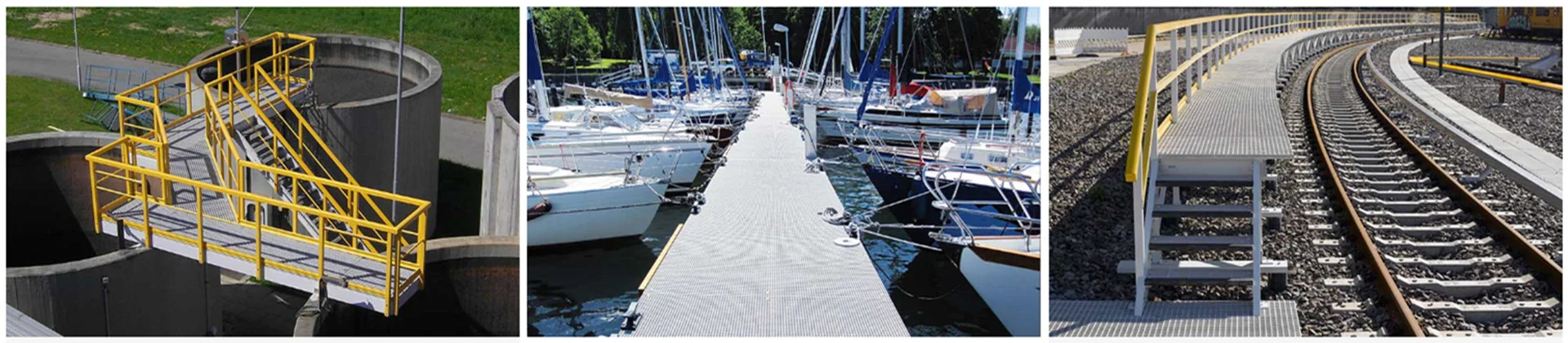
Fill and Walkway Support: FRP Grating
FRP grating serves two distinct functions in cooling tower systems: structural support for fill media and drift eliminators, and the walking surface for routine maintenance access. Both functions impose specific performance requirements that determine the grating specification.
For fill support applications, molded FRP grating with 25 mm depth and standard 25 mm × 25 mm or 38 mm × 38 mm mesh openings provides adequate distributed load capacity for most fill media weights while allowing unrestricted airflow through the structure. For maintenance walkways, pultruded grating in 38 mm or 50 mm depth carries higher one-way load capacity and is the appropriate specification for platforms rated to 2.5–5.0 kN/m² under OSHA 1910.22 walkway load requirements.
Fire rating applies to both uses. For any cooling tower platform where maintenance personnel have regular access, ASTM E84 Class 1 (flame spread index ≤ 25, smoke developed index ≤ 450) is the standard specification in North American projects. Buyers must request third-party test certification for the specific grating series and depth being supplied — not the manufacturer’s broader product family — before finalizing the specification.
Water Distribution and Piping: Pulwinding Pipes
Pulwinding — a hybrid manufacturing process combining continuous pultrusion with helical filament winding — produces FRP pipes and tubes with both high axial stiffness and elevated hoop strength. The combination is essential for pressurized water distribution applications where internal pressure loads require circumferential reinforcement that straight pultrusion alone cannot provide.
Standard pulwinding pipe for cooling tower water distribution is available from DN50 to DN300, with pressure ratings from 0.4 MPa for large-diameter headers to 1.6 MPa for smaller distribution branches, depending on wall thickness and winding angle. In pressurized cooling tower distribution systems handling chlorinated water at operating temperatures up to 45°C, project engineers routinely specify vinyl ester pulwinding pipe at PN10 pressure rating with a 20% design safety margin — a specification that standard PVC fittings and fittings cannot match without derating the operating pressure or accepting accelerated chemical degradation at joints. Confirm operating pressure, fluid temperature, and chemical profile with the supplier before finalizing pipe specification.
Access and Maintenance: Fiberglass Ladders and Handrail Systems
Access systems in cooling towers demand the same corrosion resistance as the structure itself — and add two requirements that the structural frame does not: non-conductivity and certified anti-slip performance. FRP ladder systems and handrail profiles satisfy both without additional treatment.
FRP ladder rungs are non-conductive, which matters in cooling towers equipped with electrically driven fan assemblies, variable-frequency drives, and vibration sensors. A metallic ladder in contact with an energized component creates a shock hazard that relevant electrical codes address through grounding requirements; FRP eliminates the hazard at the material level. GRP ladder rungs with factory-applied aluminum oxide anti-slip grit surfaces meet OSHA 1910.23 requirements for fixed industrial ladders without additional field modification.
The component-level overview established above sets the specification baseline — the material comparison that follows gives procurement teams the quantitative data to defend that specification against lower-cost alternatives at the project approval stage.

frp in cooling towers
FRP vs. Steel, Aluminum, and PVC in Cooling Towers
Procurement decisions for cooling tower structural components almost always involve a unit cost comparison that favors steel or PVC at the order stage. The table below is designed to reframe that comparison around the metrics that determine 20-year total cost of ownership.
The table below compares the four most commonly specified materials for cooling tower structural components across seven dimensions relevant to lifecycle performance and procurement risk:
| Evaluation Dimension | FRP Fiberglass | Carbon Steel (galvanized) | Aluminum Alloy | PVC / CPVC |
|---|---|---|---|---|
| Weight relative to steel | ~25% | Baseline | ~35% | ~15% |
| Corrosion resistance | Excellent — no surface treatment required | Poor–Moderate — galvanizing fails in 5–8 yr in chemical environments | Moderate — pits in chlorinated or acidic conditions | Good — degrades with UV and sustained high temperature |
| Chemical resistance | Excellent (vinyl ester) — resistant to chlorine, acids, alkalis within rated concentrations | Poor — requires epoxy coating in chemical environments | Moderate — limited pH range | Good — limited to lower operating temperatures and pressures |
| Structural load capacity | High — 207–310 MPa tensile; carries 2.5–7.5 kN/m² in grating applications | High | Moderate | Low — not suitable for primary structure |
| Fire rating achievable | ASTM E84 Class 1 with standard resin formulation | Non-combustible | Non-combustible | CPVC Class 1 achievable with additives; standard PVC does not qualify |
| Typical service life | 20–30 years | 8–15 years depending on environment | 10–18 years | 10–15 years |
| Relative material cost | Moderate–High | Low | Moderate | Low |
A steel grating system requiring professional recoating at year six and structural replacement at year 14 accumulates maintenance and replacement costs equal to 1.8–2.4× the original material cost over a 20-year period — a differential that the FRP material premium at initial purchase rarely exceeds. The total cost of ownership argument for FRP does not require aggressive assumptions: it holds under conservative steel maintenance cost estimates in any environment with active chemical dosing.
Specifying FRP for Cooling Tower Projects: What Procurement Teams Need to Confirm
Correct FRP specification for a cooling tower project requires decisions at four levels: resin system selection, fire rating certification, structural load verification, and dimensional documentation. Each is a procurement risk point if left unaddressed in the purchase order documentation.
Resin System Selection by Chemical Exposure
The resin system determines the FRP component’s chemical resistance — and the standard options are not interchangeable. Isophthalic polyester provides adequate water resistance for general cooling tower service where biocide concentrations remain within standard treatment parameters (free chlorine below 3 ppm, pH maintained between 6.5 and 8.5). Vinyl ester resin is the correct specification wherever free chlorine exceeds 3 ppm, pH correction drops the circuit below 6.5, or oxidizing scale inhibitors are used at elevated concentrations — conditions that isophthalic polyester handles poorly beyond a three-to-five year service horizon. Phenolic resin applies where fire performance governs over chemical resistance, typically in enclosed mechanical rooms or applications requiring UL-rated materials.
Buyers should provide the complete chemical treatment profile — chemical names, concentrations, and operating temperature range — to the FRP supplier at the quotation stage and request written confirmation of resin system compatibility against ASTM C581 immersion data. Verbal assurances at the sales stage do not constitute a specification; a written chemical compatibility statement does.
Fire Rating, Load Certification, and Dimensional Documentation
Before releasing a purchase order for FRP cooling tower components, procurement teams should request four documents as standard practice. First, a third-party ASTM E84 test certificate for the specific profile or grating series — not the product family. Second, a span-and-load table from the supplier for the grating depth and mesh size specified, confirming the assembly meets the platform’s rated load under OSHA 1910.22. Third, dimensional tolerances for pultruded profile sections (wall thickness ±0.4 mm, outer dimension ±0.8 mm are standard benchmarks for quality production). Fourth, a first-article inspection report for the initial production run confirming dimensional and resin compliance.
These documents exist for well-manufactured products. A supplier unable to provide them at the quotation stage represents a qualification risk regardless of the price offered.
Sourcing FRP Cooling Tower Components from Unicomposite
Cooling tower projects typically require multiple FRP product categories from a single bill of materials: structural profiles, grating, piping, and access systems. Sourcing these from multiple suppliers introduces tolerance mismatch risk, inconsistent resin system specification across component categories, and extended procurement lead times that complicate project scheduling.
Unicomposite Technology Co., Ltd. — ISO 9001-certified and operating from an 18,000 m² manufacturing facility in Nanjing — produces the full range of FRP cooling tower components from a single manufacturing source: pultruded structural profiles across more than 40 standard cross-sections from 25 mm to 300 mm, molded and pultruded grating in standard and custom mesh configurations, pulwinding pipes for pressurized distribution applications, and GRP access system components. The facility operates pultrusion, pulwinding, filament winding, and compression molding lines, which means vinyl ester resin can be specified consistently across all component categories — eliminating the resin system inconsistency risk that arises when structural profiles, grating, and piping are sourced from separate suppliers with different production standards.
Engineering support for non-standard configurations — custom profile geometries, non-catalog section depths, hybrid fiber constructions, or project-specific chemical compatibility requirements — is available at the specification stage, before orders are placed.
Conclusion
FRP cooling tower components deliver their value through consistent performance across a 20–30 year service life in conditions that degrade every conventional alternative within a decade. Five decisions determine whether procurement teams capture that value or dilute it through incomplete specification:
- Specify the resin system using chemical threshold data, not product categories. Vinyl ester for free chlorine above 3 ppm, pH below 6.5, or oxidizing inhibitor chemistry. Isophthalic polyester for standard treatment parameters within those bounds. Require written ASTM C581 compatibility confirmation before purchase order release — not verbal assurance.
- Require ASTM E84 Class 1 certification for the exact product series supplied to occupied platforms. Product-family certifications do not cover specific grating depths or mesh configurations. The certificate must match what ships to site.
- Consolidate to a single-source FRP supplier where the bill of materials spans multiple component categories. Resin system consistency across structural profiles, grating, and piping eliminates interface risk that multi-supplier procurement introduces at no additional cost.
- Build span-and-load table review into the specification process. Grating depth and mesh opening must be confirmed against actual distributed load and span conditions for each platform — not selected from catalog defaults without engineering review.
- Model total cost of ownership before comparing unit prices. A steel grating system requiring recoating at year six and replacement at year 14 accumulates 1.8–2.4× its original material cost in maintenance and replacement expenditure — a differential the FRP premium at initial purchase rarely reaches.
[Contact Unicomposite for FRP cooling tower component specifications, resin system recommendations, and a project-specific quote →]
Frequently Asked Questions
The threshold is defined by chemical exposure parameters rather than application type. Isophthalic polyester is appropriate where free chlorine stays below 3 ppm and pH is maintained between 6.5 and 8.5 — conditions typical of standard biocide-treated open cooling circuits. Vinyl ester is required wherever those thresholds are exceeded, wherever oxidizing scale inhibitors are used at elevated concentrations, or wherever operating temperature consistently exceeds 50°C. Buyers should provide a full chemical treatment schedule — chemical names, dosing concentrations, and temperature range — to the supplier and request written compatibility confirmation against ASTM C581 immersion test data.
In most cases, yes. Pultruded FRP channels, angles, and I-beams can be specified to match the outer dimensions of existing steel sections and connected using the same bolted patterns and connection details. The 25% weight reduction relative to steel typically eliminates crane requirements for refurbishment lifts in modules up to 6 meters, reducing installation cost and schedule. Buyers should provide the original structural drawings to the FRP supplier for dimensional confirmation and section property verification before the specification is finalized.
ASTM E84 Class 1 — flame spread index ≤ 25 and smoke developed index ≤ 450 — is the standard requirement for FRP grating on occupied cooling tower platforms in North American commercial and industrial projects. Buyers must request a third-party test certificate covering the specific grating series, depth, and mesh configuration being supplied. Product-family certifications do not substitute for product-specific documentation; confirm with the local Authority Having Jurisdiction which standard applies before finalizing the specification.
Four documents provide the minimum verification baseline: a third-party ASTM E84 test certificate for the specific product series and configuration; a span-and-load table confirming the grating meets the platform’s rated load under OSHA 1910.22; dimensional tolerances for pultruded profiles (wall thickness ±0.4 mm and outer dimension ±0.8 mm are standard quality benchmarks); and a first-article inspection report for the initial production run. Suppliers who cannot provide all four at the quotation stage represent a qualification risk that lower unit pricing does not offset.
Standard pultruded profiles and grating in catalog configurations generally ship within 7–15 business days. Custom configurations — non-standard profile geometries, specialty resin systems, non-catalog grating depths, or pre-cut and pre-drilled components — typically require 20–35 production days after engineering review and first-article approval. Pulwinding pipe in non-standard diameters or wall thicknesses carries comparable lead times. For projects with fixed installation windows, custom component lead times should be built into the procurement schedule at the design development stage, not the purchase order stage.


