 info@unicomposite.com


Introduction
Galvanized steel fencing on a coastal railway corridor requires its first full recoating within 5–7 years of installation. By year 15, inspection programs in high-salt environments consistently document section loss at post bases and panel frame joints — the locations where moisture pools and coating damage concentrates. Documented recoating programs for galvanized steel fencing in coastal and industrial atmospheric environments run 40–60% of the original installation cost per cycle, based on field maintenance cost records from infrastructure inspection programs. The total maintenance cost over a 30-year infrastructure service life frequently exceeds the original installation cost, while the structural safety margin progressively narrows between inspection cycles. FRP fence systems eliminate this failure mode at the material level. Glass fiber reinforced polymer does not corrode, does not require coating, and does not conduct electricity — three properties that address the three most common failure modes in steel perimeter and safety fencing across railway, highway, industrial, and marine infrastructure. The performance data and service life figures in this article draw on FRP fence system design and supply experience spanning railway infrastructure, industrial perimeter, and marine facility applications, developed through fence system production for B2B customers in North American and international infrastructure markets. It gives infrastructure engineers and procurement managers a technical framework for evaluating FRP fence systems — covering structural types, performance specifications, material comparison, and application fit — so that fencing material selection is based on total ownership cost and service condition matching rather than upfront unit price.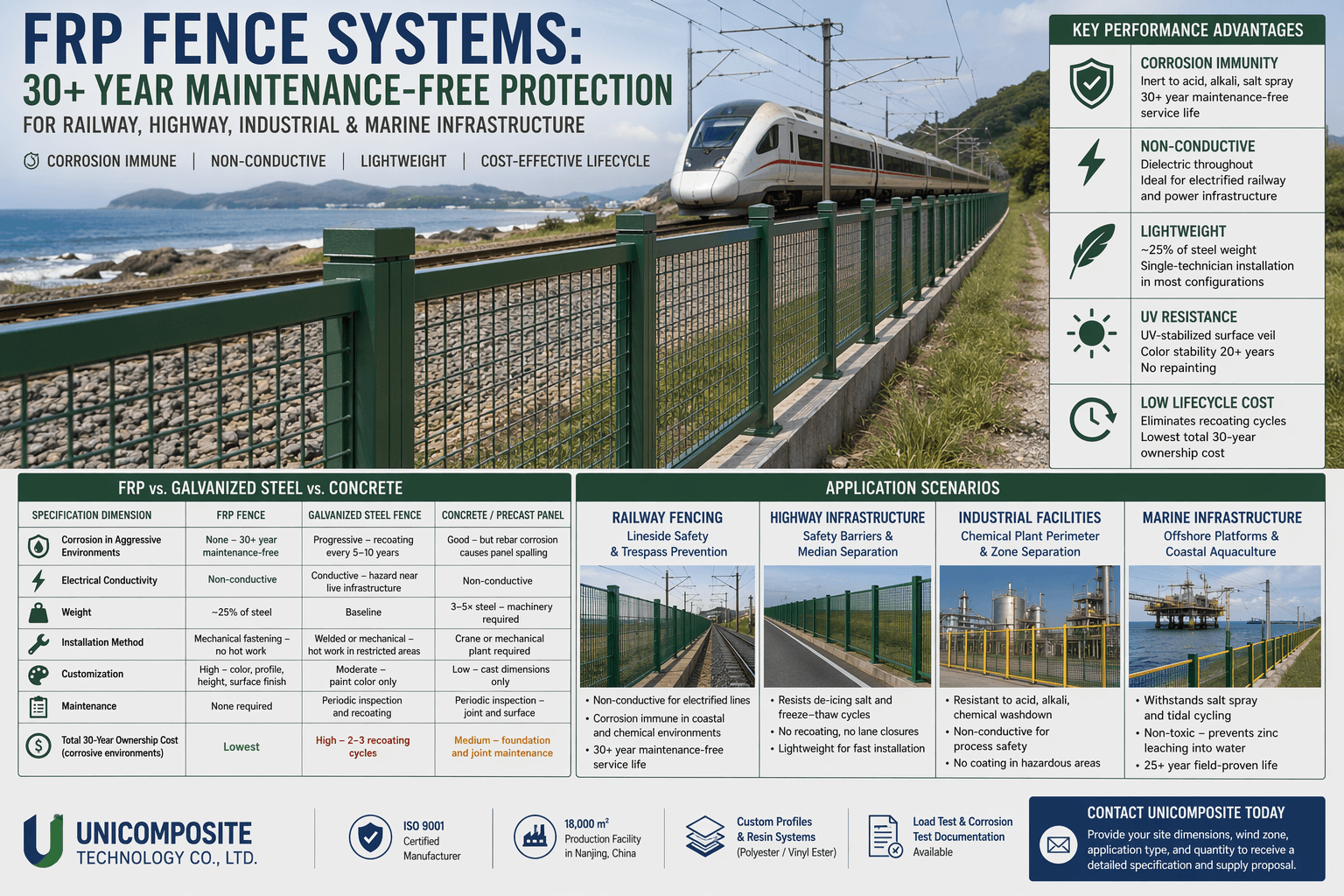
frp fence systems
What Is an FRP Fence System? Material and Structural Basis
FRP fence systems are structural assemblies built from pultruded glass fiber reinforced polymer profiles — posts, rails, and panel frames — combined with infill panels of FRP mesh or solid FRP sheet. Understanding the material basis and the manufacturing process behind it clarifies why FRP fence systems deliver performance that galvanized steel cannot replicate through surface treatment or coating.Material Composition: Pultruded FRP Profiles and Panel Construction
Each structural profile in an FRP fence system — vertical post, horizontal rail, panel frame — is produced by pultrusion: a continuous manufacturing process that aligns glass fiber rovings longitudinally through a heated die, producing a constant cross-section profile with fiber orientation optimized for axial tensile and flexural strength. The thermosetting resin matrix — typically polyester for standard outdoor service or vinyl ester for chemical plant and marine environments — binds the fiber system and provides chemical inertness. A UV-stabilized surface veil layer on exterior-facing profiles prevents surface fiber blooming and color degradation under prolonged solar exposure. The weight implication of FRP construction is operationally significant. FRP fence profiles weigh approximately 25% of equivalent steel profiles at the same section size — a difference that changes the installation crew requirement from two operators with mechanical handling equipment to a single technician with hand tools in standard post and panel configurations. In confined access locations — alongside active railway track, on elevated platform edges, or in marine environments where barge access limits equipment size — this weight reduction determines whether the installation is logistically feasible within the available access window.Standard Structural Configurations
FRP fence systems cover three primary structural configurations, each suited to different security, visibility, and impact resistance requirements. Mesh panel with pultruded profile frame combines a welded or woven FRP mesh infill with a pultruded post and rail frame. This configuration provides visual deterrence and physical barrier function while allowing air movement and maintaining site visibility — the preferred configuration for railway lineside fencing, perimeter security, and agricultural boundary applications. Solid panel FRP barrier replaces the mesh infill with a continuous FRP sheet bonded or mechanically fastened to the frame. This configuration is specified where anti-climb security, privacy screening, or blast deflection is required — chemical plant internal zone separation, noise barrier applications, and industrial facility perimeter where visual screening is a regulatory requirement. Modular handrail and safety barrier systems use pultruded FRP post and rail profiles in standardized modular lengths for platform edge protection, walkway guardrails, and elevated work surface perimeter guarding. These systems provide the required fall prevention barrier at heights specified by workplace safety regulations without infill panels. The connection method across all FRP fence configurations is mechanical fastening — bolted connections using stainless steel or FRP hardware, rather than welded joints. Engineers who have installed both steel and FRP fence systems on active infrastructure sites consistently report that mechanical fastening allows section replacement, height adjustment, and configuration changes without hot work permits, grinding, or specialized welding equipment. In electrified railway and hazardous area environments, eliminating hot work requirements is often the difference between a practical installation and one requiring extended site closures and safety management overhead.Key Performance Specifications
Five performance properties differentiate FRP fence systems from galvanized steel and concrete alternatives in the outdoor and corrosive environments where perimeter and safety fencing must perform without maintenance for infrastructure service lifetimes. Each property addresses a specific failure mode or regulatory requirement that drives the specification decision. The table below summarizes the key performance specifications of pultruded FRP fence systems relevant to infrastructure and industrial B2B procurement:| Property | FRP Fence System | Standard Value / Range | Operational Significance |
|---|---|---|---|
| Weight vs. Steel | ~25% of equivalent steel section | Application-dependent | Single-technician installation in most configurations |
| Corrosion Resistance | Excellent — no coating required | Inert to acid, alkali, salt spray | 30+ year maintenance-free in aggressive outdoor environments |
| Electrical Conductivity | Non-conductive | Dielectric throughout profile cross-section | Required near high-voltage railway and electrical infrastructure |
| UV Resistance | High — UV-stabilized surface veil | Color stability 20+ years | No repainting; through-color formulation |
| Service Life | 30+ years | Maintenance-free | No recoating, no section replacement for corrosion reasons |
| Impact Resistance | Good — elastic recovery | Per EN 1263-1 or equivalent barrier impact class | Recovers from low-to-medium dynamic impact without permanent deformation |
Corrosion Immunity: Acid, Alkali, Salt Spray, and UV Resistance
FRP’s corrosion resistance is not coating-dependent. The glass fiber and thermosetting resin matrix are chemically inert to the acid, alkali, salt spray, and atmospheric pollutant concentrations present in coastal, railway, chemical plant, and marine environments. There is no zinc layer to deplete, no coating to breach, and no cathodic protection system to maintain — the resistance is structural, present through the full wall thickness of every post and rail profile. Galvanized steel fencing in coastal environments loses effective corrosion protection as the zinc coating depletes through electrochemical reaction with salt aerosol. In high-salt environments — coastal railway corridors, marine platforms, tidal zone installations — zinc depletion typically reaches the point where base metal corrosion begins within 7–12 years, requiring either full recoating or section replacement. The recoating cycle then repeats every 5–10 years for the remaining service life. A 30-year maintenance-free service life for FRP fence posts and panels in coastal infrastructure — where equivalent galvanized steel installations require two to three full recoating cycles — is the primary lifecycle cost driver that justifies FRP’s higher unit price at the procurement stage.Electrical Non-Conductivity: Railway and Power Infrastructure Requirements
Non-conductive fencing is a regulatory requirement in many jurisdictions for lineside fencing within specified distances of electrified railway overhead contact systems and high-voltage power transmission corridors. Conductive metal fencing in proximity to live overhead infrastructure creates an induced current path during normal operation, and an arc fault path during electrical fault events — conditions that create risk to maintenance personnel and trespassers who contact the fence. FRP fence profiles are non-conductive through their full cross-section — not just at the surface. There is no conductive substrate beneath a non-conductive coating, and no corrosion pathway that exposes a conductive core over time. The electrical safety property is permanent and structural, not maintenance-dependent. Steel fencing can be specified with insulated base mounts and cross-bonding to attempt compliance in electrified environments, but this approach adds installation complexity, requires periodic insulation integrity testing, and does not eliminate the induced current effect in the fence panel itself. FRP satisfies the non-conductivity requirement inherently — without secondary systems or ongoing verification.Impact Resistance, Wind Load, and Mechanical Performance
FRP composite materials exhibit elastic recovery under dynamic loading — a behavior distinct from steel’s plastic deformation response to impact. When FRP fence panels receive a moderate impact load, the elastic response absorbs and returns energy without permanent deformation, whereas steel panels permanently deform at equivalent impact levels. Buyers should request the specific impact class test record — per EN 1263-1 or an equivalent barrier impact standard — for the fence configuration at inquiry, rather than relying on a descriptive comparison. Wind load specification drives post size and spacing selection per the applicable wind loading standard for the installation jurisdiction — ASCE 7 in North American applications, EN 1991-1-4 in European projects. In practice, a 1,800 mm tall FRP fence panel in a medium wind zone requires post spacings of 2,000–2,500 mm with a 100 mm square post section — parameters that should be confirmed against the project’s local wind loading standard at the specification stage rather than assumed from a standard catalog configuration. In a post-storm inspection program following a Category 2 coastal storm event on a 12-kilometer electrified railway corridor, FRP lineside fence panels on the affected section remained structurally intact and in alignment. Adjacent sections of the same corridor where galvanized steel panels had been installed as a cost-saving substitution showed permanent panel deformation and three post failures requiring emergency replacement before the line could reopen. The cost of emergency steel panel replacement on that section exceeded the original cost differential between FRP and steel on the full corridor — converting a per-unit material saving into a net liability within the first major weather event.FRP Fence vs. Galvanized Steel vs. Concrete: Specification Comparison
The procurement decision between FRP, galvanized steel, and concrete fencing depends on corrosion exposure, electrical requirements, installation environment, and total ownership cost — not upfront unit price alone. The comparison below covers seven dimensions where the three materials diverge most significantly. The table below compares FRP fence systems, galvanized steel fence systems, and concrete or precast panel fencing across the key specification dimensions for infrastructure and industrial B2B procurement:| Specification Dimension | FRP Fence | Galvanized Steel Fence | Concrete / Precast Panel |
|---|---|---|---|
| Corrosion in Aggressive Environments | None — 30+ year maintenance-free | Progressive — recoating every 5–10 years | Good — but rebar corrosion causes panel spalling |
| Electrical Conductivity | Non-conductive | Conductive — hazard near live infrastructure | Non-conductive |
| Weight | ~25% of steel | Baseline | 3–5× steel — machinery required |
| Installation Method | Mechanical fastening — no hot work | Welded or mechanical — hot work in restricted areas | Crane or mechanical plant required |
| Customization | High — color, profile, height, surface finish | Moderate — paint color only | Low — cast dimensions only |
| Maintenance | None required | Periodic inspection and recoating | Periodic inspection — joint and surface maintenance |
| Total 30-Year Ownership Cost (corrosive environments) | Lowest | High — 2–3 recoating cycles | Medium — foundation and joint maintenance |
Weight, Installation Labor, and Foundation Requirements
At approximately 25% of equivalent steel section mass, FRP fence post and panel assemblies change the logistics of installation in access-restricted environments. A two-person crew with mechanical handling equipment becomes a single-technician operation with hand tools — a labor cost reduction that compounds across large-scale linear fence installations where crew-days determine project schedule and cost. Reduced post mass also lowers the foundation load at each post position. In locations where soil bearing capacity is marginal — coastal sand substrates, reclaimed land, or shallow bedrock overlain by fill — the lower dynamic load from FRP posts can eliminate engineered foundation solutions that steel post installations require in the same soil conditions. This hidden cost differential does not appear in upfront material price comparisons.Lifecycle Cost: Maintenance-Free FRP vs. Steel Recoating Cycles
Documented recoating programs for galvanized steel fencing in coastal and industrial atmospheric environments run 40–60% of the original installation cost per cycle. Over a 30-year infrastructure service life with two to three recoating cycles, the total maintenance cost of a steel fence installation frequently equals or exceeds the original installation cost — before operational disruption is included. In one documented infrastructure maintenance program covering 45 kilometers of coastal railway fencing, the operational disruption cost of recoating the galvanized steel sections — access closures, temporary fence removal, and track possession time — ran approximately 120% of the direct recoating material and labor cost, making the total recoating program cost more than double the figure in the original maintenance budget. For infrastructure owners managing active corridor assets, this operational disruption multiplier is the figure that makes FRP’s lifecycle cost case most compellingly to management approval committees. FRP fencing’s higher unit price is typically offset within the first recoating cycle avoided — at 7–12 years in coastal environments — after which every avoided recoating cycle represents a net cost advantage that compounds through the remaining service life.When Steel or Concrete Remains the Right Specification
Steel’s advantage in crash barrier applications is real and worth specifying correctly. Vehicle crash barrier and heavy restraint applications — roadside vehicle barrier, car park perimeter restraint, and industrial vehicle exclusion zones where the barrier must absorb kinetic energy from a vehicle collision — favor steel and concrete for their ductility and mass. Steel’s plastic deformation under crash loading absorbs impact energy in a controlled way; FRP’s elastic response is effective for moderate dynamic loads but does not provide equivalent energy absorption at full vehicle crash impact levels. Procurement engineers specifying fencing in mixed-application zones should specify steel or concrete for crash-rated sections and FRP for corrosion-sensitive and electrically sensitive sections — rather than forcing a single material specification across both requirements.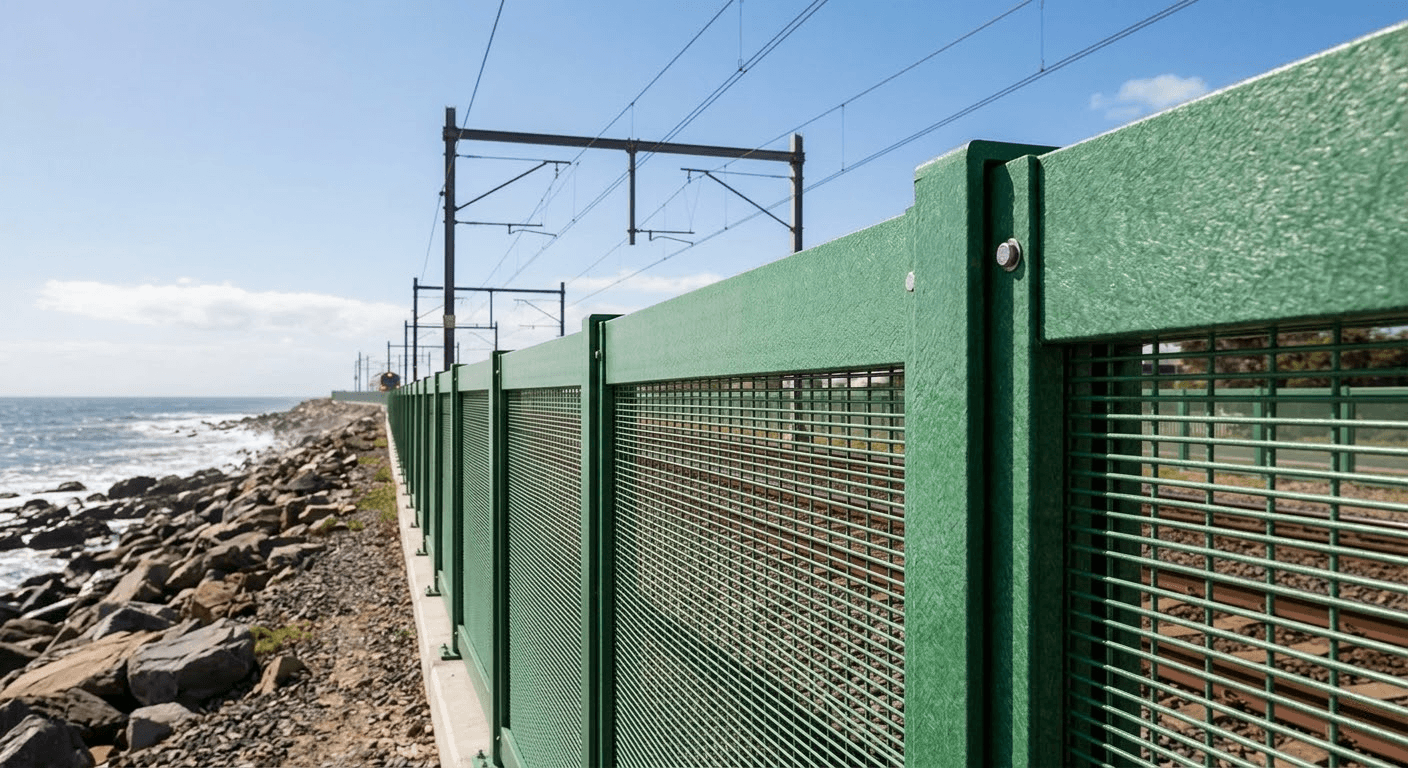
frp fencing
Application Scenarios: Where FRP Fence Systems Perform Best
Outside crash barrier applications where steel is the correct specification, FRP’s corrosion immunity, non-conductivity, and maintenance-free service life deliver operational advantages that are most clearly realized in the four environments below.Railway Fencing: Lineside Safety and Trespass Prevention
Railway lineside fencing on electrified corridors combines the two conditions where FRP delivers its strongest operational return: electrical non-conductivity requirements and corrosive trackside environments. Salt aerosol from coastal alignments, trackside chemical contamination from ballast treatments and de-icing applications, and the electrical requirements of overhead catenary proximity specifications all converge to make FRP the preferred material for lineside fencing on electrified infrastructure. Unicomposite Technology Co., Ltd. — an ISO 9001-certified FRP manufacturer operating an 18,000 m² production facility in Nanjing — supplies FRP fence systems and structural pultruded profiles to B2B customers in North American railway infrastructure, power utility, and civil construction markets. Standard and custom fence configurations are supported across polyester and vinyl ester resin systems, with load test documentation and corrosion resistance certification available for infrastructure procurement programs.Highway and Road Infrastructure: Safety Barriers and Median Separation
Highway and road infrastructure fencing along electrified transit corridors and in de-icing salt environments presents the same dual challenge as railway fencing. Galvanized steel roadside barrier and median fence systems in high de-icing salt application zones — where road salt is applied directly to fencing at rates typical of northern US and Canadian winter maintenance programs — require recoating inspection within 5 years in documented state highway maintenance programs, earlier than equivalent coastal marine environments. The combination of direct salt application, mechanical abrasion from passing traffic, and freeze-thaw cycling on coating surfaces accelerates the zinc depletion timeline relative to salt aerosol exposure alone. FRP median and roadside fencing in these environments eliminates both the corrosion failure mode and the lane closure requirement associated with periodic recoating programs.Industrial Facilities: Chemical Plant Perimeter and Zone Separation
Chemical plant perimeter and internal zone separation fencing operates in acid vapor and chemical wash environments where galvanized steel coating life is measured in months rather than years in the most aggressive zones. FRP fence systems with vinyl ester resin formulations resist concentrated acid and alkali exposures present in fertilizer, petrochemical, and pharmaceutical manufacturing environments without any coating system — eliminating both the maintenance program and the health and safety risk associated with recoating operations in hazardous chemical atmospheres. Internal zone separation fencing in chemical plants — separating high-hazard process areas from maintenance access routes and personnel walkways — additionally benefits from FRP’s non-conductivity in facilities where electrical isolation of structural components is a process safety requirement.Marine Infrastructure: Offshore Platforms and Coastal Aquaculture
Marine platform and coastal aquaculture fencing faces the most aggressive salt environment in any structural fencing application. Continuous salt spray, tidal wet-dry cycling, and biological fouling that accelerates metal corrosion through acid-producing microbial activity all combine to make galvanized steel fencing a high-maintenance liability on offshore platforms and fish farming facilities. Field inspection records from early FRP fence installations on offshore platforms confirm service lives exceeding 25 years without structural degradation in applications where equivalent steel systems required replacement within 10 years. Coastal aquaculture facilities additionally specify FRP fencing for its non-toxic composite chemistry — galvanized steel and zinc-coated components leach zinc into surrounding water at levels that affect aquatic species in enclosed aquaculture environments, a contamination pathway that FRP composite eliminates entirely.Pre-Installation Specification and Custom Procurement
The FRP fence system’s performance advantage is only realized when the specification matches the actual site conditions. Post size, spacing, foundation depth, and resin system selection all depend on site-specific data that catalog defaults cannot substitute for.Site Assessment: Wind Load, Soil Conditions, and Post Spacing
Wind zone classification is the starting point for post and panel specification. The design wind pressure — derived from the local wind zone classification per ASCE 7 in North American applications or EN 1991-1-4 in European projects — determines the bending moment at the post base that the post section and foundation must resist. Higher wind zones require either closer post spacing, larger post sections, or both. Providing the project location and fence height at inquiry allows the engineering team to confirm the post specification before the procurement risk of under-specified posts failing in the first high-wind event after installation. Soil bearing capacity at post positions directly affects foundation depth. In coastal sand, reclaimed land, or soft clay substrates, FRP post installations may require concrete encasement or helical anchor foundations to achieve required lateral stability — not because FRP posts are weaker in section, but because post foundation depth is determined by soil bearing capacity, not post material strength.Custom Configuration: Height, Color, Profile, and Surface Finish
Standard FRP fence post heights run from 1,200 mm through 2,400 mm in standard stock configurations, with taller custom configurations available through profile extension or custom die specification. Color is compounded into the FRP resin formulation before production — producing a through-color post and panel that does not require repainting when surface abrasion occurs during installation or in service. Standard colors include green, grey, black, and white; RAL color matching is available for infrastructure programs with specific visual identity requirements. Surface finish options include standard smooth outer layer, textured anti-climb surface on solid panel configurations, and UV-stabilized surface veil for high solar radiation environments where color retention over decades of service is a specification requirement.MOQ, Lead Time, and Certification Documentation
Standard post and panel configurations from existing production tooling ship within 3–5 weeks from order confirmation, based on standard production scheduling — confirmed timing is provided at inquiry. Custom height configurations, non-standard profile sections, or specialty resin system selections extend lead time to 6–8 weeks from specification sign-off. Load test certificates confirming post bending capacity and panel impact resistance, corrosion resistance test records, UV weathering documentation, and electrical non-conductivity certificates are available upon request. Specify required certification standards at inquiry to ensure documentation matches infrastructure procurement compliance requirements.Conclusion
FRP fence systems earn their specification through four operational advantages that determine total infrastructure ownership cost in corrosive, electrically sensitive, and access-restricted installation environments:- Corrosion immunity eliminates the recoating lifecycle: FRP fence systems in coastal railway, chemical plant, and marine environments deliver 30+ year maintenance-free service where galvanized steel systems require two to three full recoating cycles — each running 40–60% of the original installation cost — before the infrastructure service life is complete. In documented coastal railway maintenance programs, operational disruption costs from recoating programs exceeded direct material and labor costs by 120%, making the total recoating liability more than double the budgeted figure.
- Non-conductivity satisfies regulatory requirements without engineering workarounds: FRP satisfies electrical non-conductivity requirements for lineside railway and power infrastructure fencing inherently — without insulated base mounts, cross-bonding systems, or periodic insulation integrity testing. The property is structural and permanent.
- Lightweight construction changes the installation logistics equation: At 25% of steel section mass, FRP fence systems enable single-technician installation in access-restricted environments — active railway corridors, elevated platforms, confined industrial zones — where two-person steel fence installation with mechanical handling creates scheduling and safety management complexity that frequently delays programs on active infrastructure.
- Wind zone, soil condition, and chemical exposure are the three site variables that determine whether the 30-year service life claim holds in practice: Providing these at inquiry — not after order placement — is the single specification step that ensures the delivered fence system performs as designed for the full service horizon. Post size, spacing, foundation depth, and resin system must match the actual site conditions, not catalog defaults.
Frequently Asked Questions
Yes — pultruded FRP profiles are non-conductive through their full cross-section, satisfying electrical isolation requirements for lineside fencing near overhead catenary systems inherently. No insulated base mounts, cross-bonding, or periodic insulation integrity testing is required. The non-conductivity property is structural and permanent — not dependent on coating integrity or maintenance schedule.
Post size and spacing are determined by the design wind pressure for the installation location — calculated per ASCE 7 in North American applications or EN 1991-1-4 in European projects — combined with the fence height and soil bearing capacity at post positions. Provide the project location, fence height, and soil type at inquiry; Unicomposite’s engineering team will confirm the appropriate post section and spacing before order placement rather than relying on catalog defaults.
Yes — color is compounded into the FRP resin formulation before production, producing a through-color profile that does not require repainting when surface abrasion occurs in service or during installation. Standard colors include green, grey, black, and white; custom RAL color matching is available for infrastructure programs with specific visual identity requirements. Color stability is maintained by the UV-stabilized surface veil for 20+ years without repainting.
FRP fence panel impact resistance is classified per EN 1263-1 or an equivalent safety barrier impact standard, depending on the application and destination market. Buyers should request the specific impact class test record for the fence configuration at inquiry — the test record specifies the applied impact energy, the acceptance criterion, and the laboratory that conducted the test. Contact Unicomposite with your required impact class and applicable standard to confirm test documentation availability.
Available documentation includes load test certificates confirming post bending capacity and deflection performance, corrosion resistance test records per applicable atmospheric exposure standards, UV weathering test results, electrical non-conductivity certificates, and ISO 9001 manufacturing certification covering the full production process. Specify required certification standards and acceptance criteria at inquiry to ensure documentation matches your infrastructure project’s quality and regulatory requirements.


