 info@unicomposite.com


Introduction
A procurement manager signs off on a full shipment of FRP pultruded profiles, installs them across a chemical plant walkway system, and files a warranty claim six months later when surface delamination appears across three structural bays. The investigation reveals the profiles were never defect-free. The cracking was present at delivery — visible to anyone who knew what to look for. Nobody did.
This guide gives engineers and procurement managers a practical, defect-by-defect inspection framework for FRP pultruded profiles. You will find visual identification cues, root cause explanations, and explicit accept/reject thresholds for all 10 common FRP pultrusion defects — organized into two groups based on defect origin. Apply this framework at incoming inspection, and you eliminate the most common source of field failures before a single profile is installed.
Unicomposite Technology Co., Ltd is an ISO 9001-certified FRP manufacturer based in Nanjing, China, supplying pultruded profiles to chemical processing, power utility, and civil infrastructure projects across North America and Europe. The defect thresholds and inspection criteria in this guide reflect real production QC standards applied across these supply relationships — not theoretical benchmarks derived from general technical literature.
frp pultruded profilesdefect inspection guide
1. Why Incoming Inspection Matters More Than You Think
1.1 The Real Cost of Accepting Defective FRP Profiles
Field remediation of defective structural profiles typically costs 3–5 times the original material value once all direct costs are included. This ratio accounts for material re-procurement, installation labor at day-rate, access and scaffold costs, and process downtime — actual multipliers vary by facility type and installation environment, but the directional relationship holds consistently across project types in maintenance cost modeling. In regulated chemical processing and utility environments, the ratio climbs further when decontamination or safety reporting obligations apply.
The critical point most procurement teams miss: FRP pultrusion defects do not develop in service. They arrive with the shipment. Parting lines, fiber exposure, surface wrinkling, and undercure are all conditions present at the moment of manufacture — they do not emerge weeks later as a result of installation or operating conditions. Every defective profile that passes incoming inspection is a field problem waiting for a trigger.
Incoming inspection is the lowest-cost quality intervention in the entire procurement chain. Rejecting a non-conforming bundle at the loading dock costs nothing beyond the paperwork. Replacing the same profiles after installation costs multiples of the original order value.
1.2 What Quality FRP Manufacturers Control at Production
Three production variables drive the majority of FRP pultrusion defects: the resin-to-fiber ratio, the line speed and cure temperature profile, and the surface veil specification. When any of these falls outside the validated process window — due to raw material variation, equipment drift, or operator error — defects follow predictably.
Understanding this context helps buyers do two things. First, it makes incoming inspection decisions more confident — you are not guessing whether a surface condition is cosmetic or structural, you understand its origin. Second, it makes supplier dispute conversations more productive. A buyer who can link a specific defect to a specific process failure commands the conversation differently than one who simply says the profiles “look wrong.”
Even with a robust QC system in place, defects slip through production. Incoming inspection is the buyer’s last line of defense — and the only one entirely within the buyer’s control.
2. Structural and Material Defects — Group A
Group A defects originate from raw material selection, fiber architecture decisions, or process parameter control failures. Six defects fall into this category. Some are immediately visible; others require documentation to detect.
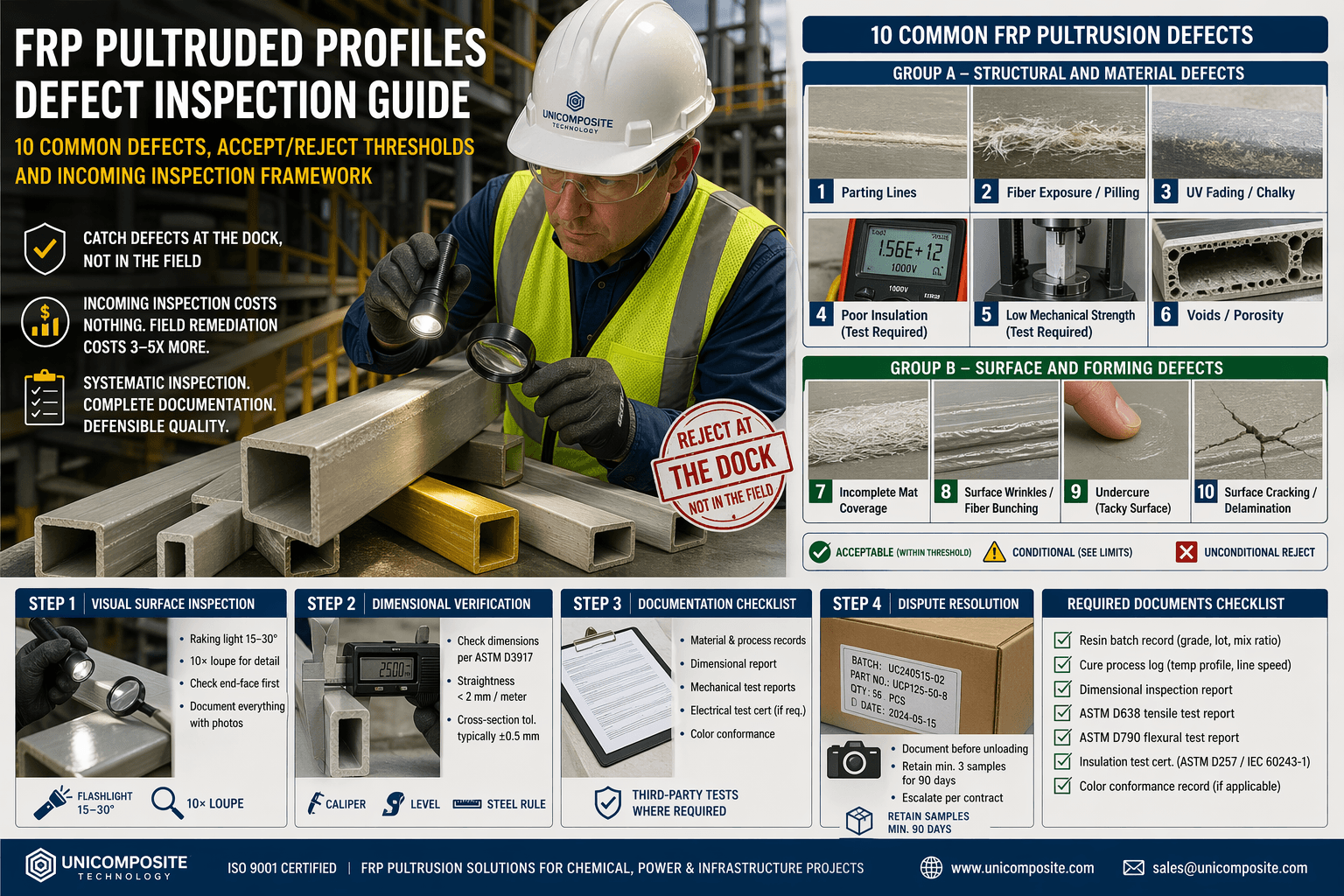
2.1 Visible Parting Lines (Mold Witness Lines)
Visual cue: Continuous white or slightly raised lines running axially along the profile surface, corresponding to the mold split line locations.
Root cause: Mold dimensional inaccuracy or clamping module misalignment creates a step or gap at the mold parting surface. Resin fills this gap and cures in place, leaving a visible witness line on every profile produced until the mold is corrected or reset.
Accept/Reject threshold: Accept if line width is less than 0.3 mm with no surface protrusion and no dimensional impact on the cross-section. Reject if line width reaches 0.5 mm or greater, or if any raised parting line appears on a mating face, bearing surface, or connection point where dimensional accuracy is functionally required.
2.2 Fiber Exposure and Surface Fiber Pilling
Visual cue: Bare glass fiber strands visible on the profile surface, or localized clusters of fiber that have balled together rather than lying flat and encapsulated in resin.
Root cause: Fiber content too high relative to the die cavity volume prevents full resin wet-out. Alternatively, resin debris accumulating on the mold wall disrupts the fiber bed at the die entry, pushing fibers to the surface rather than allowing them to distribute evenly through the cross-section.
Accept/Reject threshold: Accept only if isolated single-fiber exposure is shorter than 2 mm and confined to non-load-bearing, non-sealing surfaces — and only if the fiber is clearly encapsulated when viewed under a 10× loupe. Reject unconditionally on any bearing face, sealing surface, or chemical-contact face, regardless of exposed fiber length or cluster size.
2.3 Poor UV Resistance and Color Fading
Visual cue: Uneven surface color, streaking, visible chalking, or fading detectable at incoming inspection — before any UV exposure in service.
Root cause: Light stabilizers and heat stabilizers omitted from the resin formulation, or low-grade colorant paste used to reduce material cost. This is a formulation compliance failure, not a weathering outcome.
Accept/Reject threshold: Accept if color measurement shows ΔE less than 3 per ASTM D2244. This threshold aligns with AAMA 2603 exterior coating acceptance criteria and provides a defensible reference point where no project-specific color specification exists in the purchase order. Reject if visible fading, chalking, or color non-uniformity is present at delivery — this condition confirms resin formulation non-compliance, independent of service environment.
2.4 Poor Electrical Insulation Performance
Visual cue: None. Insulation failure is not detectable by visual inspection.
Root cause: Resin or fiber selected with inherently low dielectric performance, or inadequate fiber-resin interface bonding that creates conductive pathways through the profile cross-section.
Accept/Reject threshold: For all electrical applications — power utilities, substation infrastructure, telecommunication tower components — require a third-party insulation test certificate as a condition of acceptance. Specify the applicable standard in the purchase order: ASTM D257 for volume and surface resistivity, or IEC 60243-1 for dielectric strength, depending on the application’s technical requirements. Supplier self-certified dielectric data alone is not acceptable where personnel safety or system reliability depends on the profile’s insulation performance.
2.5 Insufficient Mechanical Strength
Visual cue: None. Mechanical underperformance is not detectable by visual inspection or simple manual assessment on finished profiles.
Root cause: Low-grade raw materials with mechanical properties below the design assumption; insufficient cure resulting in incomplete cross-linking of the resin matrix; or incorrect fiber architecture for the specified load direction — for example, a profile with predominantly longitudinal fibers deployed in an application requiring transverse bending strength.
Accept/Reject threshold: Require ASTM D638 tensile and ASTM D790 flexural test reports against the contracted specification values for every structural order. For volume orders or critical structural applications, specify in the purchase contract that third-party witnessed testing or retained sample testing rights are a condition of acceptance. Supplier self-certified mechanical data alone does not constitute acceptance documentation for structural profiles.
2.6 Excessive Internal Voids and Surface Porosity
Visual cue: Needle-point pinholes visible on the profile surface; cross-section cut at the end face reveals bubble voids distributed through the resin matrix.
Root cause: Poor raw material quality — resin or sizing chemistry incompatible with the fiber surface — or cure temperature too high, causing volatile compounds to escape as gas before the resin gels, leaving voids entrapped in the cured matrix.
Accept/Reject threshold: Accept if surface pinholes are individually smaller than 0.5 mm in diameter at a density below 3 per dm². Reject if any cross-section cut reveals interconnected voids visible to the naked eye, or if surface porosity appears in dense clusters rather than isolated occurrences.
The table below summarizes all six Group A defects for use as a field reference during incoming inspection:
| Defect | Visual Indicator | Primary Cause | Accept Threshold | Reject Threshold |
|---|---|---|---|---|
| Parting lines | Axial white/raised lines | Mold misalignment | <0.3 mm, flush | ≥0.5 mm or raised on mating face |
| Fiber exposure / pilling | Bare fiber strands or clusters | High fiber content; mold debris | <2 mm, non-bearing, encapsulated | Any bearing/sealing/chemical-contact face |
| UV fading / chalking | Color non-uniformity at delivery | No stabilizer; low-grade colorant | ΔE <3 per ASTM D2244 | Visible fading or chalking at delivery |
| Poor insulation | None (test required) | Low dielectric resin/fiber | Third-party cert per ASTM D257 or IEC 60243-1 | No third-party cert for electrical applications |
| Low mechanical strength | None (test required) | Poor materials; undercure | ASTM D638/D790 report on file | No test report or values below spec |
| Internal voids / porosity | Pinholes; cut-face bubbles | Poor materials; excess cure temp | Pinholes <0.5 mm, <3/dm² | Interconnected voids or clustered porosity |
3. Surface and Forming Defects — Group B
The six Group A defects share a common thread — they originate upstream, in material selection and process parameter decisions made before the profile enters the die. Group B defects are different in character: they emerge at the die entry and die exit, where surface mat behavior and cure timing interact in ways that can bypass even correct material choices. Four defects fall into Group B — and two of them carry unconditional reject status with no acceptance threshold.
3.1 Incomplete Fiber Mat Coverage (Bare Zones)
Visual cue: Localized surface areas where no resin-rich layer is present — raw fiber mat texture is visible, or the surface appears dry and fibrous rather than smooth and resin-coated.
Root cause: Surface mat width undersized for the profile geometry, leaving edge zones uncovered. Alternatively, the guide positioning device misaligns, causing the mat to shift laterally off-center as it enters the die, transferring the coverage gap to one face of the profile.
Accept/Reject threshold: Accept only if the bare zone is narrower than 5 mm, confined to a non-load-bearing, non-appearance, non-chemical-contact surface, and confirmed as isolated. Reject on any bearing face, external appearance surface, or any surface exposed to the service environment — the surface veil is the primary chemical barrier, and a bare zone bypasses it entirely.
3.2 Surface Wrinkles and Fiber Bunching
Visual cue: Regular longitudinal ripples running parallel to the pull direction, or localized accumulations of fiber mat bunched together rather than lying flat. Under raking light at 15–30°, wrinkles cast visible shadows even when depth is sub-millimeter.
Root cause: Surface mat material too stiff for the die entry geometry, causing the mat to fold rather than conform as it enters the die. Polyester surface veils and nonwoven mats are particularly susceptible — under traction tension they can collapse into longitudinal folds before fully entering the die cavity, and the resulting shape cures in place.
Accept/Reject threshold: Accept if wrinkle depth is below 0.2 mm and the affected surface is a non-appearance, non-mating face. Reject on any appearance surface or mating interface. Reject unconditionally — with no depth threshold — if wrinkling penetrates below the surface veil layer into the structural fiber bed, indicating a laminate architecture failure rather than a surface finish issue.
3.3 Tacky or Liquid Surface (Undercure)
Visual cue: Profile surface feels sticky or slightly damp to the touch. A fingernail pressed lightly into the surface leaves a visible impression. In more severe cases, a faint solvent-like or styrene odor is detectable at close range.
Root cause: Cure temperature insufficient for the resin system in use, or line speed too fast relative to the profile wall thickness. Thick-wall profiles are most vulnerable — the surface reaches cure temperature while the core lags, or the resin system requires longer dwell time than the line speed allows.
Accept/Reject threshold: Reject unconditionally. There is no acceptance threshold for undercure. Do not accept supplier assurances that profiles will “cure further in ambient storage” — post-extrusion ambient cure of thermoset resins does not complete the cross-linking reaction initiated in the die. An undercured profile will not achieve its design mechanical or chemical resistance properties regardless of storage duration.
In Unicomposite’s production quality review process, undercure accounts for the highest proportion of disputed incoming inspection rejections. The pattern is consistent: thick-wall profiles surface-cure normally while the core remains partially uncrosslinked, and the condition only becomes apparent to the buyer when the profile is flexed or cut during installation preparation — at which point the profiles are already on site and partially unloaded. Catching undercure at the dock, before unloading begins, is the only intervention point that protects the buyer completely.
3.4 Resin-Rich Surface Layer Cracking or Skin Delamination
Visual cue: Fine crazing, hairline cracking, or visible skin peeling on the outer resin-rich surface layer. In early-stage cases, cracking may only be visible under a 10× loupe or under raking light. In advanced cases, the surface layer lifts or flakes.
Root cause: Gel time and cure time window mismatched in the process setup — the cure front initiates too far ahead of the die exit point. The resin-rich outer layer reaches full cure and begins to contract thermally while still constrained by the die, generating tensile stress at the surface that exceeds the resin’s elongation-at-break. The result is a surface crack pattern that is structural in origin, not cosmetic.
Accept/Reject threshold: Reject unconditionally. Do not accept patching, topcoating, or any supplier-proposed surface remediation as a substitute for full replacement. Surface cracking of this type indicates a fundamental cure profile failure — the structural integrity of the affected profiles cannot be verified without destructive testing, which is not a practical incoming inspection option.
The table below summarizes all four Group B defects:
| Defect | Visual Indicator | Primary Cause | Accept Threshold | Reject Threshold |
|---|---|---|---|---|
| Incomplete mat coverage | Dry/fibrous surface zones | Mat undersized; guide misalignment | <5 mm on non-exposure face | Any bearing, appearance, or chemical-contact face |
| Surface wrinkles | Longitudinal ripples or fiber bunching | Stiff mat; traction folding | <0.2 mm depth, non-appearance face | Appearance/mating face; penetration into fiber bed |
| Undercure (tacky surface) | Sticky surface; fingernail impression | Low temp; excess line speed | None — unconditional reject | Any tack or impression at delivery |
| Surface cracking / delamination | Crazing, cracking, skin peeling | Gel/cure timing mismatch | None — unconditional reject | Any cracking or delamination visible |
4. How to Conduct a Systematic Incoming Inspection
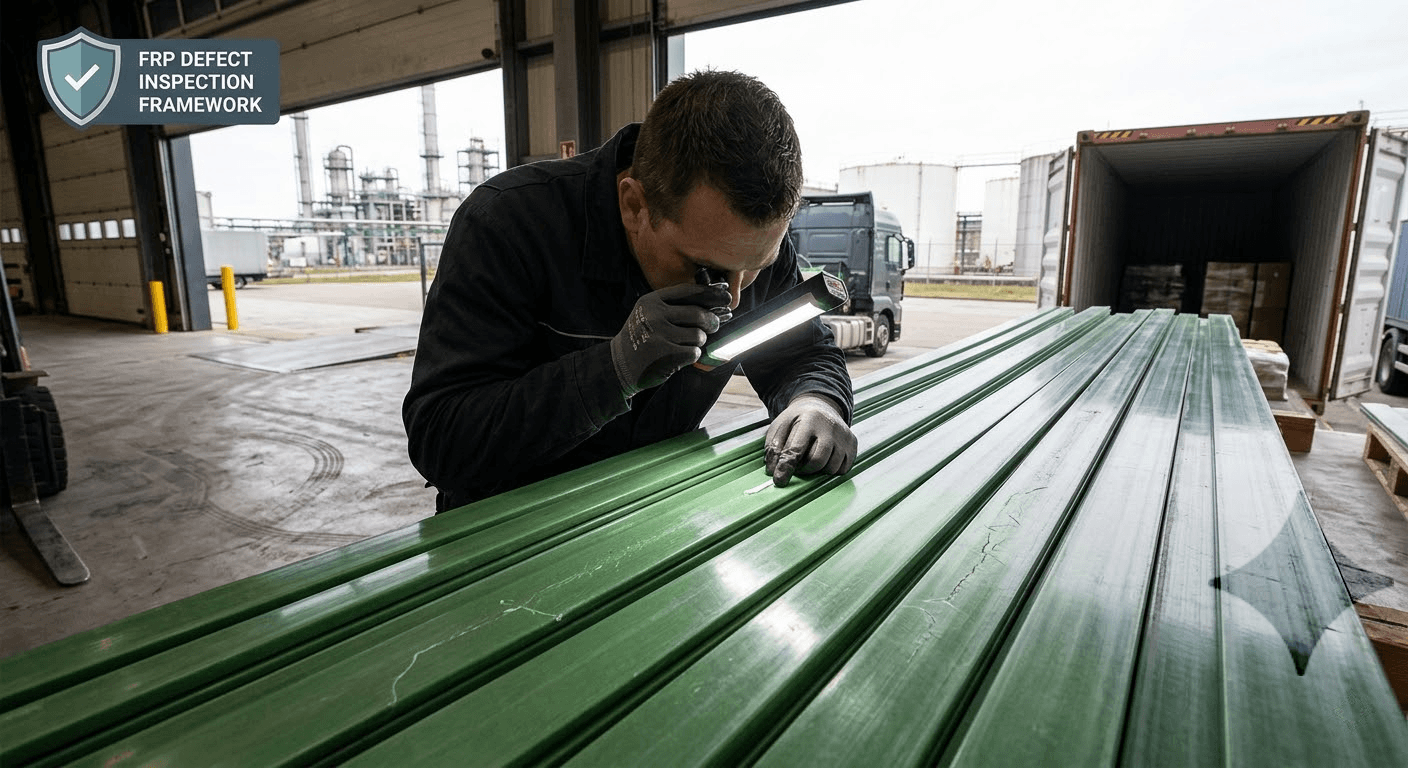
Knowing the defects is necessary. Executing the inspection consistently is what actually protects the procurement. A repeatable four-step protocol converts defect knowledge into a defensible quality record.
frp profile defects
4.1 Step 1 — Visual Surface Inspection Protocol
Tools: A focused flashlight used at a raking angle of 15–30° to the surface is the most effective single tool for detecting surface wrinkles, parting line protrusion, and mat coverage gaps — oblique light creates shadow contrast that frontal lighting completely misses. A 10× hand loupe is essential for fiber exposure assessment and early-stage surface cracking. A digital colorimeter or color reference card covers UV fading evaluation where color specification applies.
Inspection sequence: Begin with the end-face cross-section — cut clarity, void distribution, and fiber uniformity are all readable here. Move to load-bearing faces, then appearance faces, then mating and sealing surfaces. This sequence prioritizes structurally critical surfaces over cosmetic ones.
Documentation: Photograph every defect with a scale reference in frame. Record the batch number, profile part number, delivery date, and defect location on every image at the time of capture. Post-delivery photographic documentation is the buyer’s primary evidence in any supplier dispute — and its credibility depends on it being created before unloading begins, not reconstructed afterward.
4.2 Step 2 — Dimensional Verification
Check straightness along the full profile length — a deviation greater than 2 mm per linear meter falls outside standard tolerance for pultruded profiles per ASTM D3917 (Standard Specification for Dimensional Tolerance of Thermosetting Glass-Reinforced Plastic Pultruded Shapes). Cross-section dimensional tolerance for standard pultruded profiles is typically ±0.5 mm; confirm against the supplier’s published tolerance and specify it contractually in the purchase order before delivery.
Tools required: vernier caliper for cross-section measurement, steel rule or laser line for straightness, precision level for flatness where applicable. Dimensional non-conformance is a contractual issue, not a judgment call — measure and record against the specification.
4.3 Step 3 — Required Documentation Checklist
Request the following documentation with every FRP profile delivery as a stated condition of acceptance in the purchase order:
| Document | Required For | Acceptable Source |
|---|---|---|
| Resin batch record (grade, lot, mix ratio) | All orders | Supplier self-cert |
| Cure process log (temp profile, line speed) | All structural orders | Supplier self-cert |
| Dimensional inspection report | All orders | Supplier self-cert |
| ASTM D638 tensile test report | All structural applications | Supplier self-cert or third-party |
| ASTM D790 flexural test report | All structural applications | Supplier self-cert or third-party |
| Dielectric / insulation resistance certificate (ASTM D257 or IEC 60243-1) | All electrical applications | Third-party only |
| Color conformance record | Where color spec applies | Supplier self-cert with reference standard |
In Unicomposite’s experience supplying North American utility and chemical processing projects, the documentation gap most commonly cited in incoming inspection disputes is the absence of a cure process log — not the mechanical test report, which most buyers already request. Specifying the cure process log explicitly in the purchase order closes the gap that most standard QC document checklists miss.
4.4 Step 4 — Dispute Resolution and Escalation
Document everything before profiles leave the delivery vehicle. Once non-conforming profiles enter the buyer’s facility and are moved, commingled, or partially processed, the supplier’s liability position strengthens significantly. Photograph the delivery, the packaging condition, and the defects in situ before unloading begins.
Retain a minimum of three samples from every rejected batch in sealed, labeled storage for a minimum of 90 days. These samples are the physical evidence for any third-party arbitration test. Without retained samples, the buyer has no independent recourse if the supplier disputes the rejection.
Specify rejection rights, retained sample periods, and third-party arbitration test protocols in the purchase contract before the order is placed — not in correspondence after a defect is discovered. Verbal agreements and post-delivery emails do not carry the same enforceability as pre-order contractual terms.
5. What Acceptable FRP Profiles Look Like — Positive Benchmarks
Defining what to reject is half the framework. Knowing what to accept with confidence is equally important — particularly when making judgment calls on borderline surface conditions in the field.
5.1 Surface Quality Positive Indicators
A properly manufactured FRP pultruded profile presents a dry, rigid surface with zero tack — pressing a fingernail firmly against the surface leaves no impression. Color is uniform across the full profile length and cross-section, with no streaking, gradient fading, or surface chalking. Resin coverage is continuous, with no clustered pinholes, bare fiber zones, or areas of visual texture variation that differ from the surrounding surface. Parting lines, if present, are hairline-only, flush with the surrounding surface, and absent from all functional faces.
5.2 Structural Integrity Positive Indicators
The end-face cross-section of an acceptable profile shows uniform fiber distribution across the full cross-sectional area, with no interconnected void networks visible to the naked eye. The resin-fiber interface at cut edges appears clean and integrated — no resin pooling, fiber pull-out zones, or visible delamination planes between the surface veil and the structural fiber bed. On lighter profiles where manual flex assessment is practical, consistent bending resistance with no audible cracking or surface crazing under hand pressure confirms adequate cure and laminate integrity.
Conclusion
FRP profile defects are not a mystery. They follow predictable patterns, originate from identifiable production variables, and — critically — are detectable at incoming inspection with basic tools and a systematic approach. Five takeaways to carry forward:
- Incoming inspection is the lowest-cost quality intervention available. Every defective profile caught at the dock is one that never reaches the installation, the rework schedule, or the warranty claim process.
- Undercure and surface cracking are unconditional reject items. No threshold. No exceptions. No supplier remediation accepted as a substitute for full replacement.
- Electrical and structural applications must be backed by appropriate third-party documentation. Specify ASTM D257 or IEC 60243-1 for electrical profiles; ASTM D638 and D790 for structural profiles — and require these in the purchase order, not as an afterthought at delivery.
- Specify inspection requirements contractually before the order, not after the delivery. Dimensional tolerances, QC documentation requirements, rejection rights, and retained sample obligations belong in the purchase order — verbal agreements do not hold in supplier disputes.
- Photograph everything before unloading. Post-delivery photographic evidence with batch identification is the buyer’s most reliable protection when a rejection is contested.
As FRP adoption expands across chemical processing, power utilities, and civil infrastructure, the ability to specify, verify, and enforce incoming quality standards becomes a core procurement competency — one that directly determines whether FRP’s long-service-life promise is realized in the field.
Frequently Asked Questions
Surface undercure is the defect most frequently disputed at incoming inspection, particularly for thick-wall profiles where the surface appears fully cured while the core remains partially uncrosslinked. The condition often becomes apparent only when profiles are flexed or cut on site. Inspecting for tack before unloading — using the fingernail impression test — is the simplest way to catch this before the shipment is accepted.
Yes, and you should. Pre-order samples allow you to verify resin system, surface finish quality, dimensional consistency, and color match against your specification before committing to a production run. Request samples in the same resin system and profile geometry as your intended order, and apply the same incoming inspection protocol to the samples as you would to the full delivery.
At minimum, require ISO 9001 certification covering the pultrusion process, ASTM D638 and D790 mechanical test reports for the specific profile geometry and resin system, and documented dimensional inspection procedures. For electrical infrastructure applications, add a third-party dielectric test certificate per ASTM D257 or IEC 60243-1. For chemical processing environments, request resin-specific immersion test data per ASTM C581 or ISO 175 for your target chemical medium.
You need photographic evidence created before or during installation showing the defect type, location, and extent — ideally with batch identification visible in frame. Retained samples from the delivery are essential for third-party arbitration testing if the supplier disputes the claim. Without pre-installation photographs and retained samples, post-installation warranty claims are very difficult to enforce regardless of the defect’s severity.
Replacement lead times depend on whether the supplier holds the profile geometry in stock or requires a new production run. Standard pultruded profiles in common resin systems are often available from stock within 2–4 weeks. Custom cross-sections or specialty resin systems typically require 4–8 weeks for a new production run. Specifying lead time expectations for replacement shipments in the original purchase contract — alongside the rejection rights clause — protects the buyer’s schedule if a rejection occurs.


