 info@unicomposite.com


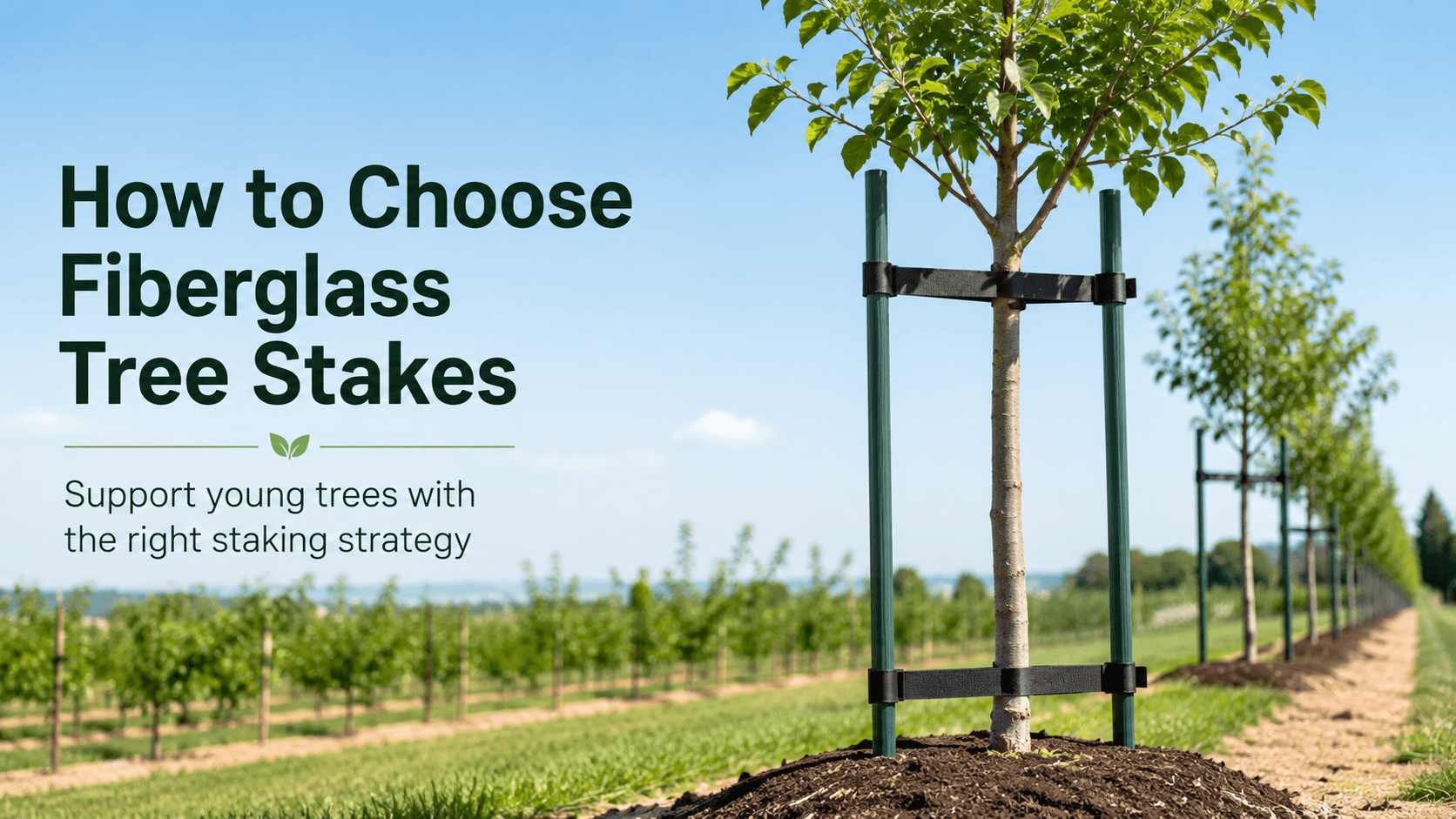
Fiberglass tree stakes are one support option for nursery, orchard and landscaping projects, but selecting one starts with a more basic question: does the tree need support? A stake may be useful when a newly planted tree cannot remain upright, when its root ball moves in the soil, or when the site is exposed to strong wind. Many trees do not need staking at all.[1][2]
The purpose of temporary staking is to control root-ball movement while allowing limited trunk movement, not to make the trunk completely rigid. For a commercial planting, do not select a fiberglass stake from tree height alone. Start with the tree and root system, then account for wind exposure, growing system, handling operations, tie position, inspection access and the expected duration of support.
how to choose fiberglass tree stakes
First Decide Whether the Tree Needs a Stake
University extension guidance consistently treats staking as a temporary intervention rather than a default requirement for every landscape tree. Support is more likely to be justified when:
- the root system or root ball cannot keep the tree stable;
- the unsupported stem bends excessively;
- the tree is top-heavy;
- the planting block is exposed to prevailing winds; or
- the production system intentionally relies on a permanent post or trellis.
The last case matters in orchards. A freestanding landscape tree and a dwarf fruit tree trained on a support system have different support requirements. Oregon State University Extension notes that fully dwarf fruit trees may require continuing support and that post-and-wire systems are commonly used to manage certain orchard forms.[3] Confirm the rootstock, training system, row layout, expected crop load and equipment clearance before specifying individual stakes or a trellis.
A quick field test
Move the trunk gently and observe the root ball rather than judging only the canopy. If the trunk moves slightly while the root ball remains stable, additional restraint may not be necessary. If the root ball shifts in the soil, support may still be needed.[2]
This test does not set a universal load or stake size. It tells the planting team what must be stabilized and provides a repeatable observation for later inspections.
When Should Fiberglass Tree Stakes Be Considered?
Once the need for support and the expected support period are clear, fiberglass tree stakes can enter the material and product-form comparison. Unicomposite’s FRP plant stake range includes solid, hollow and trellis forms for tree, seedling, nursery, farm, vineyard and related plant-support applications. These application categories identify possible uses; they do not establish that every form or specification fits every tree or site.
Consider the available FRP form together with the support arrangement, attachment height, site exposure, soil, handling operations and inspection plan. Final selection still depends on confirmed dimensions, product properties, tie system and installation method for the specific project. Do not assume that the material name alone determines the required length, diameter, stiffness or service period.
Use a Selection Matrix Instead of a Single “Standard Size”
The following matrix helps a nursery, orchard, or landscape team define the support requirement before requesting a product specification.
| Selection input | What to observe or record | Why it changes the support decision | Selection result |
|---|---|---|---|
| Tree form and root system | Bare-root, container-grown, balled-and-burlapped, root-ball movement, stem flexibility | Determines whether the tree needs support and what part of the system must be stabilized | Staking required: yes/no; reason documented |
| Growing system | Temporary establishment, nursery leader training, freestanding orchard tree, dwarf tree, post-and-wire row | Separates temporary staking from a production support system | Temporary stake, individual permanent post, or trellis concept |
| Site exposure | Prevailing wind, open rows, wind funneling, slope, traffic and vandalism risk | Changes the direction and level of restraint and the number of support points | Stake orientation and preliminary support arrangement |
| Tree geometry | Trunk height, first branches, canopy distribution and future growth | Influences usable attachment zone and clearance from branches | Attachment zone and required above-ground reach |
| Operations | Mowing, irrigation, cultivation, harvesting, loading and pedestrian access | Poor placement can obstruct equipment or create trip and impact hazards | Clearance envelope and visible inspection route |
| Tie interface | Bark condition, trunk diameter, tie width and contact surface | Narrow or rigid ties can abrade or girdle the stem | Broad, smooth, flexible tie specification |
| Inspection plan | Growth rate, wind events, tie condition and removal trigger | A suitable system can still damage a tree if it is ignored | Inspection timing, responsible person and removal criterion |
This framework intentionally stops before assigning a diameter, length, or stiffness. Those values depend on the selected support arrangement, the tree, the site, and the verified properties of the exact stake.
Select the Attachment Before Finalizing the Stake
The tree tie is part of the support system, not an accessory to choose later. The University of Minnesota and Iowa State University recommend broad, smooth, flexible materials where the attachment contacts the stem. Wire, narrow cord, and rigid contact surfaces can abrade or girdle a growing trunk.[1][2]
The attachment should restrain root-system movement without clamping the trunk rigidly. Leave enough freedom for limited sway, then verify the result under ordinary site conditions. If the canopy moves but the trunk is locked directly below it, wind can concentrate stress at the attachment point.[1]
For procurement, record:
- tie material and width;
- contact surface against the bark;
- adjustment method;
- expected trunk growth during the inspection interval;
- attachment location; and
- replacement or removal trigger.
Avoid assuming that a smooth stake surface eliminates tie-related bark risk. Tie width, tension, placement, trapped debris, growth, and inspection frequency still control the contact condition.
Place Stakes Around the Root Zone and the Work Zone
Extension guidance places landscape-tree stakes outside the planting hole or near its outer edge so they can reach firm soil while reducing the chance of damaging the root system.[1][2] The precise placement must be set at the site because root-ball dimensions, soil condition, underground services, irrigation, and the selected support layout vary.
Before installation, mark four boundaries:
- Root protection boundary: avoid driving a stake through the root ball or major roots.
- Equipment clearance: keep the support clear of mowers, cultivators, harvest equipment and loading paths.
- People clearance: keep anchors and ties out of walking routes or make them conspicuous and protected.
- Branch clearance: prevent the stake from rubbing the canopy as the tree and branches move.
Do not publish or apply a universal insertion distance or depth without an approved installation specification for the exact product and planting system.
Match the Support Strategy to the Application
Commercial nurseries
Nursery production may use stakes to maintain a leader, hold a container-grown tree during establishment, or prepare uniform stock for handling. Define whether the goal is root-ball stability, leader training, transport presentation, or continued field support. These goals require different attachment points and removal criteria.
Build inspection into routine block work. Check tie tension, bark contact, stake movement, visible damage and interference with irrigation or handling. When stock is moved or sold, remove temporary nursery supports that are not part of the approved landscape installation. University of Minnesota Extension specifically advises removing poles or bamboo sticks used only to straighten nursery stock because leaving them attached can damage or girdle the tree.[1]
Orchards
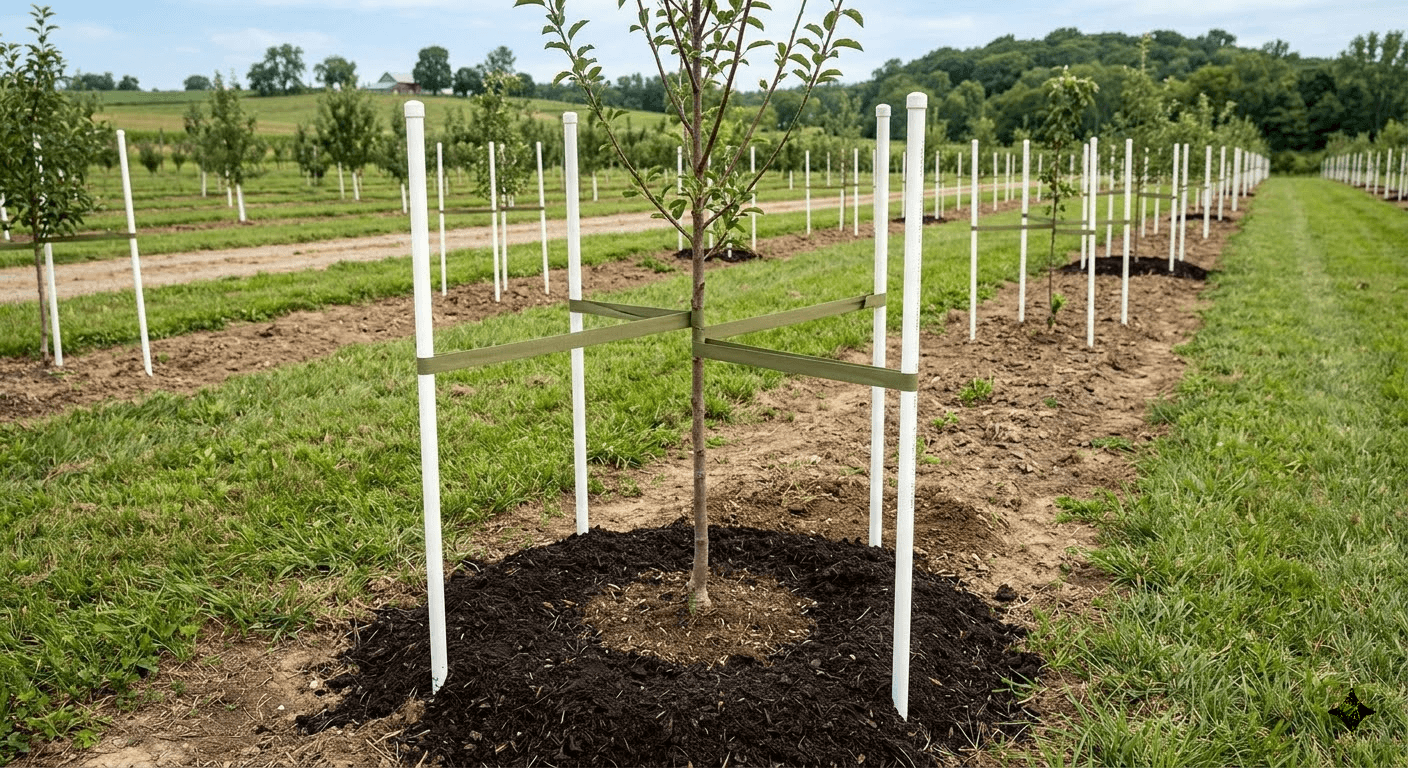
For freestanding young fruit trees, evaluate rootstock, canopy form, prevailing wind and soil anchorage. For dwarf or high-density systems, treat the support as part of the orchard training system rather than as a temporary accessory. Confirm the row design, post and wire arrangement, tree spacing, crop load, pruning system and equipment clearance with the orchard designer or extension specialist.[3]
An individual stake cannot automatically substitute for a designed trellis, and a post intended for a trellis should not be specified from a generic tree-stake table.
how to choose frp tree stakes
Landscaping and exposed sites
Use the minimum support that keeps the root system stable. Align the arrangement with prevailing wind and keep ties broad and flexible. Inspect after major wind events and remove the support once the tree can remain stable without it.[1][2]
Inspect, Adjust and Remove Temporary Support
A temporary support system needs an owner and a removal criterion. University extension guidance commonly recommends checking stability after one growing season rather than leaving stakes indefinitely.[1][2]
At each inspection:
- Look for bark abrasion, compression or girdling.
- Check whether ties have tightened as the trunk grew.
- Confirm that the stake remains stable and does not rub branches.
- Move the trunk gently and observe whether the root ball shifts.
- Check for damage after wind, machinery contact or handling.
- Remove the support when the tree can remain stable without it, or document why continued support is necessary.
Orchard systems designed for continuing support follow a different maintenance plan. Inspect the complete system, including posts, wires, anchors, tree attachments and row alignment, according to the orchard design.
Frequently Asked Questions
Does every newly planted tree need a stake?
No. A tree may need support when its root system or root ball cannot remain stable, when the stem needs temporary support, or when the growing system is designed around continuing support. A newly planted tree that is already stable may not need staking.[1][2]
When should tree stakes be removed?
Temporary stakes can be removed once the tree remains stable and the root ball no longer shifts during inspection. Continue to check bark contact and tie tension until removal. Orchard trees that depend on permanent posts or trellises follow a different support plan and should not use this temporary-removal rule.[1][2][3]
How do I choose the size of a fiberglass tree stake?
Do not select stake size from tree height alone. Define the root-stability problem, support arrangement, attachment height, wind exposure, soil, operating clearances and required support period first. Then match those inputs to verified dimensions and properties for the specific fiberglass stake. This page does not assign a universal length, diameter or stiffness.
Information to Prepare for a Fiberglass Tree Stake Discussion
Unicomposite offers FRP plant stakes in solid, hollow and trellis forms for tree, seedling, nursery, farm, vineyard and related plant-support applications. Available forms, dimensions and project suitability must be confirmed for the specific requirement.
Before requesting a recommendation or quotation, prepare:
- application: nursery, orchard, vineyard, landscaping or another use;
- tree species, rootstock and production stage;
- temporary or continuing support requirement;
- tree height, trunk diameter, root-ball dimensions and first-branch height;
- site wind and soil conditions;
- individual stake or trellis arrangement;
- tie system and attachment requirements;
- required quantity and packaging;
- destination and handling constraints; and
- any required drawings, inspection records or purchasing requirements.
Review the available fiberglass tree stakes for bulk orders and send the project inputs above for discussion. Product form, dimensions, surface, packaging, installation method and commercial terms must be confirmed during project review and quotation.
References
- University of Minnesota Extension, “Staking and Guying Trees,” reviewed 2026: https://extension.umn.edu/planting-and-growing-guides/staking-and-guying-trees
- Iowa State University Extension and Outreach, “Care of Newly-Planted Trees,” last reviewed May 2026: https://yardandgarden.extension.iastate.edu/how-to/care-newly-planted-trees
- Oregon State University Extension Service, “Training and Pruning Your Home Orchard,” revised February 2025: https://extension.oregonstate.edu/catalog/pnw-400-training-pruning-your-home-orchard


