 info@unicomposite.com


Select a fiberglass plant stake by defining the support job first. Record the crop’s growth habit, the support layout, the required above-ground reach, the way the system will be anchored or attached, site exposure, soil or base conditions, tie or mesh requirements, and the inspection plan. A length or diameter by itself does not show whether a stake fits the application.
This guide explains how to turn those field inputs into a useful stake request. It does not assign a universal size or installation depth, because those decisions require verified product data and site-specific installation requirements.
A fiberglass plant stake is an FRP support component used to guide, hold, or organize plants within an individual support, cage, trellis, or row-support system. The material name alone does not determine the required length, cross-section, stiffness, or installation method.
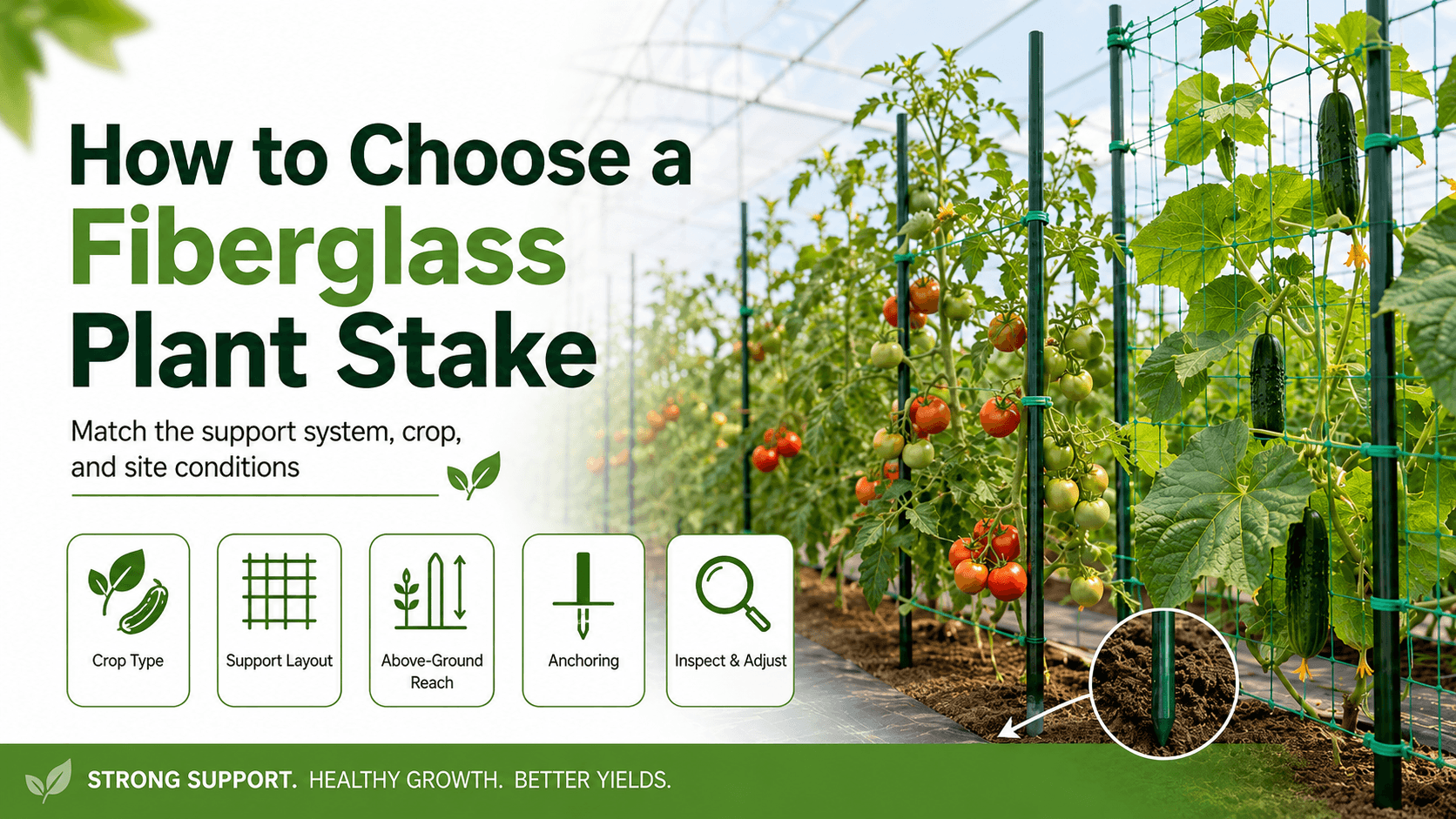
how to choose a fiberglass plant stake
Start With the Support System, Not the Stake Size
The same crop can use different support systems. Tomatoes may be managed with an individual stake, a cage, or a trellis. Climbing crops may use mesh suspended between vertical supports. A greenhouse row may connect plant support to an existing overhead or bench system. Each arrangement creates a different job for the stake.
University of Minnesota Extension recommends installing tomato supports at planting time and explains that crop growth habit affects the choice of stakes, cages, or trellises.[1][2] Before choosing a fiberglass stake, define:
- What needs support: a main stem, multiple branches, a vine, netting, or a complete row.
- When support begins: at planting, during early training, or after a defined growth stage.
- How the load reaches the stake: through individual ties, clips, mesh, twine, or a row system.
- How long the support remains: one crop cycle, repeated seasonal use, or a continuing structure.
- What must stay clear: irrigation, cultivation, harvesting, carts, aisles, workers, and plant roots.
The selection result should be a support layout, not just a requested length.
Match the Layout to the Crop and Growing Environment
Our FRP plant stake range includes solid and hollow stake forms, along with products intended for trellis-support applications. We offer plant-stake products for greenhouse, vineyard, horticulture, garden-center, nursery, farm, ranch, tree, seedling, vegetable, flower, tomato, cucumber, vine, and shrub applications. These categories identify possible project directions; the exact form and geometry still need to match the support layout and verified project inputs.
Tomatoes and upright crops
First identify whether the variety is determinate or indeterminate and whether the production method uses an individual stake, a cage, or a row trellis. University of Minnesota Extension notes that indeterminate tomatoes continue growing through the season and generally need more continuing support than determinate varieties.[2]
For an individual-stake layout, record the intended attachment zone, plant spacing, pruning or training method, tie type, and access for repeated inspection. For a cage or trellis layout, define whether the fiberglass component is an individual plant support, an end support, an intermediate support, or part of another structure. Do not treat these positions as interchangeable without checking the complete system.
Cucumbers, beans, peas, and other vines
Climbing crops usually require a system rather than a standalone rod. University of Minnesota Extension describes a trellis as vertical supports with mesh or another climbing surface between them, and it advises matching mesh and support strength to crop vigor and fruit load.[2]
Record the row length, support spacing concept, mesh or twine type, expected vine path, fruit-support needs, harvest access, and wind exposure. The stake request should state whether the component will support one plant, carry mesh, or act as part of a wider row.
Greenhouse and protected-crop systems
In a greenhouse, stake placement must work with the existing production layout. Map benches or beds, irrigation lines, floor or soil anchorage, overhead support, carts, doors, aisles, and sanitation routines before choosing the stake form. Also record whether the proposed stake is freestanding or connects to another support.
This page does not assign fiberglass stakes to a particular greenhouse crop or loading condition. Use the layout information to define the product and installation questions that need to be resolved during project review.
Trees and nursery stock
Tree staking uses a different stability test, attachment method, and removal decision from vegetable and vine support. For that task, use our separate fiberglass tree stake selection guide for nurseries and orchards. This page does not duplicate its tree-staking framework.
Define Size From Reach, Engagement, and System Geometry
Fiberglass stake size should be derived from the support layout. The overall length must cover the required above-ground reach plus the portion used for ground engagement or connection to another structure. Diameter or cross-section selection must then account for the support arrangement, spacing, site exposure, attachment points, and verified properties of the exact product.
Use the following matrix before requesting a size:
| Selection input | What to record | Why it changes the decision | Output for the stake request |
|---|---|---|---|
| Crop and growth habit | Crop, variety or type, expected growth form, training method | Changes the required support zone and attachment pattern | Support purpose and attachment zone |
| Support layout | Individual stake, cage, trellis, mesh line, or connected structure | Changes how loads and movement reach each support | Layout sketch and component role |
| Required reach | Planting level, lowest and highest attachment points, overhead or branch clearance | Determines useful above-ground length | Required above-ground reach |
| Engagement or connection | Soil installation, container or bed, bracket, bench, or another structure | Adds length or connection geometry and changes installation planning | Engagement method and required allowance |
| Site exposure | Wind direction, open row, protected structure, slope, traffic | Changes restraint, orientation, and inspection needs | Exposure description and layout notes |
| Soil or base | Compacted, loose, wet, rocky, containerized, or structural attachment | Affects stability and the installation method | Site condition and verification method |
| Tie, mesh, or clip | Contact material, adjustment, spacing concept, growth allowance | Controls plant contact and transfers force to the stake | Attachment specification |
| Operations | Irrigation, cultivation, harvest, mowing, carts, people | Poor placement can obstruct work or create hazards | Clearance envelope |
| Inspection plan | Growth rate, weather events, tie adjustment, removal or replacement trigger | A suitable initial layout can become unsuitable as plants grow | Inspection owner and decision criteria |
This matrix intentionally stops before assigning a length, diameter, wall thickness, or stiffness. Those values must come from the selected layout and verified product information.
How to Evaluate 6-, 8-, and 12-Foot Stake Requests
A request for a 6-foot, 8-foot, or 12-foot fiberglass stake describes length, not suitability. Before treating one of those lengths as the answer, separate the total length into:
- required support reach above the soil or mounting point;
- ground engagement or connection allowance;
- clearance from branches, fruit, mesh, overhead systems, and equipment; and
- any unusable portion created by the end condition or attachment method.
A longer stake is not automatically more stable. Stability also depends on the base condition, exposure, support spacing, connection details, and product properties. Similarly, an 8-foot by 3/4-inch request or an 11/16-inch diameter request is only a candidate geometry. Confirm the measurement convention, actual cross-section, product form, application role, quantity, and installation arrangement before using it in a quotation or field plan.
Do not infer that the dimensions named in older articles are standard Unicomposite inventory or approved application sizes. The exact product scope must be established from current project information.
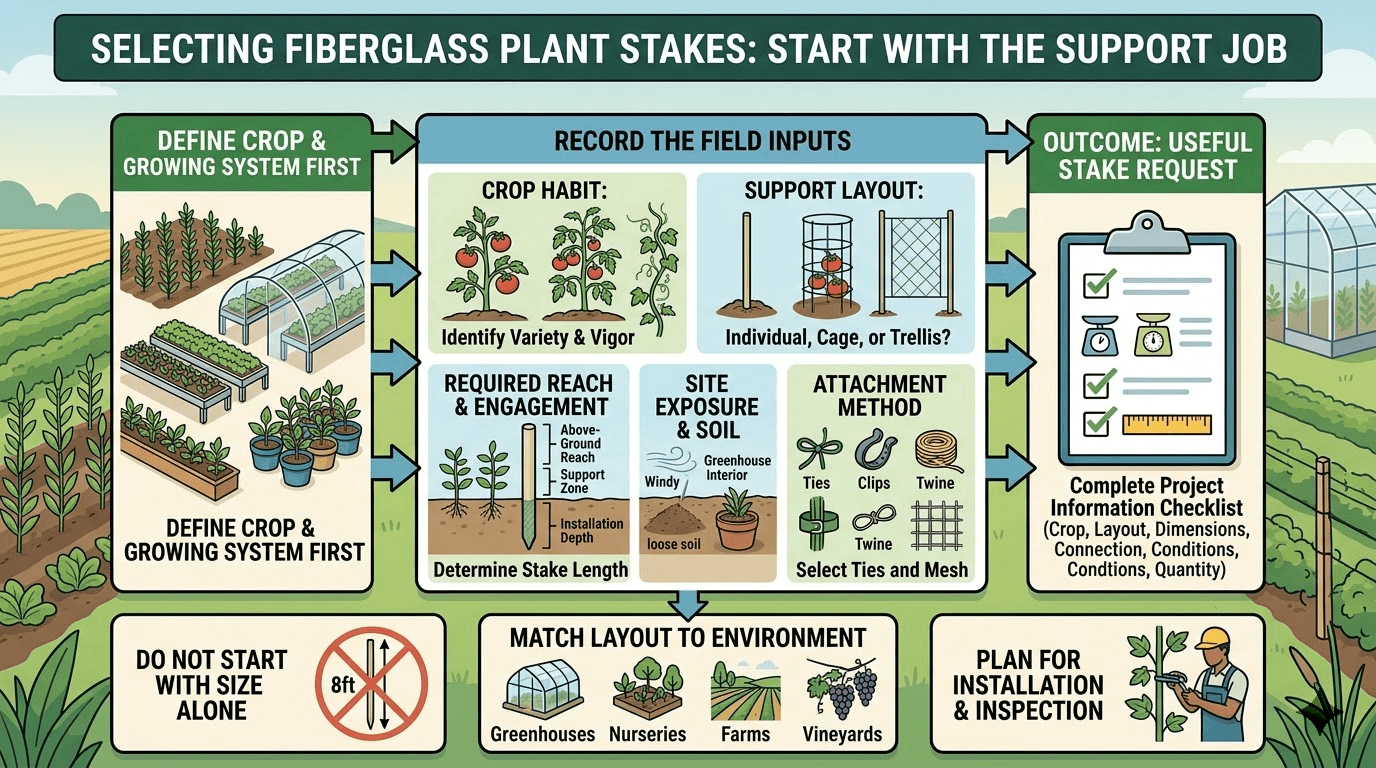
selecting fiberglass plant stakes
Plan Installation Without a Universal Depth Rule
There is no reliable percentage-of-length rule that covers every plant stake, crop, soil, and support layout. Installation planning starts with the site and the complete support system.
1. Mark the support line and protected areas
Lay out the plant row, attachment zone, irrigation, root area, access routes, and any underground or structural constraints. Place supports early enough to reduce interference with established roots and mature plant growth. University of Minnesota Extension recommends placing tomato supports while plants are still young, ideally at planting time.[1][2]
2. Define what provides stability
Identify whether stability comes from soil engagement, a container or bed, a bracket, another structural member, or a multi-stake system. Record the soil or base condition and how the installed support will be checked. Do not choose a driving tool, pilot-hole method, insertion depth, or end treatment until the exact product and site procedure have been approved.
3. Select the plant attachment
The tie, clip, twine, or mesh is part of the support system. For woody stems, University of Minnesota Extension recommends broad, smooth, flexible contact materials and warns against rigid restraint or narrow materials that can abrade or girdle the stem.[3] Crop stems also need an attachment that avoids cutting or constricting growth.
Record the contact material, adjustment method, attachment zone, growth allowance, and inspection trigger. The support should control unwanted movement without creating damaging contact.
4. Check clearances before use
Confirm that stakes, ties, anchors, and mesh do not interfere with irrigation, cultivation, harvest, doors, carts, walkways, or moving branches and vines. A support that blocks routine work is likely to be struck, displaced, or ignored during inspection.
5. Establish an inspection and removal plan
Inspect the system after installation, during rapid growth, and after events that can change alignment or tension. Check:
- stake movement or loss of alignment;
- loose, displaced, or overloaded mesh and connections;
- ties that have tightened or begun rubbing plant tissue;
- root-zone disturbance or irrigation interference;
- contact with fruit, branches, equipment, or people; and
- visible damage that requires the support to be taken out of service.
Temporary support should have a removal condition. Continuing trellis or greenhouse systems need a maintenance plan for the complete assembly, not only the individual stake.
Common Selection and Installation Errors
Choosing from crop name alone
“Tomato stake” or “cucumber stake” does not define variety, growth habit, row system, exposure, or attachment method. Add those inputs before choosing geometry.
Treating one dimension as a complete specification
Length without above-ground reach and engagement details is incomplete. Diameter without product form, layout, spacing, and verified properties is also incomplete.
Copying a universal installation depth
Fixed percentages and insertion depths can be unsuitable for different soils, containers, brackets, wind exposure, and end conditions. Define a site-specific stability check instead.
Selecting ties after the stake
Attachment material and position affect plant contact and the force transferred to the support. Select the stake and attachment as one system.
Skipping inspection ownership
Plant growth changes tie tension, contact points, and load paths. Assign the inspection task and define what triggers adjustment, replacement, or removal.
Project Information Checklist
Prepare the following before requesting a fiberglass plant stake recommendation or quotation:
- crop or plant type and growth habit;
- greenhouse, field, container, bed, or trellis application;
- individual-stake, cage, mesh, or row-support layout;
- required above-ground reach and attachment zone;
- proposed ground engagement or structural connection;
- soil, container, bed, or mounting condition;
- wind exposure and other environmental conditions;
- tie, clip, mesh, or twine details;
- irrigation, cultivation, harvest, aisle, and equipment clearances;
- quantity, destination, packaging constraints, and required documents; and
- a sketch or photos of the proposed layout when available.
Explore our FRP plant stakes in solid and hollow forms, including products intended for trellis-support applications. Send us the checklist above for a project discussion. We will use the information to define the quotation scope and identify the product, dimension, surface, packaging, installation, and document requirements that still need to be addressed. Commercial terms and the exact product scope will be set during quotation.
References
- University of Minnesota Extension, “Growing tomatoes in home gardens,” reviewed 2024: https://extension.umn.edu/vegetables/growing-tomatoes
- University of Minnesota Extension, “Trellises and cages to support garden vegetables,” reviewed 2024: https://extension.umn.edu/garden-and-home/yard-and-garden/gardening-minnesota/trellises-and-cages
- University of Minnesota Extension, “Staking and guying trees,” reviewed 2026: https://extension.umn.edu/planting-and-growing-guides/staking-and-guying-trees


