 info@unicomposite.com


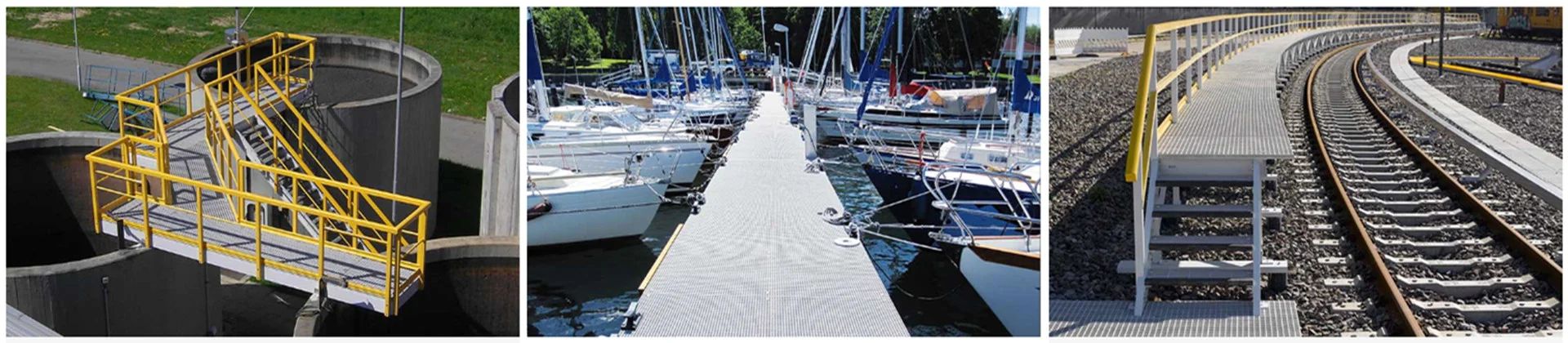
Introduction
When flame, smoke, and corrosion risks overlap, engineers often specify phenolic fiberglass grating. Built on glass reinforcement and a phenolic resin system, it limits flame spread/smoke and performs in wet, salty, or chemically aggressive environments.
About Unicomposite: ISO-certified FRP manufacturer in China with in-house pultrusion and custom fabrication for utilities, marine, wastewater, cooling towers, agriculture, and OEMs.

phenolic fiberglass grating
What Is Phenolic Fiberglass Grating?
Composition & Manufacturing
Glass fibers are combined with phenolic resin and cured to form panels. The two common formats are molded (integral mesh, good multidirectional strength) and pultruded (unidirectional bearing bars and cross-rods for longer spans).
How Phenolic Differs from Other FRP Resins
Phenolic resins tend to char rather than melt, helping limit ignition and smoke. Versus polyester or vinyl ester, phenolic typically offers better FST (fire, smoke, toxicity) behavior; check chemical resistance against your environment.
Where It Excels
-
Offshore and marine decks where sparks, solvents, and saltwater combine.
Properties & Specifications (What to Check Before You Buy)
Mechanical & Thermal
Check supplier data sheets for flexural strength, modulus, and recommended service temperatures. Typical phenolic gratings provide flexural strength near 150–300 MPa with service temperatures up to 150–200 °C.
Fire, Smoke, and Toxicity (FST)
Projects often reference ASTM E84 flame spread targets (e.g., FSI ≤ 25) and low smoke developed index; some also ask for smoke density via ASTM E662. Confirm the method, conditioning, and panel thickness tested.
Expert quote: “Phenolic’s advantage is stability under heat—you can hit stringent smoke/ignition targets without jumping to metals,” says Li Wei, Senior Applications Engineer, Unicomposite.
Surface, Mesh, and Panel Options
-
Open vs. covered (solid) top: Open mesh drains; covered tops contain spills and protect what’s below.
-
Slip resistance: Grit systems improve wet traction; request dry/wet coefficient of friction values.
Load & Deflection Criteria (with a Worked Example)
Select thickness/span from vendor load tables and limit deflection to L/200–L/240 under service load.
Worked example: If your clear span is 900 mm and your target is L/240, allowable deflection is 900/240 ≈ 3.75 mm. Choose a panel that shows ≤ 3.75 mm at your service load; otherwise move up a thickness or shorten the span.
Quick Compatibility Snapshot (illustrative)
| Chemical (typ.) | Temp (°C) | Compatibility note |
|---|---|---|
| Sodium hypochlorite | 25 | Generally acceptable; verify long-term chlorine exposure. |
| Seawater | 40 | Good; rinse after hot-work or contamination. |
Applications & Use Cases
High-Risk, High-Value Environments
-
Offshore platforms: walkways, cable trays, splash-zone areas.
-
Wastewater plants: clarifier bridges and chemical dosing skids.
Case Study (Anonymized)
A coastal processing facility replaced painted steel grating near solvent lines with phenolic fiberglass grating specified for FSI ≤ 25 and wet CoF ≥ 0.6. After 18 months, inspections showed no coating failures and fewer slip incidents during wash-downs.
Compliance Mapping (What Specifiers Ask For)
| Requirement on Project | Typical Test/Document | What to Request from Vendor |
|---|---|---|
| Low flame spread / smoke | ASTM E84 (FSI/SDI) | Report for the same thickness/surface you’ll install. |
| Smoke density (if required) | ASTM E662 | Conditioning details and lab accreditation. |
Design & Selection Guide (How to Specify Correctly)
Simple Decision Tree
-
Need multidirectional strength or complex cutouts? Choose molded.
-
Need longer spans or directional stiffness? Choose pultruded.
-
Need spill containment or drip shielding? Add a covered (solid) top.
Step-by-Step Sizing Flow
-
Define loads (uniform + point) and clear spans.
-
Choose molded vs. pultruded using the decision points above.
-
Pick thickness/span by load table and L/200–L/240 target.
-
Select surface/grit; add edge banding, kick plates, and nosing as required.
-
Confirm chemicals, UV, temperature, and any electrical/anti-static needs.
Detailing, Expansion & Accessories (with a Numeric Example)
Use corrosion-resistant clips and frames. Typical clip spacing is every 300–450 mm; torque to secure without crushing bars. Provide for thermal expansion.
Example: With a coefficient ≈ 2.5×10⁻⁵/°C, a 10 m run over a 40 °C swing expands by 10 000 mm × 2.5×10⁻⁵ × 40 ≈ 10 mm—slot holes and leave movement gaps accordingly.
Installation & Maintenance
Cutting, Drilling, and Finishing
Use carbide or diamond tools, capture dust with local exhaust/HEPA vacuums, and wear PPE. Seal cut edges where recommended to protect against wicking and to keep grit intact on stair treads.
Fastening & Inspection Intervals
Seat panels on uniform supports, avoid point loads at corners, and re-torque clips after the first thermal cycle. Plan quarterly visual checks; re-grit high-traffic zones when slip tests fall below your threshold.
First-person anecdote (shop-floor): “On a hot, coastal deck we had a few panels ‘talking’ after noon heat. We slotted the clip holes, added two extra hold-downs per edge, and left a 3 mm expansion gap. The noise disappeared and torque stayed stable through the next summer.”
Safety & Verification Notes
Wear respiratory protection when cutting FRP; capture dust at source.
Confirm test thickness and surface match your installed panels.
Obtain third-party reports and keep them in the project QA file.
Follow owner/AHJ requirements; this article is guidance, not a substitute for stamped engineering.
Cost, Lead Time & ROI
What Drives Price
Resin system, thickness, format, panel size, grit, coatings, certifications, volume, and CNC machining are typical cost drivers.
Total Cost of Ownership
Because phenolic fiberglass grating resists corrosion, many facilities see fewer shutdowns and lower labor over 5–10 years.
Procurement Checklist (RFQ Helper)
-
Drawings with clear spans/supports and any curved cutouts
-
Loads (uniform/point), deflection criteria
-
Environment: chemicals, temperature, UV, electrical
-
Surface finish, grit, open/solid top, color
-
Standards/tests required and the panel thickness to be tested
-
Quantity and delivery window
Ask us for a downloadable RFQ template/spec sheet to speed quoting.
Why Source from Unicomposite
Manufacturing & Credentials: Unicomposite is ISO-certified with in-house pultrusion and custom fabrication (pulwound, SMC/BMC, hand lay-up).
Engineering Support: Sizing help, drawings, and documentation for marine, utility, wastewater, and industrial environments.
Quality & Delivery: Batch traceability, grit-adhesion checks, clip kits, and replacement panels for maintenance.
Conclusion
Phenolic fiberglass grating is a strong fit when you need corrosion resistance plus proven flame and smoke performance. Select using real load tables, design for expansion and fastening, and align documentation with owner/AHJ requirements. For a sizing recommendation or a compliant RFQ package, share your project parameters with Unicomposite.
Frequently Asked Questions
1) Can phenolic fiberglass grating handle long spans?
Use pultruded formats for directional stiffness and consult load tables. If deflection at your service load exceeds your limit (e.g., L/240), move up a thickness or shorten the span.
2) Is a covered (solid) top necessary?
Choose covered tops for spill control or shielding equipment below. Open mesh drains better and weighs less—pick based on process risk and housekeeping needs.
3) What documentation should I request?
Ask for third-party reports for ASTM E84 (flame spread/smoke) and, if specified, ASTM E662 smoke density. Ensure the test thickness and surface match your installed product.


