 info@unicomposite.com


Introduction
Fiberglass decking is steadily replacing wood and coated steel where corrosion, electrical safety, and uptime matter most. This buyer’s guide is for project managers, plant engineers, procurement leads, and OEMs who need spec-grade answers, not brochures. You’ll learn how to choose formats and resins, set spans and deflection, plan installation, and model lifecycle cost with fewer surprises.
Unicomposite adds field perspective as an ISO-certified pultrusion manufacturer in China producing standard profiles and custom composite parts for utilities, wastewater, cooling towers, marine, agriculture, aquaculture, and OEMs—shared here to inform your spec, not to hard-sell.

fiberglass decking materials
What Are Fiberglass Decking Materials?
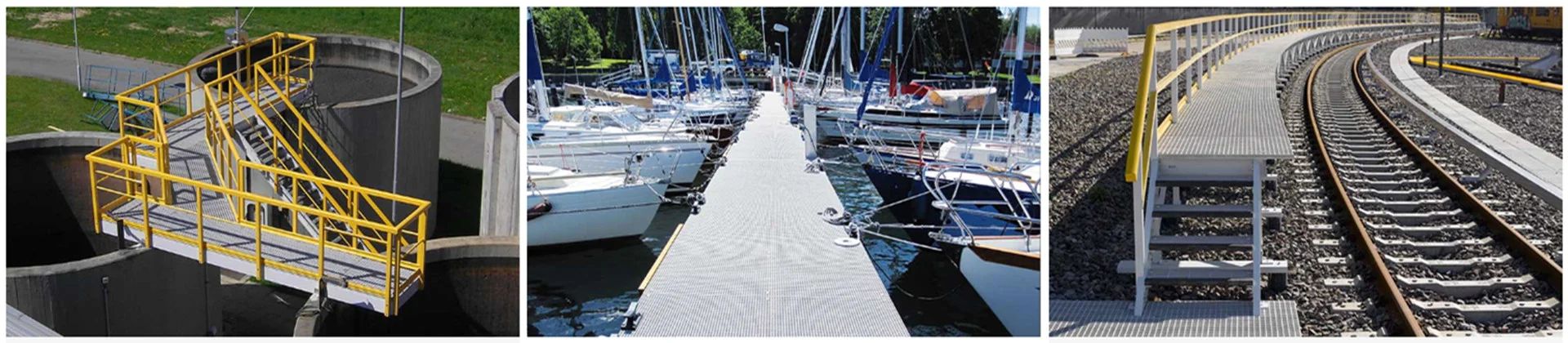
Fiberglass decking materials combine glass reinforcements with a thermoset resin matrix to create planks or panels that resist corrosion, stay dimensionally stable, and remain non-conductive. Common formats include pultruded planks, interlocking panels, pultruded grating, molded grating, and covered (solid-top) grating for hygienic or spill-control surfaces.
Composition & Manufacturing Methods
-
Pultrusion: continuous fibers pulled through a heated die for straightness, controlled fiber volume, and repeatable mechanical properties.
-
Molded grating: resin-rich intersections for multidirectional strength; economical on small spans.
-
Covered tops: sealed walking surface; aids cleaning, carts, and debris control.
Where Each Format Fits
-
Pultruded planks/panels: longest practical spans; comfortable underfoot.
-
Pultruded grating: directional capacity across bearing bars; fast clip installation.
-
Molded grating: good for complex cutouts and multidirectional loads.
-
Covered grating: reduces splash-through; easier housekeeping in process areas.
Specifications at a Glance (verify with your supplier)
| Property | Typical Range* | Method (example) | Notes |
|---|---|---|---|
| Flexural strength | 200–350 MPa (29–50 ksi) | ASTM D790 | Pultruded, along bearing direction |
| Flexural modulus | 18–26 GPa (2.6–3.8 Msi) | ASTM D790 | Drives span/deflection behavior |
| Water absorption (24 h) | ≤ 0.5% | ASTM D570 | Edge sealing preserves performance |
| Coef. thermal expansion | 6–12 ×10⁻⁶ /°C (axial) | ASTM D696 | Allow expansion gaps |
| Flame spread / smoke (FR grades) | FS ≤ 25 / SD ≤ 450 | ASTM E84 / E662 | Project-specific FST may vary |
| Wet slip resistance | Target DCOF ≥ 0.6 | e.g., ASTM E303 pendulum | Specify grit grade & renewal plan |
| *Indicative only; request stamped load tables and third-party test data for your exact product. |
Performance Advantages with Practical Data Points
-
Corrosion & dielectric: resists chlorides, many acids/alkalis; inherently non-conductive—ideal near energized equipment.
-
Strength-to-weight: roughly a quarter of steel’s weight at comparable stiffness classes, easing rigging and crew fatigue.
-
Fire behavior by resin: polyester (general), vinyl ester (enhanced chemical resistance), phenolic (FST-critical).
-
UV & traction: surfacing veil + inhibitors slow chalking; gritted or meniscus tops boost wet traction.
How to Specify: A Decision Framework
Structural Criteria
Define live loads (pedestrian, carts, light equipment), impact allowances, and deflection limits (commonly L/200–L/240). Confirm support lines, bearing lengths, and edge conditions. Require manufacturer span/load tables for the exact format and thickness.
Worked example (L/240): For a 8-ft clear span (96 in), allowable live-load deflection = 96 / 240 = 0.40 in (≈10 mm). Select a panel that meets this under your design load with the stated safety factor.
Resin System Selection
-
Polyester: cost-effective, general plants.
-
Vinyl ester: aggressive chemicals/wastewater.
-
Phenolic: flame/smoke/toxicity constrained spaces (offshore, transit, tunnels).
Tip: map the worst-case chemical and temperature—not the average—and choose accordingly.
Surface & Top Options
Open mesh for drainage; covered tops for hygiene and spill control. Specify grit grade (fine/medium/coarse) matched to footwear, cleaning method, and slip-test targets.
Standards, Tests & Compliance
Call out the properties and methods you expect in submittals (see table). If your owner’s standards mandate specific FST or wet DCOF values, list them in the spec to prevent resubmittals.
Environment & Risk
Account for UV, splash zones, thermal swings, and ATEX-like risks. Use color coding for hazard awareness. Prefer cold-work methods (cutting, drilling) to avoid hot-work permits.
Profiles, Dimensions & Connections
Sizes & Panelization
Standardize on one or two panel widths to simplify clips and spares. Plan shipping units that match your crane/fork capacity and walkway bays.
Fastening & Joint Design
Use stainless or FRP clips, proper washers, and torque values. Isolate dissimilar metals where corrosives are present; maintain dielectric breaks near live gear. Define minimum clip density per m² and require torque logs at handover.
Movement, Drainage & Thermal Effects
Slope decks for runoff, leave expansion gaps per data sheet, and seal cut edges to keep moisture and chemicals out of the laminate.
Installation & Safety in the Field
First-Person Field Note
On a coastal retrofit, our crew cold-cut three pultruded panels with a diamond blade, sealed edges, and torqued clips to spec. Each bay swap took <30 minutes without hot-work paperwork, and the deck reopened before lunch—something we couldn’t do with steel recoating.
Handling, Cutting & PPE
Carbide/diamond blades, dust extraction, respirators, eye/skin protection. Vacuum dust; seal all field cuts. Pre-stage clips and fasteners by bay.
Anchoring to Steel/Concrete/FRP
Pre-drill, respect edge distances, and check embed locations before delivery. Use isolation washers where required.
Site QA/QC Checklist
Orientation arrows, minimum clip counts, flushness checks, wet slip test, and documented torque verification.
Lifecycle Cost & ROI: Mini Model (assumptions shown)
Scope: 1,000 ft² deck, coastal splash zone, 10-year horizon.
Assumptions: labor $85/h; downtime $2,500/h; cleaning is in-house; steel recoating every 3 years (16 h each); wood replacement at Year 6 (24 h).
-
Galv. steel grating: lower Capex; recoats at Y3, Y6, Y9 (≈48 h total + materials); occasional hot-work permits.
-
Hardwood: mid Capex; refinish annually (light), major replacement at Y6; slip issues in biofilm season.
-
FRP (pultruded/covered): higher Capex; no recoats; annual torque check (2 h) + washdowns.
Outcome (illustrative): FRP shows fewer downtime hours and no coating material spend; projects often reach 10-year TCO parity or better when downtime costs are included. Replace assumptions with your plant rates for a precise model.
Case Study (Anonymized)
Context: Wastewater aeration deck had rusting steel and slip incidents after biofilm growth.
Solution: Pultruded covered panels (vinyl ester) with medium-grit top; spans reset to meet L/240.
Results (18 months): maintenance calls dropped 6→1 per year; reported slip incidents → 0; no hot-work disruptions during installation.
Expert Insight
“Consistency in fiber wet-out and die temperature control is what keeps span behavior predictable. If your loads are clear and your spans are honest, pultrusion will meet the numbers.”
— Applications Engineer, Unicomposite (ISO-certified QA system; stamped load tables available on request)
Safety & Compliance Notes
-
Edge-seal all field cuts; re-apply after any modification.
-
Enforce PPE for FRP dust (respirator, eye, skin).
-
Specify wet slip-test method and acceptance value.
-
Document torque checks; retain spare clips and two spare panels per deck.
Maintenance Schedule (typical)
| Interval | Task | Outcome |
|---|---|---|
| Monthly/Quarterly | Washdown; inspect grit | Restores traction; removes biofilm |
| Annually | Torque check on clips/bolts; check expansion gaps | Maintains panel security |
| As-needed | Grit renewal (high-traffic) | Keeps wet DCOF on target |
| After any field cut | Edge sealing | Preserves corrosion resistance |
Procurement & Vendor Vetting Checklist
-
Technical dossier: data sheets, span/load tables, resin/corrosion guide, FST declarations, third-party test reports, ISO certificates.
-
Fabrication & lead time: tolerances, machining, edge-seal policy, color coding, packaging; confirm realistic window based on volume.
-
Warranty snapshot: coverage for manufacturing defects, exclusions (improper installation/chemicals outside published limits), typical replacement lead time, and traceability tags on panels.
-
References: request three recent projects in your application category.
About Unicomposite (Capabilities Snapshot)
Unicomposite produces pultruded profiles and custom fabricated panels for utilities, wastewater, cooling towers, marine, agriculture, aquaculture, and OEMs. Additional forming options include Pulwound, SMC/BMC, and hand lay-up for special geometries. Support for specifiers includes panel-layout assistance, submittal packages, samples, and access to engineering for span reviews.
Conclusion
If your environment is corrosive, wet, or electrically sensitive, fiberglass decking materials help you control risk and downtime while delivering predictable spans and traction. Start with loads, exposure, and deflection targets, choose the right resin and surface, and lock in panelization, QA, and maintenance. When you’re ready, request stamped load tables, a sample panel, and a quick bill-of-materials review to finalize your spec.
Frequently Asked Questions
Q1: How do I choose between pultruded planks and molded grating?
Pultruded planks/panels excel at longer spans and directional loads; molded grating suits multidirectional loads and complex cutouts. Use covered tops when hygiene or spill control matters.
Q2: Which resin should I use in a wastewater plant?
Vinyl ester is commonly preferred for aggressive chemical exposure. Validate against your specific chemical map and temperatures.
Q3: Do I need hot-work permits to install FRP decks?
Usually no—FRP cuts and drills cold. This reduces permits and fire watch, but you must manage dust with extraction and PPE.
Q4: How do I maintain wet slip resistance?
Specify grit grade up front, clean on a set cadence, and plan for grit renewal in high-traffic lanes to keep wet DCOF on target.
Q5: What documents should I demand at submittal?
Stamped span/load tables, third-party test reports, resin/corrosion guidance, FST declarations, installation instructions, and QA certificates (ISO).


