 info@unicomposite.com


Introduction
When a project operates outdoors, around moisture, near corrosive chemicals, or close to energized equipment, material choice affects both performance and operating cost. A solid orange fiberglass rod is often selected because it combines corrosion resistance, electrical insulation, low weight, and easy visual identification in one product. Those traits make it useful for industrial buyers who need durable components for marking, support, spacing, or application-specific assemblies.
For B2B purchasers, the real buying decision goes beyond the material name. The better question is whether the rod will stay consistent across repeat orders, hold its tolerances, and match the service environment. That is where supplier capability matters. Unicomposite, for example, positions itself as an ISO-certificated manufacturer with its own factory producing pultruded FRP profiles and custom composite parts for sectors including electricity, landscaping, wastewater treatment, cooling towers, agriculture, aquaculture, and marine applications. In this guide, the focus is on how buyers can evaluate a solid orange fiberglass rod more carefully and source it with fewer downstream surprises.
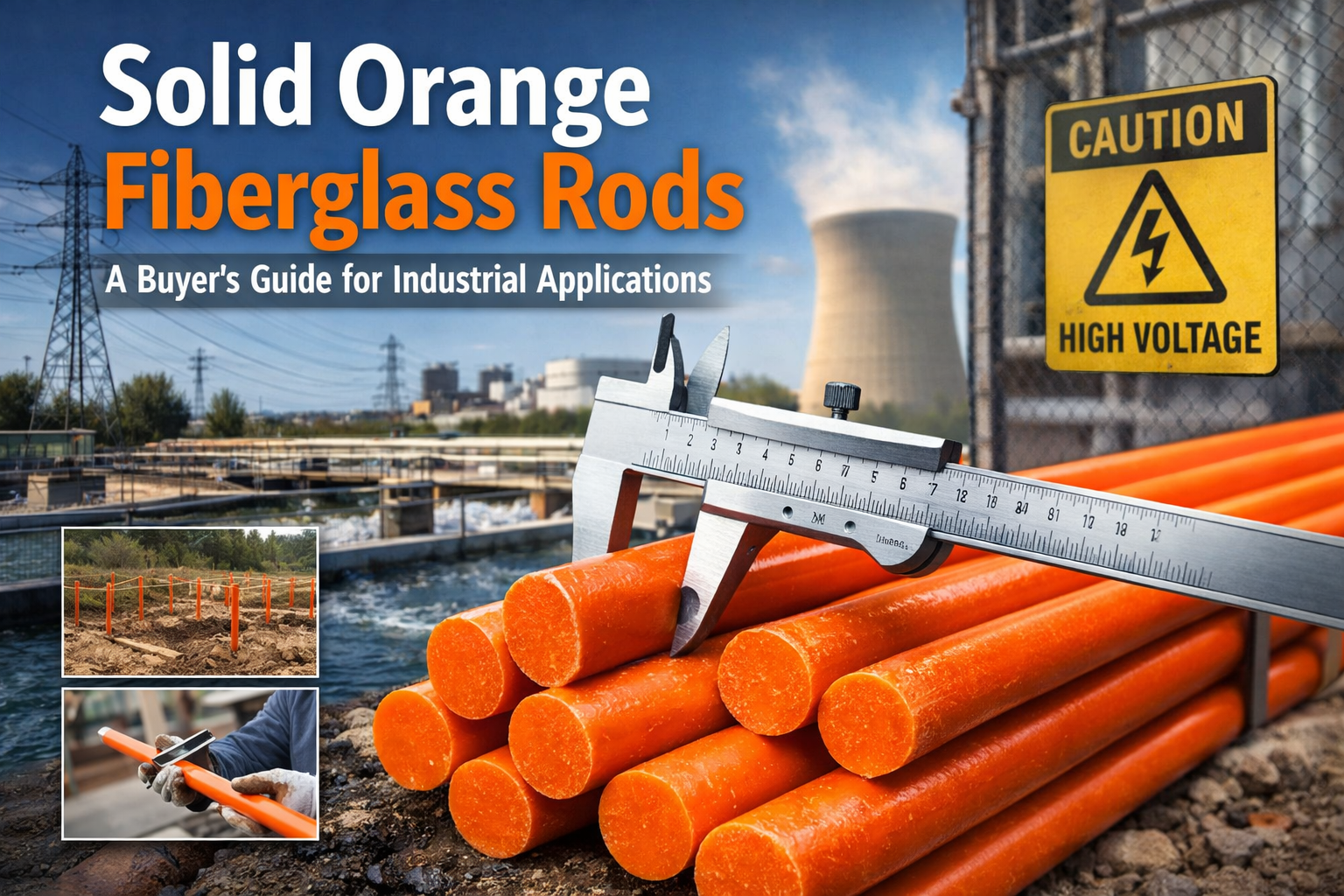
solid orange fiberglass rod
Why Buyers Choose a Solid Orange Fiberglass Rod
Performance benefits in demanding environments
A solid orange fiberglass rod addresses several common industrial concerns at once. Fiberglass-reinforced composites are widely used where corrosion resistance, low maintenance, and nonconductive behavior are important design priorities, especially in outdoor and chemically aggressive settings. ACMA describes pultrusion as a process used across many industries and markets, while supplier and industry materials consistently emphasize corrosion resistance and electrical performance as key reasons FRP is specified.
The lifecycle argument is especially important. AMPP has highlighted prior corrosion studies estimating the global cost of corrosion at roughly $2.5 trillion, or about 3.4% of global GDP. Even though that figure is broad and not specific to fiberglass rods, it explains why buyers in utilities, marine, wastewater, and construction often look for corrosion-resistant materials early in the specification stage.
From a practical sourcing perspective, many buyers eventually learn that the biggest gains do not always come from the highest headline strength values. They come from a material that survives the environment, installs easily, and performs consistently across reorders. In day-to-day procurement, repeatability often matters more than marketing claims.
Why the orange color matters in field applications
Orange is useful because visibility has operational value. OSHA notes that fluorescent yellow-orange is highly visible in daylight exposure, and older OSHA interpretation guidance also references orange among accepted daytime high-visibility garment colors in work-zone contexts. That does not make every orange fiberglass rod a regulated safety device, but it does support the broader point that orange is commonly chosen when fast visual identification matters.
On crowded sites, that visibility can help crews locate markers or components faster, distinguish rods from surrounding materials, and reduce handling mistakes. For teams managing multiple outdoor work areas, easier identification is a real operational advantage.
Common Applications Across Industrial Sectors
Utility and electrical infrastructure
In utility and electrical settings, buyers often favor fiberglass because nonconductive materials can support applications where electrical isolation and outdoor durability matter. Pultruded composite products are used broadly across infrastructure and industrial markets because they can offer corrosion resistance with lower weight than traditional metals.
A solid orange fiberglass rod may be considered for marking, spacing, support, or visibility-related uses depending on the design requirement. The right specification still depends on the exact mechanical load, installation method, and exposure conditions, but the combination of dielectric behavior and visibility is a strong reason these rods appear in utility-related purchasing discussions.
Construction, landscaping, and agriculture
Construction and landscaping teams often need rods that are easy to handle, visible in the field, and resistant to weathering. Agriculture and aquaculture buyers may value the same properties in wet environments where wood can degrade and metal can corrode. Industry materials on FRP repeatedly position composites as a fit for harsh environments and long service life, which aligns with these use cases.
A typical anonymized scenario is a buyer replacing coated metal markers that required repainting or frequent replacement after exposure to moisture and handling. The fiberglass alternative did not eliminate all maintenance, but it reduced rust-related replacement issues and improved visual consistency across the site. That kind of modest but measurable improvement is often what makes a material switch worthwhile.
Marine, wastewater, and cooling tower environments
These are among the most punishing service conditions for conventional materials. Moisture, chemicals, salt, and temperature swings can accelerate corrosion and increase maintenance burden. That is why FRP is often specified in corrosive industrial environments: the material category is closely associated with corrosion resistance and lower maintenance needs compared with unprotected metal in similar conditions.
For buyers in wastewater, marine, and cooling tower work, the appeal is straightforward. If a rod can remain dimensionally stable, resist surface degradation, and reduce replacement frequency, it may offer better value over time even if the purchase price is not the lowest line item.
How to Evaluate Quality Before You Buy
Material composition and manufacturing process
Not all fiberglass rods are equal. Performance is influenced by the resin system, fiber architecture, cure control, and production consistency. Pultrusion is valued in industrial supply because it is a continuous manufacturing process suited to constant cross-section profiles, which helps support repeatability from run to run.
This is where manufacturing depth matters. Unicomposite’s factory-based model and stated experience with pultrusion, standard fiberglass profiles, and custom fabrication are relevant because industrial buyers usually need more than a catalog item. They need a supplier that can explain how the rod is made and how production variables are controlled.
Key specifications B2B buyers should review
Before issuing a large order, buyers should review a short but disciplined checklist:
- Diameter and straightness tolerance
- Tensile and flexural requirements
- UV exposure expectations
- Resin suitability for the operating environment
- Surface finish and color consistency
- Cut length accuracy
- Packaging method for shipment and field use
This is where expertise shows up in the buying process. The best procurement conversations usually connect these specifications to the actual jobsite conditions instead of treating them as generic data-sheet items.
Questions to ask a supplier
A capable supplier should be able to answer questions such as:
- Can you support custom diameters, lengths, or resin systems?
- What quality checks are performed on each run?
- Can you provide engineering input for the intended application?
- How do you manage repeatability across bulk production?
- What tolerance or visual acceptance criteria do you use?
Standard vs. Custom Solid Orange Fiberglass Rods
When standard rods are enough
Standard rods usually make sense when the application is already defined, the dimensions are common, and reorder speed matters more than performance tuning. For repeat purchases in familiar service conditions, a standard profile can simplify quoting, stocking, and replenishment.
This approach often works well for basic marker or support functions where the environment is understood and the design does not depend on unusual load, stiffness, or chemical-resistance requirements.
When custom fabrication adds value
Custom fabrication becomes more valuable when the rod must meet unusual length requirements, tighter tolerances, special resin demands, or OEM integration needs.
A useful buyer test is simple: if failure would create downtime, rework, or repeated replacement costs, custom engineering deserves a closer look. In those cases, a supplier with broader capabilities, including related forming options beyond basic pultrusion, may create better long-term value than the lowest upfront quote.
Verification Steps Before You Place a Volume Order
Trust in this category comes from verification, not just description. Before approving a larger purchase, buyers should request test data where relevant, confirm dimensional tolerances in writing, review a sample if the application is sensitive, and make sure the specification reflects the real environment rather than an assumed one.
This step is especially important for rods used in electrical, chemical, or high-exposure environments. A part that is technically “fiberglass” can still be a poor fit if the resin, finish, color stability, or tolerance control does not align with the application.
How the Right Manufacturer Impacts Project Success
A reliable supplier does more than ship product. It communicates clearly, controls quality, and supports specification decisions with enough detail to reduce purchasing risk. ACMA represents the FRP composites supply chain broadly, and conference materials tied to pultrusion emphasize the range of industries, applications, and technical stakeholders involved in this market. That context matters because it shows pultrusion is not a niche curiosity; it is a mature industrial manufacturing category serving engineers, OEMs, and procurement teams.
This is where Unicomposite’s company profile fits best: not as a sales pitch, but as a credibility signal. Its ISO-certificated manufacturing, in-house factory, pultrusion experience, and ability to support both standard FRP profiles and custom composite parts make it more relevant to solution-oriented B2B buyers than a trader offering only generic stock items. For customers buying in bulk or developing custom solutions, that manufacturing depth can reduce risk across both current orders and future design revisions.
Conclusion
A solid orange fiberglass rod is most valuable when the application demands more than basic material substitution. It offers a practical mix of visibility, corrosion resistance, dielectric performance, and handling convenience that suits many industrial environments. The strongest buying decisions come from matching those benefits to the real service conditions, then verifying the product’s tolerances, material system, and manufacturing consistency before scaling up.
For B2B buyers, the smartest next step is to compare standard and custom options against your environment, load requirements, and reorder expectations. If the project involves bulk purchasing, custom dimensions, or engineering support, working with an experienced pultrusion manufacturer such as Unicomposite can make the sourcing process more predictable and more efficient.
Frequently Asked Questions
Its main advantage is combining several useful traits in one part: corrosion resistance, low weight, electrical insulation, and strong field visibility. That mix makes it attractive for industrial environments where metal may corrode or be less practical to handle.
Sometimes, yes. If the application is straightforward and the dimensions are common, a standard rod can be the fastest and most cost-effective option. Custom rods are more useful when tolerances, resin choice, stiffness, or integration requirements are more demanding.
Because resin choice affects how the rod performs in UV exposure, chemicals, moisture, and heat. Two fiberglass rods can look similar but perform differently if they are built with different material systems.
Confirm tolerance requirements, ask about quality-control checks, review sample parts when needed, and make sure the specification matches the real operating environment. For critical uses, request supporting test or inspection information rather than relying only on a product description.
Some can, and that is often an advantage for long-term B2B sourcing. A manufacturer with in-house production and broader composite capabilities is usually better positioned to support repeat orders, design changes, and application-specific requests.


