 info@unicomposite.com


Introduction
When a product will stay outdoors for months or years, raw strength is only part of the buying decision. Sunlight, moisture, handling damage, and temperature swings all affect service life, which is why many industrial buyers now specify a fiberglass stake with UV protection instead of a general-purpose fiberglass rod.
For B2B buyers in landscaping, agriculture, utilities, and OEM manufacturing, the real issue is long-term value. A UV-protected stake can help reduce replacement frequency, preserve appearance, and maintain more reliable outdoor performance. That matters when you are purchasing in bulk and need consistency across jobsites, growing operations, or production programs.
Supplier capability also matters. Unicomposite positions itself as an ISO-certificated pultrusion manufacturer with its own factory for FRP profiles and custom composite parts, serving industries such as electricity, landscaping, wastewater treatment, agriculture, aquaculture, and marine applications. In a market where buyers often need both standard profiles and custom fabrication, that kind of in-house manufacturing depth supports better specification decisions.
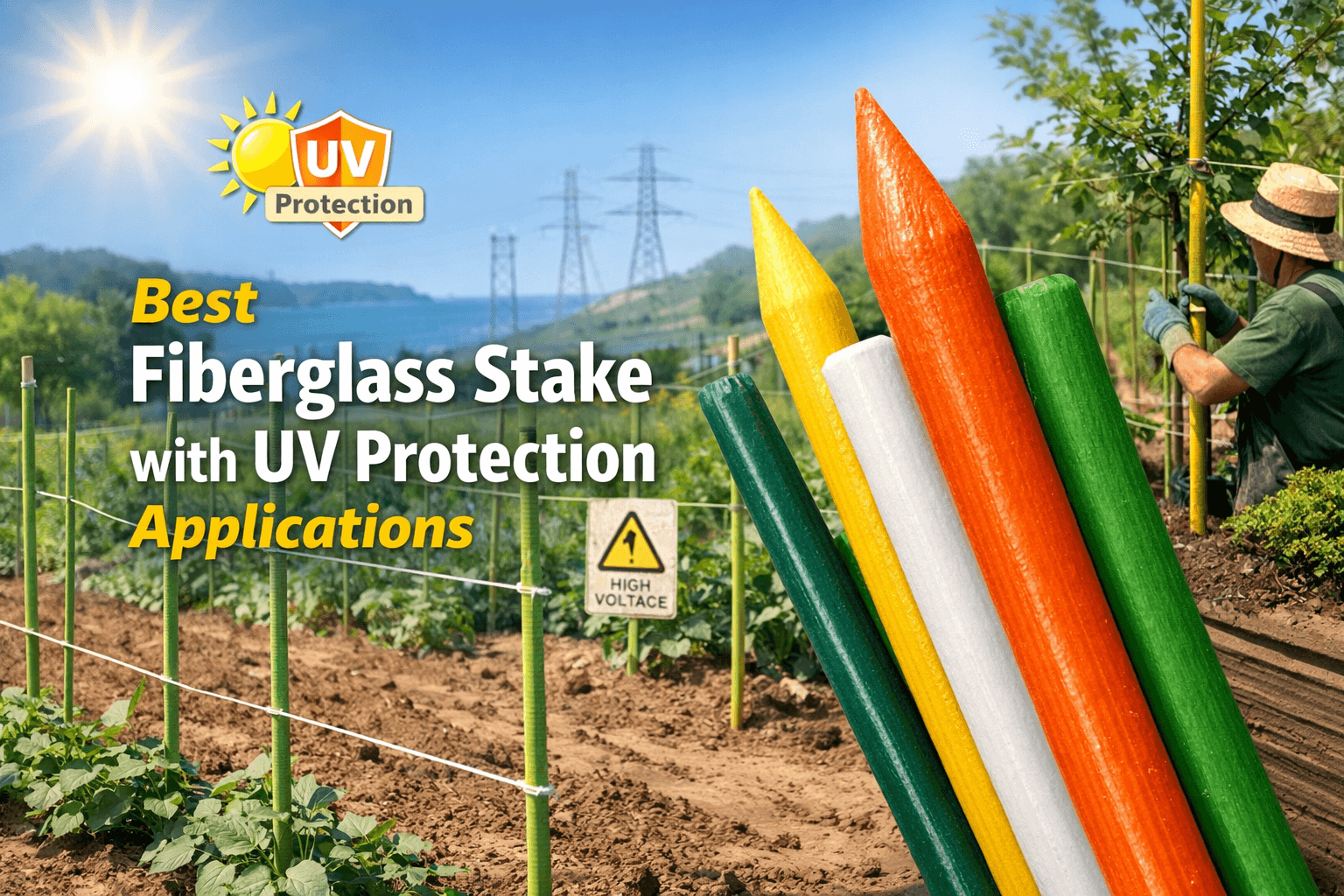
fiberglass stake with UV protection
Why UV Protection Matters in Fiberglass Stakes
How sunlight affects fiberglass outdoors
Fiberglass reinforcement itself is durable, but the resin-rich outer surface is still vulnerable to weathering. MIT materials guidance notes that UV radiation is among the most serious threats to polymer durability and that coatings and protective approaches are commonly used to reduce that damage.
In field use, that degradation often shows up as fading, chalking, fiber bloom, and gradual loss of surface quality. For a buyer, that means a stake may still exist physically but perform or look worse than expected after long exposure. A fiberglass stake with UV protection is designed to address that weakness through resin choice, additives, surface veils, or protective coatings.
How UV protection is typically achieved
Outdoor-grade fiberglass products are often improved with UV stabilizers, protective coatings, or surface films that shield the laminate from solar attack. Composites industry sources describe UV-resistant coatings and surfacing solutions as ways to protect both appearance and structural durability in exposed GFRP applications.
For buyers, this means UV protection should be treated as a specification item, not a marketing extra. It is worth asking a supplier exactly how outdoor resistance is built into the product.
Key Applications for Fiberglass Stakes with UV Protection
Landscaping, nursery, and tree support
In landscaping and nursery operations, stakes may be exposed to sun, irrigation, fertilizer, and repeated handling over long growing cycles. UV-protected fiberglass is attractive here because it can stay lightweight, resist moisture-related decay, and maintain a cleaner appearance than untreated wood.
A common buying lesson in this segment is that low-cost supports often create hidden labor costs. In an anonymized use case, a grower that had frequent breakage and weathering issues with lower-grade supports improved replacement intervals after switching to a fiberglass design with better outdoor protection and tighter dimensional consistency. The improvement came less from “more material” and more from a better-matched specification.
Agriculture, utilities, and industrial marking
In agriculture and utility environments, buyers may also value corrosion resistance and dielectric behavior. Fiberglass composites are often chosen where metal can rust or where electrical non-conductivity is preferred.
That broader anti-corrosion value is significant. AMPP states that global corrosion costs are about $2.5 trillion, equal to roughly 3.4% of global GDP, and that good corrosion-control practices can reduce those costs by 15% to 35%. While a stake is a small component, the same lifecycle logic applies: choosing a more durable material can lower maintenance and replacement costs across a large outdoor program.
What Buyers Should Look for Before Ordering
Material and process factors
A serious buyer should ask more than “What diameter do you have?” Useful technical questions include:
- What resin system is being used?
- Is UV protection built into the resin, the surface, or both?
- Is there a surfacing veil or coating for outdoor exposure?
- How consistent are dimensions from lot to lot?
- What kind of fabrication options are available after pultrusion?
Pultrusion is widely valued in B2B supply because it supports consistent cross-sections, controlled reinforcement placement, and repeatable volume production. That is one reason manufacturers like Unicomposite, which emphasize pultrusion plus custom fiberglass fabrication, are relevant to OEM and project buyers who need stable quality at scale.
Customization and fit-for-use
Not every project needs the same stake. A nursery may prioritize flexibility and appearance, while an industrial site may care more about visibility, stiffness, and fabrication details. Buyers should define:
- Length and diameter
- Flex profile or stiffness target
- Color and visibility needs
- Pointed, drilled, or fabricated ends
- Packaging and bulk handling requirements
This is where engineering support becomes valuable. In practice, many ordering problems come from vague requirements rather than bad manufacturing. A slightly more tailored specification often saves labor in the field.
Fiberglass vs. Wood and Metal Stakes
Durability and maintenance
Wood is common and inexpensive, but it can absorb water, split, rot, or attract pests. Metal is strong, but in outdoor service it may corrode or require coatings and added maintenance. Fiberglass offers a different balance: corrosion resistance, light weight, and good outdoor service when designed properly for UV exposure.
This does not mean fiberglass is automatically best in every case. If the application involves unusual impact loads, very high temperatures, or highly specific compliance requirements, the buyer should validate the design first. That limitation is part of a trustworthy purchasing process.
Total cost of ownership
Bulk buyers usually care more about service-cycle cost than line-item price. A lower-cost stake that fails early can trigger added labor, replacement purchasing, installation delays, and disposal work.
In practical terms, the strongest business case for a fiberglass stake with UV protection is often not the material itself but the operational stability it brings. Fewer replacements and more predictable outdoor performance are what make the product attractive to procurement teams.
How to Evaluate a Reliable Supplier
Questions worth asking
Before scaling up an order, buyers should ask suppliers:
- Do you have an ISO-based quality system?
- How do you verify outdoor-use suitability?
- Can you explain the UV-protection method clearly?
- Do you offer sampling before production rollout?
- Can you support custom dimensions or secondary fabrication?
These questions help separate real manufacturing capability from generic product listings.
Why experience and process range matter
Composite projects often look simple until they need custom color, drilled features, packaging changes, or application-specific performance. A supplier with broader process knowledge can help reduce those risks early.
That is where Unicomposite’s positioning fits naturally. Its in-house FRP production, pultrusion capability, and additional forming options such as Pulwound, SMC/BMC, and hand lay-up suggest flexibility for buyers that need more than a stock profile. For industrial purchasers, that kind of range can improve speed from sample approval to volume supply.
Testing, Samples, and Realistic Expectations
Trustworthy content should also be clear about validation. Even a well-made UV-protected fiberglass stake should be tested against the real environment it will face. Exposure conditions vary widely by geography, chemical contact, installation method, and handling practices.
A good buying process usually includes sample review, field trials, and confirmation of key dimensions and surface quality before full-scale purchasing. That step helps prevent over-specifying, under-specifying, or relying on broad claims that do not match the actual application.
Conclusion
A fiberglass stake with UV protection is a smart long-term option for buyers who need outdoor durability, low maintenance, and reliable performance across bulk applications. The best results come from matching the stake’s resin system, UV strategy, dimensions, and fabrication details to the actual use environment.
For procurement teams and project managers, the checklist is straightforward: verify how UV resistance is achieved, compare lifecycle cost instead of unit price alone, confirm customization needs early, and work with a supplier that can support both repeatable production and application-specific engineering. If your project requires bulk supply or a custom composite solution, requesting samples and reviewing specifications with an experienced manufacturer is the most practical next step.
Frequently Asked Questions
Service life depends on resin system, surface protection, climate, and handling conditions. In many outdoor applications, UV-protected fiberglass lasts significantly longer than untreated alternatives, but field validation is still the best way to estimate real project life.
It can be, especially where corrosion resistance and electrical non-conductivity matter. Metal may still be preferred for some high-impact or high-load uses, so the right answer depends on the environment and performance target.
Yes. Buyers often request custom lengths, diameters, colors, pointed ends, drilled holes, or special fabrication features. That is why supplier engineering support is important for larger or more specialized orders.
Ask whether the protection comes from the resin, additives, surfacing veil, coating, or a combination of these. You should also ask how the supplier recommends validating outdoor suitability for your specific environment.
Pultrusion supports repeatable dimensions and stable quality across higher production volumes. For B2B buyers, that consistency helps reduce fit issues, simplifies installation, and improves order-to-order reliability.


