 info@unicomposite.com


Introduction
Buying stakes for farms sounds simple until the wrong material starts failing in the field. A stake that bends, rots, rusts, or loosens too early can trigger extra labor, rework, and crop or fencing problems that cost far more than the original purchase price.
For B2B buyers, distributors, and agricultural project specifiers, the better question is not “Which stake is cheapest?” but “Which stake will hold up in our real operating conditions?” That is where smarter procurement begins. Service life, maintenance demands, environmental exposure, and installation efficiency all matter.
In practice, many farm teams learn this after a frustrating season. A low-cost stake may look fine on paper, but if crews have to replace hundreds of units after heavy rain, strong sun, or livestock pressure, the total cost changes quickly. Buyers who step back and compare materials by lifecycle performance usually make stronger long-term decisions.
stakes for farms
Why Stakes for Farms Matter in Daily Operations
Matching stake performance to field conditions
Farms put support materials under constant stress. Wet ground can speed up rot and corrosion. UV exposure can weaken lower-grade plastics. Wind loads test stiffness and anchoring. Livestock can rub, push, or loosen stakes over time. Fertilizers, moisture, and repeated handling add even more wear.
That is why the best stakes for farms are chosen based on use environment, not habit. A stake for tree support may need different performance than one used for electric fencing, row marking, or greenhouse framing. In utility-adjacent areas, non-conductive materials may also be a practical safety consideration.
A useful buying principle is simple: match the material to the stress, not just the task. That keeps teams from underbuying for demanding conditions or overbuying for short-term applications.
The hidden cost of poor stake selection
The visible unit price is only one part of the cost equation. When stakes fail early, the hidden expenses often include:
-
Reinstallation labor
-
Emergency replacement orders
-
Lost crew time during peak season
-
Crop support issues or fence instability
-
More frequent maintenance checks
-
Safety concerns from splinters, sharp edges, or conductive materials
One common field scenario illustrates the problem. A farm team installs budget stakes before the season, then sees a portion loosen or degrade after repeated rain and sun exposure. The second round of labor becomes more expensive than the first purchase. That is why experienced buyers look at replacement cycles and handling costs, not just the invoice value on day one.
Common Types of Stakes for Farms
Wooden stakes
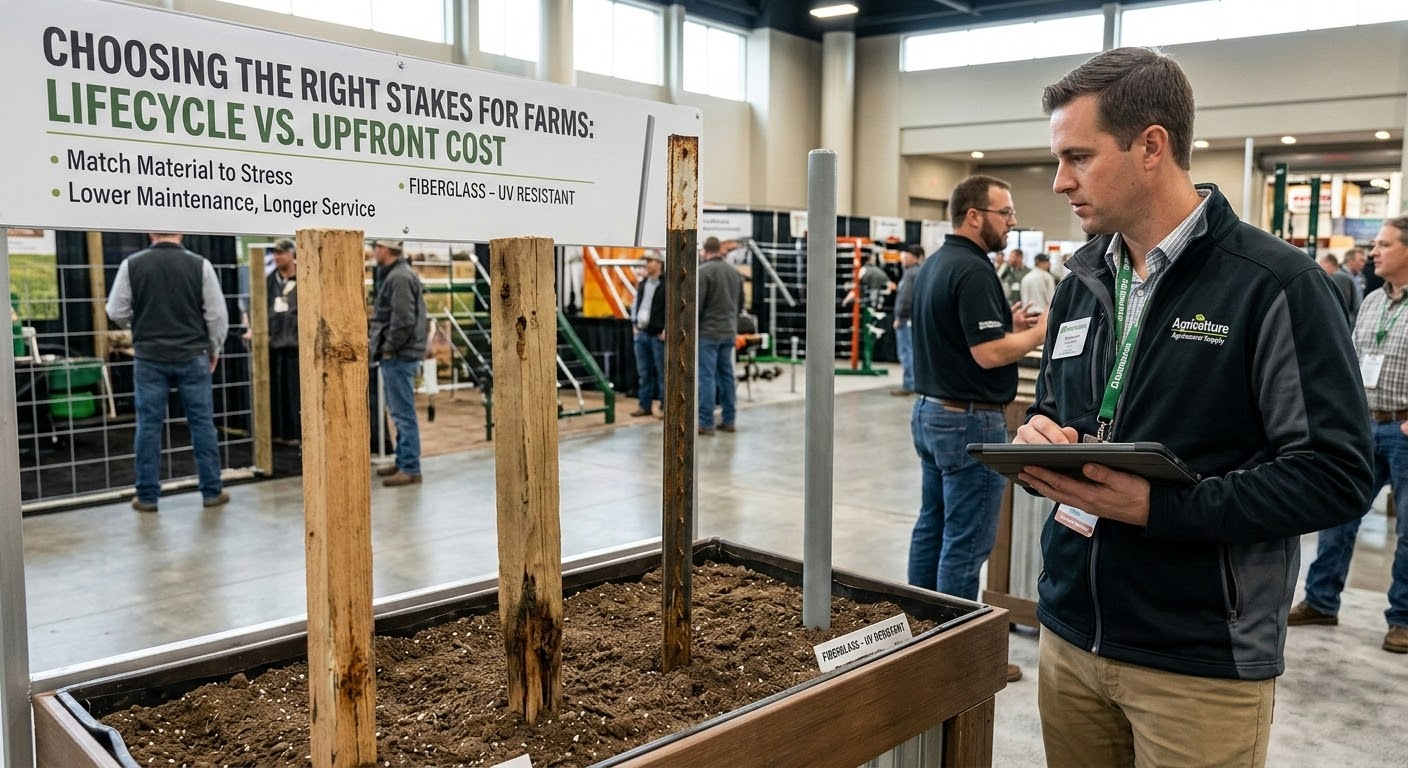
Wooden stakes remain popular because they are familiar, easy to source, and often inexpensive upfront. They can work well for light-duty or temporary uses where long service life is not the main concern.
Their drawback is durability. In wet or humid environments, wood can rot, split, or weaken over time. Insects and repeated handling also affect consistency. For seasonal jobs, wood may still make sense. For longer-term agricultural use, replacement frequency should be part of the buying decision.
Metal stakes
Metal stakes are often chosen for strength-heavy applications, especially where rigid support is a priority. Steel posts, for example, are common in fencing and structural support roles.
The trade-offs are just as important as the benefits. Metal can corrode in wet or chemically aggressive conditions. It is heavier to transport and install. It may also be conductive, which can matter in certain agricultural settings. Buyers should evaluate whether maximum rigidity is the main need, or whether weight, corrosion resistance, and safety also carry importance.
Fiberglass and composite stakes
Fiberglass and composite stakes are increasingly used where buyers want a balance of strength, corrosion resistance, low maintenance, and long service life. In agricultural environments, these materials can perform well where wood may decay and metal may rust.
This is also where manufacturing quality matters. Unicomposite is an ISO certificated professional pultrusion manufacturer with its own factory producing FRP, or fiberglass reinforced plastic, profiles and custom composite parts in China. Its production capabilities cover standard pultruded fiberglass profiles as well as custom fiberglass fabrication for industries including agriculture, landscaping, wastewater treatment, cooling tower construction, aquaculture, marine, and power-related applications. That kind of background matters because composite stakes are not just alternative materials; they can be engineered for repeated outdoor service.
Plastic and lightweight options
Plastic stakes can be useful for row marking, temporary positioning, or low-load applications. They are easy to move and usually simple to install.
Still, not every plastic product is built for long-term agricultural stress. Lower-grade options may deform under heat, become brittle over time, or fail under impact. For buyers managing broad acreage or repeated deployment, lightweight stakes should be reviewed carefully before being used as a long-duration solution.
How to Choose the Right Stakes for Farms
Start with the application
Before comparing materials, define the job clearly. Common uses include:
-
Crop support
-
Young tree stabilization
-
Electric fencing
-
Livestock area control
-
Greenhouse or light structural support
-
Field and boundary marking
Ask four questions first:
-
What load will the stake carry?
-
How long does it need to stay in service?
-
What weather and chemical exposure will it face?
-
How often can the crew maintain or replace it?
Those questions usually clarify whether the priority is low upfront cost, long-term durability, faster installation, or a mix of all three.
Compare the material properties that affect performance
A reliable comparison should include more than a basic price check. Buyers should review:
-
Strength-to-weight ratio
-
Corrosion or rot resistance
-
UV stability
-
Electrical conductivity or dielectric performance
-
Ease of handling and installation
-
Surface consistency and dimensional tolerance
-
Expected maintenance burden
-
Total lifecycle cost
For example, a heavier material may offer strength but increase labor during installation. A cheaper material may lower purchase cost but shorten replacement cycles. The best choice depends on how those trade-offs affect operations over multiple seasons.
Standard vs. custom stake designs
Off-the-shelf stakes meet many common needs, but some agricultural buyers require more specific performance. Custom sizing, wall thickness, profile shape, or surface finish can make a difference when the stake is part of a broader engineered system.
That is where supplier capability becomes important. Manufacturers with pultrusion experience and custom fabrication support can help buyers select a product that fits the application instead of adapting the application to a standard part. For bulk buyers, that can reduce field issues and improve long-term consistency.
Where Composite Stakes Can Offer a Long-Term Advantage
Best-fit environments for composite solutions
Composite stakes are often worth closer consideration when farms operate in high-moisture, corrosive, or maintenance-heavy environments. They can also be useful where weight reduction and non-conductive properties matter.
Typical fit-for-use scenarios include:
-
Wet ground and irrigation-heavy zones
-
Corrosion-prone agricultural environments
-
Long-term support applications
-
Sites where consistent dimensions matter across bulk orders
-
Installations near electrical systems or utility-sensitive areas
In these settings, buyers often find that lifecycle stability matters more than the lowest entry price.
What B2B buyers gain over time
For larger farm operations and industrial buyers, composite stakes can create value through operational efficiency as much as material performance. Potential advantages include:
-
Lower replacement frequency
-
Reduced maintenance labor
-
Easier handling than heavier alternatives
-
Better resistance to moisture and corrosion
-
More consistent quality in volume production
-
Design flexibility for custom agricultural systems
A practical example is a farm group that replaces support stakes every season due to weather exposure and handling damage. Once the labor cost, freight, and downtime are added up, a longer-life alternative often becomes easier to justify. That is the kind of analysis experienced procurement teams increasingly make.
What Buyers Should Ask Suppliers Before Ordering
Verify manufacturing quality, not just claims
Supplier evaluation should go beyond marketing language. Buyers should ask for details that show whether the product is suited to the intended environment.
Key questions include:
-
What material system is being used?
-
Is UV protection built into the product?
-
What dimensional tolerances are maintained in production?
-
What loading conditions is the stake designed for?
-
Is there guidance for proper installation and use?
-
Can the supplier provide test data or technical documentation?
For composite products in particular, resin choice, fiber structure, surface finish, and consistency in pultrusion all affect real-world performance.
Why supplier capability matters
A supplier with stable manufacturing processes can reduce purchasing risk. Unicomposite’s ISO-certificated production environment, pultrusion lines, and ability to support custom fiberglass fabrication are relevant here because serious buyers often need more than catalog availability. They may need engineering input, repeatable dimensions, or modifications based on the end-use environment.
That matters most when a project involves bulk procurement, multiple sites, or specialized agricultural conditions. A capable manufacturer helps buyers move from guesswork to specification-based sourcing.
What to verify before you buy
To make the purchase decision more trustworthy, buyers should confirm three things before placing an order:
-
The stake is appropriate for the actual service environment
-
The supplier can explain both strengths and limitations of the product
-
Technical support or documentation is available if the application is more demanding than standard use
This step is important because no material is ideal for every condition. Trustworthy sourcing depends on transparent guidance, realistic expectations, and application-specific recommendations.
Conclusion
The best stakes for farms are the ones that fit the work, the environment, and the replacement strategy behind the purchase. Wood, metal, plastic, and composite materials all have practical uses, but they do not offer the same long-term value in every agricultural setting.
For B2B buyers, the smarter path is to compare total operating cost, expected service life, maintenance demands, and supplier capability before choosing a material. That leads to better field performance and fewer expensive surprises after installation.
Unicomposite supports that approach through ISO-certificated manufacturing, in-house pultrusion production, and custom FRP fabrication for agriculture and other demanding industries. If your team is sourcing in volume, it is worth discussing not just price per unit, but the material properties and production support that will hold up over time.
Frequently Asked Questions
They can be a better fit when moisture, corrosion, long service life, and reduced maintenance are priorities. Wood may still work for short-term or lower-cost applications, but composite often performs better in demanding outdoor conditions.
Focus on service environment, expected lifespan, dimensional consistency, and supplier support. It also helps to request technical information on UV resistance, load suitability, and customization options before placing a large order.
Custom stakes are useful when standard sizes or profiles do not match the installation demands. This is common in engineered agricultural systems, OEM projects, or multi-site deployments that require repeatable performance.
Fiberglass and FRP products are often valued for dielectric properties, which can make them attractive in certain utility-sensitive applications. Buyers should still confirm the exact product specifications and intended use with the supplier.
Start with the application, then verify the material properties and request technical guidance. A supplier that can explain both benefits and limits is usually a safer partner than one relying on broad claims alone.


