 info@unicomposite.com


Introduction
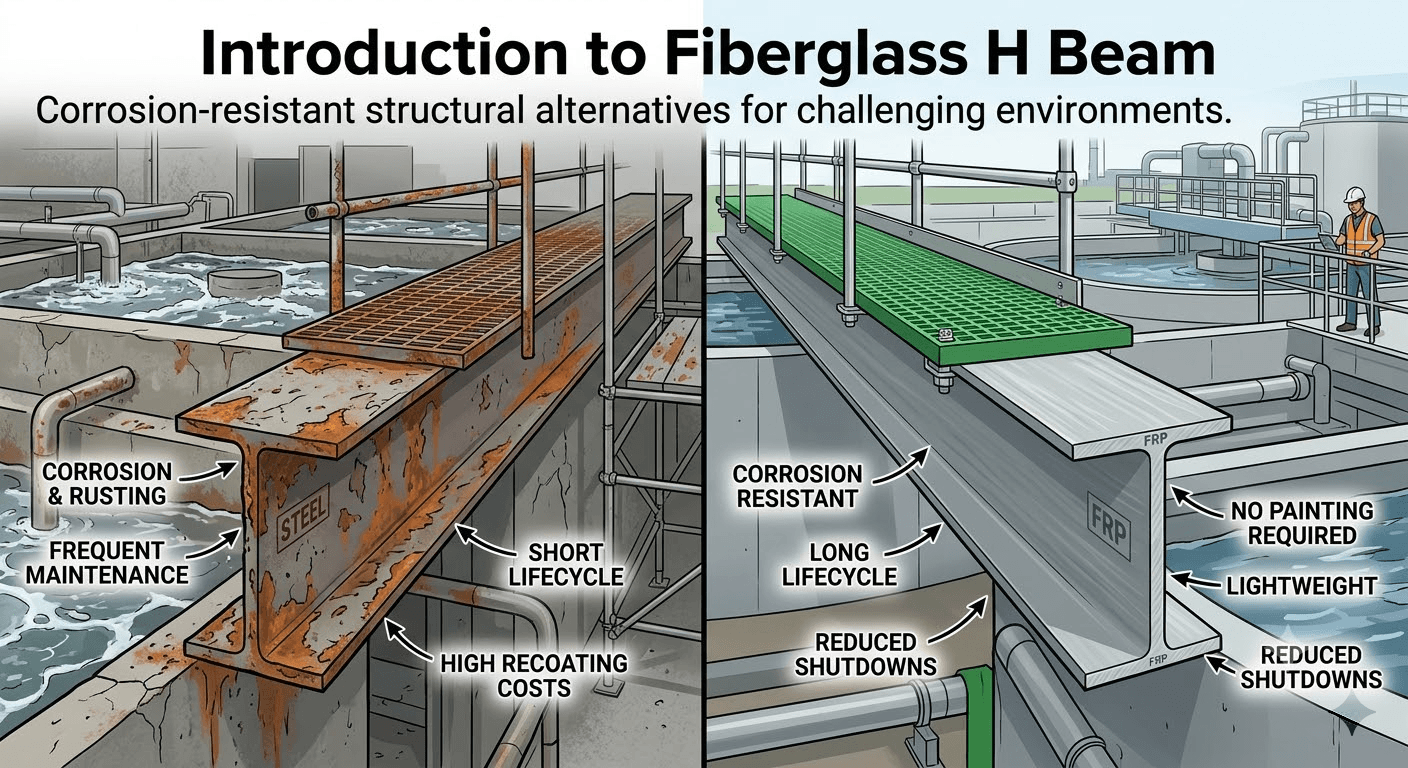
Corrosion adds inspections, coating cycles, scaffolding, shutdowns, and production delays. In wastewater plants, coastal facilities, cooling towers, farms, and chemical sites, these obligations can exceed the original structural cost.
A fiberglass H beam gives engineers and buyers another option for structural applications. This guide covers lifecycle cost, design behavior, and purchasing.
Why Corrosion Drives Long Term Structural Costs
How Corrosion Affects Steel Beams in Harsh Environments
Moisture, chlorides, fertilizer residues, and washdown chemicals can damage coatings and expose steel. Maintenance may then include thickness checks, recoating, reinforcement, and replacement.
Calculations should also include access equipment, containment, permits, and lost production.
fiberglass h beam
How Does a Fiberglass H Beam Resist Corrosion?
A fiberglass H beam uses glass reinforcement within a thermoset resin matrix, so it does not rust like carbon steel. Durability still depends on resin type, chemical concentration, temperature, contact time, moisture, and surface protection. Engineers should confirm compatibility for the service environment.
Polyester systems often suit moderate industrial service, while vinyl ester systems are commonly considered for more aggressive exposure. Profiles with matching dimensions may still have very different properties because resin formulations and reinforcement arrangements vary.
Lifecycle Cost Factors Buyers Should Calculate
Buyers should compare material, fabrication, transport, installation, coating, inspection, shutdown time, and replacement. A second scenario covering coating failure can expose risks hidden by the quotation.
How Fiberglass H Beam Reduces Maintenance Requirements
No Routine Painting or Galvanizing
A correctly specified pultruded profile normally avoids recurring anti corrosion painting, removing blasting, containment, curing delays, and repeated surface preparation.
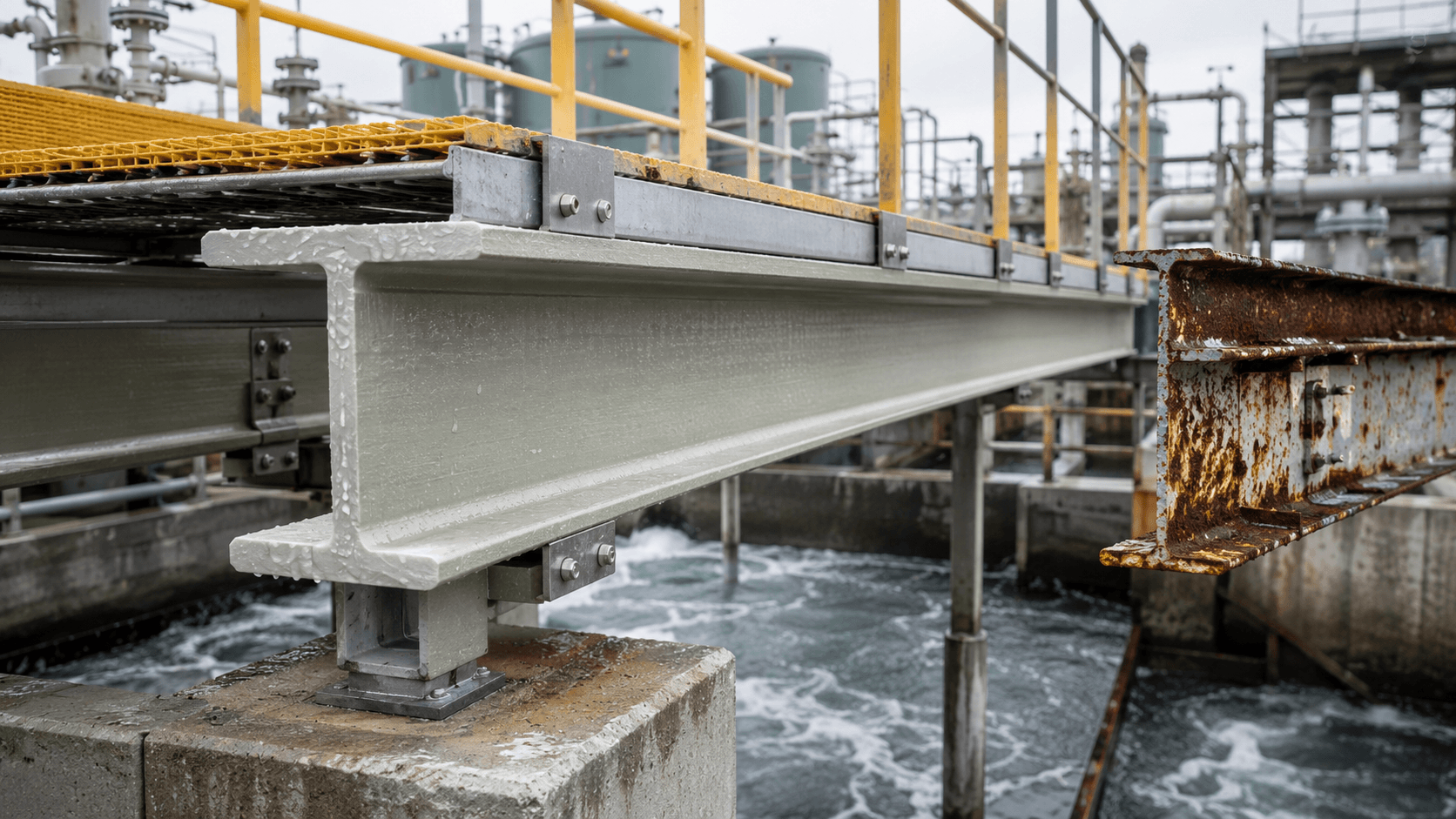
Consider a representative wastewater platform above operating tanks. Steel recoating would require controlled access and containment, while FRP inspection would focus on impact damage, connections, movement, and localized chemical attack.
Easier Inspection and Fewer Corrosion Repairs
FRP still needs inspection for cracks, loose connections, exposed fibers, UV deterioration, chemical attack, and abnormal deflection. ASTM D4385 classifies visual defects in thermoset reinforced pultruded products.
Can Fiberglass H Beam Lower Total Ownership Cost?
Yes, especially where corrosion, restricted access, or shutdowns create recurring expense. Savings depend on loading, resin selection, fabrication, temperature, installation, and maintenance assumptions.
The table below identifies the cost factors that should be quantified:
| Cost factor | Fiberglass H beam | Painted steel | Galvanized steel |
|---|---|---|---|
| Initial material | Often higher | Often lower | Usually above untreated steel |
| Protection | Resin and surface system | Applied coating | Zinc layer |
| Handling | Lower mass may simplify lifting | Heavier lifting may be required | Similar to steel |
| Corrosion work | Usually limited in compatible service | Recoating may recur | Depends on zinc loss |
| Shutdown exposure | Often reduced | Can be significant | Usually delayed |
| Replacement risk | Design, impact, heat, UV, chemistry | Corrosion and coating failure | Exposure severity |
Labor rates, beam size, coating system, access, and design life determine the actual result.
Structural Performance and Design Considerations
Strength to Weight Advantages
Pultrusion draws continuous glass reinforcement through resin and a heated die. Fiber placement, resin formulation, curing, and pull speed affect the profile.
The values below come from one published structural profile family and show what buyers should request from their own supplier:
| Property | Representative value | Verification |
|---|---|---|
| Density | 0.062 to 0.070 lb/in³ | Product data sheet |
| Longitudinal tensile stress | 30,000 psi | ASTM D638 report |
| Full section elastic modulus | 2.6 to 2.8 million psi | Full section test |
| Longitudinal shear modulus | 0.425 million psi | Profile test report |
| Bearing stress | 30,000 psi | ASTM D953 report |
These manufacturer specific values vary with resin, geometry, reinforcement, and temperature.
Deflection Often Controls the Design
Pultruded FRP has a much lower elastic modulus than steel, so deflection often controls selection. Its directional properties and lower shear modulus can also add movement beyond classical bending deflection.
Some specifications use L/180 as a deflection limit, although the engineer of record must apply the governing project criteria. Matching a steel beam’s outside dimensions does not establish equivalent performance.
Is Fiberglass H Beam as Strong as Steel?
A fiberglass H beam can provide useful strength at low weight, but stiffness, shear, creep, bearing, temperature sensitivity, and transverse properties differ from steel. Engineers should compare full section values, span, loading, stability, and environmental reduction factors.
ASTM D7290 addresses characteristic values for structural composites, ASTM D8069 covers full section flexural modulus, and ASTM D953 measures pin bearing strength relevant to bolted joints.
Connection and Load Transfer Requirements
Bolted joints need suitable washers or plates, controlled torque, edge distances, clean holes, and sufficient bearing area. Designers should check bearing, net section rupture, block shear, and concentrated loads.
These structural differences must be resolved before corrosion savings can translate into reliable service.
Where Fiberglass H Beam Delivers the Most Value
Wastewater, Chemical, and Cooling Tower Structures
FRP beams can support platforms, walkways, equipment frames, and secondary structures exposed to moisture or chemicals. The business case becomes stronger where future coating work would require scaffolding, containment, permits, or process interruptions.
Electrical Utilities and Substations
Low electrical conductivity can benefit selected utility applications, subject to verified product data and the complete electrical design. Moisture, clearances, grounding, and safety rules still require review.
Agriculture, Aquaculture, and Marine Facilities
Fertilizers, animal waste, salt spray, humidity, and cleaning chemicals create persistent maintenance demands. Lower mass may also simplify installation at remote sites with limited lifting equipment.
OEM Frames and Custom Industrial Assemblies
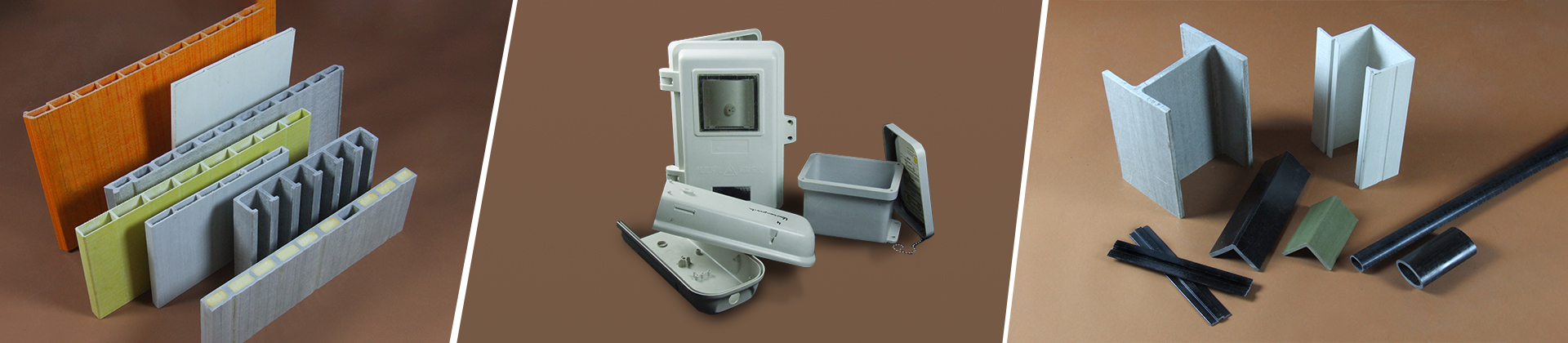
OEM buyers may require cut lengths, drilled holes, brackets, inserts, or modules. Unicomposite uses pultrusion, pulwinding, molding, hand layup, and vacuum infusion for beams, grating, handrails, utility components, and custom assemblies.
The best application is one where corrosion resistance solves a defined operating or maintenance problem.
introduction to fiberglass h beam
How to Specify the Right Fiberglass H Beam
Select the Resin System for the Environment
Specifications should list chemicals, concentrations, temperature, UV exposure, fire requirements, and service life. Broad claims such as “chemical resistant” are insufficient.
Confirm Mechanical and Dimensional Data
Buyers should request profile dimensions, weight, longitudinal and transverse properties, full section modulus, shear modulus, bearing strength, tolerances, allowable values, and environmental reduction factors. Test temperature and specimen orientation should accompany the results.
Procurement Specification Checklist
The following checklist converts design intent into purchase requirements:
| Specification item | What to verify | Why it matters |
|---|---|---|
| Geometry | Depth, flange, web, thickness, straightness | Controls capacity and fit |
| Resin | Type, additives, compatibility | Determines durability |
| Reinforcement | Glass content and orientation | Affects directional properties |
| Mechanical data | Coupon and full section results | Supports calculations |
| Fire and UV | Test, rating, inhibitor | Confirms exposure suitability |
| Tolerances | Standard and inspection plan | Reduces assembly problems |
| Fabrication | Cuts, holes, sealing, labels | Protects fit and connections |
| Documentation | Traceability and reports | Supports approval |
Review Codes, Standards, and Project Requirements
The engineer of record should reconcile supplier data with codes, loads, creep, temperature, deflection, fire, and connection design. Test reports support this review but cannot replace project specific engineering.
Common Mistakes That Increase Cost or Risk
Choosing by Price Alone
A low quotation may include a different resin, less reinforcement, wider tolerances, or limited testing. Buyers should compare equivalent technical submissions.
Copying a Steel Design Without Recalculation
Steel and FRP differ in stiffness, directional behavior, creep, shear response, thermal effects, and connection mechanics. Reusing a steel span and section can create excessive deflection even when coupon strength appears adequate.
Ignoring Fire, Temperature, or UV Exposure
Published guidance for one polyester profile family flags design temperatures above 150°F, while its vinyl ester family uses 200°F as the corresponding threshold. These values are product specific, and outdoor profiles also need defined UV protection and fire criteria.
Buying Without Traceable Test Data
Buyers should require lot identification, dimensional inspection, material records, profile specific test results, and certificates. Unicomposite states that it operates an ISO 9001 certified, 18,000 square meter facility for standard and custom composite production.
Avoiding these mistakes depends on supplier process control and documentation.
How to Evaluate a Fiberglass H Beam Supplier
Manufacturing Capability and Process Control
A qualified supplier should control resin mixing, reinforcement placement, die temperature, pull speed, curing, dimensions, and fabrication. At Unicomposite, these controls should connect to inspection points, traceability, drawing approval, and first article checks.
Engineering and Customization Support
Buyers should confirm whether the supplier can review loads, recommend resin, interpret drawings, hold tolerances, and seal fabricated surfaces. First article approval is valuable for custom holes, inserts, and bonded joints.
Documentation and Quality Assurance
A complete submittal can include data sheets, drawings, certificates, inspection plans, test reports, and measurements. Published FRP specifications also emphasize manufacturer qualifications, approved shop drawings, visual criteria, and material compliance.
Supplier evaluation should end with evidence that the delivered beam matches the calculated beam.
Conclusion
- Fiberglass H beam can reduce corrosion maintenance when its resin system matches the environment.
- Lifecycle cost should include access, coating, inspection, lifting, shutdowns, and replacement.
- Structural design must address stiffness, shear, connections, creep, fire, temperature, and UV exposure.
- Traceable test data and fabrication control directly affect reliability.
[Contact Unicomposite for a custom fiberglass H beam quote →]


